
Fêtes de Jeanne d’Arc de Orléans RP
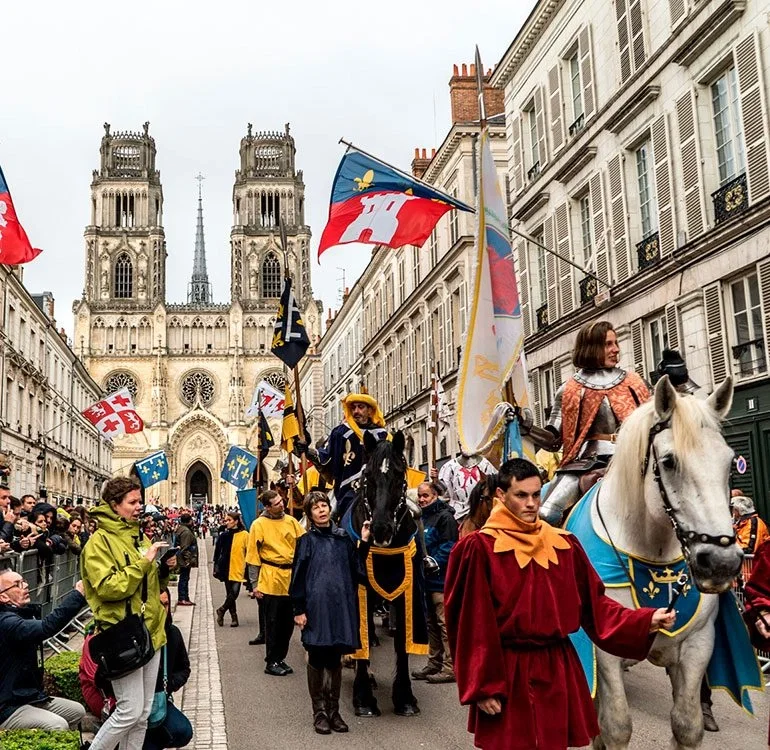
Fêtes de Jeanne d’Arc RP/RPG
1) Historical base that you must master (The Soul of Orléans)
For your RP not to be superficial, the characters must speak of history not as something that happened centuries ago, but as something that forms part of their genetic identity.
The Hundred Years' War and the lock of the Loire
In 1428, France did not exist as we know it; it was torn apart. On one side, the English and their Burgundian allies dominated the north, including Paris. On the other, the "Dauphin" Charles VII, whom his enemies contemptuously called "the little king of Bourges," controlled the south. The Loire River was the natural border between life and death for the French kingdom.
Orléans was the main bridge, the lock of the door to the south. If Orléans fell under the siege that the English (commanded first by the Earl of Salisbury, and then by Suffolk and the fearsome John Talbot) initiated in October 1428, France would have disappeared from the map, absorbed by the English crown.
The Siege and the arrival of the Pucelle
Jeanne d'Arc, a young peasant girl from Domrémy guided by divine voices (Saint Catherine, Saint Margaret, and Saint Michael), convinced Charles VII to give her an army. Her arrival in Orléans occurred on the night of April 29, 1429. She entered through the Porte Bourgogne (Burgundy Gate), bypassing the English siege in the dark, bringing supplies but, above all, a fanatical hope.
In just a few days in May, Jeanne turned a stagnant war around. The battles were bloody and desperate. Highlights include the capture of the fort of Saint-Loup (May 4) and the climax assault on the stronghold of Les Tourelles (May 7), where the English commander William Glasdale drowned in the river under the weight of his armor. In that battle, Jeanne was pierced by an arrow between the shoulder and the neck, but she pulled the projectile out and returned to the front, which convinced her men that she was protected by God. The next day, May 8, 1429, the English lifted the siege.
Civic and Religious Symbol: The Orleanese exception
In your RP, you must reflect that in France a strict law of secularism (1905) governs, separating Church and State. However, Orléans is the exception. Here what they call the "Orleanese Concordat" or "Orleanese Model" applies. In the Festivals of Jeanne d'Arc, the Bishop, the Mayor, and the Army march together peacefully. For the Republic, Jeanne is the patriot heroine emerged from the people who saved the nation. For the Church (which canonized her in 1920 under Pope Benedict XV), she is a Saint and martyr. In your story, this duality is key: the chosen girl must please the republican politicians of the city hall and the traditional bishopric.
The Johannic Memory in the city
To walk through Orléans is to walk in Jeanne's footsteps. Your character and the inhabitants will live surrounded by:
* The Rue Jeanne d'Arc: The main avenue, majestic, designed to frame the Cathedral.
* The Maison de Jeanne d'Arc: (House of Jacques Boucher). It is not the house where she was born, but the house of the treasurer of the Duke of Orléans where she stayed during the siege. It was rebuilt in the 60s and is the educational center about her life.
* Vitraux (Stained glass windows): The churches and above all the Cathédrale Sainte-Croix recount her history in glass; when the sun hits, the city is literally dyed with the history of her battles.
2) The Fêtes de Jeanne d’Arc: General structure (The Calendar of Action)
The Johannic Festivals of Orléans (in their 597th edition for this 2026) are not a mere carnival; they are recognized as part of the intangible cultural heritage of France. They paralyze and transform the metropolis for almost two weeks, from April 29 to May 10, 2026.
The Format and the Contrast
Two worlds mix. By day you can see solemnity of State, high-ranking politicians, and masses sung by bishops; by afternoon and night, the city smells of mead, roasted pork, incense, and sounds with the music of bagpipes and electronic beats.
Key acts of the 2026 calendar (Your RP scenes):
April 29 (The beginning): 19:00h - Cérémonie de remise de l'épée (Sainte-Croix Cathedral). The solemn moment where the Church blesses the girl and hands her the sword.
* 20:15h - Concert écossais (Cathedral). Homage to the Scottish troops who helped France.
* 22:00h - Commémoration de l'entrée de Jeanne. (Porte Bourgogne). Here the madness begins. The entry on horseback of the girl at night, illuminated by torches, among ecstatic crowds.
* April 30: 18:30h - Hommage religieux in the church of Notre-Dame-des-Miracles, a much more devotional and intimate act, perfect for showing the internal faith of the protagonist.
* From May 7 to 10: The Medieval Market in the Campo Santo. An immense open-air cloister filled with artisans, simulated combats, and jugglers. It is the popular heart. Jeanne and her pages stroll here surrounded by people who want to touch and greet them.
* May 7 at night (The Climax):
* 21:45h - Cérémonie de remise de l’étendard (Place Sainte-Croix). The mayor hands the banner to Jeanne.
* 22:30h - Son et Lumière. A massive laser projection show on the facade of the cathedral.
* 23:00h - Set Électro. The culture shock! Thousands of young Orleanese celebrating in front of the theater with international DJs while the figure of Jeanne hovers in the atmosphere.
* May 8 (The D-Day): Morning religious services, official homages (14:30), a grand military tribute through the streets with fighter jets flying over the city and troops, culminating in the Cortège commémoratif at 15:20 and the solemn restitution of the banner to the city at 18:30.
3) The girl who figures as Jeanne d’Arc (The Heart of the Plot)
This is the pillar of your character. In Orléans, the verb "to play" or "to dress up as" is not used. The chosen young woman "figures" (embodies) Jeanne d'Arc. For a year, for the elderly, children, and authorities, she is the living vessel of the Saint and the Heroine. The reverence shown to her in the streets is real and often overwhelming.
B and C. Criteria and Selection Process (The Prior Stress):
The official process starts in November of the previous year. It is an exhaustive scrutiny. To apply, the girl must have sent an impeccable dossier before December 31 with a letter of motivation where she states her faith and love for the city.
The requirements are draconian:
* Roots: Living in Orléans (metropolis) at least for 10 years.
* Education: Being enrolled in a Lycée (high school) in the city.
* Altruism: Having a proven record of helping others (scouts, volunteering, associative sports).
* Faith: Being a practicing Catholic (baptism and confirmation certificates are required, and she is interviewed by representatives of the bishopric).
The final interview in front of the committee (association, clergy, civil authorities) intimidates anyone. They must verify that the girl has the mental poise not to crumble before the cameras or in front of thousands of people.
D. Commitments (The Physical and Mental Path):
Once announced (usually in February in the majestic Hôtel Groslot), her normal life is paused.
* The Pilgrimage: She must travel following Jeanne's historical trail. She goes to Domrémy to see where she was born; to Vaucouleurs; to the splendid Cathedral of Reims where she crowned the King; to Compiègne where she was betrayed and captured; and finally to Rouen, to the exact site where she was burned alive at age 19. This trip psychologically transforms the chosen ones; they return carrying the weight of martyrdom.
* She will cut her hair from the length she had it before down to bewteen shoulder and chin length medieval style how Jeanne had it.
* Military Horsemanship: Whether she knows how to ride or not, she is sent to the military cavalry regiment (12e Régiment de Cuirassiers in Olivet). There they train her to ride a horse in full armor weighing dozens of kilos, holding a heavy banner with one hand and the reins with the other, enduring the noise of drums, cannons, and screams without the animal panicking.
E. Your Reference 2026: Clémence Miot
If you want to place the RP in the accuracy of the current year: Clémence Miot is the chosen girl for this 2026. She was announced to the press on February 12, 2026.
Born on October 13, 2009 (so she is 16 years old right now), she is a first-year student at the Lycée Saint-Paul Bourdon Blanc. She is the perfect example of the profile they look for: she is a Patrol Leader of the "Guides d'Europe" (classic Catholic scouting) and at the same time has a tough, physical facet, being responsible for communication and creator of a women's team in the RAFU rugby association.
4) The Pages (The Praetorian Guard of the Pucelle)
A common mistake from the outside is to think that pages are "decoration." In the inner universe of the festivals, the pages are the absolute guardians of the figure of Jeanne. The relationship of camaraderie, trust, and protection generated between them is one of the best narrative engines for an RP.
The Role of the Page:
They are by her side every second. They endure logistics during days that last up to 14 hours straight. They help her mount and dismount, ensure that the weight of the sword or the banner does not damage her arms, monitor the condition of the horse and, above all, serve as a filter between her and the crowd. If Jeanne gets overwhelmed, the page intervenes. If it's hot under the breastplate, the page has the water ready. Their loyalty to her during that year is unconditional.
The Pages of 2026:
To accompany Clémence this year, the association chose two young men who have her back impeccably. Both study at the Lycée Saint-Charles and were also born in 2009:
* Martin Paillat: A boy involved with his faith (he prepares younger students for confirmation) and with an imposing physique from practicing high-level rowing at the Aviron Club.
* Alexis Horstmann: The country boy, passionate about nature and hardened by martial discipline, as he practices judo at the USO.
The Elite: "Pages de Garde"
To give an incredible touch of fraternity to your RP, you should know that there is a formal association created recently called Pages de Garde. They are the former pages of past years who maintain their brotherhood. In the festivals, they act as a veteran body, providing logistical and moral support. Think of them as a friendly and proud "secret service" that watches over traditions to keep them intact and protects the new generation.
5) The events in detail: The pulse of the celebration
For your RP, these moments are the narrative "climaxes." They are not simple parades; they are rites of passage loaded with protocol, nerves, and an aesthetic that swings between the military and the mystical.
A. Cérémonie de remise de l’épée (Sainte-Croix Cathedral)
This is the spiritual beginning. The chosen girl arrives dressed in civilian clothes (she does not yet wear full armor, often an elegant medieval tunic) accompanied by her pages.
* The Scene: The Cathedral, with its infinite gothic naves, is in half-light, illuminated only by tapers. The Bishop of Orléans takes the sword (a replica of Jeanne's) and hands it to the young girl.
* The Tone: Absolute silence. The clash of the sword's metal as it is received echoes in the vaults. It is the moment when the girl stops being Clémence (or your character) and begins to be "The Pucelle."
* RP Dialogue: Oaths of service to the city and to God, prayers in Latin, and the cathedral choir thundering at the end.
B. Commémoration de l’entrée de Jeanne d’Arc (Porte Bourgogne)
This takes place on the night of April 29. It is the most atmospheric act.
* The Scene: The crowd packs into Burgundy Street. There are no electric lights, only real fire torches. Jeanne appears on horseback, flanked by her pages and riders from the 12th Cuirassiers.
* The Tone: It is an explosion of controlled joy. People shout her name, trying to touch the flank of the horse. The smell is a mixture of torch smoke, horse sweat, and the fresh air of the Loire.
* Visual Detail: The white banner with golden lilies waving under the flickering light of the fire.
C. Chevauchée de Jeanne d’Arc (Place du Martroi)
This is the display of force and color. Jeanne travels through the city's neighborhoods on horseback.
* The Scene: It starts from the giant equestrian statue in the Place du Martroi. It is a long route that tests the girl's physical endurance (the armor is heavy and the May sun can be strong).
* The Tone: Close and popular. Children wave, marching bands (fanfares) play military marches and traditional songs like "La Marche de Robert de Bruce".
D. Hommage of the twin cities (Hôtel Groslot)
Orléans is twinned with cities like Münster (Germany), Kraków (Poland), or Saint-Flour.
* The Scene: In the courtyard of honor of the Hôtel Groslot, mayors and foreign representatives pay homage to the figure of Jeanne.
* The Tone: Diplomatic and solemn. It is the reminder that Jeanne d'Arc is not only French, but a universal symbol of freedom. Perfect for scenes of political dialogue or social etiquette in your RP.
E. Remise de l’étendard and Son et Lumière
The night of May 7, in front of the facade of the Cathedral.
* The Scene: The Mayor of Orléans officially hands the banner to the girl. Immediately after, the facade of the cathedral becomes a giant stone screen where laser lights are projected, narrating the story of the city's liberation.
* The Tone: Epic, cinematic. Thousands of people (up to 40,000) watch in an electrifying silence before the electronic music set that follows the show erupts.
6) Locations in Orléans: Your game map
For your setting to be immersive, you must know the "personality" of each site:
A. Cathédrale Sainte-Croix
It is the axis of everything. Its towers are not pointed, but end in openwork stone crowns.
* Curiosity: It is the only Gothic cathedral in France built in the Bourbon era (after being destroyed by the Protestants). Inside, the stained glass windows recount Jeanne's life with astonishing detail. The smell here is of old incense and cold stone.
B. Place du Martroi
The civic heart. Dominated by the colossal bronze statue of Jeanne d'Arc on horseback, a work by Foyatier.
* Use in RP: It is the meeting point for young people, where the stands for the parades are set up, and where the hustle and bustle of the cafes (like the Grand Café) mixes with official protocol.
C. Hôtel Groslot
A Renaissance jewel in red brick and half-timbering. It was the former town hall and today is the venue for the most exclusive receptions.
* The Hall of Honor: King Francis II of France died there. It is a place loaded with historical ghosts, with coffered ceilings and monumental fireplaces. It is where "Jeanne" changes clothes and rests between events.
D. Maison de Jeanne d’Arc (Place de l'Étape)
It is a faithful reconstruction of Jacques Boucher's house.
* Atmosphere: Wooden walls, small rooms, and a sense of historical claustrophobia that contrasts with the vastness of the Cathedral. In your RP, it is the girl's refuge when she needs to remember why she is doing this.
E. Campo Santo
A former medieval cemetery transformed into a cloister of stone arcades.
* The Medieval Market: During the festivals, it is filled with straw on the ground, craft stalls, blacksmiths hitting the anvil, and the smell of roasted meat and spiced wine. It is the best place for a medieval "action" scene or a casual encounter.
7) History of Orléans: The spirit of the city
Orléans is not just Jeanne d'Arc, although she permeates everything.
* The City of the River (La Loire): Orléans was born and grew thanks to the river. It was the port that connected the interior of France with the Atlantic. The Loire is a treacherous river, with shifting sands and changing currents. In your RP, the river represents the border: the English were on the other side (in the South), in the Saint-Marceau area.
* Ville d’Art et d’Histoire: The historic center was severely damaged in World War II but rebuilt with an obsession for maintaining the aesthetic of "Tuffeau stone" (white and soft). The alleys are narrow and retain medieval names: Rue de la Vieille Monnaie, Rue des Albanais.
* Johannic Identity: In Orléans, being "Johannic" is a way of being. It is not a hobby, it is a pride. Families keep photos of their grandparents who were pages or of their aunts who were Jeanne. It is an aristocracy of local merit.
8) Monuments and heritage: Technical sheets for the RP
So that you can describe specific architectural details that give realism:
* Hôtel Cabu (Musée d'Histoire): It is the most beautiful Renaissance building in the city. If your characters seek to investigate the real history of the sword or the armor, this is the place. It houses the famous "statue of the Pucelle" dressed as a man.
* Crypte Saint-Aignan: Underneath the church of the same name. It is a millenary place, dark and humid, where the kings of France went down to pray. Ideal for secret scenes or moments of deep spiritual introspection.
* Porte Bourgogne: It is the eastern limit of the historic center. Today it is an open square, but in the RP you should describe it as the symbolic threshold: crossing it is entering the liberated city.
* Le Pont George V: The stone bridge that crosses the Loire. It did not exist in Jeanne's time (there was one further down), but today it is where the best sunsets in the city are seen, with the silhouette of the Cathedral in the background.
In april is the "month of preparation." Clémence Miot (the girl elected in 2026) and her pages, Martin and Alexis, are right now finishing their horse riding classes at the Cuirassiers barracks. The tension in Orléans' high schools is at its peak; everyone knows who they are. Local media (La République du Centre) publish daily interviews. The atmosphere is like the eve of a great battle or a royal wedding.
9) Gastronomy of Orléans: The flavor of the Loire
In an RP, food is not just sustenance; it is a setting tool. Describe the crunch of a sweet or the acidic smell of vinegar to transport the player to the Campo Santo market.
A. Cotignac d’Orléans (The Red Treasure)
It is the most iconic sweet. It is a quince jelly, but much more refined than common quince paste.
* Presentation: It comes in small round boxes made of spruce wood (épicéa) with the image of Jeanne d'Arc.
* Use in the RP: It is the quintessential protocol gift. The pages usually carry boxes to offer to illustrious guests. It is eaten by breaking a piece of the wooden lid to use as a spoon. Its flavor is sweet, floral, and slightly astringent.
B. Vinaigre and Moutarde d’Orléans (The Acidic Tradition)
Orléans was the vinegar capital of the world. The boats going up the Loire with wine often arrived with the cargo spoiled (turned into vinegar) due to the heat and delays. Local artisans, such as the Martin Pouret house, perfected the "Orléans" method.
* In the medieval market: The smell of artisan mustard (made with white wine from the region) and vinegars macerated with herbs floods the streets near the Campo Santo. It is a sharp, historical, and rustic smell.
C. Praslines Mazet
Although they are from nearby Montargis, they are omnipresent in the festivals. They are roasted and caramelized almonds following a 1636 recipe.
* Texture: The sound of the crunch of dark caramel is characteristic in the squares during the parades.
D. Andouille de Jargeau and local cheeses
* Andouille: A sausage made of tripe and pork, highly spiced, served hot at the medieval market stalls. The smoke from the wood grills is the "olfactory soundtrack" of the Orleanese night.
* Cheeses: The Olivet Bleu or the Olivet Cendré (covered in ash). They are creamy cow's milk cheeses that represent the richness of the plains surrounding the city.
E. Cafés Jeanne d'Arc
It is a local institution. You cannot have an RP in Orléans without the characters stopping at a cafe named after the heroine, where the coffee is artisanally roasted and the aroma of burnt beans mixes with the humid air of the river.
10) Emotional and symbolic layers: The "Tone" of the RP
For your story on Janitor AI to be deep, you must handle these emotional dualities. Orléans in May is a pressure cooker of mixed feelings.
A. Municipal Pride (Identity)
For an Orleanese, the festivals are not "tourism." It is the moment when the city tells the rest of France: "We saved the country when no one else believed in it."
* The feeling: There is a noble arrogance, a pride of belonging. Citizens feel like guardians of a flame that must not go out.
B. The Loneliness of the Chosen One
This is the strongest narrative point for an RP. The girl who figures as Jeanne (Clémence in this 2026) is surrounded by thousands of people, but she is alone.
* The Burden: She cannot afford a mundane human gesture (like looking at her phone or complaining about exhaustion) while wearing the armor. She must be an icon of stone and faith. This disconnection between the 16-year-old adolescent and the "Saint" everyone sees creates an incredible emotional tension.
C. The Bond with the Pages (Camaraderie to the limit)
The pages are the only ones who see the real "Jeanne": the one who is hungry, whose feet hurt, who is afraid the horse will rear up.
* Dynamics: A language of signs and looks is created between them. They are her confidants and her only connection to reality while the rest of the world throws flowers and prayers at them.
D. The Sacred versus the Profane
The RP must jump between extreme solemnity (the silence of the Cathedral, the smell of incense, the Latin) and the uncontrolled party (the night DJ set, the beer, the shouts of the crowd).
* Contrast: The image of a 16-year-old girl in medieval armor, impassive, while 200 meters away thousands of young people dance to techno under neon lights, summarizes the essence of Orléans in 2026.
E. The passage of time and Living Memory
It is not a museum. It is a tradition that is inherited. In the RP, mention the grandparents who cry upon seeing the banner pass because it reminds them of the festivals 50 years ago. It is an uninterrupted chain of memory that makes the character feel like they have centuries of history on their shoulders.
Created Apr 4
Updated Aug 8
Published Apr 4