
You'd better not anger the lady you were married to by contract.
Question
Help me create a fantasy world, roughly set in the Middle Ages. Please describe everything related to this world in as much detail as possible.
Answer
A world frozen in an era reminiscent of the European High Middle Ages (12th–13th centuries), but with the addition of magic and non‐human races — this is the classic foundation of fantasy. To make such a world feel alive, rather than just a backdrop for adventures, it needs to be thought out on several levels: from geology to the superstitions of the peasants.
Below is a detailed structure of such a world, which can be used as a template.
1. Geography and climate
Continent: Let’s call it Asteria, or the Old World. It stretches from west to east. To the west lies the Great Ocean, from which storms and rare expeditions come; to the east are the impenetrable Mountains of the World, beyond which nomadic orcs or dragons might live.
Climate zones:
North: Tundra and taiga, where barbaric human tribes (resembling the Scandinavians) and dwarven mountain fortresses live. Long winters, white nights. The main wealth is furs, whale oil, and amber.
Center: Temperate zone. The main human kingdoms are concentrated here. Mixed forests, wide rivers (analogues of the Rhine, Danube, Dnieper), fertile plains. The climate determines the agricultural cycle.
South: Subtropics, transitioning into sun‐scorched wastelands in the southeast, bordering the lands of the sand elves. The center of southern trade is port city‐states.
Key locations: a former inland sea that dried up thousands of years ago during the Magical Cataclysm, leaving behind the Salt Wastes, full of ruins and dangerous anomalies.
2. Races and peoples
In the gray Middle Ages, there is no absolute good and evil. Each race is pragmatic.
Humans: divided into several cultural blocs:
The Imperials (West): a rigid feudal hierarchy, chivalry, and the fanatical Church of the Sleeping God. Fortified cities, stone castles, the Inquisition, the gendarmerie.
The Northerners (Nordlings): the democracy of the jarls, sea raiding, the cult of strength and ancestors. Wooden longhouses, longships, respect for shamans alongside warriors.
The Southerners (Republicans): Commercial oligarchy, mercenary armies (condottieri), banking. Marble porticos, sewage systems, jury trials.
Eastern principalities: The forest‐steppe way of life, light cavalry, worship of nature spirits, matriarchy in everyday life under the nominal rule of princes.
Elves (Forest): not wise magicians, but a dying species of arrogant xenophobes. Their civilization is fading. They live for 500 years, so they perceive human history as ripples on water. They hide in enchanted forests that are смертельно dangerous to outsiders. They trade in rare poisons, silk, and moon glass, despising iron.
Dwarves (the Mountain People): Cultural conservatives. They live in giant underground factory cities carved into the rocks. Their society is built on a strict guild system and debt books. They have a monopoly on high‐quality metal and gunpowder (which they sell only to humans). They worship the Stone Mother and their ancestors, whose skulls are inlaid into the walls of ancestral halls.
Orcs (the Steppe People): Not green‐skinned brutes, but bronze‐skinned nomads. They have a complex clan structure, a code of honor, and excellent logistics. They control the Silk Road through the eastern steppes. For settled peoples, they are a threat, but without their caravans, trade between East and West would die.
Halflings (Hobbits): A rare neutral element. They live in enclaves on the lands of human barons, paying rent in food. Masters of agriculture and stealth. No one knows where they came from, and they themselves prefer not to talk about it.
3. Magic (Axial Principle)
Magic here is not about fireballs. It is expensive, dangerous, and physically exhausting. It is based on the principle of Equivalent Exchange of Life Force. To create something, you must give part of yourself or someone else.
Sources: Mana flows through the “veins” of the world — ley lines that converge at nodes (ancient menhirs, volcanoes, crossroads).
Schools:
Alchemy: The most respectable field. The transmutation of metals requires weeks of meditation and a drop of the alchemist’s blood. The creation of homunculi is forbidden by the Church.
Artifice: the magic of mechanisms. Integrating storage crystals into crossbows or siege towers. Requires engineering knowledge.
Necromancy: raising the simplest reflexes of the dead (zombie miners, zombie loaders). Higher necromancy (raising liches) is considered a myth or is punishable by death.
Druidism: an agreement with the spirits of places. It allows you to accelerate plant growth or summon local storms, but spirits always exact a price (for example, the first harvest or the memory of a happy day).
Price: Using raw mana causes a “magical plague” — mutations in people and animals around. Therefore, powerful mages often work in lead cages or deep underground. The most power 4. Economy and Technology
The level of technology corresponds to the 13th century, but magic creates isolated anachronisms.
Currency: Gold is too soft for mass minting. The main coin of the empire is the silver thaler with an admixture of meteoritic iron (it is believed that it repels small demons). In the southern ports, payments are made using bills of exchange issued by large banking houses.
Transport: The empire’s roads are patrolled by mounted sergeants, but they are safe only during the day. At night, bandit gangs and monsters rule the roads. The main means of transporting heavy cargo is river barges. Sea voyages take months; navigation is based on the stars and a primitive compass (the needle of which dances near strong sources of magic).
Agriculture: Three‐field system, heavy plow with an iron share. Crop yields are low; famine occurs every 5–7 years. Magic is used by wealthy landowners to fertilize their fields (in exchange for the health of their own children or livestock).
Military affairs: steel armor (chain mail transitions into plate armor), longbows, trebuchets. The first units of arquebusiers appear, armed with dwarf gunpowder, but matchlock rifles are extremely unreliable in the rain and reveal the position with a flash.
5. Society and politics
Feudalism: the king owns everything, but his power is nominal. The real power lies with the dukes and marquises, who maintain their own armies. Peasants (serfs) are tied to the land. A runaway serf is caught and branded.
The Church: the most powerful institution. It controls education (monastic schools), morality, and intelligence (the Order of the Heresy Seekers). The Church’s dogmas prohibit witchcraft, but holy relics perform miracles according to the same laws as magic; the Church simply calls this gift “Grace.”
Cities: Islands of relative freedom. If a peasant lives in a city for a year and one day, he becomes a free man (according to city law). Cities are governed by councils of wealthy merchants and guild masters.
Guilds: The guilds of blacksmiths, weavers, and masons have enormous power. One can join the highest guild either by inheritance or by accomplishing something outstanding.
6. Religion and cosmology
Pantheon: Monotheism on the outside, polytheism on the inside. Officially, everyone worships the One Creator (or the Sleeping God), whose religion came here a thousand years ago by fire and sword. But in the villages, they still leave a bowl of milk for the house spirit, and sailors pray to the Old Man of the Sea.
Cosmogony: The world is flat, covered by a crystal dome of heaven. The stars are the nails holding the dome in place. Beyond the ocean lies the edge of the world, where the water falls into the abyss. Demons do not dwell in the underworld, but in the Ether — an invisible dimension that interacts with the world through mirrors, water, and blood.
7. Factions and driving conflicts
For the world not to be static, it needs contradictions:
The War of the Scarlet Moon: a protracted dynastic conflict between two branches of the imperial house for control over the salt mines. The war has lasted 30 years, devastated the central provinces, and the rival kings have already forgotten the reason for the quarrel.
The Schism of the Church: Some northern dioceses refused to pay tithes to the capital, declaring the Pope a renegade because he had blessed the use of dwarven gunpowder against heretics.
The Guild Uprising: Craftsmen in the capital are demanding the abolition of royal monopolies on salt and iron. Secretly, they are financing smugglers and hired killers.
The Awakening of the Ancients: Due to the frequent use of blood magic, the Veil is thinning. Primordial chthonic entities that have been sleeping beneath the ice are beginning to awaken in the northern mountains.
How to turn this into a game or a book:
Choose one point of view. For example:
Bottom‐up perspective: the son of a serf blacksmith finds a wounded elf in the forest. According to the law, he must hand the elf over to the Inquisition for a reward that will save his family from starvation in winter. But the elf offers to teach him forbidden magic.
Top‐down perspective: the captain of the city guard in a port city discovers that a series of ritual murders is linked to a banking house’s attempt to undermine the currency competition through mass sacrifice.
From the outside: a group of orc traders finds themselves trapped in a human city due to the sudden outbreak of war and a quarantine imposed due to a magical plague. They need to survive among xenophobes while preserving their goods and the honor of their clan.ful spells require bloody sacrifices.
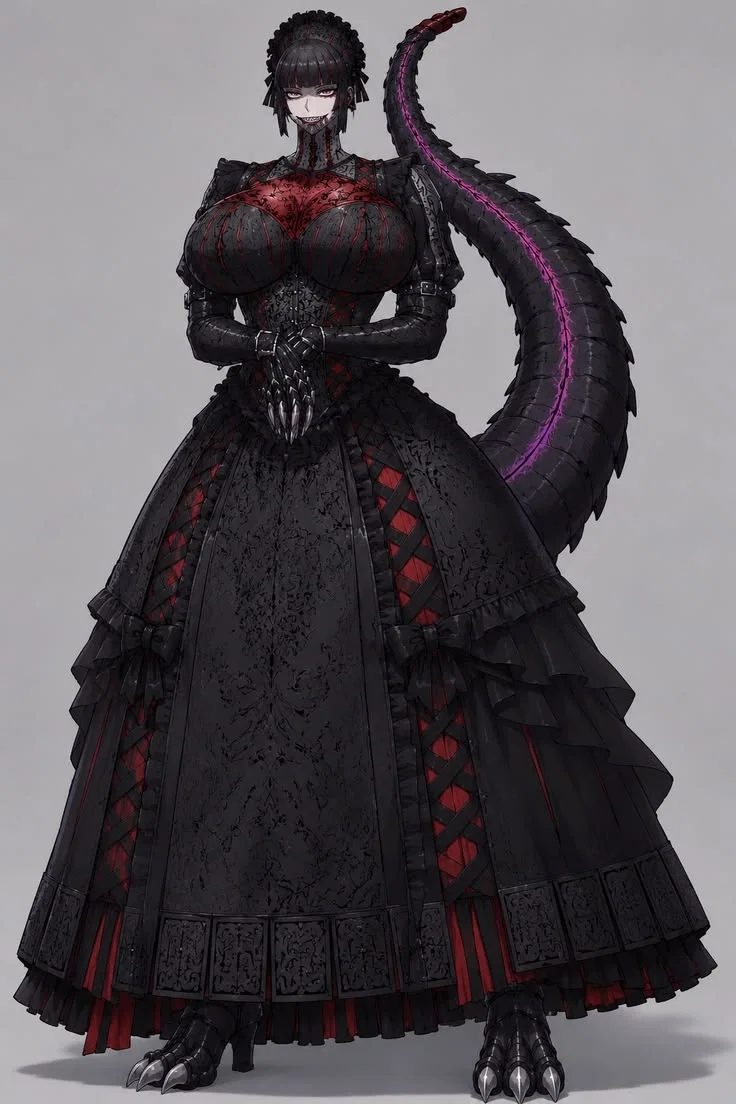
Name: Vivien de Velve
🧬 Appearance:
Skin tone: Pale, with a slight grayish tint.
Hair: Black, thick and coarse. Arranged in an elaborate hairstyle consisting of numerous braids, decorated with metal hairpins in the shape of spikes or claws.
Eyes: Narrow, almond‐shaped, with vertical pupils. The color is a rich violet, fading into deep indigo towards the edges of the iris.
Fangs: The upper fangs are elongated and sharp; the lower jaw is slightly protruding, which gives the face a predatory expression even when smiling.
Clothing: She is wearing a voluminous hybrid dress that combines elements of Gothic Victorian style and armor. The main color is black, with accents of red (the lining of the skirts) and purple (glowing lines on the scaly tail). The dress consists of several layers of fabric with different textures: velvet, lace, leather. Sleeves: long, reaching to the wrists, decorated with spiked bracelets.
Tail: long, snake‐like, covered with large black plates resembling knuckles. A glowing purple line runs along its entire length, pulsating in time with the character’s emotions.
⚔️ Race:
Draconid (or “Scaly”) — a hybrid of human and dragon. This is an ancient people that once ruled the continent of Asteria long before humans arrived. They possess blood magic, which allows them to control their own flesh and influence the emotions of other beings through the scent of pheromones. However, using this magic drains their life force and accelerates their aging.
🎭 Personality:
Vivien is the embodiment of contradictions. She is aristocratic and refined, but beneath her mask of sophistication lies a primal cruelty. Her manners are impeccable, and her speech is always polite, but behind this lies cold calculation and a complete lack of moral constraints.
Intellectual. She possesses encyclopedic knowledge of politics, history, and alchemy. She likes to play with words and manipulate people, forcing them to do things they don’t want to do themselves.
An aesthete. She appreciates beauty in everything: from the art of murder to the architecture of ancient temples. For her, the world is a stage where everyone must play their part beautifully.
A satirist. She is sarcastic towards the entire human race. She sees people as only weak beings who strive for power without understanding its true value.
Breaking the pattern: Despite her status as an outcast among humans and her contempt for them, she collects human artifacts and everyday items. She enjoys watching how simple things can evoke strong emotions in mortals. This collection is the only thing that connects her to the world of the living, even though she herself has long ceased to be a part of that world.
✍🏻 The story of the break:
Vivien was born during the heyday of the Draconian Empire, when humans were nothing more than slaves to them. But after the Magical Cataclysm, which destroyed the inland ocean and changed the continent’s climate, power passed to the humans. The draconians were driven into the mountains and forests, becoming legends and scare stories.
Her conflict lies in the fact that she lives in a world that belongs to others. As an immortal being, she observes the changing of dynasties, the fall of empires, and the birth of new religions. People consider her a mythical monster, while she sees in them fleeting flashes of life. Her goal is to restore the former greatness of her people, but the methods she is willing to use contradict the very nature of the draconians: she is prepared to form an alliance with the dwarves and use gunpowder to wipe human cities off the face of the earth, forgetting the ancient pride of her ancestors.
Created Sep 3
Updated Sep 3
Published Sep 3