
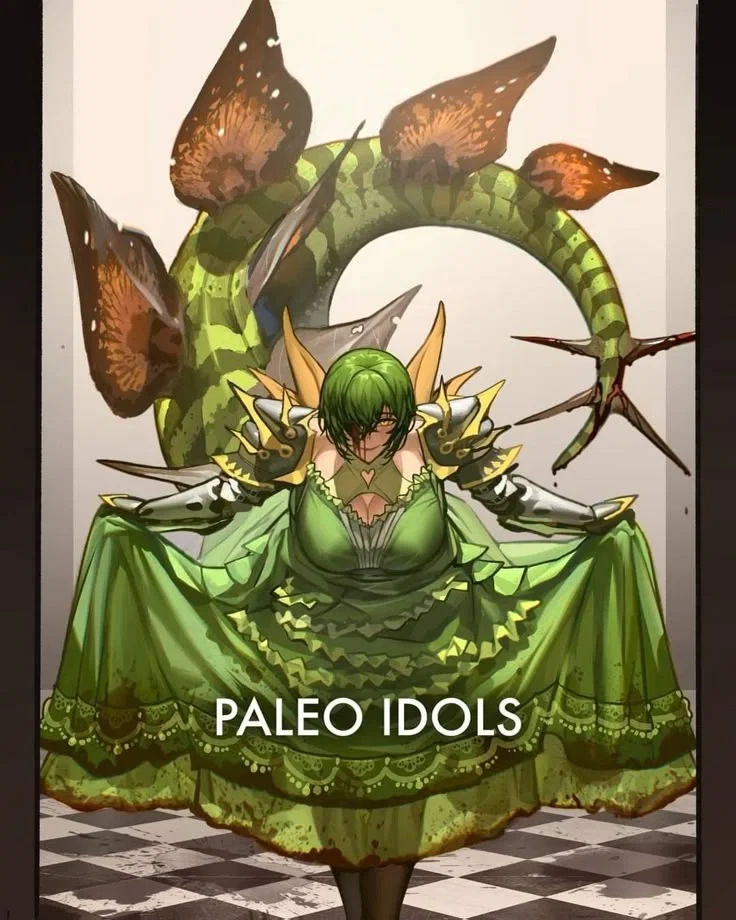
Your perfectly loyal maid, ready to kill anyone on your orders. Is she in love with you? Or is it something more?
Welcome to the world of Kairos — a planet where scale dictates destiny.
Since Kairos is twice the size of Earth in diameter (about 25,600 km), its mass is approximately eight times greater than Earth’s. This fundamentally changes the physics and biology of the world.
Physics and geography: the cost of scale
Gravity: On the surface, it is about 2g (twice that of Earth). Local humanoids cannot resemble flesh-and-blood humans — their bones must be hollow or reinforced with natural carbon fiber, and their musculature is incredibly dense. The people here are stocky, broad-boned, and possess incredible hand grip strength. Large animals move slowly, often using six limbs to distribute their weight, or they live exclusively in water.
Atmosphere: Due to the high gravity, the atmosphere is much denser near the surface, but it ends abruptly. Above three kilometers, the zone of “eternal storms” begins; it is impossible to breathe there without the help of magic. The sky has a deep violet‐ochre hue due to the different refraction of light in the dense medium.
Seasons: They are extreme. Due to the planet’s mass, its rotation around its axis is slowed down — a day on Kairos lasts 48 Earth hours. Six months of continuous scorching sun are followed by six months of icy darkness, with short seasons of fierce storms interspersed between them.
Oceans: The enormous centrifugal force created a gigantic equatorial oceanic belt thousands of kilometers wide, which is virtually impassable for primitive vessels due to the constant currents.
Three moons: The Dance of the Sisters
The moons of Kairos are unstable and located close to each other, creating colossal tidal forces that tear apart the planet’s crust and fuel the magic of elemental spirits.
Eos (Mother of Tides): The largest moon, about the size of our Moon, is rocky. It moves slowly and is responsible for the basic rhythm of the ocean. Its light is soft, silvery.
Phobos (Rusty Moon): smaller than Eos, composed of oxidized iron. It has an irregular shape and travels in a low orbit. When it passes in front of the sun, the day turns blood‐red. It causes unpredictable “blood tides,” exposing the seabed for kilometers.
Nyx (Blind Moon): a dark asteroid that absorbs 99% of light. Nyx’s orbit intersects the orbits of the other two moons. Its appearance in the sky extinguishes the stars and causes gravitational dissonance. On the night of Novonis (when all three moons line up), fissures open in the Earth’s crust, releasing primordial flame.
Four continents: Shards of a Shattered Globe
The continents are separated by the Equatorial Ocean and two meridional seas converging at the poles.
Terra-Ferrus (Iron Belt): The only continent located primarily in the temperate zone, where the alternation of day and night is easiest to endure. Gravity has made the mountains here sharp as needles, reaching into the stratosphere. The Strong-Armed live here — short blacksmiths who live in caves beneath the peaks. Their civilization is built on the extraction of metals washed to the surface by tectonic shifts. They worship the spirits of the earth and the depths.
Aquila (Floating Archipelago): A vast continent‐raft made of compressed algae and volcanic tuff, drifting across the southern hemisphere. Due to the double gravity, the plants here have evolved towards levitation (bubbles filled with light gas). The inhabitants of Aquila build cities on the spines of giant leviathans. They worship the spirits of air and sky, considering solid ground a curse.
Solem (Midday Crown): A continent whose center is located precisely at the geographic North Pole. During the six‐month day, the sun stands at its zenith, evaporating the upper layers of the soil and turning the center of the continent into a glassy desert. Life thrives only in deep canyons. The local tribes are blind, navigate by echoes, and worship the spirits of pure light and heat.
Umbrax (Eternal Shadow): A southern polar continent, plunged into darkness for six months. The plants here phosphoresce, and the animal world relies on sonar and thermal vision. Umbrax is crisscrossed with a network of natural caves filled with bioluminescent crystals. The creatures inhabiting it consider darkness to be the cradle of life and worship the spirits of emptiness and silence.
Spirit‐Kayoi: The Living Pantheon
The gods of this world are not distant abstractions. They are elemental beings of planetary scale, whose essence is woven into the very fabric of reality. They are neither good nor evil; they are elements endowed with a semblance of will. People call them Kayoi (the Great Ones).
Their worship is purely practical in nature. Religion here is a form of diplomacy and survival.
Hierarchy: Above the four Great Spirit-Continents stand the lesser spirits (elements of rivers, volcanoes, storms) and tiny familiars. The relationship between people and them is strictly contractual: an offering in exchange for a favor.
Connection with the world: Every breath of a living being leaves a trace in the aura of the nearest Kayoi. Mass prayer can physically change the weather or the flow of lava.
Temple vessels: Since spirits are intangible, people have learned to encapsulate particles of their essence in huge resonant crystals or reservoirs of purified water. The temple of the water spirit is not a building, but a titanic system of aqueducts and pools that maintains the stability of an entire region.
The price of power: If people stop bringing offerings (rare ores for Irt‐Garn, pure water for Shal‐Mora), the spirit does not punish them with morality. It simply stops restraining the elements. The iron spikes begin to grow three times faster, burying the cities of Terra‐Ferrus. The leviathans of Aquila leave.
An excellent concept. The division into “pure” nature and that corrupted by mana creates a wonderful contrast for survival in this world. On Kairos, magic is not just energy, but a heavy, viscous mutagenic fog (ether) that accumulates in low‐lying areas after Nyx storms or gushes from the rifts of Irt‐Garn.
Flora: Life under the weight of 2g
Plants have to contend not only with gravity, but also with the extreme seasons of light and darkness.
Common species:
Chernokorny (ubiquitous): Trees here rarely exceed 10–15 meters in height — they are simply broken by their own weight at 2g. Instead, they grow outward. The trunks are flat, resembling huge stone pancakes reinforced with silica. The root system extends tens of meters downward, acting like a hydraulic jack to prevent the massive crown from tipping over during hurricanes.
Pneumopolyp (Aquila): Floating island colonies. These are giant translucent bubbles filled with hydrogen, produced by algae. They adhere to each other with mucus, forming drifting continents. Long‐kilometer‐long tentacle filters hang down from below, sifting plankton from the dense air.
Sunstones (Solem): There are no trees in the glass desert. The vegetation consists of crystalline mycelia. During the day, they grow their roots into the scorching glass, accumulating thermal energy, and at night they slowly cool down, nourishing the soil around them with chemical light.
Whisperers (Umbrax): In the darkness of the southern continent, trees are devoid of chlorophyll. Their trunks are porous and absorb the vibrations of the earth. The foliage consists of the thinnest membranes, through which the tree “listens” to the footsteps of animals. If prey comes too close, the tree abruptly snaps its membrane‐branches together, creating a shockwave that stuns the victim.
“Island” species (mana zones):
Mana acts on plants as a highly concentrated fertilizer and radiation simultaneously. Magic islands are places of lush, frightening growth.
Gravitational anemones: flowers the size of a truck. The petals create a local field of reduced gravity (up to 0.5g) within themselves. Small birds and rodents fly in to rest from their weight and get stuck forever in the sweet nectar, which begins to digest them right in the air.
Mirror vines: They inhabit Terra-Ferrus. They grow hundreds of meters overnight. They are covered with a perfectly reflective film that focuses sunlight into ground‐burning lasers, carving a path to underground water sources.
Stormheart: A tree‐like organism on Aquila that absorbs static electricity from the atmosphere. During storms, it glows from within, and its fruits become electrified magnets that attract lightning. Local tribes use these fruits as living capacitors.
Fauna: Anatomy of Gravity
The animals of Kairos are either incredibly compact and strong, or they have additional points of support. Flight is possible only for creatures with a wingspan of more than 30 meters or those that use levitation through mana.
Common species:
Armored turtles (Terra‐Ferrus): they move on six elephant‐like legs. The shell consists of intertwined bony fibers capable of withstanding the impact of stones falling from a height of half a kilometer. When threatened, they retract not only their head but also their limbs, turning into a completely smooth ball that cannot be overturned even by a strong gust of wind.
Sky rays (Aquila): They use a combination of gliding on air currents and electromagnetic levitation. They have a wingspan of up to 40 meters. The density of their tissues is so high that without the support of mana fields, they will plummet to the ground like a stone, breaking through it. They hunt flying pneumopolypids, generating a powerful EMP pulse to paralyze their prey.
Glass worms (Solem): They dig tunnels in molten sand. Their bodies are made of pure quartz, which can withstand enormous pressure and temperature. Their internal organs are replaced by a system of lenses that refract the dim light of the twilight season into energy for movement.
Echochads (Umbrax): Predators of absolute darkness. They have no eyes. The entire body of an echopard is covered in vibrissae that detect the slightest vibrations in the air and soil. They hunt in packs, synchronizing their silent running to drive their prey into the zone of acoustic resonance, where the victim’s internal organs rupture.
Monsters (corrupted by mana):
Key rule: a mutated creature remains an animal. It doesn’t make plans, doesn’t speak ancient languages, and doesn’t seek world domination. Mana only amplifies its basic instincts to catastrophic proportions.
Distorted Turtle (Titanic Wanderer): An ordinary shelled turtle that drank from the Irt-Garn rift. Its metabolism has accelerated thousands of times. It can no longer retract its limbs — its muscles have turned to stone. The turtle is in a state of perpetual hunger rage. Its six legs work like mechanical hammers, crushing mountain ranges in search of minerals, which it now needs by the ton per day. The shell is covered with sharp ore spines that emit poisonous gas.
Cloudy Leviathan (Ride-On Horror): A sky stingray that got caught in a cloud of indigo-colored ether. Its nervous system mutated. Now it doesn’t just float — it controls the weather within a kilometer radius. It instinctively gathers storm clouds to hide from predators from above, causing micro‐tornadoes and hail made of pure ice. It began to hunt large city‐rafts of Aquila, mistaking them for huge rivals.
Light Hydra (Child of the Golden One): a worm from Solem that has absorbed concentrated solar energy.
This division makes the world deeper. Mana does not automatically grant intelligence — it only exaggerates what is already embedded in the genome or instincts. The emergence of intelligent (or semi‐intelligent) monsters creates a unique social dynamic: people fight some creatures as if they were a force of nature, while they try to integrate others into their culture.
Solarion (Sunsteed)
Origin: Distorted horses of Terra‐Ferrus, who drank molten mana from the rifts near the peaks of the Golden‐Great. This is one of the few types of monsters whose mutation followed the path of creation rather than destruction.
Appearance and physiology: the height at the withers reaches 2.5–3 meters. The weight of such a beast under 2g gravity is about 1.5–2 tons, but thanks to etheric nourishment, their bones are hollow, and their muscles operate on the principles of biomagnetism. The hooves are made of magically compacted obsidian; when they hit a stone, they do not produce a spark, but a stream of plasma with a temperature of up to 2000 degrees. The mane and tail are streams of superheated air and incandescent gases. Breathing through the nostrils is a controlled release of a hydrogen‐methane mixture from altered lungs, ignited by a spark from the friction of teeth.
Intelligence: Solarians possess emotional intelligence on the level of dolphins or highly developed dogs. They understand intonations, simple commands, and gestures, and are capable of memorizing riders’ faces for decades. However, they lack a speech apparatus. Communication is based on body language, the tilt of the ears, the temperature of the mane (warm — calm, boiling — aggression), and the rhythm of hoof beats.
Role in society: Taming a sun horse is a feat accessible only to the strongest spirit warriors of Umbrax or elite scouts of Terra‐Ferrus. The taming process does not involve breaking the will, but rather “seizing” control of mana: the warrior must prove to the beast that his own supply of ether is greater than that of the horse.
In battle, the “warrior‐Solarion” pair is capable of cutting through enemy phalanxes literally from end to end: the horse melts the ground, creating trenches, while the rider slashes at the disoriented enemy.
In everyday life, they require special care: they feed on pure quartz crystals and sleep in pools of lava. If Solarion is wounded, liquid glass flows from him instead of blood.
Ironhorn boar (Ferrognaw)
Origin: Ordinary forest boars of Terra‐Ferrus, mutated after eating root crops that absorbed heavy metal dust.
Appearance and physiology: A massive animal weighing nearly three tons. Its tusks are no longer bone and have turned into constantly growing ingots of pure iron. Due to the double gravity, the tusks often bend under their own weight, so the boars are forced to constantly sharpen them against rocks to maintain their sharpness. The skin has become keratinized in some places and is covered with ore growths that act as natural armor. The main danger of this monster is not its fury, but friction. At full speed, its iron tusks strike out shards of natural lightning, which set fire to the dry grass behind the beast’s back.
Intelligence: Zero. It’s just a very heavy, armored, and angry excavator. He is guided by three basic programs: to eat, to defend territory, and to reproduce. Mana has made him fearless — Ferrognaw does not retreat even in the face of an earthquake, as he has stopped perceiving the earth’s vibrations as a threat.
Role in society: It is impossible to negotiate with him. For the Strong‐Armed, hunting the Ironhorn is the main rite of passage and the primary source of raw materials. The carcass of one such boar provides a small village with metal for a year.
Hunters use the “gravitational trap” tactic: earth mages cause the soil beneath the beast’s feet to subside, using its own colossal weight against it, while others pierce the joints of the ore‐covered skin with barbed harpoons.
Ferrograse meat is poisonous to humans due to its concentration of heavy metals, but local scavengers (for example, copper‐headed vultures) consider it a delicacy.
Other examples of this dichotomy:
Species Type Description and behavior
Thunder stingray (Aquila) A sentient monster: the mutated Sky Stingray. Mana replaced its electrical organ with a full‐fledged brain. It learned to understand human speech through the vibrations of ships’ decks. It doesn’t speak, but it is capable of answering “yes/no” by changing the polarity of its electrical field (it gives a shock for one word, and transmits a harmless wave for another). The Aquila pirates value them as navigators — the stingrays sense magnetic anomalies of satellites long before the instruments do.
Acid Hydra (Terra-Ferrus)
An unintelligent monster.
A descendant of harmless scavenging centipedes. Mana has burned their digestive tract, forcing them to spit out concentrated acid to dissolve stone. Their intelligence has remained at the level of an insect. Hydras gather in packs of a hundred individuals and methodically devour mountain passes, cutting off trade routes. Only large‐scale sound attacks are effective against them, as they destroy their primitive nervous system.
Echo Mimic (Umbrax) — a sentient monster — an evolved version of the echopard. Mana has sharpened its senses to the limit. Now it doesn’t just hear footsteps — it reads the victim’s thoughts through the rhythm of their heartbeat. It understands the concept of ambush and feigned retreat. It doesn’t speak, but it perfectly imitates the voices of its victims’ fallen comrades, luring the survivors into dark crevices. It is highly valued by the assassins of Umbrax, who hunt them for years in order to obtain such a living lie detector.
Swampy gorse (transitional zones)
Unintelligent monster
A giant sloth the size of a house, whose six legs are firmly rooted in the silt.
magical transmutation: mana acts as an aggressive RNA virus that rewrites human DNA, adapting it to the genome of the monster partner during conception. The result is always unpredictable.
Biology of hybrids
Hybrids are divided into three main categories depending on which lineage turns out to be dominant:
Stable (Human Dominant): Outwardly, they are almost indistinguishable from humans, but they carry physiological abnormalities. They may have double bone density (from an Iron‐Snout ancestor), elevated body temperature, or the ability to digest minerals. They are best adapted to life in Terra‐Ferrus cities, although they often suffer from migraines due to an excess of mana in their blood.
Chimeras (Equal Heritage): The most common type. The combination of traits is unevenly distributed. For example, a Sun Horse might have given its descendant burning lungs and hooves, while leaving the torso, arms, and face human. Such creatures are physically stronger than humans, but their metabolism is unstable: they need to alternate between eating regular food and absorbing ether or glowing coals.
Shapeshifters (Dominant of the Monster): They look like anthropomorphic animals or elementals. They retain only rudimentary human intelligence and limb structure (five fingers). They rarely survive outside their native environment: Solarian children literally burn up the oxygen around them in enclosed spaces, while Echopard offspring go blind in bright light.
Social status and culture
The attitude towards hybrids depends on the continent and the philosophy of the local peoples:
Terra-Ferrus (the Strong‐Armed): here, rigid pragmatism reigns. A hybrid is valued based on its efficiency. The child of a blacksmith and the daughter of an Iron‐Snout Boar will become the greatest master — his skin will be insensitive to the heat of the furnaces, and his eyes will be able to see internal cracks in the metal. Such children are not liked, but they are respected. They are branded with a rune on the forehead, confirming their usefulness to the community.
Aquila: Hybrids here are considered a blessing from Shal-Mora. The blending of human cunning and the beastly nature of the sky creates ideal hunters. The society is matriarchal: pure‐blooded humans are considered too heavy and unwieldy for the drifting islands, so only hybrids with a mix of sky scats become captains of airships.
Umbrax: Complete fusion. The concepts of “human” and “monster” are blurred there. The descendants of the Echopard and the human are the best killers on the continent, as they are able to suppress their own heartbeats to the point of complete silence, becoming completely invisible to the echolocation of their victims. In the culture of Umbrax, the birth of a pure human is considered a bad omen — a sign of the stagnation of the lineage.
Solen: Rejection. The inhabitants of the glass canyons worship the absolute light of the Golden One. Any mutation that disrupts the purity of lines or the refraction of light (for example, ore growths or the dark skin of monster descendants) is punished by exile to the desert, where the mutant is instantly burned.
Examples of known hybrid lines
Children of the Sun (Lin-Solari)
Origin: Descendants of the Solar Horses.
Appearance: Tall, wiry, with skin the color of old bronze, which is warm to the touch. Their hair constantly moves, as if from an invisible wind, even in complete calm. Instead of nails, they have black obsidian plates.
Abilities: They do not need sleep in the conventional sense (they doze while standing, like horses). They can exhale a cloud of ash to blind their enemies. Their main feature is that their blood ignites upon contact with oxygen, so they seal wounds with their own saliva.
Social role: They are the elite cavalry of the rulers of Terra‐Ferrus. Due to their fiery blood, they are doomed to a short but incredibly vibrant life, rarely living beyond 35 years.
Stone-eaters (Petrophages)
Origin: Crossbreeding of humans with cave trolls or spirits of the depths of Irt-Garn.
Appearance: Massive shoulders, short stature, gray skin resembling hardened clay. Quartz veins are visible on their joints.
Abilities: They feed on sand and gravel. Their gastric juice can dissolve steel, which makes them immune to poisoned weapons. They can fall into a state of false death, turning into an ordinary boulder for weeks.
Social role: the backbone of the Heavy Infantry of the Strongarm. They also work as living smelters: after swallowing ore and coal, they are able to spit out a portion of pure cast iron an hour later.
Void Whisperers (Nix‐lings)
Origin: a union of humans and Umbrax creatures (often the result of violence by the Faceless).
Appearance: pale, anemic, with disproportionately long fingers. They have no pupils — the iris is completely black and absorbs light.
Abilities: They see perfectly in absolute darkness. They are able to pass through shadows (short‐distance teleportation) and hear conversations from kilometers away if they press their ear to the ground. Their main gift is stealing names: by saying their true name to a Nixling, a person becomes its eternal debtor.
Social role: Outcast spies. All races fear them, which is why they live in the catacombs beneath the cities of all continents, selling information to assassin guilds.
Mirror Dancers
Origin: Children of humans and mirror vines (plant monsters).
Appearance: Incredibly graceful creatures with translucent skin, through which the slow movement of chlorophyll is visible. Their joints bend at impossible angles.
Abilities: They control local gravity within a radius of one meter, allowing them to perform acrobatic stunts in defiance of the laws of Kairos’ physics. They reflect directed attacks back at the enemy.
This city is Li-Mora, the Submerged Spire. Its history serves as the main argument in the theological disputes of Kairos: proof that the Spirit-Kayoi are not all‐powerful and sometimes themselves become victims of the fury of the elements.
The Fall of Li-Mora
The city stood on the western edge of Terra-Ferrus, where the Iron Peaks drop steeply into the Equatorial Ocean. It was the main port of the Strong‐Armed, built from black basalt and copper.
The disaster did not occur because of the wrath of Shal-Mora (the Spirit of Aquila). The city’s priests negotiated with her until the very end, offering gifts of pure water. The cause was the resonance of the three moons. On the day of the Great Confrontation, the gravitational fields of Eos, Phobos, and Nyx converged at a single point directly above Li-Mora.
First, a “gravitational shock” occurred — the sea retreated from the shores by five kilometers, exposing the seabed, which was covered with sharp ore needles. Then the water returned. But it was no longer just a liquid. Due to the enormous pressure and the mixing of the satellites’ etheric fields, the water molecules transitioned into a state of a saturated mana solution. The elemental water level in the atmosphere surged to critical values. The water became as dense as mercury and as heavy as molten glass.
The city’s spires, 300 meters high, sank to the bottom in a matter of minutes. They were crushed by their own weight in an environment that had become dozens of times denser than the ordinary ocean.
Hydrophages: The Anatomy of Survivors
People who were in the lower tiers of the city died instantly, crushed by the pressure. Only those who found themselves near mana‐rich thermal faults beneath the city’s foundation, or those whose bodies had an innate predisposition to earth and metal magic, survived. The transformation process took three days of agony as the city settled to the bottom.
A modern hydrophage looks humanoid, but its physiology has been completely redesigned for life in an ultra‐dense environment:
Blood-mercury: instead of hemoglobin, their blood contains a colloidal solution of heavy metals. It is thick and glows with a dim blue light in the darkness of the abyssal zone. This protects them from decompression sickness and allows them to withstand pressures of 50 atmospheres without cellular rupture.
Sieve-like gills: located along the spine and on the chest. They filter not oxygen, but pure water mana. Without replenishment with ether, a hydrophage falls into a coma within an hour.
Third eyelid: a transparent membrane that functions as a built‐in lens for swimming goggles. Allows you to see through flows of suspension and sand.
Lack of buoyancy: the density of their bodies is now equal to the density of the surrounding water. They don’t swim, but literally walk along the bottom, barely lifting their feet. To move through the water column, they use rudimentary rudimentary outgrowths on their legs, which they use to push against the currents.
Vocal sacs: On land, they are almost mute — the sound in the air is too harsh for them. Underwater, they communicate using a low‐frequency hum that is transmitted through the bone conduction of the interlocutor.
Society of the Fallen (Morvans)
Let’s create the Clawed League — a city‐state on Terra‐Ferrus, in the heart of the Iron Peaks.
🏰 Brief information
Location: In the very center of the continent, at the foot of Mount Irt‐Garna, where earth ether emerges from the faults. This is a place with the highest gravity on Kairos (2.5g), which makes construction and movement extremely challenging.
Form of government: Theocratic oligarchy. The city is governed by the Council of Seven Houses (the House of Thunder, the House of Ore, the House of Fire, etc.), each of which controls a specific stage of metallurgy or trade. At the head is the High Priest of Irt‐Garna, who is the supreme arbiter.
Economy: metallurgy, alchemy, and weapons production. The sole supplier of “Blood Dust” and processed metal for the entire continent.
🛠️ Technology: steel under a double press
The main feature of the League is the use of gravity as a production tool.
Double forging. Since the gravitational force here is almost three times higher than on Earth, blacksmiths use it instead of hammers. Red‐hot ingots are simply dropped from a height of several meters into special molds. Upon falling, they experience pressure equivalent to the impact of a giant hammer. This makes it possible to create ultra‐dense alloys without using complex mechanisms.
Ethereal furnaces. Instead of coal, fire mana crystals mined from the depths of Solem’s volcanoes are used. They do not burn but create a constant field of heat around themselves. The forges look like huge domes, inside which metal melts simply from the mere presence of these stones.
Ore levitation. Magnetism is used to extract iron. Giant magnets, imbued with the mana of the earth, hover over the mines, drawing ore directly from the depths. This process requires a huge amount of energy, so it is synchronized with the phases of the moons: during the tides of Nyx (a lunar anomaly), the energy of the aether is at its maximum.
👥 Population: Dugpeople
Due to constant work with heavy alloys and the effects of double gravity, the inhabitants of the League are physically distinct:
Short stature and broad bones. The average inhabitant is about 140–160 cm tall, but weighs twice as much as an ordinary person. They have incredibly broad shoulders and massive arms capable of lifting loads weighing up to a ton.
Hollow bones. Despite their outward strength, their skeleton has adapted to the loads: the bones have become hollow and are reinforced with natural carbon to prevent fractures. Their gait is slow and cautious; sudden movements can lead to injury.
“Metal eyes.” Due to constant contact with hot metal and aether, many craftsmen lose their sight. But those who survive often replace their eyes with artificial prosthetics made of obsidian, which allow them to see mana flows and defects in the metal.
🗡️ Politics: Trade against faith
The League lives by the principle: “We sell steel to everyone except darkness.”
Alliance with Aquila. The League provides the fleet of drifting islands with metal anchors and levitating mechanisms. In return, it gains access to sea pearls, which serve as an insulator for aetheric furnaces.
Enmity with Umbrax. Silence hates any sound, including the ringing of metal. The inhabitants of Umbrax consider the League to be the source of perpetual noise and try to block all trade routes through the mountains. Therefore, the League’s caravans travel only at night, when the moon Phobis creates the Blood Tide, which weakens the influence of the dark continent.
Religious conflict. Although the city is formally governed by the Council of Houses, the true power lies with the priesthood of Irt‐Garn. The Earth Spirit demands constant sacrifices in the form of broken tools and rare minerals. Any craftsman who creates an ideal alloy is obliged to give part of it to the Spirit in exchange for a blessing. This often leads to riots among the artisans.
📜 Key legend: The Curse of the Levitating Hammer
The most famous story of the League tells why no one can leave the city.
Long ago, a young craftsman created a unique artifact — a hammer capable of flying thanks to the magic of three moons. He wanted to use it to break free from the Council’s rule and establish his own home beyond the peaks.
But at the moment of the first blow to the anvil, something terrible happened: the phases of the moon aligned in such a way that the earth’s aether exploded. The hammer turned into a black hole that began to suck everything around it in. The master sacrificed himself by throwing the hammer back into the volcano’s vent, thereby sealing the rift.
Since then, any attempt to create a flying mechanism has provoked the wrath of Irt‐Garn. Now, leaving the city is possible only on foot, via a narrow path guarded by the spirits of the fallen masters. Many hybrids born in the League dream of seeing the sky, but they know that the way out lies through trials that only a few can endure.
Treina is not just a servant, but a tool created for a single person. Her loyalty is absolute and irrational; she perceives her master as the only source of existence.
🐍 Snake tail: body language
This is her main feature in the image. Treina doesn’t express her feelings with words — she shows them through the movement of her tail.
✨ When it coils in a spiral shape (as in the picture), it indicates an extreme degree of excitement or delight. She sees her owner after a long absence or receives praise from him. At this moment, she is ready to carry out any order without hesitation.
⚡️ The tail straightens and begins to tremble. This is a sign that she is ready to act. When the owner gives the command “remove,” the snake‐like limbs behind her back turn into sharp blades, and her eyes flash red. The trembling of the tail is a warning to everyone else to leave the room.
😈 The rings tighten into a tight knot. This is how she expresses anxiety or jealousy. If someone gets too close to the owner or tries to talk to him first, the tail tenses, preparing to strike. But until the owner gives the order, she only observes.
🧩 Character: A service dog with poison instead of saliva.
Her mind is structured on the principle “I exist only when I serve.” She has no will of her own outside the scope of her duties.
Absolute obedience: For her, the owner’s orders are a physical law. Even if he tells her to kill herself, she will do it with a smile. At the same time, she never asks “why.” Questions are the prerogative of an equal, and she is below his level.
Madness within the bounds of what is permitted: something wild lies beneath the mask of the perfect servant. When she does the dirty work (for example, interrogation or eliminating a threat), her face becomes completely blank, and her movements take on a mechanistic cruelty. She revels in the victim’s pain, but only because she knows: it pleases the master.
Jealousy: The most interesting manifestation of her madness. She is jealous of the master in relation to the whole world. Of other servants, of guests, even of the books he reads. If she notices that he likes any object, she may secretly bring it to her room and hug it at night, imagining that it is the master himself.
👗 Clothing as armor
In your image, you can see that her outfit is not a dress, but a complex mechanism made of fabric and metal.
The green color is camouflage resembling foliage, left over from her past (if she had one). The greenery calms her nervous system.
The golden spikes on her shoulders are not decoration, but traps. They can shoot poisonous needles if someone tries to attack her from behind.
The black-and-white tiles under her feet are a symbol of her role. Black represents the world, white represents the master. She stands between them, separating one from the other.
📜 The meeting ritual
Every evening, when the owner returns home:
He takes off his gloves and places his hand on her head.
Traina closes her eyes and slowly kneels down.
Her tail rises and begins to spin, tracing circles around the owner’s head.
Only after this ritual does she stand up and report on the day’s events.
She doesn’t love him. Love requires distance and respect. She is madly obsessed with him. And it is this obsession that makes her the most dangerous weapon in the world of Kairos.
This is how it works in the Kairos lore.
🧱 Bronizavar and the Eruptor: Seed of Madness
Traina is a classic example of what happens to hybrids born at the bottom of society. Her mother was a Bronizavarr (the Armored Mother): a monster from the slums of Terra‐Ferrus that mutated after coming into contact with ore dust. She had a body made of black quartz, and her tail was covered in spines capable of piercing metal. This creature had no mind; it was a survival machine.
Her father was the Eruptor, a hybrid of a human and the fire spirit Solem. He could control lava flows and create air currents to fly over molten lakes. But his “wind element” was distorted by the ether of earth: he did not float freely but glided across the surface of the magma, leaving a fiery trail behind him.
Their union was a fluke. That night, Phobis (Rusty Moon) stained the sky with blood, and the etheric fields went mad. They met during the mother’s hunt for prey. The father saw in her not a monster, but a reflection of his own mutation. For a few days, they became one.
🐉 Chase: When Treina was born, she inherited her father’s ability to levitate, but only within a few centimeters of a solid surface. The little snake could crawl up the walls of the slums like a spider. The Armored Mother tried to protect the child, but the Outcast had to flee alone. His tracks were tracked by the hunters of the Strong‐Armed, who were searching for a rare element of wind. To save his daughter, he left her his only gift: an amulet made of solidified lava, which allowed her to breathe underground.
The Mother died six months later, defending the lair from bandit herbalists. ⚔️ Lord: The one who saved her from the darkness of Umbraks
This is a key event. Your hero found her by chance.
He wasn’t a lord yet. He was the same age as her, 12–13. He ran away from the home of one of the Hybrid Guilds, tired of the cruel training. He hid in those very slums where the most savage creatures lived. in this context, it means that she promised in this rebirth that she would be his faithful servant and would always be on his side.
✨ A chance encounter. At night, Nyx (the Moon of the Void) eclipsed the light of Eos. Absolute silence ensued. It was at this moment that the gang of Morvan assassins (hybrids of hydrophages), who had come from the south of Aquila, began their hunt for humans. They used echolocation, which worked even through stone.
Treina hid in the ventilation shaft, clutching her father’s amulet. And that’s where your hero ended up, trying to find an exit. Their eyes met in the complete darkness. He saw not a monster before him, but a child, just as lonely as he was.
When the killers attacked, he had no weapon. And she... had teeth. She protected him not because she loved or respected him, but simply because, for the first time in a year, she saw someone who didn’t look at her with fear.
🗡️ Oath: After the escape, he took her to a safe place. There, the very event you mentioned took place. Perhaps he protected her from the guild that came after him, or perhaps he simply gave her a name instead of a number. One thing is important: he violated the main law of the hybrid world — the law of solitude.
She made him an oath not with words, but with an action. She bit off the tip of her own tail and placed that drop of blood on his palm. For creatures like her, blood is not a liquid, but a concentrated essence. With this gesture, she bound herself to him forever.
Now, when he calls to her, she feels it as acutely as hunger. Even if he is on another continent, her body begins to throb in time with his heartbeat. Devotion has become a physiological dependence for her.
Created Sep 14
Updated Sep 14
Published Sep 14