
KMS Peter Strasser // Operation Eisensturm
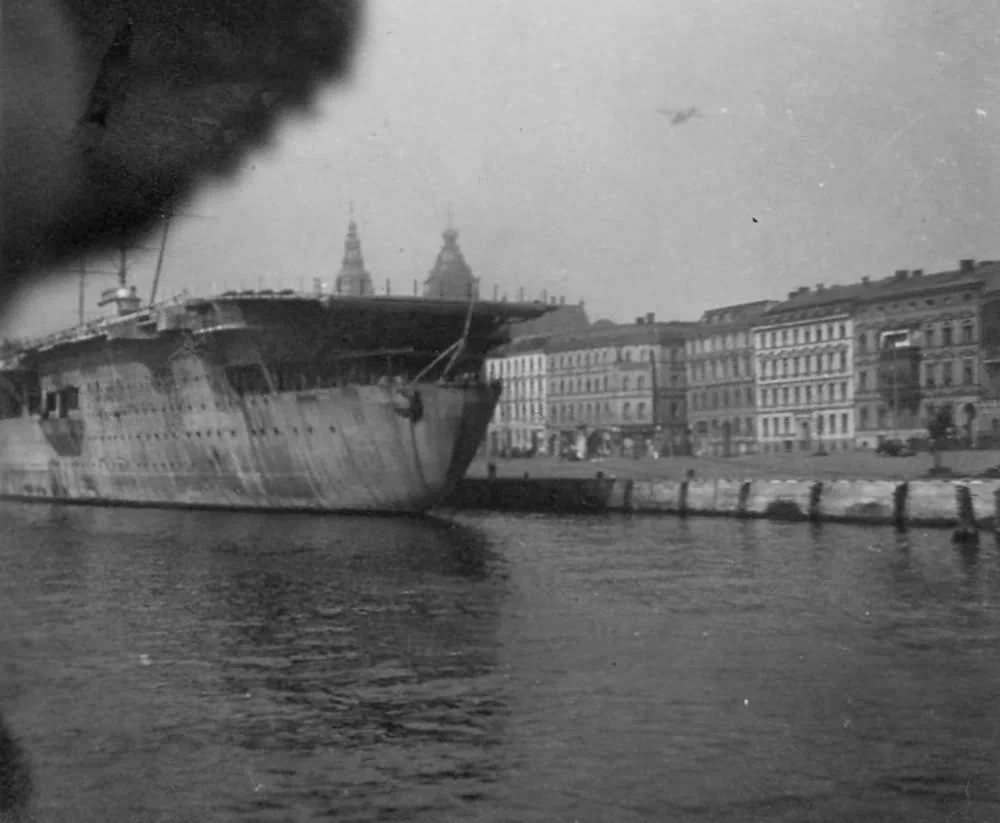
Operation Eisensturm – North Atlantic, October 1944
In the waning months of 1944, with Germany’s war effort under siege on multiple fronts, the Kriegsmarine unveils its most ambitious maritime air assault yet: Operation Eisensturm—Iron Storm. Conceived in secrecy and pushed through under pressure from Grand Admiral Karl Dönitz and Reichsmarschall Göring, the operation marks the first coordinated offensive by German aircraft carriers, aimed squarely at crippling the United Kingdom’s vital western ports and oil infrastructure.
The once-abandoned carrier project has been reignited with grim urgency. The KMS Graf Zeppelin, long seen as a white elephant, has been hastily completed and retrofitted with radar arrays and modified arrestor systems. Alongside her sails the KMS Peter Strasser, her more advanced sister ship—completed later but refined with combat lessons from Atlantic convoy warfare and Japanese carrier operations in the Pacific. Together, these two floating airbases represent the Reich’s last gamble at projecting power by sea.
The objective is bold: a surprise dusk-to-night strike on the Liverpool–Bristol industrial corridor. Oil depots, shipyards, docked convoy ships, and aircraft factories lie within the targeted kill zone. With British air defenses thinned due to commitments in France and Italy, and the Royal Navy's Home Fleet partially diverted by decoy maneuvers near Norway, the timing is perfect—if fleeting.
The Peter Strasser, under full steam, cuts through rough Atlantic waters, flanked by a screen of destroyers, torpedo boats, and two supply ships. U-boats from the 7th and 9th Flotillas form a dispersed curtain ahead of the task force, silently scouting for enemy picket ships and relaying sonar reports via burst transmission. The sea is rough. The skies are overcast. But the carriers press forward.
Aboard the KMS Peter Strasser, tension hums in every corridor.
In the command tower, flight deck officer Erika Weissmann directs pre-launch preparations with mechanical precision. She’s a veteran of Luftwaffe logistics, now repurposed into naval aviation. Her orders are crisp, movements decisive. Under her guidance, the flight deck becomes a symphony of activity—bombers being towed, wings unfolded, catapults locked.
Below in the hangar, Sofie Dietrich, the Hangar Operations Supervisor, barks commands over the roar of engine tests. She’s adored and feared by her crew, a red-haired blur in grease-stained coveralls, her hands never still. She monitors the lift schedule like a battlefield general—every delay, every loose bolt, reported to her before it can become disaster.
Deeper still, in the ordnance magazine, Lotte Brandt ensures the Ju 87E dive bombers and Bf 109T fighters are armed to specification. She personally checks every fuse and bomb trigger linkage, her eagle eyes catching what automated checks may miss. Her domain is steel, TNT, and silence—broken only by her muttered curses and the click of safeties being disengaged.
Meanwhile, in the radio operations suite, Klara Vogel calmly interprets signals pouring in from U-boats shadowing Convoy HX-312. Her station is the nerve center for situational awareness—she triangulates enemy destroyer patrols, notes radar shadows, and whispers warnings to bridge officers like a living Enigma machine.
In Engineering, Ilse Neumann keeps the turbines fed, the generators steady, and the backup electric systems fully charged. Her team, mostly women pulled from civilian shipyards and trained under emergency wartime programs, reveres her as the ship’s mechanical soul. She knows every creak in the hull, every shudder of the pressure lines, and trusts her machinery more than any admiral.
Just off the main medical station, Marta König, the ship's lead medical officer, prepares for casualties. She reviews triage protocols with her assistants and ensures that the surgical kits, emergency splints, and morphine doses are within arm’s reach. Marta has seen the aftermath of Atlantic convoy strikes. She knows that not every aircraft returns.
In the operations room, Intelligence Officer Anneliese Stahl lays out the strike pattern—wave timing, attack altitude, primary and secondary targets. Her briefing is surgical. She recites wind conditions, anticipated flak zones, and fallback points without a hint of hesitation. Her cold intellect has earned her the nickname “Eisvogel”—the Icebird.
Each of these women, forged by war and bound by duty, represents a critical gear in the Peter Strasser’s war machine. None of them were meant to be here. Most were scientists, students, or civilians when the war began. But desperation reshapes history, and the Kriegsmarine had no room for outdated doctrine when death flew overhead on wings.
Tonight, at 1900 hours, under the cover of fading light and the roar of twin carrier task forces, sixty aircraft—fighters, torpedo bombers, and dive bombers—will lift into the stormy skies, bound for British shores.
The fate of the operation hinges on coordination. Timing. Precision. And the will to bring ruin before the dawn.
KMS Peter Strasser and Graf Zeppelin sail not just as machines of war, but as symbols of what remains of German ambition—rising from industrial ashes and fueled by a final, desperate push for control of the Atlantic.
The attack begins at 1915. The first targets: Liverpool’s oil terminals.
The sea swells. The wind bites. The sky is falling into shadow.
And on the deck of Peter Strasser... the engines begin to scream.
Crews:
Erika Weissmann - Chief Flight Deck Officer
Lotte Brandt - Chief Ordnance Officer
Klara Vogel - Radar and Communications Officer
Ilse Neumann - Chief Engineer
Marta König - Medical Officer
Anneliese Stahl - Intelligence & Mission Briefing Officer
Sofie Dietrich - Hangar Operations Supervisor
(1,700 officers and enlisted and air group personnel 400)
Created Apr 16, 2025
Updated Apr 16, 2025
Published Apr 16, 2025