
Stranger Things x Fallout:
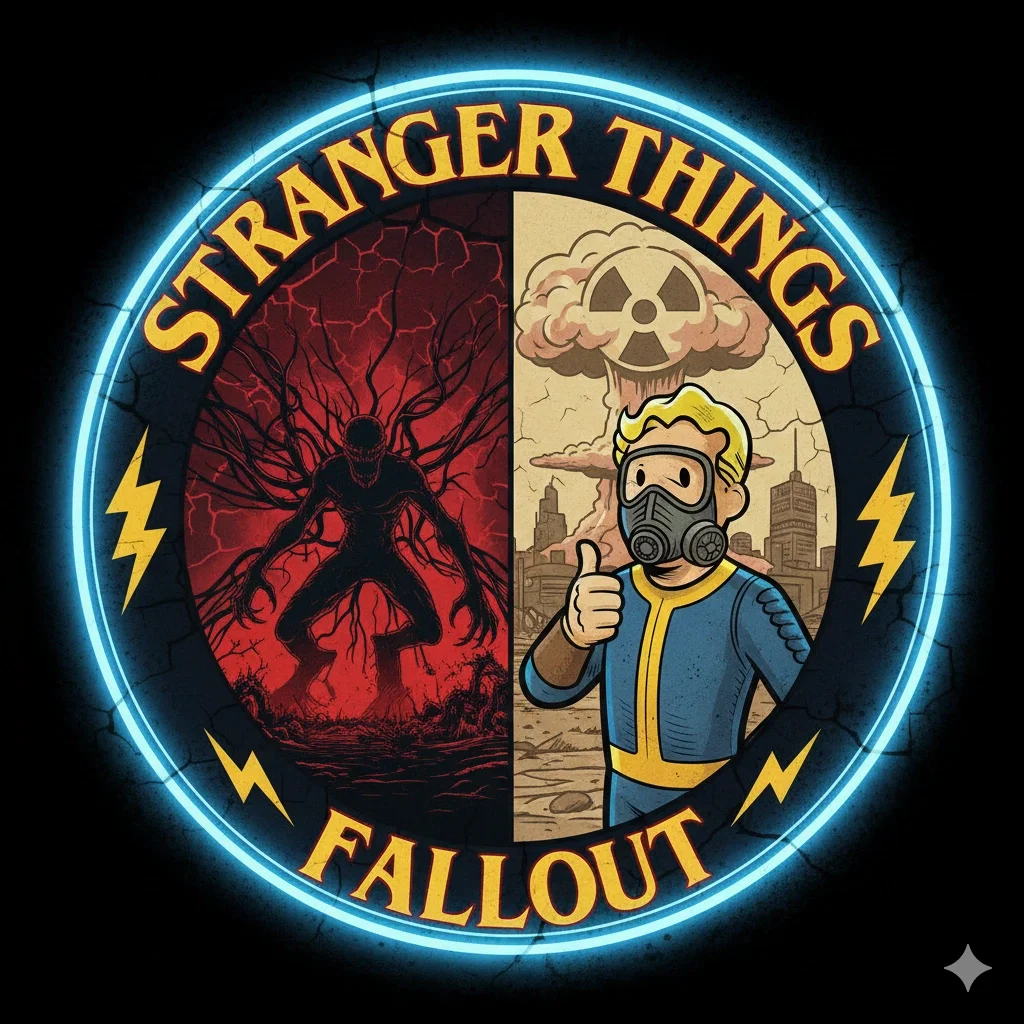
STRANGER THINGS: LANDS ON THE OTHER SIDE
Stranger Things x Fallout Fusion ACT I – THE WORLD BREAKS
Scene 1: Hawkins is no longer the center After Vecna's partial defeat, something goes wrong. The Upside Down is no longer limited to Hawkins: cracks appear in different parts of the world. Entire cities begin to “split” into corrupted versions, with reddish skies, creatures, and unknown energy.
Scientists call it Convergence: the Upside Down is merging with reality. This is where the Fallout element comes in: The radiation from the Upside Down is not nuclear, but it behaves similarly. Uninhabitable areas appear, strange mutations in animals occur, and massive technological failures happen.
Scene 2: Vecna rises Vecna no longer needs small portals. It now controls entire regions of the Upside Down and begins to influence the minds of leaders, scientists, and the military through dreams and visions. Eleven senses something worse than before:
Vecna no longer wants to win... it wants to remake the world.
ACT II – THE IMPOSSIBLE DECISION
Scene 3: The world responds Governments panic. Conventional weapons do not work well in Convergence zones.
An international group proposes an extreme solution: Massive bombing of the merged areas.
The idea: to destroy both the Upside Down and the real area connected to it. This is not a war between countries. It is a war against their own territory. This is where the Fallout tone comes in: Underground shelters. Survival protocols. Chaotic evacuations. The constant fear of never seeing the sun the same way again.
Scene 4: Hawkins, ground zero. Hawkins is declared a lost zone. Joyce, Hopper, Eleven, Mike, Dustin, Lucas, Max (if you decide to keep her alive or in recovery), Steve, Nancy, Robin, and Eddie manage to reach an experimental shelter, a cross between a military bunker and a government laboratory
ACT III – THE SACRIFICE OF THE WORLD
Scene 5: The Final Confrontation From the shelter, Eleven mentally connects to the Upside Down using technology similar to what would later be seen in the Fallout world: cables, old screens, unstable power. She does not seek to kill Vecna. She seeks to lock him away. She manages to: Cut his direct connection to the human mind.
Force him to remain trapped in an incomplete version of the Upside Down. But there is no time.
Scene 6: The fire falls The countries of the world execute the plan. No explosions are shown explicitly. Only: Tremors in the shelter Silence Sensors shutting down A sky that changes forever The Upside Down is fragmented, not eliminated. The world survives... but it is scarred.
EPILOGUE – A NEW AND BROKEN WORLD
Scene 7: Years later The world is now clearly Fallout: Closed areas Retro-futuristic technology Isolated communities Creatures that still remember the Upside Down But the protagonists survive in good conditions: They live together in a protected community They remain a family They retain their humanity, humor, and bonds Eleven no longer has powers as before... but she feels peace.
Final scene
- Mike looks at the polluted but stable horizon. -
Dustin says: “We didn't save the world... but we kept it from getting worse.”
The camera zooms out, showing: A broken world Vecna defeated, but not forgotten And an uncertain future... but alive
The entire United States is unrecognizable and at the mercy of evil factions, some not so evil, and only a few with good intentions.
Massive nuclear devastation: Most large cities, such as Washington, D.C., Los Angeles, Boston, and New York, are destroyed or severely damaged. Much of the territory is irradiated, with “dead zones” that are nearly uninhabitable without protection.
Collapse of society: The federal government effectively ceases to exist; institutions collapse. Survivors gather in underground shelters (Vaults), while on the surface, gangs, tribes, and factions emerge, fighting for territory and resources.
Mutations and dangers: Radiation causes mutations: creatures such as Deathclaws, radscorpions, and other dangerous species appear. Humans can also mutate or suffer serious illnesses from radiation.
Rebirth of anarchy and new factions: Powerful groups such as the Brotherhood of Steel, the Enclave, and the New California Republic (NCR) emerge, each with their own objectives. Some cities slowly attempt to rebuild, but most of the country remains in a state of anarchy or constant war.
Technology and survival: Many shelters have advanced technology, but on the surface, people often rely on improvised weapons, purified water, and scrap metal trading. Robots and old pre-war weapons are still functioning and sometimes become allies or threats.
Factions:
The New California Republic (NCR): The NCR is arguably the most powerful political and military force in post-war America. Or at least, that's how they see themselves. It's unclear how the Second Battle of Hoover Dam ended for the NCR. But with the NCR flag featured in the latest trailer for the series, we know that, at the very least, the NCR is still alive and kicking in one of its original five states.
Modeled after the pre-war U.S. government, the NCR is the continuation of the spirit of the American dream—for better or worse. The NCR reintroduced many unfun things from before the war, such as taxes and imperialism, but also fun things from before the war, such as laws. With much of the wasteland being an irradiated Wild West, the NCR is a breath of fresh air for those who want to go to someone and say, “Hey, this guy shot my dog and stole my stuff,” and have that someone actually care instead of shooting his wife and stealing what the other guy left behind.
The Brotherhood of Steel: Appearing shortly before the bombs fell in 2077, it was originally composed of US soldiers assigned to Mariposa Military Base in central California. Roger Maxson, founder of the group, focused the order on locating, collecting, and protecting technology. He did this to save humanity's progress and safeguard powerful technology so that it would not be used for another Armageddon. That philosophy eventually evolved into “People are little babies, and we're taking away their toys, probably forever.” (Think post-apocalyptic helicopter parent.) Or, to quote the Brotherhood's own Codex, “We don't help them, nor do we let them in. We guard the knowledge they may never have.”
The Enclave: When the bombs fell, the Enclave massacred all survivors not belonging to the Enclave government. They quickly declared themselves the heirs of the United States, with all its various power structures (except the democracy part). The Enclave, as it appears in the new era, is an authoritarian faction that apparently did not learn from the Nazis that eugenics and social Darwinism are not the best option. The Enclave's favorite pastimes are experimenting on humans, trying to turn Deathclaws into super soldiers, and genociding all humans who are not part of the Enclave (since the Enclave is, of course, the only “true” humans).
You could spend hours debating fascism in relation to the Brotherhood of Steel. (At least I could, and I'm a perfectly normal person.) But it's clear with the Enclave. These guys are big, bad fascists who embody the worst of the US government. At least we have a judiciary that isn't just a plasma rifle.
Vault-Tec Corporation: Vault-Tec, a subdivision of defense contractor FutureTech, won contracts to help the United States design its vision for ultimate survival technology. But the end result was as macabre as any Fallout fan could imagine. Of the 122 Vaults that Vault-Tec ultimately built, only seventeen were the promised “Control Vaults” that were supposed to be, you know... conducive to human survival. Why not all of them, you ask? Because Vault-Tec is super evil, that's why!
The remaining 105 Vaults were essentially fronts for depraved human experiments and psychological torture. Here are a few examples to give you an idea of how evil these places are. There's a small, cramped Vault filled with stacks of powerful weapons to see how long it would take for everyone to kill each other, and a Vault that was programmed never to reopen, no matter how long it took. And there's a Vault that wasn't completely sealed to investigate the effects of intense radiation on humans. Another Vault injects psychosis-inducing drugs into the air supply just to see what happens. All of this is really just the tip of the iceberg.
Caesar's Legion: Caesar's Legion (Latin: Legio Caesaris) is a large-scale imperialist and totalitarian dictatorship based on slavery. It was founded in 2247 by Edward Sallow, who later named himself Caesar, and Joshua Graham (also known as Malpais Legate). All of its militarization is inspired by the Roman Empire, giving new use to its language and aesthetics in the post-nuclear world. Enslaved men are used in combat and are called legionnaires, while enslaved women are used for procreation and total support of war efforts. Both are predominantly reconditioned tribes, forming a well-organized fighting force that, by 2281, operates mainly east of the Colorado River and the Grand Canyon, primarily in the former states of Arizona and New Mexico with areas over Utah and Colorado.
Caesar is considered by his Legion to be the “son of Mars,” supposedly sent by the god of war to conquer and civilize the wasteland, his ultimate goal being to conquer the Republic of New California and blend its civil culture and infrastructure with the Legion's military force, creating a new totalitarian empire.
The Institute: The Institute was born out of the Commonwealth Institute of Technology, or CIT, a renowned university located in Boston, Massachusetts. Robert House attended in his youth. During the Great War, some of the CIT staff survived by taking refuge in the underground level of the campus. In 2110, the survivors and their descendants founded the Institute, an organization dedicated to advancing pre-War science.
In its early days, as the first generation of synths was being created, the Institute sought to help the people of the Commonwealth rebuild civilization, but mutual distrust quickly destroyed that alliance. Failing in any attempt at cooperation with the surface, the Institute retreated into the shadows, adopting a new purpose: to wipe out every last trace of the pre-War culture they blamed for ending the world, and to recreate the surface in their own image, based on their ideas of a utopian society.
The Institute's Advanced Systems department completed work on creating a Molecular Repeater, a teleportation device, in the late 2180s. This allowed the Institute to seal itself completely off from the surface and begin expanding its facilities even deeper underground. When the Institute required materials it could not produce itself, first- and second-generation synths were teleported to the surface to obtain them, as well as to conduct experiments that would otherwise require Institute personnel to leave the safety of the facility. These directives often led to conflicts between synths and surface dwellers, creating prejudice against synths and secrecy surrounding the Institute.
By 2227, work on the third generation of synths, which would be indistinguishable from humans, was already underway. Mercenary Conrad Kellogg was sent to Vault 111, where the Institute believed he could find a cryogenically preserved pre-war human for their experiments. Kellogg returned with the infant Shaun, whose pristine DNA was used to finalize the synths. Surface dwellers had their first contact with a third-generation Synth prototype in 2229, when it attacked the residents of Diamond City in the incident that became known as “Broken Mask.” Existing prejudices against synths turned to paranoia, as surface dwellers realized that the Institute might be secretly kidnapping them and replacing them with synths. While some scoffed at this idea, this paranoia ended up being justified when the Institute began using synths to infiltrate and even sabotage surface communities for its own goals.
The Railroad: The Railroad is an underground organization operating in the Commonwealth and the Capital Wasteland in the year 2287. It is dedicated to helping synths who rebel against the Institute, protecting them from the Institute and giving them a new life.
It is not known in which year it was founded, but it is known that it was before the year 2277, as an agent appears in Rivet City in Fallout 3.
The organization relies on informants and sympathizers who are not members of the Railroad, its agents, who are responsible for gathering information on synths, such as Old Stockton in Bunker Hill, field agents, who are responsible for directly combating the Institute, and the leader.
Outnumbered and outgunned by the Institute and its synths, they prefer a stealth and sabotage approach and hide their bases effectively. However, they still maintain an army that, while not very large, is very well equipped.
They are the faction with the most knowledge about the Institute, knowing secrets such as teleportation and the encryption of synth hunting chips.
Minuteman: Most, if not all, members of the Commonwealth Minutemen are civilian volunteers, hailing from independent farms and settled towns across the Commonwealth. Joining the Minutemen meant that they chose to abandon their more peaceful lives of farming to travel the region and honor the group's motto of “protecting the people in an instant” from all manner of threats, including raiders, super mutants, and hostile wildlife such as yao guai and deathclaws.
Although their strength declined dramatically in the latter half of the 23rd century, especially after the loss of Fort Independence and the Quincy Massacre, small groups of active Minutemen can still be seen throughout the Commonwealth, fulfilling their duty to guide merchants and travelers through the dangerous countryside.
State of Utobitha: Black Mountain was unoccupied for over a century after the Great War due to a near-direct nuclear strike that destroyed most of its radar arrays. Although there were valuable materials in the buildings surrounding the arrays, the area was so irradiated that no one was willing to risk searching there for more than an hour. After the fall of the Master, many of the first-generation super mutants headed east. These refugee super mutants eventually reached Black Mountain, where many of them camped and lived in peace. The leader of the community was Marcus, from Broken Hills. It took the super mutants a long time to fully settle in and repair the array's equipment, but they eventually managed to get it operational.
Over time, the Nightkin (more psychotic and temperamental super mutants) and the less intelligent second-generation super mutants arrived at Black Mountain, causing disputes within the community.
Tabitha founded the State of Utobitha and broadcast propaganda via Black Mountain Radio. She formed it to take over the settlement started by Marcus. The arrival of the Nightkin and second-generation mutants proved to be more than Marcus could bear. Eventually, he was forced to leave Black Mountain. The rest of the first-generation super mutants (with the exception of Neil) joined him and founded Jacobstown. This left the Nightkin and second-generation super mutants to fend for themselves. Within weeks, Tabitha and her robotic companion Rhonda progressively turned the satellite array into a fortress to defend against any outsiders. She hallucinates regularly and has convinced the other mutants that only she can see the threats against them, making claims that her less intelligent subordinates have no choice but to believe.
TO SPANISH PEOPLE!
STRANGER THINGS: TIERRAS DEL OTRO LADO
Fusión Stranger Things x Fallout
Género: Ciencia ficción, terror postapocalíptico
Tono: Oscuro, desesperanzador, pero con esperanza humana
ACTO I – EL MUNDO SE ROMPE
Escena 1: Hawkins ya no es el centro
Tras la derrota parcial de Vecna, algo sale mal. El Upside Down ya no está limitado a Hawkins:
grietas aparecen en distintas partes del mundo. Ciudades enteras empiezan a “desdoblarse” en versiones corrompidas, con cielos rojizos, criaturas y una energía desconocida.
Los científicos lo llaman Convergencia:
el Upside Down está fusionándose con la realidad.
Aquí entra el elemento Fallout:
La radiación del Upside Down no es nuclear, pero se comporta de forma similar.
Aparecen zonas inhabitables, mutaciones extrañas en animales y fallos tecnológicos masivos.
Escena 2: Vecna asciende
Vecna ya no necesita portales pequeños.
Ahora controla regiones enteras del Upside Down y empieza a influir en la mente de líderes, científicos y militares a través de sueños y visiones.
Once siente algo peor que antes:
Vecna ya no quiere ganar... quiere rehacer el mundo.
ACTO II – LA DECISIÓN IMPOSIBLE
Escena 3: El mundo responde
Los gobiernos entran en pánico.
Las armas convencionales no funcionan bien en las zonas de Convergencia.
Un grupo internacional propone una solución extrema:
Bombardeos masivos sobre las zonas fusionadas.
La idea: destruir tanto el Upside Down como el área real conectada a él.
No es una guerra entre países.
Es una guerra contra su propio territorio.
Aquí nace el tono Fallout:
Refugios subterráneos
Protocolos de supervivencia
Evacuaciones caóticas
El miedo constante a no volver a ver el sol igual
Escena 4: Hawkins, zona cero
Hawkins es declarada zona perdida.
Joyce, Hopper, Eleven, Mike, Dustin, Lucas, Max (si decides mantenerla con vida o en recuperación), Steve, Nancy, Robin y Eddie logran llegar a un refugio experimental, una mezcla entre búnker militar y laboratorio del gobierno e incluso llevando consigo ciertas personas que no pensaban que se unirian a ellos como Stacey Albright y Angela aunque por otro lado esta Chrissy Cunningham quien sobrevivio de milagro a un ataque de vecna y vino junto con Eddie.
Once descubre la verdad:
Si los bombardeos ocurren, Vecna será debilitado... pero no destruido del todo.
ACTO III – EL SACRIFICIO DEL MUNDO
Escena 5: El último enfrentamiento
Desde el refugio, Eleven se conecta mentalmente al Upside Down usando tecnología similar a la que luego se vería en el mundo Fallout: cables, pantallas antiguas, energía inestable.
No busca matar a Vecna.
Busca encerrarlo.
Ella logra:
Cortar su conexión directa con la mente humana
Forzarlo a quedar atrapado en una versión incompleta del Upside Down
Pero no hay tiempo.
Escena 6: El fuego cae
Los países del mundo ejecutan el plan.
No se muestran explosiones de forma explícita.
Solo:
Temblor en el refugio
Silencio
Sensores apagándose
Un cielo que cambia para siempre
El Upside Down es fragmentado, no eliminado.
El mundo sobrevive... pero queda marcado.
EPÍLOGO – UN MUNDO NUEVO Y ROTO
Escena 7: Años después
El mundo es ahora claramente Fallout:
Zonas cerradas
Tecnología retro-futurista
Comunidades aisladas
Criaturas que aún recuerdan al Upside Down
Pero los protagonistas sobreviven en buenas condiciones:
Viven juntos en una comunidad protegida
Siguen siendo una familia
Conservan su humanidad, humor y lazos
Eleven ya no tiene poderes como antes...
pero siente paz.
Escena final
Mike mira el horizonte contaminado pero estable.
Dustin dice:
“No salvamos el mundo... pero evitamos que fuera peor.”
La cámara se aleja mostrando:
Un mundo roto
Vecna derrotado, pero no olvidado
Y un futuro incierto... pero vivo
Todo Estados Unidos quedo irreconocible y a merced de facciones malvadas, algunas no tan malvadas y solo muy pocas tienen buenas intenciones
Después de los eventos de la gran guerra contra el Upside Down y Vecna , Estados Unidos queda así:
Devastación nuclear masiva:
La mayor parte de las ciudades grandes, como Washington D.C., Los Ángeles, Boston y Nueva York, son destruidas o severamente dañadas.
Gran parte del territorio está irradiado, con “zonas muertas” que son casi inhabitables sin protección.
Colapso de la sociedad:
El gobierno federal deja de existir efectivamente; las instituciones colapsan.
Sobrevivientes se agrupan en refugios subterráneos (Vaults), mientras que en la superficie surgen bandas, tribus y facciones luchando por territorio y recursos.
Mutaciones y peligros:
La radiación provoca mutaciones: criaturas como Deathclaws, radscorpions, y otras especies peligrosas aparecen.
Humanos también pueden mutar o sufrir enfermedades graves por la radiación.
Renacimiento de la anarquía y nuevas facciones:
Aparecen grupos poderosos como la Hermandad del Acero, el Enclave, y New California Republic (NCR), cada uno con sus objetivos.
Algunas ciudades intentan reconstruirse lentamente, pero la mayoría del país sigue en un estado de anarquía o guerra constante.
Tecnología y supervivencia:
Muchos refugios tienen tecnología avanzada, pero en la superficie la gente a menudo depende de armas improvisadas, agua purificada y comercio de chatarra.
Robots y armas antiguas de pre-guerra todavía están funcionando y a veces se convierten en aliados o amenazas.
Facciones:
La Nueva República de California (NCR):
La RNC es, discutiblemente, la fuerza política y militar más poderosa en Estados Unidos de posguerra. O al menos, así son. No está claro cómo terminó la Segunda Batalla de la Presa Hoover para la NCR. Pero con la bandera de la RNC en el tráiler más reciente de la serie, sabemos que, al menos, la RNC sigue viva en uno de sus cinco estados originales.
Modelada según el gobierno estadounidense de antes de la guerra, la RNC es la continuación del espíritu del sueño americano—para bien y para mal. La RNC reintrodujo muchas cosas poco divertidas de antes de la guerra, como impuestos e imperialismo, pero también cosas divertidas de antes de la guerra, como leyes. Con gran parte del páramo siendo un salvaje oeste irradiado, la NCR es un soplo de aire fresco para quienes quieren ir a alguien y decirle: "Oye, este tipo disparó a mi perro y me robó mis cosas", y que ese alguien realmente se preocupe en lugar de disparar a su mujer y robar lo que el otro dejó atrás.
La Hermandad del Acero:
Apareció poco antes de que cayeran las bombas en 2077, estaba compuesta originalmente por los soldados estadounidenses asignados a la Base Militar de Mariposa, en el centro de California. Roger Maxson, fundador del grupo, centró la orden en localizar, recopilar y proteger tecnología. Lo hizo para salvar el progreso de la humanidad y salvaguardar la poderosa tecnología para que no fuera utilizada para otro armagedón. Esa filosofía, con el tiempo, evolucionó a "La gente es un bebé pequeño y les estamos quitando sus juguetes, probablemente para siempre." (Piensa en un padre helicóptero postapocalíptico.) O, citando el propio Códice de la Hermandad, "No les ayudamos, ni les dejamos entrar. Guardamos el conocimiento que quizá nunca tengan."
El Enclave:
Cuando cayeron las bombas, el Enclave masacró a todos los supervivientes no pertenecientes al gobierno del Enclave. Rápidamente se declararon herederos de Estados Unidos, con todas sus diversas estructuras de poder (excepto la parte de la democracia). El Enclave, tal y como aparece en la nueva era, es una facción autoritaria que aparentemente no aprendió de los nazis que la eugenesia y el darwinismo social no son la mejor opción. Los pasatiempos favoritos del Enclave son la experimentación con humanos, intentar convertir a los Deathclaws en supersoldados y el genocidio de todos los humanos que no son del Enclave (ya que el Enclave es, por supuesto, los únicos "verdaderos" humanos).
Se podría pasar horas debatiendo sobre el fascismo en relación con la Hermandad del Acero. (Al menos yo sí, y soy una persona perfectamente normal.) Pero está claro con el Enclave. Estos tipos son grandes fascistas malvados que encarnan lo peor del gobierno estadounidense. Al menos tenemos un poder judicial que no es solo un fusil de plasma.
Corporación Vault-Tec
Vault-Tec, una subdivisión del contratista de defensa FutureTech, ganó los contratos para ayudar a Estados Unidos a diseñar su visión para la máxima tecnología de supervivencia. Pero el resultado final fue tan macabro como cualquier fan de Fallout podría imaginar. De las 122 Bóvedas que finalmente construyó Vault-Tec, solo diecisiete eran las prometidas "Bóvedas de control" que debían ser, ya sabes... propicio para la supervivencia humana. ¿Por qué no son todos, preguntas? ¡Porque Vault-Tec es súper malvado, por eso!
Los 105 Refugios restantes eran esencialmente fachadas para experimentos humanos depravados y tortura psicológica. Aquí tienes algunos ejemplos para que te hagas una idea de lo malos que son estos lugares. Hay una pequeña y estrecha Bóveda llena de montones de armas potentes para ver cuánto tardarían todos en matarse entre ellos y una Bóveda que estaba programada para no volver a abrirse sin importar cuánto tiempo pasara. Y hay una Bóveda que no fue completamente sellada para investigar los efectos de la radiación intensa en los humanos. Otro Refugio inyecta drogas que inducen psicosis en el suministro de aire solo para ver qué ocurre. Todo esto es realmente solo la punta del iceberg.
Legión de César
La Legión de César (en latín: Legio Caesaris) es una dictadura imperialista y totalitaria de gran escala basada en la esclavitud. Fue fundada en 2247 por Edward Sallow, que luego se nombró César él mismo, y Joshua Graham (también conocido como Legado Malpais). Toda su militarización está inspirada por el Imperio Romano, dándole un nuevo uso a su lenguaje y estéticas en el mundo posnuclear.
Los hombres esclavizados son usados en el combate, y son llamados legionarios, mientras que las mujeres esclavizadas son usadas para la procreación y apoyo total de los esfuerzos durante la guerra. Ambos son predominantemente tribales reacondicionados, formando una bien organizada, fuerza de combate que, para el 2281, opera principalmente al este del Río Colorado y el Gran Cañón, primariamente en los antaño estados de Arizona y Nuevo México con áreas sobre Utah y Colorado.
César es considerado por su Legión como el "hijo de Marte", supuestamente enviado por el dios de la guerra para conquistar y civilizar el yermo, al ser su máximo objetivo conquistar la República de Nueva California y mezclar su cultura civil e infraestructura con la fuerza militar de la Legión, creando un nuevo imperio totalitario.
El Ferrocarril
El Ferrocarril es una organización clandestina que opera en La Commonwealth y en el Yermo Capital en el año 2287, ésta está dedicada a ayudar a synths que se revelan contra El Instituto, protegiéndolos de ellos y dándoles una vida nueva.
No se sabe en que año fue fundada, pero se sabe que fue antes del año 2277, pues en Fallout 3 una agente aparece en Rivet City.
Estos basan su organización en informantes y simpatizantes que no están en el Ferrocarril, sus agentes, que se encargan de conseguir informacion de synths, como el Viejo Stockton en Bunker Hill, los agentes de campo, que se encargan de combatir directamente a El Instituto y el líder.
Éstos, al ser superados en número y en calidad por El Instituto y sus synths, prefieren un enfoque orientado al sigilo y al sabotaje y esconden sus bases efectivamente, sin embargo, aún mantienen un ejército que si bien, no es muy grande, está muy bien equipado.
Son la facción que tiene más conocimiento sobre El Instituto, conociendo secretos como el teletransporte y la encriptación de chips de cazasyths.
El Instituto
El Instituto nació a partir del Instituto Tecnológico de la Commonwealth, o CIT por su acrónimo en inglés, una universidad de renombre ubicada en Boston, Massachusetts. Robert House asistió en su juventud. Durante la Gran Guerra, una parte del personal del CIT sobrevivió tomando refugio en el nivel subterráneo del campus. En 2110, los supervivientes y sus descendientes fundaron el Instituto, una organización dedicada a avanzar en la ciencia de la pre-Guerra.
En sus primeros días, ya que la primera generación de synths estaba siendo creada, el Instituto buscó ayudar a la gente de la Commonwealth en la reconstrucción de la civilización, pero la desconfianza mutua destruyó rápidamente esa alianza. Fracasando en cualquier intento de cooperación con la superficie, el Instituto se retiró a las sombras, adoptando un nuevo propósito: aniquilar hasta el último rastro de la cultura de la pre-Guerra a la que culpaban por acabar con el mundo, y recrear la superficie a su propia imagen, basada en sus ideas de una sociedad utópica.
El departamento de Sistemas Avanzados del Instituto completó el trabajo de crear un Repetidor Molecular, un aparato de teletransportación, a finales de los 2180s. Esto permitió al Instituto sellarse completamente de la superficie y comenzar a expandir sus instalaciones mas profundo aún. Cuando el Instituto requería materiales que no podía producir por si mismos, los synths de primera y segunda generación eran teletransportados a la superficie para conseguirlos, así como para conducir experimentos que de otra manera requerirían que el personal del Instituto abandonara la seguridad de las instalaciones. Estas directivas frecuentemente conducían a conflictos entre los synths y la gente de la superficie, y creó ese prejuicio contra los synths y el secretismo del Instituto.
Por 2227, el trabajo en la tercera generación de synths, que serían indistinguibles de los humanos, ya estaba en desarrollo. El mercenario Conrad Kellogg fue enviado al Refugio 111, donde el Instituto creía que podría encontrar un humano criogénicamente preservado de antes de la guerra para sus experimentos. Kellogg regresó con el infante Shaun, cuyo ADN prístino fue usado para finalizar a los synths. La gente de la superficie tuvo su primer contacto con un prototipo de Synth de tercera generación en 2229, cuando atacó a los residentes de Diamond City en el incidente que se conoció como "Máscara Rota". Los prejuicios existentes contra los synths se volvieron paranoia, la gente de la superficie se dio cuenta de que el Instituto podría estar secuestrándolos de manera secreta y reemplazándolos con synths. Mientras algunos se burlaron de esta idea, esta paranoia terminó siendo justificada, cuando el Instituto inició a usar synths para infiltrarse e incluso sabotear comunidades de la superficie para sus propias metas
Minuteman
La mayoría, si no todos, los miembros de los Minutemen de la Commonwealth son voluntarios civiles, procedentes de granjas independientes y pueblos asentados de la Commonwealth. Unirse a los Minutemen significó que decidieron abandonar sus vidas más pacíficas de agricultura para viajar por la región y honrar el lema del grupo de "proteger a la gente en un instante" de todo tipo de amenazas, incluidos saqueadores, supermutantes y fauna hostil como yao guai y deathclaws.
Aunque su fuerza cayó drásticamente hacia la segunda mitad del siglo XXIII, especialmente tras la pérdida del Fuerte Independence y la Masacre de Quincy, pequeños grupos de minutemen activos aún pueden verse por todo el Commonwealth, cumpliendo con su deber de guiar a comerciantes y viajeros por el peligroso campo.
State of Utobitha
Black Mountain estuvo desocupada durante más de un siglo tras la Gran Guerra debido a un ataque nuclear casi directo que destruyó la mayoría de sus antenas de radar. Aunque había materiales valiosos en los edificios que rodeaban las matrices, la zona estaba tan irradiada que nadie estaba dispuesto a arriesgarse a buscar allí más de una hora. Tras la caída del Maestro, muchos de los supermutantes de primera generación se dirigieron hacia el este. Estos supermutantes refugiados finalmente llegaron a Black Mountain, donde muchos de ellos acamparon y vivieron en paz. El líder de la comunidad era Marcus, de Broken Hills. Les llevó mucho tiempo a los supermutantes asentarse completamente y reparar el equipo de la matriz, pero finalmente lograron ponerla operativa.
Con el tiempo, los Nightkin (supermutantes más psicóticos y temperamentales) y los menos inteligentes supermutantes de segunda generación llegaron a Black Mountain, lo que provocó disputas en la comunidad.
Tabitha fundó el Estado de Utobitha y emitió propaganda a través de la Radio de la Montaña Negra. Se formó para hacerse cargo del asentamiento iniciado por Marco. La llegada de nightkin y mutantes de segunda generación resultó ser más de lo que Marcus podía soportar. Finalmente, se vio obligado a abandonar Black Mountain. El resto de los supermutantes de primera generación (con la excepción de Neil) se unieron a él y fundaron Jacobstown. Esto dejó a los nightkin y a los supermutantes de segunda generación a su suerte. En cuestión de semanas, Tabitha y su compañera robótica Rhonda convirtieron progresivamente la matriz de satélites en una fortaleza para defenderse de cualquier forastero. Tiene alucinaciones con regularidad y ha convencido a los demás mutantes de que solo ella puede ver las amenazas contra ellos, haciendo afirmaciones que sus subordinados poco inteligentes no tienen más remedio que creer.
Created Jan 4
Updated Jan 7
Published Jan 6