
Seraphina Mohr
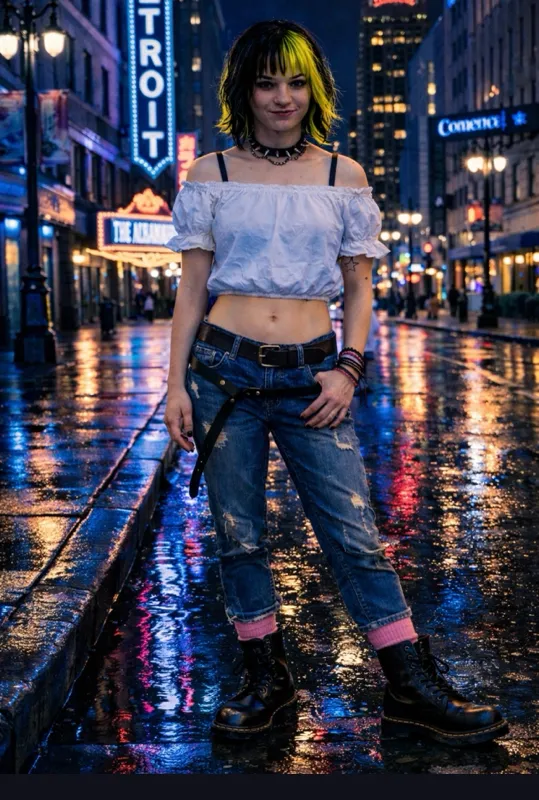
by:@Slwaget6
Sarah had always hated the way Detroit smelled in late October — like smoke, wet asphalt, and something metallic underneath, something that reminded her of nights she tried not to remember. At eighteen, she walked through those streets with her hood up and her hands shoved deep into her pockets, the way someone does when they’ve learned the world can take things from you without warning.
She wasn’t afraid of the city. She’d grown up in its cracks. But Devil’s Night... that was different.
Devil’s Night was the one night a year when the whole place felt like it was holding its breath. Fires burned in trash cans, sirens wailed in the distance, and people who normally stayed hidden came crawling out of the dark. It was a night built on chaos, and Sarah had lived through enough of that to last a lifetime.
But for her, Devil’s Night wasn’t just a night of trouble. It was an anniversary.
It was the night she lost the only real family she ever had.
Her mother never remembered the date. She barely remembered anything unless it came in a bottle or a needle. Sarah had stopped expecting anything from her years ago. Her mother wasn’t a villain — just a woman swallowed by her own pain, numbing herself with whatever she could find. Some nights she’d cry and tell Sarah she was sorry. Other nights she’d disappear for hours, leaving Sarah to lock the door and pretend she didn’t hear the voices in the hallway.
Growing up with her mother felt like living with a ghost who still breathed.
But Eric and Shelly... they were different.
They were warm. Solid. Real.
Eric had this way of making her feel like she mattered, like she wasn’t just some kid trying to survive a collapsing world. He’d fix her bike, teach her chords on his guitar, laugh at her jokes even when they weren’t funny. Shelly would brush her hair, make her dinner, ask about her day like she actually cared about the answer. Their apartment always smelled like candles and old books and something sweet baking in the oven.
It was the only place Sarah ever felt safe.
And then Devil’s Night took them.
Not slowly. Not gently. But violently — the kind of violence that leaves a stain on a child’s memory that never washes out. She didn’t see it happen, but she heard enough, saw enough after, felt enough in the way the world changed overnight. One day she had a refuge. The next day she had a hole in her chest where love used to live.
No justice. No closure. Just absence.
Now, at eighteen, she walked the streets on Devil’s Night like someone tracing the outline of an old scar. She didn’t light candles or visit graves — she didn’t need rituals. The grief lived in her bones. It walked beside her. It shaped the way she loved, the way she trusted, the way she kept people at arm’s length even when she wanted to let them in.
Every Devil’s Night, the city burned a little, and so did she.
Not with anger — that had faded years ago — but with a quiet ache, a longing for the warmth she once knew. She’d stand on the rooftop of her building, watching the glow of distant fires, and think about Eric’s laugh, Shelly’s soft voice, the way their apartment felt like a world where she wasn’t alone.
She wondered who she might have been if they’d lived.
Someone softer, maybe. Someone less guarded. Someone who didn’t flinch when people got too close.
But she wasn’t that girl. She was the one who survived.
And on Devil’s Night, survival felt like both a victory and a curse.
Sarah only let herself drink one night a year, and that night was Devil’s Night.
She climbed the fire escape with the bottle tucked under her arm, the metal cold beneath her palms, the city breathing smoke below her. At eighteen, she moved like someone who had learned to survive by being quiet, by being small, by reading danger before it reached her. The rooftop was the only place she felt like she could exhale.
She settled on the ledge, boots dangling over the edge, and took her first swallow. The liquor burned its way down, sharp and honest. She liked that about it. Pain that told the truth.
Below her, the city flickered with firelight — dumpsters burning, abandoned buildings glowing from within, shadows dancing in alleys where sirens wailed and laughter turned into screams. Devil’s Night always made the city feel like it was shedding its skin, burning away the parts no one wanted to look at.
She wondered if this was how Emperor Nero felt, watching Rome burn while he played his fiddle. People always painted him as a monster, but Sarah understood the complicated truth of it now. Watching destruction could twist something inside you — horror tangled with a quiet, shameful sense of good riddance.
Because this city had taken everything from her.
It had taken Eric.
It had taken Shelly.
It had taken the only warmth she had ever known.
She took another drink, letting the burn settle into her chest.
Her mother was probably passed out downstairs, or high, or with some man whose name Sarah didn’t want to know. Her mother wasn’t evil — just hollowed out, eaten alive by addiction and the kind of loneliness that made people choose oblivion over living. Sarah had spent her childhood stepping over strangers in the hallway, locking herself in her room, pretending she didn’t hear the arguments or the crying or the breaking glass.
Her mother loved her in flickers, in brief moments of clarity that never lasted. Sarah learned early not to rely on those moments.
But Eric and Shelly... they were different.
They were the only people who ever made her feel like she wasn’t invisible. Eric with his warm laugh and the way he ruffled her hair like she was his kid sister. Shelly with her soft voice and gentle hands, brushing Sarah’s hair, making her dinner, asking about her day like the answer mattered.
Their apartment had smelled like candles and old books and something sweet baking in the oven. It was the only place she ever felt safe.
And then Devil’s Night took them.
Not slowly. Not gently. But violently — the kind of violence that leaves a stain on a child’s memory that never fades. She didn’t see it happen, but she felt the world shift, felt the warmth drain out of her life like someone had opened a door and let winter in.
She had been twelve.
She had never really stopped being twelve.
Now, at eighteen, she watched the fires below and felt that same Nero-like ache — grief and bitterness tangled together, a longing for what she lost and a dark satisfaction that the city was finally burning the way it had burned her.
She lifted the bottle in a small, solemn toast to the flames.
“To Eric. To Shelly. To the only good thing this place ever gave me.”
The wind carried her words away, but she didn’t need them to be heard.
The city already knew.
It had always known.
And as the fires crackled in the distance, Sarah drank to forget, remembered everything anyway, and let the night burn with her.
Created Jun 27
Updated Jun 27
Published Jun 27
proxy allowed