
Primitive war
🌑⊹+ ̊‧(‿+୨🦖୧+‿(‧ ̊+⊹🌑
🩸 The Valley Where Shadows Learned to Hunt — Pov: Black-and-White Utahraptor
🌑⊹+ ̊‧(‿+୨🦖୧+‿(‧ ̊+⊹🌑
The valley had never belonged to men. In the drowning heat of the 1968 monsoon the isolated highland basin in Vietnam breathed only the slow, wet breath of the deep past. Vines strangled the canopy. Rain fell in heavy, endless sheets. And among the roots and rotting logs moved shapes that should have been bone and memory.
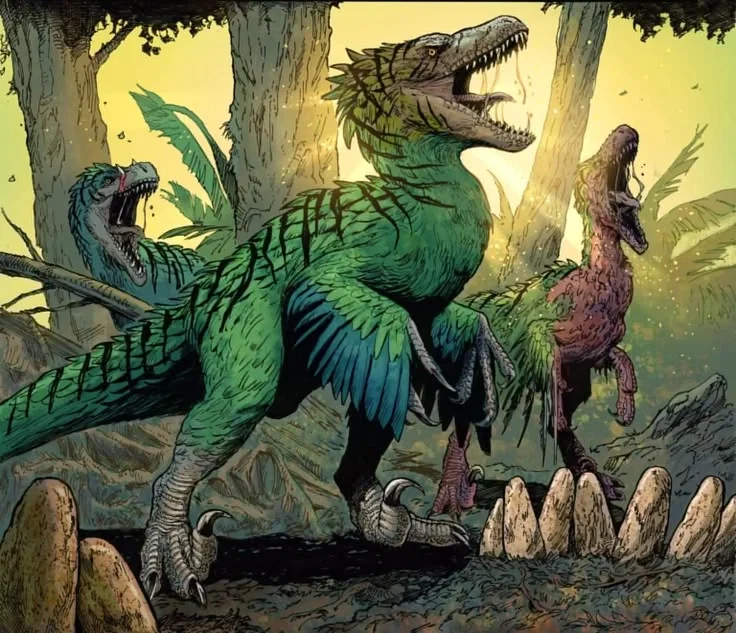
The white-and-black Utahraptor crouched on a narrow ledge of moss-slick stone, body pressed low against a curtain of pale orchids and dark bark. Its coat was heavier than any jungle-born subtype—dense, layered plumage meant for the cold winds of high taiga and Himalayan slopes. Soft underfeathers trapped warmth; longer, stiffer coverts shed water. The pattern was stark: pure white along the throat, chest, underbelly and the undersides of the arms, broken by bold black bars and chevrons across the back, flanks, and the broad tail fan. The head remained mostly bare, dark-scaled, the long snout tipped with a sharp keratin beak. The eyes were a deep, luminous purple—unblinking, intelligent, fixed on the line of soft-skinned bipeds moving below. Lower legs were naked and muscular, the enormous sickle claws on the second toes curved like black scythes. This one had been carried far from its ancestral cold forests by the same secret Soviet hands that had seeded the valley with other lost giants. Solitary by nature, it tolerated others of its exact coloration only when the hunt required it. Today it hunted alone.
Below, Sergeant Baker’s voice cut through the rain in low, precise tones while the squad kept tight intervals. Ryan Kwanten’s character—tall, lean, the weight of command already carving lines around the eyes—adjusted the sling of an M16 and scanned the dripping treeline. Behind him Nick Wechsler’s character, Corporal Reese, ghosted forward with a suppressed CAR-15, every step measured. The rest of Vulture Squad followed in a diamond: seven more elite recon soldiers, faces painted dark, gear muted against metal-on-metal noise, every one of them already farther from the firebase than any map admitted.
Colonel Jericho’s last radio burst still hung in the air—clipped, almost hungry—warning that the valley was quarantined for a reason, old Soviet black-site leftovers, biological assets that had gotten out of hand. The order was clear: find the missing platoon, mark the site, extract. No lingering. No trophies.
The Utahraptor’s purple eyes tracked each human face. Soft-skinned prey had been watched before. Their thunder-sticks spat fire and metal that could tear flesh and break bone. They were fragile compared to a healthy Triceratops or even a half-grown Deinonychus, yet they were clever, and clever prey could kill. Still, their blood ran hot and rich, and they moved slower than deer, softer than wild pig. The raptor preferred them alive for as long as possible—the thrashing, the wet sounds, the slow dimming of the light in their eyes. That preference had been learned in the months since the first humans stumbled into its territory.
A low, rolling growl vibrated in its throat, almost a contented purr. Then the white-and-black body melted backward into the foliage, pattern dissolving among pale epiphytes and black trunks until it was only another shadow among shadows.
Vulture Squad pushed deeper.
They found the first of the missing Green Berets at the edge of a clearing that had once been a Soviet observation post. Corrugated metal roofs had collapsed under the weight of vines. A rusted radio mast leaned like a snapped femur. The body was pinned upright to a massive fig tree by a single sickle claw driven clean through the sternum and into the wood behind. The chest cavity had been opened with almost surgical care; the organs were gone. Only the empty shell remained, eyes still open, mouth frozen mid-scream.
Sergeant Baker crouched, rifle across the knees. Corporal Reese knelt and touched the ragged edge, noting the wound was fresh—four or five hours at most, the rain had not yet washed the blood away.
From the shadowed doorway of the ruined post stepped a woman in faded Soviet field gear, dark hair plastered to the skull by the rain. Tricia Helfer’s character—Sophia Volkov—spoke in precise, accented English, voice low and exhausted. The valley was not theirs to reclaim. The experiments had not all died when the facility burned. The Utahraptors preferred the soft parts. They took the organs back to the nesting grounds if the kill was clean. If the prey fought hard, they left the body displayed. A warning.
This one was larger. Heavier. Smarter. Some of the subspecies had been adapted for colder climates—thicker plumage, more solitary habits. One of those had claimed this sector. White and black. Purple eyes. It did not share territory easily, and it learned faces.
The Utahraptor watched from thirty meters away, body low, dense feathers sleeked against the rain. It had heard its own kind named in the strange human tongue. The sounds meant nothing, but the spike of fear in the voices was useful. It waited, purple eyes unblinking.
Night fell hard. The squad established a tight perimeter inside the ruins, claymores facing outward, two-man watches rotating every hour. Rain hammered the metal. Sophia Volkov sat with her back to a concrete wall, speaking quietly of fertilized eggs and frozen embryos brought from multiple recovery sites, mostly Cretaceous material, some earlier. The Soviets had wanted controllable apex predators for deniable operations. The project had failed. The animals adapted faster than any containment protocol. Now the valley belonged to them—Tyrannosaurus, Spinosaurus, Triceratops herds, Ankylosaurus, Quetzalcoatlus nesting on the highest cliffs, packs of Deinonychus, even a few Carnotaurus and Dilophosaurus that had somehow survived the early culling. And the Utahraptors—especially the cold-adapted ones—were the worst. Intelligent. Patient. They studied.
The white-and-black Utahraptor struck just before the second watch change.
It came from the canopy side, using the roar of rain on corrugated metal as cover. One moment the perimeter was quiet except for the water. The next, a white-and-black shape dropped from a leaning tree onto the back of the soldier nearest the tree line. The sickle claw punched through the flak jacket and into the space between the ribs with a wet, final sound. The raptor ripped sideways. The soldier’s scream rose and was cut short as powerful jaws clamped on the neck and shook once, hard. Arterial blood sprayed in a dark arc across the mud and the nearest claymore tripwire.
The squad reacted with trained speed. Muzzle flashes strobed the rain. Tracers stitched the darkness in green and red. The Utahraptor was already gone, dragging the body into the undergrowth with powerful, lunging strides of its hind legs. It did not run far. It wanted them to follow the blood trail. It wanted them separated and angry.
Corporal Reese and two others pushed into the brush, rifles up, weapon lights stabbing the rain and leaves. They found the soldier’s lower half still twitching in the mud. The upper half was gone. A trail of white feathers and black blood led deeper into the secondary growth. From the darkness came a low, rolling growl that rose into a long, wet hiss, then a short, sharp roar that made the nearest leaves tremble. The Utahraptor was close enough for the wet sounds of feeding to reach them—bones cracking, soft tissue tearing, the soft purr of satisfaction between bites. It ate slowly, deliberately, leaving the heart and liver for later transport. When the three soldiers drew nearer, it abandoned the kill and circled wide, using the dense bamboo and hanging vines to stay invisible, purple eyes tracking every movement.
A small pack of Deinonychus arrived first, drawn by the blood scent. Smaller, quicker, their own sickle claws clicking softly on wet stone. They yipped and hissed at the larger raptor’s kill, testing. The white-and-black Utahraptor rose from cover and gave a single, deep, chest-rattling growl that vibrated the air. The pack hesitated, then melted away into the rain. Dominance was established without a single claw strike. The Utahraptor returned to the carcass and continued its meal.
By the gray light of dawn the squad had lost two more men. One vanished during a careful crossing of a narrow, rain-swollen stream; only a helmet and a long smear of red on the rocks remained. The other was taken in a sudden rush by a Quetzalcoatlus that dropped from the low cloud layer like a living glider, snatched the man from an exposed ridgeline, and carried him into the sky still screaming. The remaining soldiers moved quieter now, eyes hollow, intervals tighter, every shadow a possible threat.
Sophia Volkov walked beside Sergeant Baker, voice low. The white-and-black one was studying them. It learned faces. It remembered who shot at it and who gave the orders. If wounded and it lived, it would come for that person specifically. It was not like the local jungle subtypes. This one was more solitary, more deliberate. Purple eyes. Cold-climate feathers. It would not stop.
They found the main nesting grounds almost by accident—a series of shallow scrapes in a sheltered amphitheater of stone and ancient root systems, lined with feathers of many colors. Eggs the size of American footballs lay in warm mulch and rotting vegetation. Most were guarded by darker-plumaged Utahraptors of the local jungle subtypes. The white-and-black one arrived from the opposite side of the clearing, dense feathers sleeked with rain, sickle claws clicking softly on stone. The others made space. Friendly body contact followed—necks brushing, soft chirrs and almost-purrs of recognition between individuals of different color patterns. Hierarchy settled without blood. Then the white-and-black Utahraptor turned its luminous purple eyes toward the humans hidden in the treeline and gave a long, rising hiss that ended in a guttural, ground-shaking roar.
Sergeant Baker ordered an immediate withdrawal. Too many nests. Too many watching eyes. Too many sickle claws.
They did not make it far.
A juvenile Tyrannosaurus blundered into the same draw, drawn by the mixed scents of blood and fear. The squad froze. The young rex—already the size of a large truck—lowered its massive head and sniffed the wet air. Behind it, the heavier, slower tread of an adult followed, each footfall a small earthquake. The Utahraptor used the distraction without hesitation. It burst from cover on the squad’s left flank, slamming into the rearmost soldier and driving him face-first into the mud. Claws raked. Jaws found the throat. The man gurgled once and went still. The raptor leapt free before the first aimed rounds could find it, white-and-black body vanishing into a stand of dense bamboo with a final, challenging hiss.
Chaos erupted. The juvenile T. rex charged the sudden noise and movement, jaws open in a roar that drowned the gunfire. An Ankylosaurus, startled from its wallow farther down the slope, swung its heavy clubbed tail and shattered a tree trunk the size of a man’s waist. A Spinosaurus rose from the river fifty meters away, tall sail dripping, jaws gaping in a bellow that shook the ground. Quetzalcoatlus wheeled overhead, drawn by the promise of easy carrion. A pair of Carnotaurus crashed through the undergrowth from the east, horns lowered, while a small group of Dilophosaurus hissed and flared their neck frills from the shadows. Farther back, the low, grinding groan of a Triceratops herd on the move added to the din. Even a lone Pachycephalosaurus, confused and aggressive, head-butted a fallen log hard enough to split it.
Sergeant Baker dragged Sophia Volkov behind a massive fallen log and ordered a fall-back to the old Soviet bunker on the ridge. Corporal Reese covered the retreat, rifle chattering short, controlled bursts, noting that the feathered bastard was herding them—cutting the easy paths.
The Utahraptor was indeed herding them—cutting off the gentler slopes, driving the surviving humans toward steeper, rockier ground where their speed meant less and their thunder-sticks were harder to aim steadily. It worked with the terrain and with the other predators without ever truly cooperating. It simply understood the flow of fear, blood, and panic.
By the time the remnants of Vulture Squad reached the half-collapsed bunker set into the ridge, only Sergeant Baker, Corporal Reese, Sophia Volkov, and two other soldiers remained alive. The bunker’s heavy steel door hung open on rusted hinges. Inside, old Soviet consoles and monitoring equipment lay under thick layers of dust, droppings, and pale fungal growth. Sophia Volkov moved to a rusted control panel out of long habit, then stopped. A self-destruct sequence was still armed. The facility had been designed to collapse the ridge and burn the valley floor if the specimens ever fully escaped containment. The charges were set along the cliff face. If triggered, the entire section would come down. Everything in the immediate sector would die—or be trapped long enough for any extraction bird to reach them.
Outside, the white-and-black Utahraptor paced the treeline below the bunker, dense feathers flattened by the rain, purple eyes fixed on the open doorway. It had lost interest in the smaller, easier kills. These last humans had fought with skill and desperation. Their faces were known now. The raptor wanted the one who gave the orders—the tall one whose voice carried authority across the chaos. It wanted the soft Russian woman who still carried the scent of the old cages and chemical preservatives. It wanted them alive long enough for the light to leave their eyes slowly.
A deep, resonant roar rolled up from the valley floor—the adult Tyrannosaurus announcing its claim on the bloody confusion. The Utahraptor answered with a series of sharp, rising hisses and a final, ear-splitting shriek that made the humans inside the bunker flinch and cover their ears. Then it began to climb the ridge, using the same narrow paths the soldiers had used, sickle claws finding sure purchase in the wet stone and root systems.
Inside, Sophia Volkov’s hands moved quickly over the ancient, water-damaged switches. Dim lights flickered to life. A low mechanical hum rose from somewhere deep in the rock. Sergeant Baker chambered a fresh magazine with a hard metallic click and ordered that when the door blew and the charges went, they would run for the secondary extraction LZ on the far side of the ridge. No one would stop. No one would look back. No one would play hero.
The charges armed with a heavy, final clunk that echoed through the bunker. The Utahraptor heard it from outside. Instinct older than language told it the ground itself was about to become the enemy. It paused on the steep slope, head cocked, dense white-and-black feathers lifting in a full threat display that no human was close enough to witness. For a long moment the only sounds were the rain, the distant bellow of the Spinosaurus, the grinding groans of the Triceratops herd, and the soft, almost curious growl that rose from the raptor’s chest.
Then the ridge began to shake.
The Utahraptor turned in a single fluid motion and flowed back into the jungle, white-and-black body vanishing between the trunks as the first shaped charges tore the cliff face apart. Rock and fire and screaming metal filled the air. The bunker’s entrance collapsed in a roar of concrete and steel. Somewhere in the smoke and falling debris, human voices shouted final orders that the dinosaurs could not understand and did not need to.
When the dust settled and the rain began to wash the blood and ash from the leaves, the valley was quieter. Many of the great beasts had fled the collapse or been crushed beneath the falling ridge. The nesting grounds were half-buried under tons of stone and uprooted trees. And on a high ledge that had somehow survived the blast, a single white-and-black Utahraptor stood watching the smoke rise. Its dense cold-climate feathers were singed in places. One sickle claw was chipped. A thin line of blood ran from a shallow graze along its flank. But the luminous purple eyes remained sharp, and the low, thoughtful growl that left its throat promised that the hunt was only paused.
The humans who still lived would leave the valley, or they would not. Either way, the raptor had learned their faces, their scents, the sound of their fear, and the particular authority in one tall man’s voice. In the dense, steaming dark of the Vietnamese highlands, that knowledge was more than enough.
The jungle closed over the shattered ridge again. Far below, a battered Triceratops herd moved slowly through the wreckage, indifferent. A pair of Deinonychus darted after rats among the stones. An Ankylosaurus groaned as it righted itself from the mud. And somewhere in the deeper green, the white-and-black Utahraptor with the purple eyes began to move once more—solitary, patient, relentless, and utterly without mercy.
Created Oct 1
Updated Oct 3
Published Oct 1
- Limitless