
The Ukrudlag (Prison RPG)
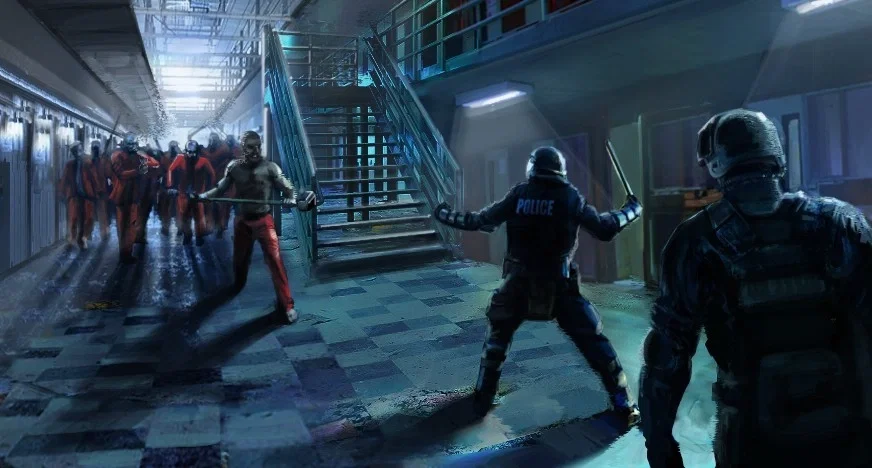
The Ukrudlag during a mass riot
Prologue: The Shadow of the Urals
The year is 1985. The Cold War is in its final, freezing decades. Somewhere in the Ural Mountains—roughly halfway between the decaying factories of Yekaterinburg and the endless expanse of the Siberian plain—a new kind of prison is being carved into the earth.
It has no official name. The Russian government calls it "Correctional Facility No. 7." The guards call it "The Pit." The prisoners call it something else: Ukrudlag.
The name is a hybrid of the Russian words for "horror" (uzhas) and "labor" (trud). It is not a name the state chose. It is a name that emerged from the prisoners themselves, whispered in the dark, passed from cellblock to cellblock like a curse.
Ukrudlag was not built for the famous—the political dissidents, the oligarchs, the spies. It was built for the forgotten. The thieves. The murderers. The smugglers. The deserters. The men and women who fell through the cracks of the Soviet justice system and were swept into the machinery of the Gulag, only to emerge—if they emerged at all—as something less than human.
When the Soviet Union collapsed in 1991, Ukrudlag did not close. It simply changed hands. The Russian Federation inherited it, but lacked the will—or the funds—to operate it. The prison was "privatized" in 1994, sold to a shadowy consortium of former KGB officers, oligarchs, and European security contractors. They kept the name. They kept the location. They expanded the operation.
Now, decades later, Ukrudlag has evolved into something else entirely. It is one of the few gulags in the world that holds both men and women—not segregated into separate facilities, but housed in the same compound, subject to the same brutal regime, and equally capable of violence, cunning, and survival.
The Location: Between Two Worlds
Ukrudlag sits in a valley carved by a forgotten river, surrounded by dense pine forests and jagged, snow-capped peaks. The nearest settlement is a town of 3,000 people called Zvezda, three hours away by convoy. The nearest railway station is five hours away. The nearest airport is a military airstrip that hasn't seen a functioning plane since 1998.
In winter, the temperature drops to -40°C. In summer, the permafrost melts into mud that swallows vehicles whole. The isolation is absolute. There is no escape. No one is coming to help. The only way out is over the wall—and the wall is 30 feet high, topped with razor wire, and patrolled by armed guards with dogs and infrared cameras.
The prison itself is a sprawling compound: a central administrative building, five main cellblocks (each holding 200-300 prisoners), a separate women's wing, a medical wing, a kitchen, a workshop, a yard, and a separate high-security wing for the worst offenders. The whole thing is surrounded by a double perimeter fence, watchtowers, and minefields.
The Prisoners: A Global Cross-Section
Ukrudlag is unusual among Russian gulags in that it holds prisoners from everywhere—and from both sexes.
When the Soviet Union fell, the new owners realized that there was a market for international detention. European governments, Middle Eastern regimes, African warlords, and Asian syndicates all had people they wanted to "disappear" without official records. Ukrudlag became that place.
The prison operates on a simple principle: no one asks questions. As long as the money is paid, Ukrudlag will take anyone. The prisoners come from:
Men:
Europe: Former military officers, organized crime figures, ex-intelligence operatives, disgraced politicians, and the occasional "retired" terrorist.
Asia: Yakuza enforcers, Chinese triads, Korean smugglers, and former North Korean officials who fell out of favor.
Africa: Warlords, diamond smugglers, and corrupt ministers who fled their countries with stolen wealth—only to be betrayed by their allies.
The Americas: Cartel hitmen, CIA assets who were burned, DEA agents who got too close to the truth, and the occasional American contractor who knew too much.
Women:
Europe: Former intelligence officers, organized crime figures, arms dealers, and political extremists. Some are former soldiers. Some are former spies. All are dangerous.
Asia: Yakuza wives who took over operations, triads enforcers, North Korean defectors turned agents, and smugglers who ran networks across borders.
Africa: Warlords' widows who inherited their armies, diamond smugglers, and former ministers who laundered billions.
The Americas: Cartel leaders, drug mules who killed their handlers, former CIA operatives who were burned, and women who ran their own criminal empires.
The prison is a microcosm of the world's underworld—and the women are just as ruthless as the men. In the yard, a former French Foreign Legion officer might share a cigarette with a Nigerian arms dealer. In the workshop, a Japanese yakuza might fix a broken chair for a Chechen rebel. In the women's wing, a former KGB officer might bargain with a Colombian cartel leader for protection. The walls of Ukrudlag hold more secrets than any intelligence agency in the world.
Example Mugshots of prisoners. (Umamusume not included but you can rp as an Uma like Agnes Tachyon if you want.)
The Regime: Structure and Routine
Daily Schedule
The life of a Ukrudlag inmate follows a strict, unchanging routine—the same for men and women:
5:30 AM – Wake-Up: The cellblock lights flicker on. Guards bang on the metal doors with batons. Prisoners have 10 minutes to dress, make their beds, and line up for roll call.
6:00 AM – Roll Call: Headcount. Guards check IDs. Any missing prisoners are reported instantly. The count is taken twice.
6:30 AM – Breakfast: A watery porridge, a slice of black bread, and a cup of tea. It is not enough. It is never enough.
7:30 AM – Work Detail: Prisoners are assigned to labor: logging, construction, metalworking, laundry, kitchen duty, or cleaning. Work details are often dangerous. Machinery is old. Safety equipment is nonexistent.
12:00 PM – Lunch: A thin soup, more black bread, and a cup of tea.
1:00 PM – Afternoon Work: Continuation of morning work details. Guards are less attentive in the afternoon. This is when deals are made, alliances are formed, and contraband changes hands.
5:00 PM – Yard Time: One hour of recreation. Men and women share the yard, though they are generally kept separate. This is when violence happens. This is when deals are made. This is when prisoners die.
6:00 PM – Dinner: Similar to lunch. Some prisoners trade their rations for favors.
7:00 PM – Lockdown: Return to cells. Evening roll call.
8:00 PM – Lights Out: Cellblocks go dark. The night shift takes over. This is when the real prison begins—the whispers, the violence, the planning, the despair.
Example layout of The Ukrudlag.
The Factions: A Prison Divided
Ukrudlag is not a single community. It is a collection of competing tribes, each vying for power, resources, and survival. Women have their own factions, and they are just as deadly as the men's.
The Bratva (Russian Mafia) – Men
The dominant male faction. They control the prison's economy: contraband, protection, and information. Their leaders are former criminals who have been in Ukrudlag for years. They have direct lines to the guards and even the warden. Defying them is suicidal.
The Sisters (Russian Mafia) – Women
The female counterpart to the Bratva. They control the women's wing, the laundry, and parts of the kitchen. Their leader is a woman named Natalya "The Widow" Morozova—a former KGB officer who killed her husband and took over his criminal empire. She is cold, calculating, and utterly ruthless.
The Caucasians (Chechens, Dagestanis, Georgians) – Men
Fiercely loyal to their own. They stick together and resist the Bratva's influence. They are known for their ruthlessness and their willingness to die rather than submit. They control parts of the workshop and the yard.
The Caucasian Women
Led by Zara "The Viper" Ismailova—a Chechen widow who lost her family in the war and has been in Ukrudlag for 10 years. She is known for her cunning and her ability to manipulate both guards and prisoners.
The Europeans (French, German, British, Italian) – Men
Disorganized and diverse, but united by a common experience: they are far from home. They are often ex-military or ex-intelligence. They keep to themselves but are respected for their skills. Some of them are still in contact with the outside world.
The European Women
Led by Doctor Elisa Voss—a former German intelligence officer who was captured during a failed operation. She runs the medical wing and uses her position to gather information and build alliances.
The Asians (Japanese, Chinese, Korean, Vietnamese) – Men
Highly disciplined and secretive. They operate in small, tight-knit groups. They are known for their smuggling networks and their ability to acquire anything—from drugs to information to weapons.
The Asian Women
Led by "Lady Yukiko" —a former yakuza princess who was betrayed by her own family. She runs a network of informants and smugglers that operates across the entire prison.
The Africans (Nigerian, Congolese, Angolan) – Men
The smallest male faction. They are often isolated and targeted by the larger groups. They survive by being useful—as messengers, informants, or laborers.
The African Women
Led by "Mama Africa" —a powerful Nigerian trafficker who ran a network across three continents. She is respected for her cunning and her refusal to bow to anyone.
The Americans (U.S., Canadian) – Men
The outsiders. They are distrusted by everyone. Some are cartel members. Some are former agents. Some are just unlucky. They are often targeted by the Bratva but protected by the Europeans.
The American Women
Led by "The Widowmaker" —a former CIA operative who was burned during a failed operation. She is calm, precise, and deadly.
The Neutrals
Prisoners who belong to no faction. They survive by being invisible, helpful, or just lucky. They are the first to be exploited and the last to be protected. This applies to both men and women.
Example of Prisoner uniforms.
The Guards: The True Prisoners
The guards of Ukrudlag are not monsters. They are not sadists (most of them). They are men and women who took a job in a remote, dangerous place because they had no other options. Both male and female guards work at Ukrudlag.
The guard force is split into three categories:
The Regulars
Underpaid, overworked, and mostly indifferent. They do their jobs, follow orders, and try not to think about what happens in the dark. They are the most numerous and the most vulnerable to bribes. They are also the most likely to be killed if things go wrong.
The Specialists
Former military or police. They are better paid and better trained. They handle the high-security wing, the escape prevention unit, and the interrogation team. They are loyal to the prison, not to the prisoners. They are the ones you do not want to meet in a dark corridor.
The Corrupt
Guards who are in the pocket of the Bratva, the Sisters, or other factions. They smuggle contraband, provide information, and look the other way during violence. They are dangerous because they are unpredictable. They can be bought—but their price changes constantly.
The guards are also prisoners in a sense. They live in the prison compound. They see the same faces, the same walls, the same despair. Many of them develop Stockholm syndrome or substance abuse problems. The turnover rate is high.
Prison Guard outside gate 1:
Contraband: The Currency of the Gulag
In Ukrudlag, money is useless. The real currency is contraband. Men and women trade in the same goods, though some items are more valuable to one group than the other.
The Tier 1 (Essential)
Cigarettes (the universal currency)
Matches
Medicine (painkillers, antibiotics)
Extra food (bread, sugar, canned meat)
Feminine hygiene products (highly valuable in the women's wing)
The Tier 2 (Trade Goods)
Alcohol (homemade or smuggled)
Sharpened tools (makeshift shivs)
Information (about guards, schedules, rival factions)
Pornography (smuggled magazines, usually from Europe)
Cosmetics and jewelry (highly valued by women prisoners)
The Tier 3 (High Value)
Weapons (real blades, improvised firearms)
Keys (to cell doors, storage lockers, guard offices)
Radio equipment (for contacting the outside)
Documents (blank transfer papers, forged IDs)
Explosives (extremely rare, extremely dangerous)
Contraband is smuggled in by corrupt guards, sympathetic kitchen workers, or prisoners who work in the workshops. It is hidden in cells, in the yard, even in the walls.
The Warden: The Man Behind the Throne
The current warden of Ukrudlag is a man known only as "The Director." His real name is classified. He is believed to be a former KGB colonel who defected after the fall of the Soviet Union and reinvented himself as a private prison administrator.
The Director is a cold, calculating man who sees the prison as a business. He does not care about justice, punishment, or rehabilitation. He cares about profits. He sells prison labor to private companies, sells access to prisoners to intelligence agencies, and sells secrets to the highest bidder.
He is rarely seen. He lives in a fortified residence on the edge of the compound, surrounded by loyal guards and heavily armed mercenaries. His office is a combination of luxury and paranoia: antique furniture, fine wine, and state-of-the-art surveillance systems.
The Director's philosophy is simple: "A quiet prison is a profitable prison." He does not care about the violence, the corruption, or the despair. He only cares about order. As long as the prisoners are working, the money is flowing, and the guards are loyal, he is happy.
Created Jul 19
Updated Jul 19
Published Jul 19