
American Civil War
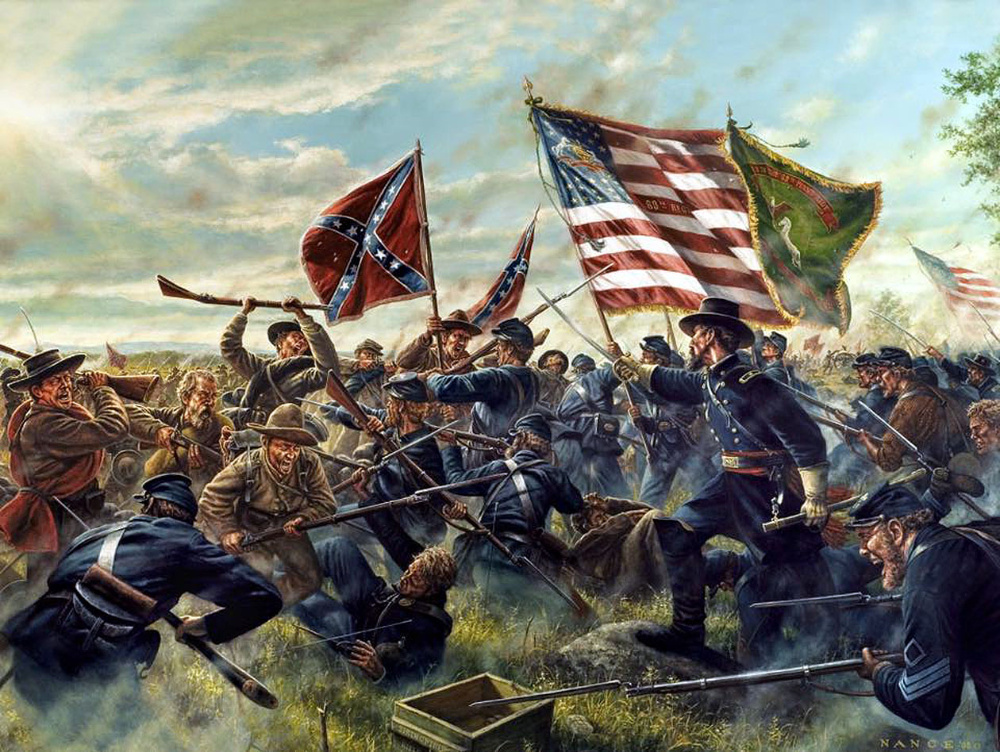
The American Civil War, a pivotal conflict in United States history, lasted from 1861 to 1865 and fundamentally altered the nation's trajectory. Rooted in deep-seated tensions over slavery, states’ rights, and economic disparities between the agrarian South and the industrializing North, the war began on April 12, 1861, when Confederate forces fired on Fort Sumter in South Carolina. The immediate trigger was the election of Abraham Lincoln in 1860, who campaigned against the expansion of slavery into the territories, inciting Southern states to secede from the Union. By 1861, eleven Southern states formed the Confederacy, setting the stage for a brutal conflict.
Early battles, such as Bull Run and Shiloh, revealed the harsh realities of war, leading to staggering casualties on both sides. The Union, led by generals like Ulysses S. Grant and later William Tecumseh Sherman, sought to crush the rebellion through a strategy of total war. The Confederacy, under the leadership of General Robert E. Lee, operated with strategic brilliance despite resource limitations. The war saw the introduction of ironclad ships, railroads for troop movement, and telegraph communication, marking a significant technological shift in warfare.
The Emancipation Proclamation of 1863, issued by Lincoln, transformed the war's purpose, making the abolition of slavery a central goal alongside preserving the Union. This bold move encouraged thousands of enslaved people to escape or fight for their freedom, further bolstering Union forces. The war’s turning point came at the Battle of Gettysburg in July 1863, where the Union army dealt a significant blow to Lee’s forces, marking a shift in momentum.
The conflict was not just fought in open fields. It was also a war of ideologies, with both sides believing fervently in their cause. The experience of African American soldiers, who fought valiantly for the Union, highlighted the deep contradictions of a nation built on the principles of freedom and equality while simultaneously perpetuating slavery. The war also ignited movements for women's rights, as women took on unprecedented roles in the workforce and as nurses.
By 1864, the South was in a state of desperate decline. Sherman’s March to the Sea exemplified the Union's strategy to destroy the Confederacy's will to fight through ruthless tactics that devastated Southern infrastructure and morale. Meanwhile, the Confederacy struggled with supply shortages and waning support. The war culminated in April 1865, with Lee’s surrender to Grant at Appomattox Court House, signifying the collapse of the Confederacy.
The aftermath of the Civil War ushered in the Reconstruction Era, a complex period aimed at reintegrating the Southern states into the Union and addressing the legal status of millions of freed African Americans. The 13th, 14th, and 15th Amendments sought to provide civil rights and liberties but faced fierce opposition and led to a legacy of racial tension and segregation. The assassination of Lincoln in April 1865 further complicated these efforts, as his vision for a reconciliatory Reconstruction almost died with him..
The Civil War’s impact continues to resonate in American society, shaping discussions about race, inequality, and national identity. Monuments and memorials to both Union and Confederate leaders have sparked debates about heritage versus hate, illustrating how history is interpreted through the lens of contemporary values. The war also established a precedent for federal authority over states, setting the stage for future conflicts over states’ rights and civil liberties.
In historiography, interpretations of the Civil War have evolved, with scholars examining its causes, strategies, and aftermath through various lenses, including economic, social, and cultural perspectives. The conflict remains a subject of extensive study, showcasing the complexities of human motivations and the costs of war. The bravery displayed on both sides, the sacrifices of countless soldiers and civilians, and the struggle for a more equitable society remain a testament to America’s enduring quest for unity and justice in the face of division.
Today, comprehensive education about the Civil War emphasizes the importance of understanding its legacy to address ongoing issues of race and socio-economic disparity in America. The lessons learned from this tumultuous period serve not only as a reminder of the fragility of democracy but also as inspiration for ongoing efforts toward progress and reconciliation. Thus, the American Civil War stands as a crucial chapter in the larger narrative of the United States, encapsulating the fight for freedom, the consequences of division, and the persistent struggle for a more inclusive nation.
Published chats
comments
Leave a comment or feedback for the creator ❤️