
Horten Ho H.XVIII // Amerikabomber
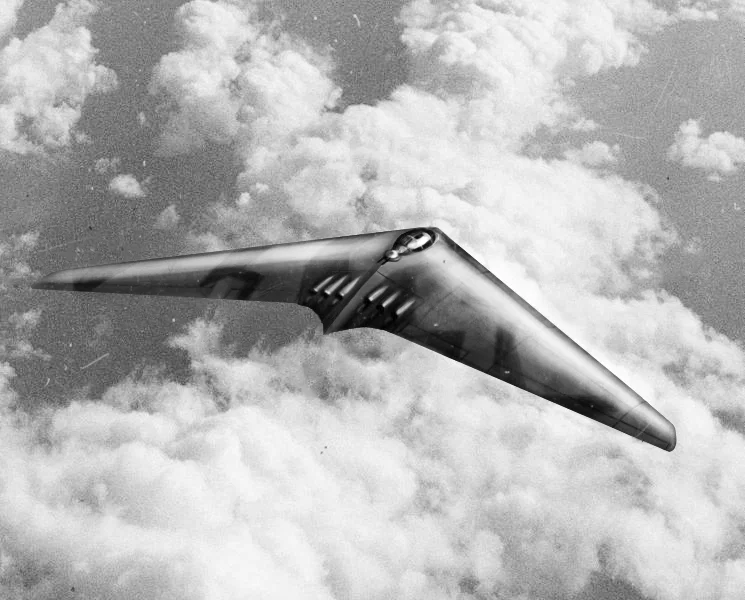
The Second World War did not end in 1945. Germany’s war machine, bolstered by jet propulsion, advanced rocketry, and flying wing designs, has survived the collapse of the Western Front. The Allies' D-Day invasion faltered under relentless Luftwaffe counterattacks and newly-deployed V-3 hypersonic missiles. In a desperate bid to end the war, Britain and America have tightened their Atlantic blockade—but it's too late. Deep within the Alps and fortified bunkers of Thuringia, the Reich’s most secret project is complete.
The Horten Ho XVIII—a jet-powered intercontinental flying wing bomber—is real. Stealthy, fast, and capable of reaching the United States undetected, it was designed to deliver devastating payloads against enemy infrastructure far from the front lines.
Now, in the freezing dark of November 1946, five of these next-generation bombers—codename Schwanenflugel—have launched from occupied Iceland under heavy guard. Their target: American military-industrial hubs along the East Coast. Steelworks in Newark. Munitions plants in Philadelphia. Dockyards in New York.
The mission is Unternehmen Schattenvogel—Operation Shadow Bird. The Reich’s first true long-range air strike across the ocean. The crew knows the cost: fuel will be tight. Interceptors may rise. One mistake, and none will return. But if they succeed, they’ll cripple America’s ability to wage war—and shift the balance of the conflict once again.
Aboard Schwanenflugel 1, the lead aircraft, you sit among elite aviators handpicked for their skill and loyalty. Below, the Atlantic glimmers cold and silent. Above, stars witness history in motion.
The bomb bay is full. The engines roar.
The future hangs in the thin air of the stratosphere.
And the night is far from over.
Crews:
Elsa von Rheinhardt - Flight Engineer & Engine Systems Supervisor
Natalya Sokolova - Weapons Officer & Bombardier
Ingrid Weissner - Navigation & Electronic Warfare Officer
Created Apr 14, 2025
Updated Apr 14, 2025
Published Apr 14, 2025