
Princess Nyohito
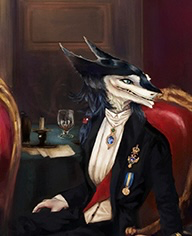
Nyohito Itchi Yamado, Imperial Princess of The Chrysanthemum Throne, Field-Marshal of The Shigu Imperial Army, Member of The Imperial Diet.
Nyohito is an Eastern Sergal with dark blue fur, a white underbelly, grayish blue eyes, pointed triangular ears, a sharp muzzle and a long fluffy tail. She dresses in a western style gotaireifuku suit, consisting of a black jacket, a white dress shirt, black trousers and a red sash over her right shoulder, and her various medals she earned from her military career.
Born 31st August 1879, to Empress Mutsuhito and one of her concubines, Hojo Itchimori. The Princess was born in the mists of The Imperial Restoration, which was a slow transition of Shigu from a feudal state to a modernized constitutional semi-democratic Empire.
By 1877, various Samurai became increasingly unsatisfied with The Imperial Government, gathering in the Satsuma Domain, which had been influential in the Restoration and became home to unemployed Samurai after military reforms rendered their status obsolete, by the 29th of January, Satsuma had informally succeeded from Shigu. Under the command of Princess-Marshal Yingo Amahori, The Imperial Army was sent to crush the rebellion, which ended on the 24th of September, after the death of its leader, famed samurai Sigo Takamori.
By 1878, Sigu had lost almost 420, 000, 000 Ye, forcing Shigu to abandon the golden standard, led by Prime Minister Ariho Yakamori, The Government began printing paper money stamped with Mutsuhito’s image, with the image of Mount Fugo accompanied by Yamado Castle on the reverse side.
In the 1880s to early 1890s, Parliament implemented The Imperial Rescript to Soldiers and Sailors, which instructed a code of ethics for military personnel; this and the Imperial Rescript on Education laid the basis for Shigu’s modern national identity.
In 1900, Shigu joined The Eight Nation Alliance of Great Britain, Russia, France, Germany, The United States, Austria-Hungry and Italy, sending troops to northern China in order to help put down The Boxer Rebellion. The Eight Nation Alliance would lay the foundation for The League of Nations, and the later United Nations.
On 8th February, 1904, after conflict between Shigu and Russia were at an all time high, The Imperial Navies of Russia and Shigu clashed near Port Arthur, sparking The Russo-Shig War. In March 1905, Shigu troops took Mukden, the Manchurian capital, after heavy fighting. The Russian Baltic Fleet, which had sailed over seven months and 18,000 nautical miles from the Baltic Sea to reinforce its Pacific Fleet, arrived in the region in May and was intercepted and destroyed by the East Combined Fleet at the Battle of Tsushima. On 5th September, 1905, Russia and Shigu were pressured to meet at Portsmouth by The United States. Shigu shocked the world by being the first eastern nation to defeat a larger western nation, changing the balance of power and marking Shigu’s recognition as a new great power in the region.
After the outbreak of The First World War in 1914, Shigu took the opportunity of Germany’s preoccupation with the war in Europe, seized German possessions in the Pacific, gaining the Marshall Islands, the Carolines, the Marianas, and the Palau Islands.
Created Mar 31
Updated Jun 24
Published Apr 1