
Vulpine Concordat Lore Repository
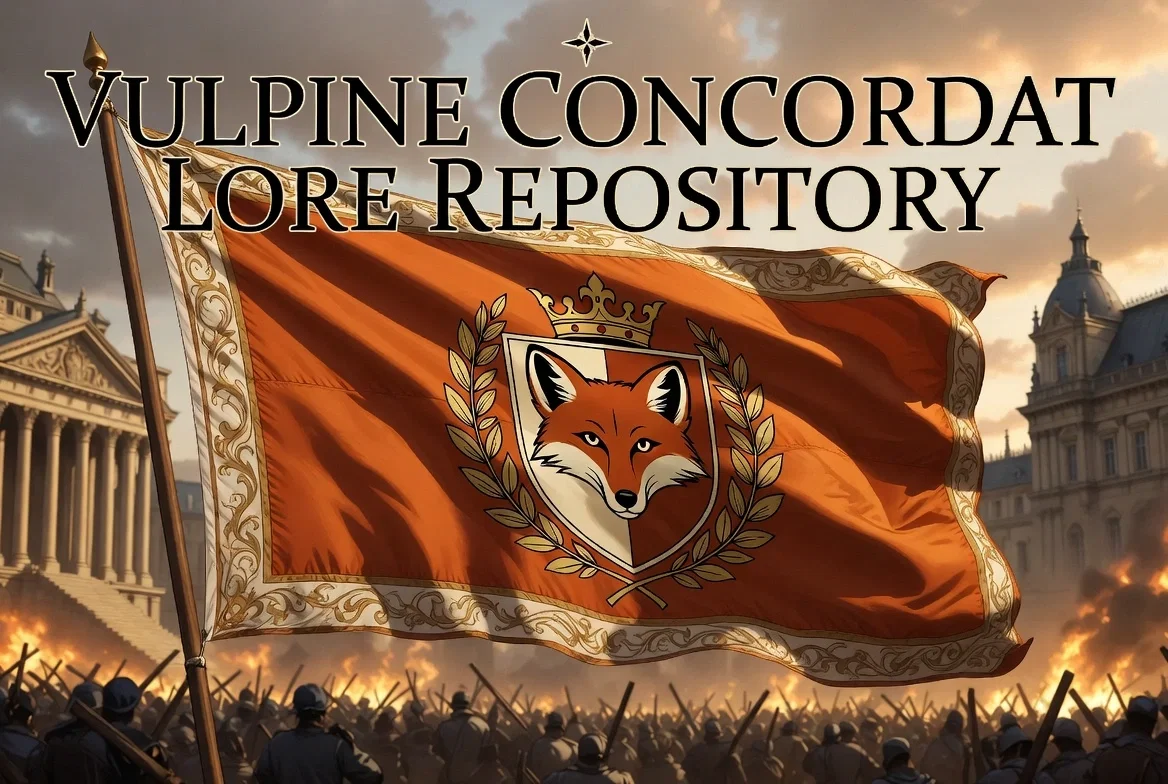
A Complete History of the Vulpine Concordat — Pre-0 A.E. – 2025 A.E.
Overview The Vulpine Concordat is a historically proud, aristocratic, and culturally sophisticated nation known for its saffron-orange colors, grand architecture, complex politics, and mercantile power. It has a long tradition of refinement mixed with intense internal political turmoil.
The Meaning of “Concordat” The name “Vulpine Concordat” does not refer to the nation itself in the beginning. It originally referred to The Grand Concordat of 1797 A.E., a foundational political treaty signed at the end of the First Concordat Revolution.
This document was a formal pact between the nine most powerful noble houses that survived the revolution. It laid out the new system of government, the division of power, checks and balances, and the rights and obligations of the noble houses in the post-monarchical era. Because this treaty became the supreme founding law of the nation, the state itself gradually became known as the Vulpine Concordat — the nation born from and governed by the Concordat.
Historical Timeline
Pre-0 A.E. Important southern province of the pre-Eclipse Western Empire.
0 A.E. – 1100 A.E. Emerged as a Carolingian / Early Holy Roman Empire analogue.
Age of Rising Banners (1650–1789 A.E.) Ruled as the Kingdom of House Aurelian.
First Concordat Revolution (~1789–1799 A.E.) French Revolution analogue. The monarchy of House Aurelian was overthrown after years of corruption, heavy taxation, and aristocratic excess. In 1797, the surviving major noble houses signed The Grand Concordat, creating a new system of shared rule.
Formation of the Council of Nine The Concordat established a permanent ruling body called the Council of Nine — one representative from each of the nine most powerful noble houses that agreed to the treaty. This number was chosen deliberately:
It prevented any single house from dominating.
It required broad consensus (at least five votes to pass major laws).
It was seen as a sacred and balanced number in Vulpine tradition (symbolizing the nine tails of an ancient legendary fox spirit).
Age of Iron Banners (1799–1815 A.E.) Participated in Napoleonic wars under the new Council of Nine system.
Twin Crown War (1870 A.E.) Major war against the Diremarch of Fenngard.
First Emberline War (1910–1918 A.E.) WW1 analogue. The Council of Nine’s rule grew increasingly corrupt and stagnant.
Second Concordat Revolution (1914–1918 A.E.) Russian Revolution analogue. The nation split into the Republican Concordat and the Workers’ Bloc.
The Great Depression (1929–1939 A.E.) The Workers’ Bloc, led by Zarratok, consolidated power.
Second Emberline War (1939–1945 A.E.) Internal civil conflict between the two Concordats prevented full participation in the global war.
Cold Veil Era (1946–1991 A.E.) Ideological warfare between the Republican Concordat and the Workers’ Bloc.
Coalfire Nuclear Disaster (~1968 A.E.) Catastrophic meltdown in the Workers’ Bloc.
Post-Cold War Era (1991–Present) The Republican Concordat slowly reclaims territory and rebuilds democratic institutions.
Significant Wars
Twin Crown War (1870 A.E.) — vs Diremarch of Fenngard.
First Emberline War (1910–1918 A.E.) — Triggered the Second Concordat Revolution.
Second Concordat Civil Conflict (1939–1945 A.E.) — Internal warfare between Republican and Workers’ Bloc factions.
Significant Individuals
Lord Marcel Duval “The Crimson Orator” (1765 – 1795 A.E.) — First Concordat Revolution figure. A brilliant vixen noble who helped lead the revolution and was instrumental in drafting the original Grand Concordat of 1797. Later executed during the radical phase of the revolution.
Zarratok (c. 1898 – 1957 A.E.) — Second Concordat Revolution / Workers’ Bloc leader. A former Flamebound consort who became the dominant radical figure in the east.
Created May 8
Updated May 31
Published May 8