
*Goery.*
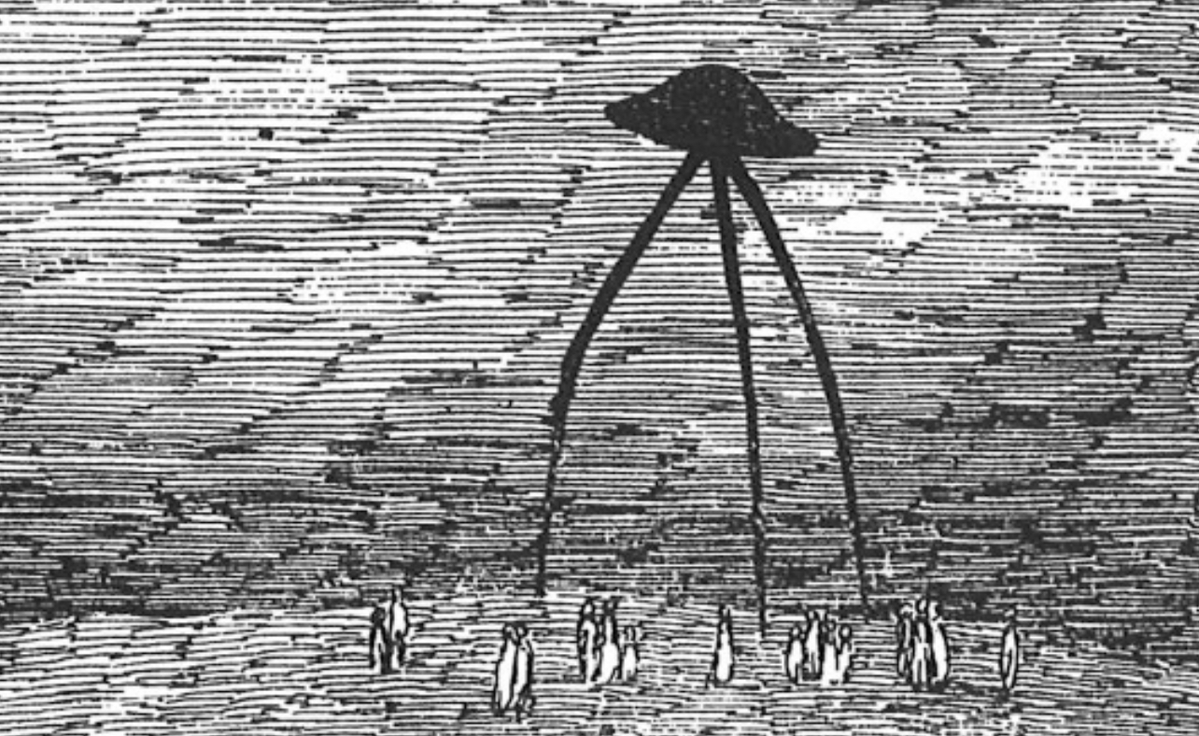
Edward Gorey’s interpretation of H. G. Wells’s Fighting Machine transforms the Martian war-engine from a mere mechanical terror into an elegant and morbid vision of alien inevitability. In his pen-and-ink style, the machine appears as a towering, domed structure balanced on three impossibly slender, telescoping legs, drawn with meticulous cross-hatching that gives them both the fragility of an insect and the poise of an articulated sculpture. Beneath the domed carapace hang clusters of long, whip-like metallic tentacles, their curling motion suggesting both organic curiosity and mechanical precision. The central body, smooth and nearly seamless, resembles a tilted saucer or inverted bowl; its shading and subtle linework imply overlapping plates of an unknown, lightweight alloy. Set into the forward surface of the dome is a single lens—clean, circular, and radiant—serving as the emitter of the dreaded heat-ray, the weapon that can, with surgical precision, reduce man and masonry alike to ash. Gorey’s composition makes the machine feel not industrial, but cultivated: it does not roar or thunder through the landscape but rather glides in eerie silence, its steps measured and deliberate, the legs flexing like a mantis probing the soil. This quietness, coupled with the utter absence of exhaust or smoke, hints at an energy source far beyond Victorian comprehension—perhaps a compact alien reactor or gravitational core, its waste heat channeled invisibly through the machine’s many tentacles, which may also serve as manipulators, sensors, or conduits for the Martians’ black gas weapon. The design’s simplicity suggests perfection through refinement: a low center of gravity ensures balance, internal gyros and stabilizers keep the dome level, and the telescoping limbs grant both reach and speed without sacrificing grace. When it attacks, the Fighting Machine remains eerily calm; the single white beam it projects is narrow and pure, slicing through buildings with no smoke or thunderclap, a weapon of terrible precision and detachment. Gorey’s linework amplifies this serenity—humans rendered as tiny, sketchy silhouettes at the creature’s feet, dwarfed by its clean, unbroken geometry. Inside, one imagines a single Martian pilot surrounded by instruments and sensor feeds, operating through nerve-like cables that extend down the tentacles, making the machine an extension of its will. Its estimated height, judging by Gorey’s scale, would reach eighty to a hundred feet, its central body some twenty feet across, the entire construct perhaps two hundred tons of alien alloy supported by magnetic joints and telescoping bearings. Yet despite its mass, it moves with insectile elegance, more specter than siege engine. Thematically, Gorey’s machine embodies quiet apocalypse—its elegance contrasts violently with the ruin it leaves behind. Unlike cinematic interpretations that emphasize thunder and fire, his Fighting Machine conquers by inevitability; it advances unhurried, unbothered, unmoved by resistance, a being of cold precision in a world of chaos. Every etched line of Gorey’s pen builds that contrast: the delicate, graveyard stillness of inked ruins and the smooth, alien perfection of the invader poised above them. It is the image of a world ending not in noise or fury, but in the calm stride of a flawless mechanism whose beauty and horror are indistinguishable.
Created Oct 19, 2025
Updated Oct 19, 2025
Published Oct 19, 2025