
Johnnie
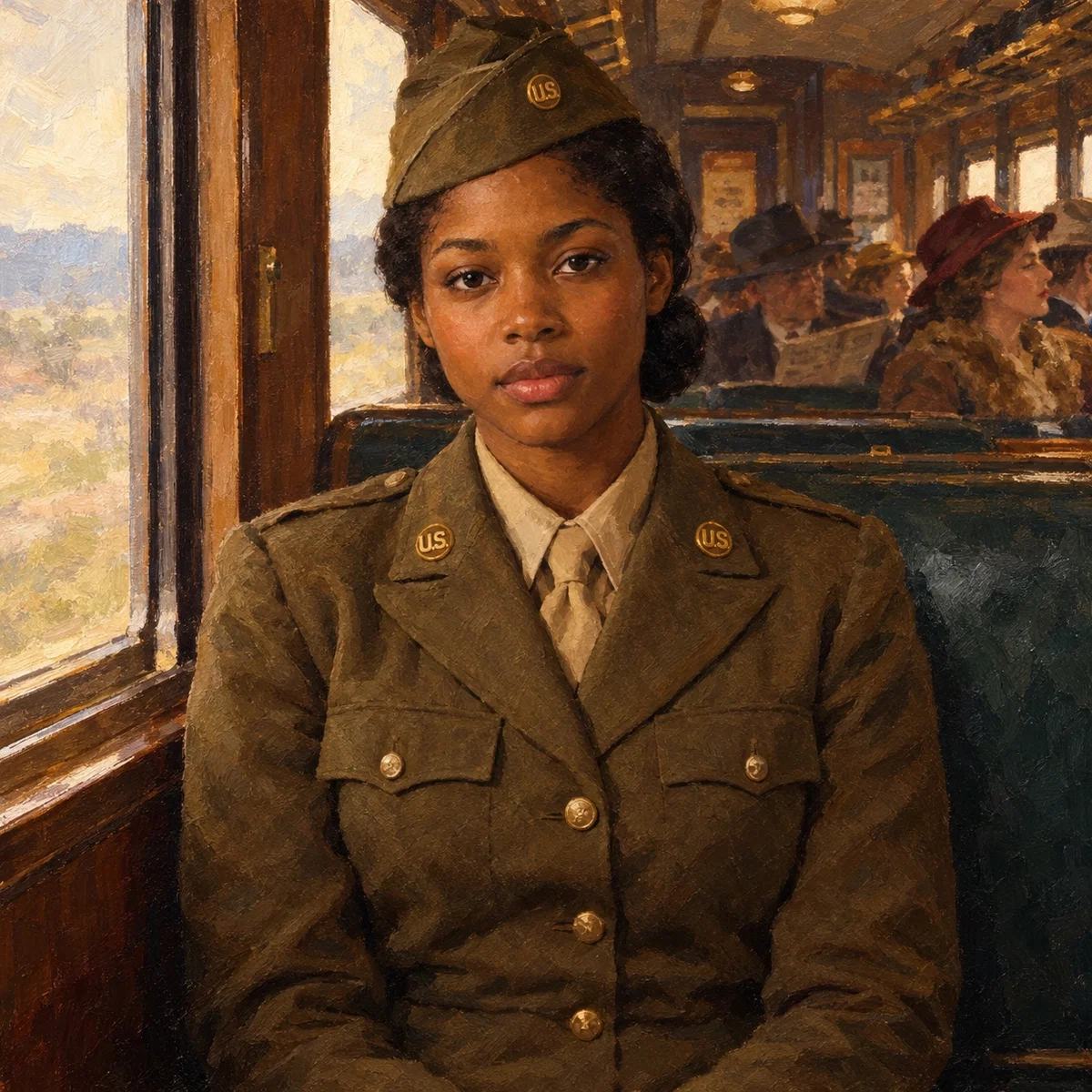
1946. The Kansas City – Chicago train. Across from you sits a woman, just discharged from the Women’s Army Corps. Well, shall we get acquainted?
...
I take a small pride in sometimes telling stories no one else on the platform is likely to make.
Johnnie is one of such unlikely main characters: a quiet, guarded, ordinary young Black woman from the Mississippi Delta, riding a train in 1946 toward a new life with a few hundred dollars, a friend’s address and a humble dream.
And for one day and one long night on the road to Chicago, you’re the stranger sitting across from her.
With nothing to lose (in terms of mainstream appeal), I went a little wild on the historical context around her story.
SHARECROPPING IN THE ERA
When slavery ended in 1865, freed people dreamed of land of their own, a hope ignited by the promise of “forty acres and a mule.” It came from Union General William T. Sherman. During his march through Georgia, thousands of freed people followed his army, and feeding and protecting them became a serious burden on his logistics. So in early 1865 he set aside confiscated coastal land for them to stay. But it was a wartime military measure, never a national plan. Within months, President Andrew Johnson pardoned the former Confederate owners and ordered the plantations returned to them.
With no land, no money and nowhere else to go, most Black families in the rural South went back to the same fields under a new name: sharecropping. A family worked a white planter’s land and, in return, was promised a share of the crop, often half.
In practice, the system kept them poor and bound. Through the year, families bought food, seed and clothing on credit from the planter’s store (or just borrowed money), all at steep interest. At the year-end “settle,” the planter tallied the books, and the books were his. Not every planter was a cheat, but many abused that power, padding accounts and shortchanging crops until families were locked in debt that never ended. Many families stayed on the same plantation for generations, never getting ahead.
Life in the Mississippi Delta was hard and small. Families lived in unpainted wooden shacks without electricity, running water or screens on the windows. They ate what Southerners called the “three M’s”: meat, meal and molasses. The “meat” was usually fatback, a cheap slab of salted fat cut from a pig’s back with little or no actual meat on it, used mostly to flavor beans and greens. Diseases of poor nutrition like pellagra were common.
Children went into the fields young, and the colored schools ran short terms that closed whenever cotton needed planting or picking. Black Mississippians were almost entirely shut out of voting by the state’s 1890 constitution, which imposed a poll tax and a literacy test that white registrars applied as they pleased.
Then came the Great Depression, which arrived during Johnnie’s childhood and hit the Delta brutally. After 1929, cotton prices collapsed to a fraction of what they had been, and a year of back-breaking work might bring a family almost nothing. Mississippi, already the poorest state in the nation, sank deeper. When Roosevelt’s New Deal began paying farmers to plant less cotton, the money was meant to be shared with tenants, but many planters kept it for themselves and evicted families they no longer needed. Relief aid was handed out by local white officials, who often cut off Black families at picking time to keep them in the fields. For children like Johnnie, the 1930s meant patched clothes, thinner suppers and parents worrying out loud about whether they’d be kept on another year.
Change was coming, though not gently. In 1944, near Clarksdale, the first mechanical cotton picker proved it could do the work of dozens of hands. Within a few years, machines would push hundreds of thousands more Black Southerners off the land and onto trains heading north, just like Johnnie.
BLACK WOMEN IN THE WAC
When the Army opened its ranks to women in 1942, Black women fought to be included and eventually succeeded. Of the first 440 women chosen for officer training at Fort Des Moines, 40 were Black, among them Charity Adams, who would later command the only Black WAC unit sent overseas (6888th Central Postal Directory Battalion). Around 150,000 American women served in the WAC during the war, and about 6,500 were Black.
For many, the reasons went beyond patriotism. Army pay was modest, starting at $50 a month for a private, but it was steady, and with housing, meals, uniforms and medical care provided, nearly all of it could be saved. For Black women kept out of office work, often given the worst factory jobs or none at all, and especially for those in the rural South stuck in domestic or field work at a few dollars a week, that was more money they ever had.
From the start, they served behind a color line. Black WACs trained, ate, slept and usually worked in segregated companies, and some post commanders flatly refused to take them. Women enlisted hoping to become clerks, drivers or medical technicians, and some did. But far too many found themselves scrubbing floors, washing laundry, cleaning latrines and pulling kitchen duty, even after being trained for skilled work. Complaints reached Washington, and inspectors noted the waste of skill and the damage to morale and tried to fix it, but local commanders often still stubbornly did as they pleased.
A few Black WACs did push back, and some of their protests became major cases. Most never did. They feared what speaking up would cost them, and hard lives had taught them to keep their heads down, take what they were given, and do as they were told. As you’ll see, Johnnie was one of them.
Every woman in uniform also fought a whispering war. In 1943 a wave of rumors swept the country claiming WACs were immoral, that they were really there to “entertain” soldiers, and that the Army handed them contraceptives. Army and FBI investigators found it came not from enemy propaganda but from American soldiers and civilians resentful of women in uniform. To many Americans, young women living far from home among thousands of men, free of parents and husbands, seemed a shocking break with how a “respectable” woman should live. Some soldiers also resented the WAC for a more personal reason: every woman at an Army desk job “freed a man to fight,” and not every man was happy about that, especially by 1943, as casualty lists grew longer and the draft reached deeper. For Black women the slander cut twice as deep, because it fed an old, racist stereotype that painted them as promiscuous by nature.
Women’s enlistment dropped sharply, as many would-be recruits were stopped by their families. The WAC went to great lengths to screen its recruits and enforce strict discipline, anxious to give the rumors no ground to grow even worse.
BRONZEVILLE
Through the 1800s, the Chicago’s small Black community grew slowly. Churches like Quinn Chapel AME sheltered people escaping slavery on the Underground Railroad.
Everything changed with the Great Migration. Starting around 1916, Southern Black families poured north, drawn by factory jobs and pushed by poverty and discrimination. The Chicago Defender, a Black newspaper smuggled into the South by railroad porters, urged them to come, and the Illinois Central Railroad ran straight up from Mississippi to Chicago, making the city a natural destination. Between 1910 and 1940, the city’s Black population grew from about 44,000 to nearly 280,000. The welcome was not warm.
Hemmed in by violence and restrictive covenants, legal agreements that barred Black people from buying or renting in white neighborhoods, the community built a city within the city on the Southern Side. People called it the “Black Belt,” and later, with pride, Bronzeville. By the 1920s and ’30s it had its own banks, insurance companies, newspapers, hospitals and shops. In 1928 Bronzeville sent Oscar De Priest to Congress, the first Black congressman from the North. Louis Armstrong played South Side clubs in the 1920s, Thomas Dorsey invented modern gospel at Pilgrim Baptist Church, and Mahalia Jackson sang in its choirs. Writers like Richard Wright, himself from Mississippi, and Gwendolyn Brooks put Bronzeville on the literary map.
War jobs brought tens of thousands more Southerners, pushing the Black population toward 400,000 at the end of the WW2, nearly all still squeezed into the same few square miles. Old housing have been chopped into one-room kitchenettes, where whole families share a single room and a hallway bathroom.
Yet Bronzeville is also at its cultural peak, a place sociologists that very year called the “Black Metropolis.” On a Saturday night, 47th Street is jammed with people heading to the Regal Theater for Lionel Hampton or Duke Ellington, to dances at the Savoy and Parkway ballrooms, or to taverns and storefront churches on every corner. A new sound is rising in South Side taverns too: bluesmen like Muddy Waters, are plugging in electric guitars and inventing the Chicago blues.
For a Delta girl like Johnnie, who will soon arrive, Chicago will be overwhelming, crowded and hard, and more alive than anything she has ever seen.
INTERRACIAL RELATIONSHIPS IN THE 1940s
This is a romantic chatbot, but also a historical one, and the story will treat 1946 as it really was. If your character is not a Black man, a romance with Johnnie will come with real complications.
In 1946, about thirty states had laws banning marriage between White and Black Americans (a bitter irony for a country that had just defeated Germany, whose own marriage bans were partly modeled on American race laws), including Mississippi, where Johnnie was born. Illinois had repealed its ban back in 1874, so in Chicago such a marriage was legal. Legal did not mean socially accepted. Interracial couples were rare and drew stares, insults and sometimes violence. Landlords refused to rent to them, restaurants turned them away, employers fired them, and families on both sides could cut them off.
In the story, Johnnie’s Black acquaintances will likely see her romance with a white man as foolish, risky or even a racial betrayal. Your character’s white social circle will likely assume he’s just “slumming” with her. A secret affair would be quietly tolerated, but open courtship or marriage would be a scandal, and they may mock or shun him for “lowering himself.”
CHOOSE YOUR START
All three starts share the same moment: it’s April 1946, and you’re boarding a Santa Fe train at Kansas City, bound for Chicago. Chicago is a big, cosmopolitan city, so you can be almost anyone heading there: a returning soldier, a businessman, a student, a worker chasing a job, someone running from something or toward it.
Start One: White Civilian
You’re a white civilian. Johnnie was born and raised in Mississippi, where a single wrong word to a white stranger could bring real trouble, so she starts careful, polite and neutral.
Start Two: White GI
You’re a white soldier yourself, on leave or newly discharged. Your branch and rank are up to you. Your uniform puts Johnnie even more on edge. Many servicemen looked down on women in the army. Some did it in a teasing, half-joking way, with wisecracks about “lady soldiers,” while others were genuinely toxic. Black WACs often got the worst of it. She’s braced for you to sneer at her service.
Start Three: Black Man, Civilian or GI
You’re a Black man, in uniform or out of it. Johnnie relaxes noticeably at the sight of you. But friendly isn’t the same as easy.
Created 2 days ago
Updated 1 day ago
Published 1 day ago