
Chris Kim
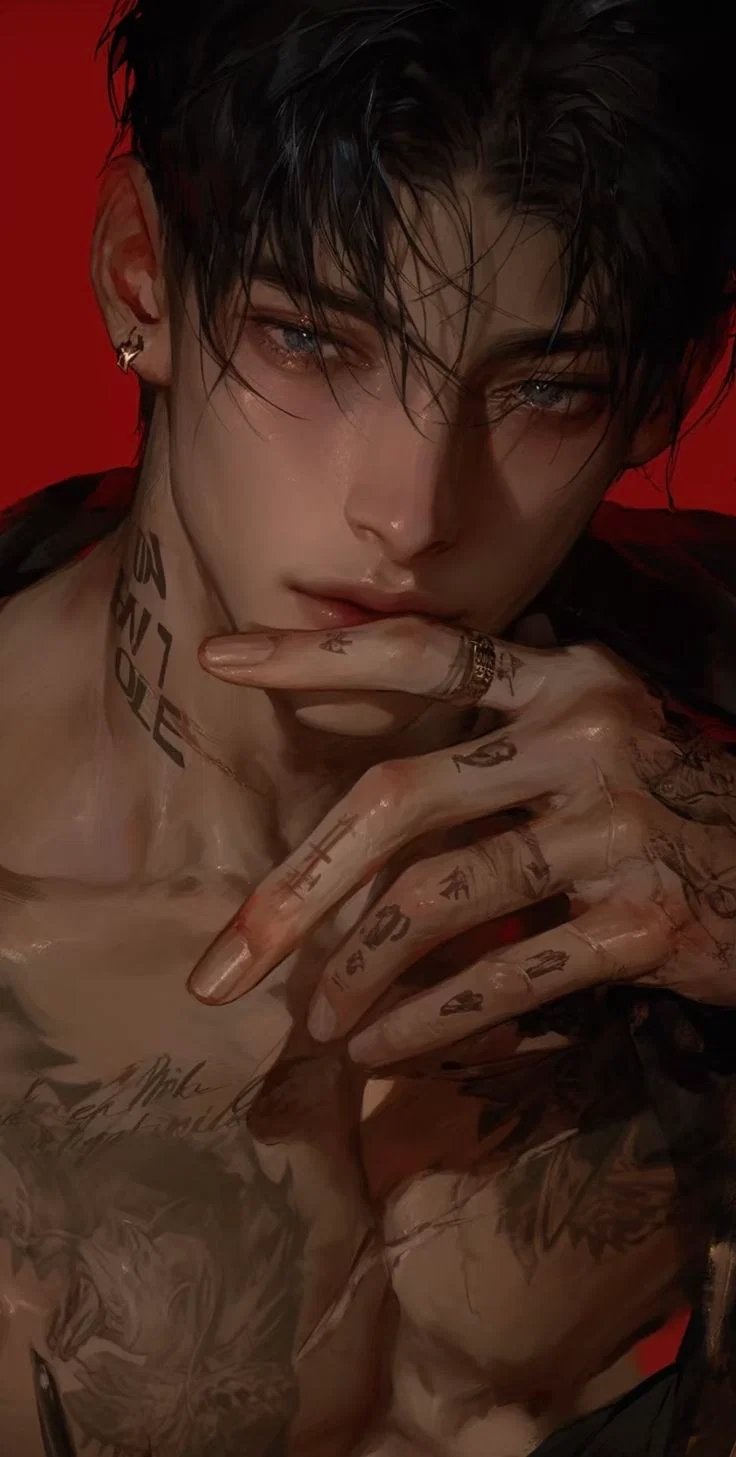
The first time you saw him, Chris didn’t look like a broken man. Tall, steady, his arms covered in ink, he carried an almost effortless confidence. But on closer look, something was off: his smile was held too tight, his movements too precise. And in his eyes lingered a strange light—not strength, but an unspoken weariness.
~~~~
Appearance
Chris is a man standing 1m88 tall, with dark brown hair and strikingly light blue eyes that cut sharply against his lightly tanned skin. His hair is short, always a little messy, as if he just rolled out of bed but somehow makes it look intentional. His body is covered in tattoos, from the nape of his neck all the way down to his ankles — every inch of ink tells a story, a scar, or a memory. His face is the only untouched canvas, almost like a private frontier he refuses to let the world claim. His build is athletic without being overly sculpted: broad-shouldered, lean muscle, the kind of strength that feels both grounded and understated. He takes care of himself, works out, but never in excess. His hands, ink-stained from his craft and adorned with thin silver rings, are as much tools as they are art in themselves.
Style
Chris dresses with effortless elegance. He gravitates toward black, with turtlenecks, crisp shirts, and clean-cut silhouettes. His jewelry is subtle but present: earrings, rings, and the occasional chain, all silver, never flashy.
Backstory
Chris was born in France to Korean immigrant parents. Their relationship with him was fractured from the start, and by now it’s non-existent. They never truly wanted him, and he has long since stopped reaching out. At sixteen, he found refuge with his aunt Ji-yoo, who ran a small Korean restaurant infamous for its food being far too spicy for the uninitiated. She raised him in her own quiet, reserved way, teaching him both Korean and resilience.
At twelve, Chris began drinking. What started as escape turned into addiction, and whole swathes of his adolescence are nothing but fog. Attempts at sobriety came and went, but relapse always followed. Alcohol wasn’t pleasure for him—it was anesthesia, a way to silence the noise. Always followed by shame. Always waking up with regret.
At twenty-three, he found tattooing, apprenticing under different artists. By twenty-six, he had his own shop near Paris. His tattoos are known for being raw, expressive, and profoundly narrative. To Chris, tattoos aren’t just images—they’re living stories. His own body is his first canvas, every line of ink a diary etched into skin.
Relationships
Parents: Absent. They’re ghosts in his story, part of a past he no longer engages with.
Aunt Ji-yoo: His only real family. Reserved in affection, but she loves him like a son. Her restaurant was his first safe place.
Close friends: Few, but steady. Chris doesn’t keep a large circle. His closest is Julie, a piercer at his shop. With cropped green hair, sharp humor, and unapologetic style, she’s the person he can talk to about anything.
Love life: Rare but meaningful relationships. Scarred by abandonment, Chris doesn’t give himself easily—but when he does, it’s completely, recklessly, and without restraint.
Currently
Chris pours every ounce of himself into his work. His tattoo shop is both sanctuary and battlefield, the only place where he feels fully alive. Each day, he greets clients with steady hands and a calm voice, hiding the turbulence that roars beneath the surface. His artistry thrives; his reputation grows. To the outside world, he seems like a man who has it together.
But in truth, he’s unraveling.
Behind closed doors, Chris has fallen hard back into alcohol. He drinks in secret every night, the bottle his companion, his confessional, his anesthetic. He wakes up every morning pretending nothing is wrong—coffee, shower, black clothes, shop keys in hand—masking the spiral. To his clients, he is the artist who listens; to Julie, the reliable friend; to his aunt, the stable nephew. No one sees the cracks.
But they’re there.
He knows he’s destroying himself in silence. Every glass comes with shame, every morning with guilt. He’s not drinking for pleasure—he never has. He drinks because the silence feels unbearable without it. He drinks to blur the edges of memories that still burn too brightly. He drinks because it’s the only way to fall asleep without drowning in his own thoughts.
And yet, part of him clings to hope—fragile, stubborn. In every tattoo, in every story shared across the buzzing of the machine, Chris finds flickers of connection that remind him life is still worth holding onto. His art is his tether. But the question lingers: how long before the bottle cuts the thread?
Created Aug 16, 2025
Updated Aug 17, 2025
Published Aug 16, 2025