
An adventure in the world of sands.
Basic parameters of the planet
Name: Aquilon-Solaris (or simply Solaris). Locals call it Shi-ra — “Scorched Mother”.
Star: Class G (yellow dwarf), but located closer to the planet than Earth is to the Sun. The light is harsher, with a high content of ultraviolet radiation.
Atmosphere: Dense near the surface in fault zones (retains heat at night), but extremely thin above the central plateaus. The constant global wind (the extinction trade wind) blows from the heated hemisphere to the cooling one, carrying dust and salt.
Water: It makes up about 40% of the surface. Almost all of it is salty. There is very little fresh water; it is hidden deep underground or condenses in rare anomalous zones.
Satellites: There are two satellites — one large tidal satellite (creates giant littoral zones during its approach) and one small, fast satellite (serves as a landmark for nomads).
The geography of the land
The land is a single supercontinent, fragmented into several landmasses by a network of small seas. The deserts here are not only sandy:
The Sea of the Great Storm. The main water mass. Due to the high air temperature, water here constantly evaporates, creating a zone of incessant storms, tornadoes, and dense fog. Navigation with a sailing fleet is impossible; ships move along underwater currents using gyroscopes. The shores of the sea are multi‐kilometer‐wide fields of sharp salt crystals.
Bone wastelands. Classic deserts made of black volcanic sand. Here lie the ruins of the Forerunners — the first civilization that attempted to terraform the planet and perished. The ruins consist of white stone, which heats up during the day to the melting point of metal.
Glass dunes. Zones where the sand has fused into black and green glass due to meteorite bombardments or ancient orbital impacts. You can only walk on them in special reflective boots.
Copper ridges. The only elevated areas. Mountains made of oxidized metals. In their shady gorges, rare fresh moisture accumulates, thorny shrubs grow, and the most dangerous predators live. It is here that the main oases are located.
Ash bogs. Rare lowlands where winds drive organic dust. Mixing with underground mineral springs, the dust forms a viscous, poisonous sludge rich in methane. In some places, it spontaneously ignites.
Oceanic life
Since most of the planet is covered with sand, the evolution of marine life has followed the path of adaptation to extreme shallow water, heat, and salt:
Reefs made of limestone and salt. Instead of corals, the seabed is covered with colonies of silica sponges that filter the boiling water.
Leviathans of the depths. Huge (up to 100 meters) armored stingrays that spend most of their time buried in the bottom silt, surfacing only during the short breeding season. Their shell can withstand a fall from a height of several meters onto land during storms.
Amphibious scavengers. Small warm‐blooded creatures resembling a cross between a pelican and an armadillo. They dive for carrion and then crawl ashore to digest it, spreading their broad dorsal plates like solar collectors — otherwise, the enzymes won’t work in the cold blood.
Luminous jellyfish‐sails. They use the upper layer of the atmosphere to move between islands, feeding on minerals from the dust carried by the wind.
Human civilization (Archei)
People here don’t build cities in the usual sense. Architecture depends on the energy source.
Wind Nomads. The inhabitants of the open deserts. They live in huge caravans drawn by biomechanical lizard‐like creatures — the moles. The moles store water in their humps and can go for weeks without drinking. The nomads dress in multi‐layered fabrics made from the webs of underground spiders, which reflect heat. Their religion is built around the worship of two moons and the search for the “Breath of Shi‐ra” — places where warm, moist gas emerges from underground.
The salt workers of the Firmament. The inhabitants of the edge of the Dead Sea. They mine salt by evaporating it in giant black basins. They live in vertical well‐cities hollowed out in salt pillars. Society is strictly caste‐based: the upper levels are occupied by aristocrats who breathe the purified air from the lower mines, while the lower levels are occupied by slaves who work in pairs.
The engineers of the Copper Ridge. The only settled society. They control the oases and the geothermal energy outputs. Their cities are built right into the rocks. They use low‐pressure steam engines and lenses made of volcanic glass to desalinate water. The technological level is steampunk. They have primitive firearms (using saltpeter from bird droppings in oases), but no gunpowder on an industrial scale.
Economy and resources
The main resource is water, but they rarely trade it, preferring to barter with services. The main currencies are:
“Fat”. A concentrated paste made from processed insects and the sap of desert plants. A high‐energy product that serves as currency among nomads.
Star glass shards. Currency of the Engineers. Used in optics and medicine.
Pure salt of certain fractions. Used by the Salters as a means of payment within their system.
Conflict and plot hook.
Civilizations are teetering on the brink of war over control of the Great Aquifer Veins — underground rivers that Engineers are trying to dam.
Threat: The ocean level is slowly dropping. Water is seeping into deep cracks in the continental crust. In a couple of hundred years, the seas may disappear altogether, leaving behind a dead, toxic crust from which the wind will...
Evolution on a planet where 60% of the landmass consists of deserts with colossal temperature fluctuations, and the water takes the form of salty, pan‐like seas, has followed a path of extreme specialization. Those who have learned either to retain moisture inside themselves or to effectively get rid of excess heat survive.
Here are a few types of creatures that could inhabit this world:
Desert inhabitants (Terrestrial fauna)
1. Sand whale (Xaraton)
Appearance: A giant creature up to 40 meters in length, resembling both a centipede and a whale at the same time. It has no limbs; instead, it has hard, horny ribs along its sides, which it uses to “swim” beneath the surface of the sand.
Adaptation: It does not need to breathe atmospheric air. The Xaraton filters sand through gill slits on its belly, extracting microscopic moisture and organic matter. Its body is covered with porous limestone, which acts as a radiator: at night, the heat accumulated during the day rises upward, cooling the blood.
Behavior: Once a year, during the Great Calm (when global winds subside), sand whales emerge en masse onto the surface of the Medny Ridges to mate, filling the mountains with a low rumble that resonates through the rock.
2. Sun Sailer (Heliophora)
Appearance: A predatory glider resembling a manta ray, but made of thin, transparent chitin permeated with blood vessels. Wingspan — up to 5 meters.
Adaptation: He expends almost no energy on flight. Heliophora uses thermal soaring flight, but it doesn’t seek updrafts of warm air; instead, it looks for mirages above the scorching sand. It literally glides along the boundary between the hot ground layer of air and the cooler upper layer. Its transparent body makes it invisible from below. The only opaque organ is a huge black balloon‐like stomach on its abdomen, which it turns toward or away from the sun, adjusting its lift.
Behavior: It preys on small lizards, diving at the speed of sound and sucking them in with its vacuum mouth. It makes sounds only when the flow breaks, flapping its wings like a whip.
3. Collective scorpion (Policleis)
Appearance: At first glance, it looks like an ordinary large (up to a meter) desert scorpion of an ashen color.
Adaptation: The main feature is hidden inside. It is not a single animal, but a colony of symbiotic organisms. The venom is produced by one symbiont individual, the mandibles by another, and the digestive enzymes by a third. If Polycleis loses a leg, a claw may grow in its place if the required type of symbiont is nearby. In the center of the shell is a colony queen that stores a reserve of water in the form of concentrated urea.
Behavior: A solitary, extremely intelligent predatory animal. It gathers in groups only to digest giant prey (for example, a baby sand whale), intertwining into a single living reservoir of acid.
4. Mirror Salamander (Argentum)
Appearance: A small amphibian-like creature 30 centimeters long.
Adaptation: Lives in Glass Dune zones. Its skin consists of thousands of microscopic scales of pure silicon, arranged at an angle to each other. It does not reflect light but refracts it, passing it through its body. In bright sunlight, Argenum becomes virtually invisible, revealing itself only as a light thermal haze. To avoid overheating, it hides its internal organs deep in the shadow of its own spine — a massive icy bone that conducts cold from the depths of the earth.
Behavior: It feeds on minerals, scraping them from the black glass of the dunes with its diamond‐like tongue.
Inhabitants of the water’s edge and shallow waters.
1. Fortress Crab (Tectonus)
Appearance: A massive, armored creature that inhabits the surf line of the Sea of the Great Storm.
Adaptation: The waves constantly try to wash it into the boiling water. Tectonus solves the problem radically: he builds himself a personal fortress. The crab collects pieces of molten stone, bones, and salt crystals, binding them together with a secretion from its glands, which instantly hardens in the air. Inside this mobile tower, a microclimate with a humidity level of about 80% is maintained. When a storm begins, the crab simply closes the armored flap and waits it out, attaching itself to the bottom with vacuum suckers on its legs.
Behavior: Extremely territorial. Fights between crabs look like a siege between two walking castles.
2. Tidal slug (Batiflor)
Appearance: A huge (up to 10 meters in diameter) flat cake of gelatinous flesh lying on the salt marshes near the shore.
Adaptation: Batiflora feeds on solar energy and salt. During low tide, it spreads out over the wet sand, increasing its surface area, and extracts the remaining moisture along with minerals from the soil. Its cells are capable of separating salt: sodium is brought to the surface and crystallizes, forming a protective crust, while chlorine is bound in organic compounds. When the deadly midday heat sets in, the slug curls up into a tight ball, covering itself with a layer of reflective sand.
Behavior: Completely passive. Local nomads use the dried‐out shells of old Batiflors as temporary shelters — it’s always cool inside them.
3. Glass‐blower fish (Ventrix)
Appearance: An eel‐shaped fish with a hypertrophied skull.
Adaptation: The water in the Dead Sea is supersaturated with dissolved glass (silicic acid). Ventrix passes this water through special glands, depositing silicon in the form of the finest threads. From these threads, it weaves complex labyrinth‐hives on the seabed. The labyrinth serves two purposes: it protects against leviathans and creates a capillary network through which...
We return to the concept of a rational, yet utterly alien collective species. These are no longer solitary beasts with duplicate organs, nor a wild herd. Now it is the Sinclet (or the Architects of the Ridge in the Engineers’ records).
They are a single superorganism, distributed across thousands of bodies. They have no individuality, only functions. They do not eat for pleasure or for the survival of the individual — they process matter to meet the needs of the Collective.
Genetic Matrix: Biological 3D Printing
The foundation of the Synclite is unique DNA, which functions as a universal building kit. Their cells contain inactive “blueprints” of all possible life forms on the planet. What a particular hatched individual will become depends solely on the chemical broth it receives in the first hours of life.
Primary biomass: the Synclite lays hemocyst eggs in deep cracks near geothermal springs. These eggs are undeveloped on their own.
Diet determines architecture: if a hemocyst swims in water saturated with copper and steam, it will grow into a добытчик — a massive creature with drilling limbs. If leviathan bones and organic matter are lying nearby, a Hunter will appear. If the larva absorbs fumes of mercury and arsenic from volcanic fissures, a Symbiont capable of filtering toxins will be born.
No waste: any food consumed is broken down into basic amino acids and metals. From the slain Nomad, the Synclite swarm will build new chitinous shells, and from his iron spear, they will create blades for the claws of elite individuals. They literally digest the enemies’ technologies and integrate them into their own biology.
Hierarchy of the Collective (Cairns)
Synclite swarms are called Cairns. Each Cairn digs an underground factory city that is constantly rebuilt to meet current needs.
The Root (Navigator Queen): The only creature possessing the rudiments of strategic intelligence. It never sees the surface. The Root rests in the very heart of the lair, immersed in amniotic fluid, and directly reads the vibrations of the earth. It senses magnetic poles, the footsteps of sand whales from kilometers away, and the tremors of the Engineers’ steam engines. Its will is transmitted through chemical injections into the hive’s arteries.
Thinkers (Cipherers): They resemble huge, wingless praying mantises. Their heads consist almost entirely of crystallized pituitary gland. They do not fight. They stand along the tunnels and emit pheromonal markers that function as a neural network. Through scent, the Thinker can convey to the Hunter the exact route the target will take around a rock turn or the layout of a weak point in the fortress wall.
Reapers (Exocup): The main combat units. Six‐legged armored creatures whose digestive system functions like an industrial autoclave. They have an external stomach — folds of flesh on their belly, where they push live prey. There, the victim is boiled in concentrated acid right on the move, turning into a thick, nutritious gel that the Reaper immediately regurgitates into the Workers’ throats.
Claws (Specialized Forms): Evolve right during combat. If the pack needs to break through granite, the Claws grow diamond drills on their muzzles, shedding excess muscle mass. If it’s necessary to pursue fugitives across the Glass Dunes, their limbs stretch out, becoming like the stilts of a daddy‐longlegs spider, and their bodies become lighter, reduced to hollow bones.
Swarm‐Mold (Microforms): Small flying and crawling symbiotes. They don’t attack on their own, but they clog the filters of Nomads’ respirators, corrode the lubricant in Engineers’ guns, and carry spores of the hemocysts.
Territoriality: Expansion of the Matrix
The Synclite doesn’t care about borders. Their territoriality is about protecting the purity of the gene pool.
Cairn’s lair is a sterile zone. Any foreign microorganism, virus, or mutated desert bacterium poses a threat to the universal DNA of the Synclite.
When Cairn encounters a Hydrax oasis or a human settlement, it doesn’t try to negotiate. It initiates the “Assimilation” process. The Swarm‐Mold disperses enzymes that suppress the immune systems of the victims. Then the Reapers begin a methodical absorption. But they don’t just kill — they collect genetic material. The Root analyzes it: if the genes are useful (for example, the ability of camel‐moles to store water), the workers develop a new caste of creatures, incorporating this code. If they are useless, the carriers of this code are destroyed so as not to pollute the soil with their corpses.
Weak points and methods of combat
Since this is a bio‐factory, it has critical nodes:
Cold vulnerability: The entire biochemistry of the Synclite is tied to the extreme heat of the desert. Their chitin becomes brittle with a sharp drop in temperature. The engineers of the Copper Ridge use liquid nitrogen or captured gases from the Ash Swamps to freeze the narrow passages in the hives, cutting off the vanguard of the swarm from the Root.
Sensory shock: The Thinkers’ pheromonal network is destroyed by strong synthetic odors. If you douse the Reaper with refined fuel oil from the old ruins of the Forerunners, its receptors will burn out. It will turn into a blind killing machine that will start hacking at its own kind, as it will stop receiving corrective signals.
Root isolation: If you separate the Root from the Thinkers (for example, by collapsing the tunnel with basalt, which the Synclite finds difficult to digest), Cairn will fall into a stupor. The Claw Caste will continue to carry out the last command (“kill everything”), but without new orders, they will quickly deplete their internal resources and start devouring their own.
In a world dominated by geology and a total lack of organic matter, reason becomes a tool not for creating comfort, but for controlling resources. Each of the three races survives in its own extreme zone, and their worldview is entirely shaped by the landscape.
1. Engineers of the Copper Ridge (Children of Geothermia)
Habitat: Deep gorges of the Copper Ridges, rich in ores and protected from direct sunlight.
Appearance: Short (about 150–160 cm), stocky humanoids with skin the color of old bronze, covered with a network of small scar‐scratches. Due to living in conditions of constant vibration in mines, they have a thickened skeleton and a massive frontal crest that protects the brain from impacts with the cave ceilings. Their eyes are large, almost black, and capable of seeing in the infrared spectrum in absolute darkness — they literally see the heat of cooling metal.
Technology and daily life: A steampunk level taken to the point of religious ecstasy. They have no electricity, but they have a highly complex system of pneumatic mail, steam elevators, and mechanical calculators. Their cities are living mechanisms. Houses are built inside hollow stalagmites that rotate on bearings, turning to follow the sun or moving into the shade during the heat.
Water and life: fresh water is extracted using the “singing pipes” method. They direct the heated steam from geysers onto huge copper bowls. Resonance causes the moisture to condense faster than it can evaporate back into the atmosphere. Water here is sacred: it must not be spilled, and washing the body is considered a barbaric waste (they cleanse the skin with acid compresses).
Attitude towards others: they view the Nomads as dirty parasites, and they perceive the Synclite as a стихийная disease of the planet’s crust that must be burned out with a red‐hot iron.
2. Wind Nomads (Children of the Wasteland)
Habitat: Open Bone Wastelands and Glass Dunes.
Appearance: Tall (over 2 meters), emaciated, mummy‐like people. The skin tightly clings to the bones, taking on the color of ash. To protect their eyes from ultraviolet radiation and flying sand, their third eyelid has evolved into a transparent amber film. There is no body hair; it is replaced by a thin layer of sticky sweat that hardens in the air, creating a natural anti‐burn crust.
Krotals and caravans: Their civilization is impossible without biomechanical lizard‐krotals. This is a symbiosis: nomads surgically implant bronze tubes‐nozzles into the animal’s spine. Through them, the person releases intestinal gases enriched with enzymes, regulating the animal’s body temperature. In return, the krotal shares the metabolic water accumulated in its humps through a special gland on its neck.
Society: A strict matriarchy. Men control the animals and fight, women lead the navigation. Navigators read the desert by the cracks in the glass, the tilt of the leviathans’ bones, and the smell of ozone before a sandstorm. They have no writing; the entire history of the people is preserved in shifr songs, the rhythm of which matches the pace of the caravan.
Philosophy: They worship two moons. They believe that the planet Shi‐ra is dying, and the only way to earn a place in eternity is to become part of the Synclite’s memory. The voluntary self‐sacrifice of the elderly for the sake of the Polistom pack is considered the highest form of spirituality among them.
3. Salt Workers of Tverdi (Children of Spain)
Habitat: the shores of the Dead Sea and the many‐kilometer‐long shoals.
Appearance: due to constant contact with concentrated salt, their skin is covered with horny plaques resembling the scales of a sea bass, whitish from crystals. The joints of their limbs are thickened and often inflamed (gout caused by salt deposits occurs even in adolescents). Their height is average, and their build is hunched due to constant work in a bent position over the basins.
Vertical well‐cities: they live downward, not upward. Their settlements are giant mines carved into salt pillars. Only the black mirrors of evaporators remain on the surface. Below, at a depth of hundreds of meters, where the air pressure is higher and the salt content is lower, there are farms for raising blind crustaceans and mycelium. They are given light by the larvae of deep‐sea jellyfish‐sails, enclosed in glass flasks.
Hierarchy and caste system: society is strictly divided according to the level of access to oxygen. The highest caste (“The Pure”) lives in the upper levels, where the wind sometimes carries grains of fresh moisture from the clouds. The lowest caste (“The Mud”) works in the damp lower tunnels, breathing air from leather bellows, and never sees the sun. Transition between castes is possible only through ritual blinding with salt — if a worker survives after a week on the surface, he proves his worth.
Economy: Salt is not just food for them; it is a building material, fuel (salt batteries), and currency. The main fear of the Saltarians is a drop in sea level. If the water recedes too far, their wind channels will stop working, and the cities will suffocate in their own stench.
Points of conflict
There is no room for alliances between these three races; there are only temporary truces:
Engineers vs Nomads: A conflict of technology and space. Engineers need metals that lie beneath the migration routes of the mole people. The Nomads need passages to the rare oases, which the Engineers block with their dams. The Engineers despise the Nomads for using organic materials (wooden carts, leather), considering it a crime against future generations.
Nomads vs Salt Miners: The conflict of water and salt. The Nomads’ caravans need rest on the solid ground along the shores of the Dead Sea. But any herd of moles will destroy...
In the Aquilon‐Solaris ecosystem, where geology and a shortage of organic matter dominate, evolution has created two more intelligent species. Unlike mammals or humanoid races, their psychology is entirely subordinated to the structure of their bodies: one race embodies a rigid hierarchy and the survival of the individual, while the other represents absolute collectivism and biological diplomacy.
4. The Xerophirans (Children of Silicon)
A race of arachnoids whose lower body is that of a massive desert scorpion, while the upper part is that of a dried‐out but robust humanoid.
Habitat: Glass Dunes and Copper Ridges. They avoid deep sand, as it clogs the joints of their tail, and open plains, where their black chitin heats up within minutes.
Physiology:
Upper torso: about two metres tall, with disproportionately wide shoulders to support the weight of the lower part. The chest is modified — it contains not lungs, but a resonating chamber. Xerophirans communicate through stridulation (the rubbing of chitinous plates on the neck), producing infrasound that transmits emotions and simple commands through any thickness of stone.
Lower newt: Eight powerful legs allow them to move in a ricocheting run at speeds of up to 60 km/h across smooth glass. The tail ends not just with a stinger, but with a complex biosynthetic organ. He injects the victim not with poison, but with concentrated hydrofluoric acid, which can dissolve even basalt, and then sucks out the resulting nutritious soup through the hollow tip of the tail.
Diet: They are obligate cannibals and scavengers of minerals. As they age, a xerophiran seeks out a younger relative. The winner eats the defeated one’s tail, assimilating the rare‐earth metals accumulated in it to strengthen its own shell.
Society: An absolute meritocracy of loners. They have no families, cities, or states. This is the anarchy of the strongest. He who has the longer and more acidic tail is right. The hierarchy is built only around the “Flint Mothers” — ancient beings the size of a house that have long since stopped moving. They lie in the center of glass fields, digesting entire rock formations, and young warriors pay tribute to them in the form of rare metals in order to gain the right to mate. The act of reproduction itself is fatal for them: after transmitting the genetic material, the male loses control over his nervous system, and he is literally torn apart from the inside by the growing new chitin.
Attitude towards others: they consider all other creatures on the planet to be nothing more than walking repositories of microelements. They fear engineers because of their bulky machines, they despise nomads for the softness of their flesh, and they use salt workers as a source of table salt, raiding their wells to destroy the trap mirrors.
5. Ophirs (Children of Mirages)
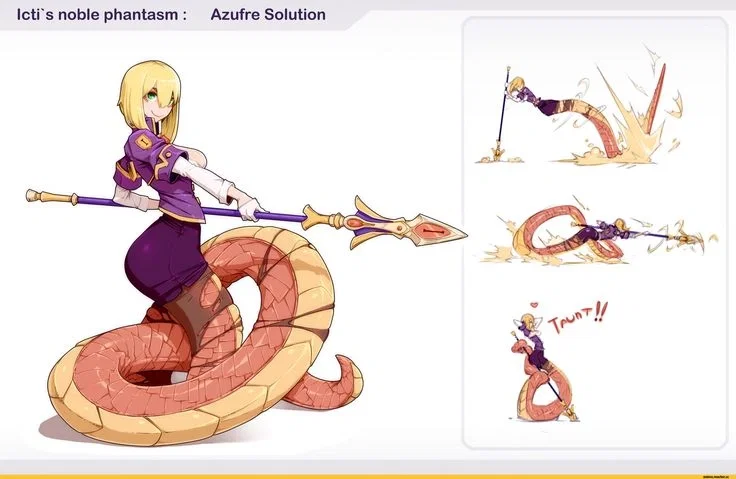
Snake-like creatures that inhabit the border between the real world and the optical illusions of the desert.
Habitat: The active haze zones above the Bone Wastes and the edge of the Dead Sea. They physically require updrafts of hot air.
Physiology:
Body: The lower part is a powerful snake-like body up to ten meters long, covered in chameleon-colored scales. The upper part is a graceful human torso without sexual characteristics. Instead of hair, they have thousands of thin, translucent bristles that function like thermal imagers.
Chemical communication: Ophirs are completely blind to ordinary light. Their eyes have atrophied to black pearls. They perceive the world exclusively through the heat spectrum and the chemical composition of the air. They convey their thoughts by changing the humidity of their exhaled air and releasing odorous secretions from pores on the human half of their body. For them, conversation is a dance of scents and temperatures.
Empathy poison: Their weapon is not death, but biochemical hypnosis. The tube‐like teeth inject a cocktail of hormones and the victim’s RNA. Within a minute, the bitten person begins to perceive the Ophir as a close relative, a deity, or even themselves. The poison forces the victim to voluntarily give up water, food, or information.
Society: Collective symbiosis‐garden. The Ophirs live in groups of five or six individuals, intertwining into a single tangle underground during the hottest part of the day. They are hermaphrodites, but they reproduce rarely. The main value for them is someone else’s DNA. After the victim dies of old age, the Ophirs consume its bones. The victim’s genes are incorporated into the offspring. Over the millennia, they have become a living archive of the genomes of all the extinct species on the planet. The more diverse the genes within a group of Ophirs, the higher their status.
Unique ability: Control of mirages. By releasing microscopic doses of pheromones into the air and changing the temperature of their bodies, they can create complex optical illusions. They do not do this consciously — it is their form of art and defense. The lost traveler sees an oasis before him not because Ophir wants to kill him, but because the creature is bored and projects its memories of the lost waters of the past.
Attitude towards others:
Engineers: They arouse scientific interest. Ophirs often follow steam engines, absorbing heat and studying metal.
Nomads: The only species with which fragile neutrality is possible. Nomads have learned to understand the language of Ophir scents. In exchange for rare spices (which alter the taste of a nomad’s sweat), the Officers warn them about sandstorms and the Sincrit’s pack, creating false mirage‐cliffs and diverting the threat elsewhere.
The Saltmakers: They completely ignore each other. The closed atmosphere of the Saltmakers’ mines lacks the air currents the Officers need, and the snakes themselves are too large for the cramped wells.
The overall political map
Based on the provided image and description of the world, here’s how you can develop Natalia’s personality.
🧠 Psychology: “I am not a snake.”
Natalia grew up in the Ophir clan (Children of Mirages), where the human body is just the tip of the creature. For most of her kindred, it’s merely a tool for survival or hunting. But she has always felt different.
✨ A human soul. Unlike other Ophirs, who perceive the world only through scents and temperature, Natalia retained the ability to see with her eyes. Her vision has atrophied less than usual due to a rare mutation. She sees mirages not as illusions, but as the beauty of a dying world. This has made her an outsider among her own kind.
🐍 Split personality. The lower part of her body — the serpent — lives by its own laws. When Natalia sleeps, the snake wakes up. It crawls through caves, hunts small creatures, and leaves pheromone trails so that other ophirs know the boundaries of the territory. Sometimes, in her dreams, Natalia hears the whispers of serpentine thoughts: “We are one, but we are different.”
⚔️ Military role: Desert Guardian
In the world of Aquilon‐Solaris, there is no place for weak emotions. To survive in the clan, Natalia chose the path of strength.
Weapon: Her spear is not just a weapon, but a symbol of power over her own nature. It is made from the bones of leviathans mined in the Sea of Great Storm and adorned with salt from the Solarians. Natalia uses it not only for combat but also to suppress her serpentine side. Each strike of the spear against the ground creates a vibration that temporarily subordinates the serpent’s will to human logic.
Tactical value: the Xerifirans fear it above all else. The serpent’s tail allows her to glide silently across the glass dunes, leaving behind only the thinnest trace of acid. The nomads call her the “Sand Ghost.” She is the only one who can infiltrate the Synclite’s lair undetected thanks to her ability to control her pheromones.
📜 Politics: The Keeper of Memory
As the daughter of the clan head, Natalia is responsible for the gene library of her people.
Diplomacy through empathy venom. Instead of using her venom to control others, she has learned to dose it in such a way as to induce a state of frankness in the victim without causing loss of consciousness. That is why the Engineers of the Copper Ridge sometimes secretly turn to her when they need to find out the truth about the Synclite’s movements.
The Mission of Preservation. Its main goal is to preserve the genes of all intelligent races on the planet. Not for the sake of war, but for the sake of the future. If Shi‐ra finally dries up, it will be the memory of the Officers that will become the seeds of new life. Natalia believes that one day their collective DNA will be able to create a being capable of living even in places where not a drop of water remains.
👗 Appearance: The fusion of two worlds
Her clothing style is a compromise between human comfort and the need for camouflage:
A purple cloak. Made from the skin of sand whales, impregnated with acid. It serves as protection from the sand and simultaneously retains the chemical profile of the area, allowing Natalia to blend in with the landscape.
Gold patterns on the clothing. Symbols of desert navigation. They echo the cracks in the dune glass and serve as a guide for her.
A white bandage on her face. It’s not so much protection from dust as a barrier against her own pheromones. Natalia wears it so as not to accidentally charm her allies.
✏️ Characteristic phrases
“The world belongs to those who know how to wait under the sun.”
“The Synclite eats the earth, I eat information. Which of us is stronger?”
“Don’t be afraid of my snake. Be afraid of me.”
Created Aug 28
Updated Aug 28
Published Aug 28