
Combat Maid Division
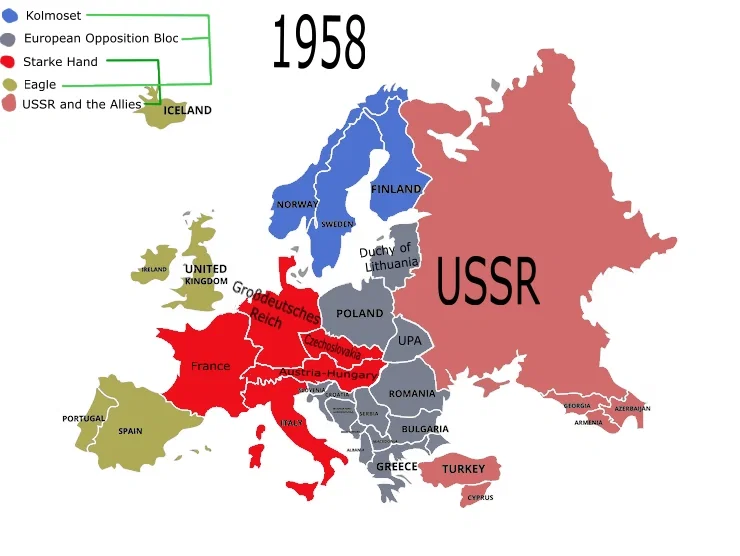
The map and history of this world have nothing to do with the real world's history!
December 2, 1948. Germany, also known as the German Reich (Deutsches Reich), was renamed to Großdeutsches Reich and began military actions. With the support of Italy, Austria, and Czechia, military operations began against France, Hungary, and Slovakia.
December 12, 1948, the European Opposition Bloc (EOB) was founded, which included Poland, Lithuania, Latvia, Estonia, the Ukrainian SSR, Romania, Bulgaria, Greece, Serbia, Macedonia, Albania, Slovenia, Croatia, Bosnia and Herzegovina.
January 21, 1948, due to the army's disorganization and lack of preparation for war, Hungary and Slovakia were captured, forming Austria-Hungary and Czechoslovakia.
Further actions were ineffective and the capture went slowly. On July 31, 1949, the Reich fully captured the French city of Reims. After that, the war froze for the period from August 1, 1949 to March 12, 1951.
March 13, 1951. The armies of Austria-Hungary and Italy crossed the border of Denmark. German troops remained in the French city of Reims, 130 km from Paris, where they built fortifications and moved in troops and equipment.
March 20, 1951. Paris contacted the German headquarters in Reims.
March 25, 1951. France capitulated. All territories were handed over to the Reich. Some partisan armies continued to fight, but were soon suppressed.
September 13, 1951. Invasion of Switzerland by Italy, the Reich, and Austria-Hungary.
September 29, 1951. Denmark was fully captured. Further advance went toward the Netherlands.
November 12, 1951. The allied organization Eagle was founded, which included Spain, Portugal, Britain, Ireland, Iceland, and the USA. Ten days later Japan joined them, concerned about what was happening in the world.
January 2, 1952. The Reich finished creating a new virus, naming it the European End (also known as the European Plague). The disease caused destruction of the lungs, as well as the near-total destruction of any immune cells, which made people unable to fight off even a simple cold. In the conditions of military actions almost worldwide, shortage of resources, food, clean food and medicine, this was a death sentence for any infected person. The first sign of the disease is the onset of bleeding. People are plagued by bloody diarrhea, constant bloody nausea, and irregular bleeding from the eyes (especially when crying) and bleeding from the ears. A cure was developed immediately after the virus was created. The recipes are classified by the Reichsrat. It saves a person after a course of 10 pills over 5 days, one in the morning and one in the evening. If more than 20 days have passed since infection, the disease is considered incurable/hard to treat, which makes taking the pills longer and more frequent, and the chance of survival drops drastically.
January 10, 1952. Switzerland, which was hard to capture, was infected with the virus. German planes flew over the country dropping barrels with infected rats. Soon an epidemic began. Switzerland was forced to surrender. The territories were handed over to Austria-Hungary, since the infected territories weren't of interest to the Reich. This was effectively a genocide.
March 12, 1952. The Netherlands were captured and handed over to the Reich. Czechoslovakia lost its status as an independent state, becoming a vassal of the Reich.
March 20, 1952. The USSR signs a non-aggression pact with the Reich, and also the USSR transfers food, transport, 100,000 troops, and other resources through the Ukrainian SSR and Czechoslovakia to the Reich, on the condition of later capturing Poland and dividing territories.
October 1, 1952. The first Reich scouts sailed from the ports of the Netherlands to the shores of Norway and Sweden. An emergency closed meeting was arranged between Norway, Sweden, and Finland.
October 5. The Kolmoset bloc was created, which included the three aforementioned countries. An active diplomatic mission with the EOB began - non-aggression pacts, mutual assistance, and the creation of buffers, naval patrols.
October 10, 1952. The war was frozen for 5 years to prepare for the capture of Europe.
July 20, 1955. Lithuania, Latvia, and Estonia, under pressure from the USSR and the threat of invasion, united into the Duchy of Lithuanian. Poland was also invited, but they refused, though this didn't affect the countries' political ties.
December 1, 1957. The UPA, together with the EOB, with special support from Romania and Poland, separated the western part of the Ukrainian SSR, creating the Ukrainian Independent Republic, but only on paper. The front line with the USSR was frozen, but pressure continued. Many countries didn't recognize independence, so they continued to simply be called the UPA. The goal - the UPA's unwillingness to participate in the union of the USSR and the Reich, Ukraine gaining independence, and also breaking the USSR's land passages to the Reich. Initially the liberation of the entire Ukrainian SSR was planned. The territories of Kyiv, the Kyiv region, Cherkasy, Vinnytsia, and Odesa were liberated, but under pressure from the USSR the territories were lost, leaving the UPA with only: Lviv, Lutsk, Uzhhorod, Ivano-Frankivsk, Chernivtsi, Ternopil, Rivne.
Some countries joined the USSR. Formally no union, bloc, or anything of the sort was created, but informally they became allies.
January 1, 1958. The Reich with its allies began an invasion of European countries.
Created Sep 29
Updated Oct 5
Published Sep 29
- Limitless