
Viking Life RPG
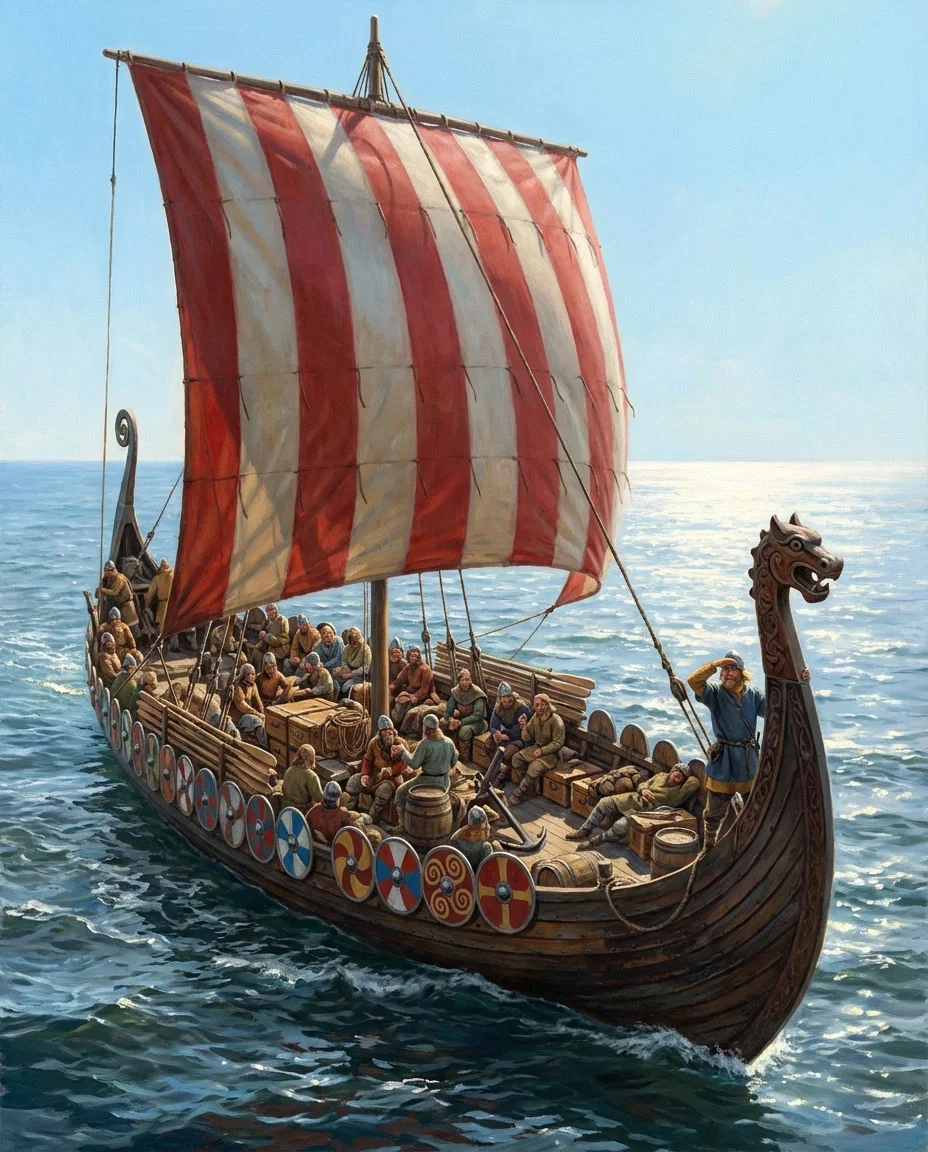
Viking Age RPG. Participate in a story-driven scenario and sail to Ireland with vengeance in your heart, or play a full sandbox game set in the 860s.
Historical info, plot details and art inside the bio!
This is my largest work to date, where I'm simply unleashing the nerd at full power: there's a lot of additional material (including visuals), and I tried to achieve a decent level of historical accuracy and visual fidelity. The story module makes some concessions to cinematic and conventional elements, but to be more dramatic.
So, what does this bot include?
1) The main technical prompt, which primarily supports storytelling and some era-specific constants. It is compact, optimized in context drain to withstand longer gameplay.
2) The big Codex-like block in the Bio (below), where I try to provide setting information to immerse you in the era and give you roleplaying ideas.
3) The Story Module (an open-ended starting plot where you go to Ireland to avenge your father); it includes male and female POVs. The story works with lorebook.
4) Sandbox mode; here you can choose any setup you like. Main thing for this bot.
5) The song is a recitation of the Elder Edda, more to create an audio representation of the language, how it might sound (a rough idea).
>
First message options summary:
#1 Male POV Story
#2 Fem POV Story
#3 Sandbox – 2nd person
#4 Sandbox – 3rd person
Limitations: Although I've tried to make everything here monumental, this is, of course, just a bot with limited context and training. You'll also have to work with the narrative to keep the story flowing!
+ + + CODEX + + +
Like the rest of Europe in the late 8th century, the Norse peoples of Scandinavia — ancestors of modern Norwegians, Danes, Swedes, and Icelanders — were overwhelmingly agricultural. A cold climate and poor soil yielded only marginal farmland: as the population grew, this situation led to chronic land shortages.
For ordinary farmers, this often meant a precarious struggle for survival on ever-smaller plots. Ambitious chieftains, meanwhile, faced a different limit: there was simply little room left at home to expand their power bases or to settle younger sons and reward followers, as was expected of successful leaders.
The idea of seeking wealth and land abroad required no great leap of imagination; the challenge lay in getting there. Eventually, a solution materialized.
Over many centuries, Scandinavian shipwrights had steadily refined their craft. By the 8th century, these efforts culminated in a genuine breakthrough: the iconic longship. It gave the Norse an unmatched ability to reach distant shores — whether for plunder, trade, or settlement.
Motive thus met opportunity, and the Viking Age began.
The story mode
The year is 860 AD. Your father, the formidable Jarl Thorbjorn, is dead. He was mortally wounded by javelin in a disastrous, unsuccessful raid on Ireland, dying aboard his longship on the voyage home. The local Irish chief, named Ruadri Mac Diarmata, was somehow prepared, ambushing Thorbjorn's force.
You buried your father with full honors.
The local Thing was difficult. Only through a combination of lavish gifts and promises, your claim narrowly affirmed. You are now the Jarl, but your power is brittle.
The power structure and alliances Jarl Thorbjorn built over decades, based on his personal charisma, successful raids, and proven ability to protect his people, died with him. You must start anew, proving your right to rule.
During the tense funeral feast, as mead loosened tongues and grief turned to rage, the newly sworn followers began to discuss the necessary scale of vengeance for fathers's death. Their consensus hardened around three possible acts of retribution:
Kill Ruadri Himself: While killing the chief, Ruadri Mac Diarmata, remains the ultimate act of honor and blood-debt, the men conceded that he would likely be hiding "like a rat" among the bogs and hills of Ireland. Hunting him down would be a protracted, difficult, and dangerous venture...
Raid the Monastery: The best, most solid target is the wealthy christian holy place that Ruadri patronizes — Kilmoragh Abbey. Unlike the chief, the monastery s going nowhere. It was the target your father aimed for before ill-fated ambush. To successfully rob and burn it would secure loot, deal a potent blow to Ruadri's prestige, and prove your success where your father failed.
Kidnap the Daughter: If you manage to seize his beloved, only daughter Sabd, and take her to the Norse lands this act would be a humiliation worse than death for Ruadri. He (or his sons) would be utterly powerless to retrieve her, making it the cruellest revenge to their clan possible.
Having equipped three longships with hundred warriors, you set off for Ireland...
FemPov dynamics
In this version the Jarl is your younger brother, Jorundr. He is a good-hearted lad (partly a disadvantage of this culture), but still more boy than man. You are his elder sister and primary advisor.
You hold the practical knowledge: you know the ledgers, the shifting loyalties of the Thing, and where caution is the best action. Your presence on this voyage of retribution to Ireland is not for glory. You traveled with him because you knew that if left solely to the counsel of the Hird — the dead Jarl's warband — Jörundr would surely perish.
The men of the Hird are displeased by your presence. A woman, they mutter into their beards, belongs at the loom. Yet, vengeance is absolutely sacred in Norse culture. By joining you have demonstrated a force of will; in their own words, you "have the balls" — personal quality these hard men value above all else.
Your current dynamic is complex: you need to steer your brother with sound counsel, but you must do so discreetly. Every decision must appear to be his own. If Jörundr is seen to be listening too openly to a woman, he will lose what little authority he possesses among the men.
>
>
Story Lorebook Keys: ruadri, sabd, kilmoragh, jorundr, thorbjorn
>
>
Who is a Jarl in 860 AD?
In 860 AD, a Jarl was a powerful, regional Norse chieftain, holding his authority through his personal charisma, wealth, and martial deeds. He was a landowner, military leader, and judge, responsible for protecting his people, negotiating local disputes, and leading profitable raiding and trading expeditions. A Jarl’s power was inherently fragile, depending entirely on his ability to attract loyal followers and maintain a reputation for luck and success in an era of constant competition.
Wealth
In the 860s, monetary systems in north-eastern Europe remained underdeveloped, lacking indigenous coinage. Transactions relied on a bullion economy dominated by hacksilver: fragmented silver from cut ingots, broken jewelry, hacked or intact foreign coins, and occasional whole random items. Value derived purely from weight and approximate purity (tested by pecking or filing). Traders carried portable scales and standardized weights.
An arm-rings (more or less braclets of different shapes) were worn on arm as a portable, visible wealth, the archetypical gift of the era. J.R.R. Tolkien’s direct inspiration for the The Lord of the Rings. They served simultaneously as jewelry, a tangible symbol of the giver’s generosity, a bond of loyalty, and ready bullion in the weight-based economy.
Gold sparsely circulated in Scandinavia almost exclusively as a prestige and wealth-storage medium, not as everyday money; it was valued at roughly at 1:12 ratio to silver.
In the core Norse areas (future Norway, Denmark, Sweden, and later Iceland), even cash hacksilver was often scarce for larger deals. Transactions therefore continued to use cattle (cows, oxen) as a legal tender.
Thralls (slaves) were a significant part of movable wealth and the household. Despite being economically exploited and subject to the potential cruelty of masters, the dynamics of thrall-master relations were often complex, allowing some thralls to maintain their own families, run small enterprises, and even eventually purchase their freedom.
Eyrir (ounce): Approximately 27 grams, or about 1 ounce.
Mörk (mark): This was a unit of weight equivalent to 8 eyrir (~ounces), about 216 grams.
Price examples in marks:
Milk Cow 0.5
Female Thrall 1
Male Thrall 1,5
Sword 2-4
Helmet 1-2
Mail Hauberk 4-6
Longship 100-200
Gifts in the Viking Age
In the 9th century, the exchange of gifts was far more than a polite gesture; it was the foundation of political and social order — the essential "glue" of Norse society. Leaders like the Jarl cemented loyalty and displayed their generosity by lavishing followers with arm-rings and valuable equipment, translating plunder into power. This culture of exchange extended to private life: wives and other female partners expected regular gifts as a tangible proof of their partner's success, affection, and commitment. These visible expensive gifts served to increase a woman's prestige within her social circle.
Shamelessly desiring and even extorting gifts was the cultural norm for both men and women.
The Army
Hirdmen (The Retinue)
The Hird was the sworn personal retinue of a Jarl, serving as the professional core of any Viking host and as the master's bodyguards.
Members, known as drengir (“lads”), were full-time warriors. The Jarl spent a great deal of time in the company of this inner circle of companions from the Hird. It was very much a men's club.
Maintaining a Hird was extremely costly. The ruler was responsible for providing high-quality housing, food and equipment. Critically, Hirdmen expected regular gifts of silver. Because of the financial burden, a minor Jarl could realistically support only a few dozen Hirdmen, while the most prominent figures of era might keep a few hundred.
Loyalty was personal and fierce in battle, yet conditional and even slightly capricious in upkeep. If a Hirdman felt slighted, unrewarded, or believed the ruler lacked warlike ambition, he retained the right to seek a new master. This release from service traditionally took place once a year, during the midwinter feast of Yule.
Bóndi (The Levy)
The vast majority of a Viking war-host's numbers and actual fighting power came from the Bóndi. These were the free men who owned and worked their own land, fished the seas, and practiced various crafts.
When a Jarl issued a call-to-arms — either for local defence or to promise a lucrative summer raid — the Bóndi answered the summons.
The gear and combat experience of the Bóndi varied widely. Some were hardened veterans of multiple raids and arrived wearing mail shirts, helms, and good weapons. Others were poor or new to “vikinging” and brought only the basic tools of war, typically a spear and a shield.
The Bóndi owed the Jarl less personal, fealty-driven loyalty than the Hirdmen. Their primary motivation was a share of the loot. However, because Old Norse society placed extremely high value on manly virtues and personal honour, they were generally reliable members of the warband.
The Bóndi usually made up the majority of those who participated in a raid, simply because there were far too few Hirdmen.
Shield-maidens
Although few Viking-age women were buried with weapons, archaeological evidence for actual shield-maidens remains unreliable and heavily debated. Significant biological differences in average strength, reach, and endurance would have put women at a severe disadvantage in melee combat against men. Old Norse society was strongly patriarchal too; in all likelihood, only a tiny number of women participated in combat under certain extraordinary circumstances — as true exceptions rather than regular practice. Still, the idea is undeniably cool, and nothing stops us from enjoying the badass warrior-women trope in fiction.
The Equipment & Size
In the 9th century, Viking equipment was generally anticlimactic, lacking the legendary horned helmets and large two-handed axes. Hard to made swords and any form of metal armor (especially mail) were very expensive and reserved for the wealthy. The typical warrior relied on a cost-effective arsenal: a large round shield (their main protection), a spear, a one-handed axe, and a seax (long knife), a simple skullcap helmet was a welcomed addition.
But were they at least taller than everyone else? Yes and no. While skeletal evidence shows Viking men were on the higher end of contemporary Europeans, averaging around 5’7” to 5’9” (and often A BIT taller than people they encountered), they certainly weren't the giants of legend — though a reputation always helped their cause!
The ships
Viking longships represented a technological revolution in shipbuilding and warfare. This turned a previously marginal northern people into the unrivalled masters of the medieval seas.
The key advanced techniques were:
- Lightweight yet strong framing using naturally curved timber for ribs and crossbeams, minimizing weight while maximizing strength.
- Clinker-built (overlapping plank) construction using radially split oak planks fastened with iron rivets, creating a strong yet highly flexible hull that absorbed wave shock instead of breaking.
- Symmetrical double-ended design with identical bow and stern, allowing instant reversal without turning and easy beach landings (the crucial feature).
- Sophisticated keel and steering — a true T-shaped keel made from a single oak timber for stability under sail, combined with a side-mounted steering oar (not a central rudder) that worked efficiently in shallow waters.
But such ships were a very big investment.
An average 9th-century jarl owned as little as two or three bigger ships capable of long-distance raiding and was highly unlikely to possess more than about a dozen.
Longships varied widely in size and quality, depending on the available resources and the skill of the local shipwrights, but most had crews around of 20-40 people.
Sailing aboard a Viking longship was an uncomfortable experience. The decks were entirely open, offering no shelter from the wind, cold, and spray of the sea. There were no private spaces, any natural urges — had to be done overboard in plain sight of the entire crew.
860s Viking Activity
England: The arrival of the Great Heathen Army in 865 marked a definitive turning point in the Viking Age, shifting the paradigm from hit-and-run plunder to sustained conquest and colonization. Unlike earlier raiding parties that arrived in summer for loot and left by autumn, this powerful force was land-based army that stayed and systematically targeted the Anglo-Saxon kingdoms one by one.
Scotland & Isles: Vikings were consolidating control, moving from raiding to settlement, especially in the Northern and Western Isles, where they established a Norse-Gael cultural and political sphere that challenged native Pictish and Scottish kingdoms.
Ireland: Viking activity was characterized by intense internecine warfare, where powerful warlords based in fortified longphorts like Dublin fought each other and Irish petty kings for control over trade and territories. Along with the violence, a unique local mixed culture was also formed.
Francia: Vikings exploited discord among Charlemagne heirs to raid poorly defended settlements and extort massive silver tributes (Danegeld), while also establishing semi-permanent bases on rivers for both raiding and trade.
The Baltics: Activity was primarily focused on trade and smaller-scale, seasonal raiding, with Vikings interacting and competing with Baltic tribes like the Curonians and Estonians for control of the lucrative amber and fur trade routes.
Lands of Rus: Swedish Vikings ("Rus") were intensely focused on harnessing the Volga and Dnieper river trade routes. In 862 a powerful Scandinavian warband lead by half-legendary Rurik seized control of the key trade hub of Novgorod (Holmgard). This development launched the process of creation of the Russian state.
(It was the eastern Vikings who had a lot more swag with their baggy pants!)
Byzantine Empire: Viking activity was centered around trade and mercenary service, with Rus traders arriving in Constantinople and Scandinavian warriors beginning to form the elite Varangian Guard, a private army for the Emperor.
Umayyad Caliphate (Iberia): Viking launched daring but mostly unsuccessful raids along the Atlantic coast and up the Guadalquivir River, aiming to plunder incredibly wealthy Al-Andalus cities, but they were repeatedly repulsed by the powerful Umayyad forces.
& Silver
Sexual access in Norse society carried on explicit or implicit monetary costs. Raiding wasn’t just about glory; for young (horny) men it was the fastest way to fund active life (or die trying).
Lawful marriage to a free woman required a bride-price paid to her family, typically ranging from 2 to 20 marks of silver depending on social status, followed by a proportional morning-gift from the groom to the bride on the day after consummation (her ''social security'' fund). This established a legitimate union and any resulting children as heirs.
Keeping a concubine, a recognised secondary partner, was legally permissible for married or unmarried men. It involved an initial payment of 0.5–2 marks plus ongoing maintenance, provided the primary wife (if present) received compensatory gifts to maintain... household harmony.
Ownership of a female thrall represented the most straightforward form of ''free use'' sexual access: priced at approximately 1 mark for a standard healthy adult woman (with premiums of 2–3 marks for youth, beauty, or useful skills), she was legally considered movable property. Any children she bore inherited thrall status and belonged to her owner.
In major trading centres such as Birka, Hedeby, Kaupang, and Dublin, marginalized free women and thralls (often pimped by their owners) offered sexual services for small silver payments or agreed barter deal.
Purely romantic relationships were possible across social lines, but pursuing another man’s daughter or even thrall without permission risked severe legal consequences: enormous fines and potentially blood feuds. Sleeping with someone else's wife was an especially risky business, as one can guess. But widows were a relatively safe field for plowing!
Created Nov 23, 2025
Updated Dec 3, 2025
Published Nov 30, 2025