
Jaxson "Jax" Blackwell
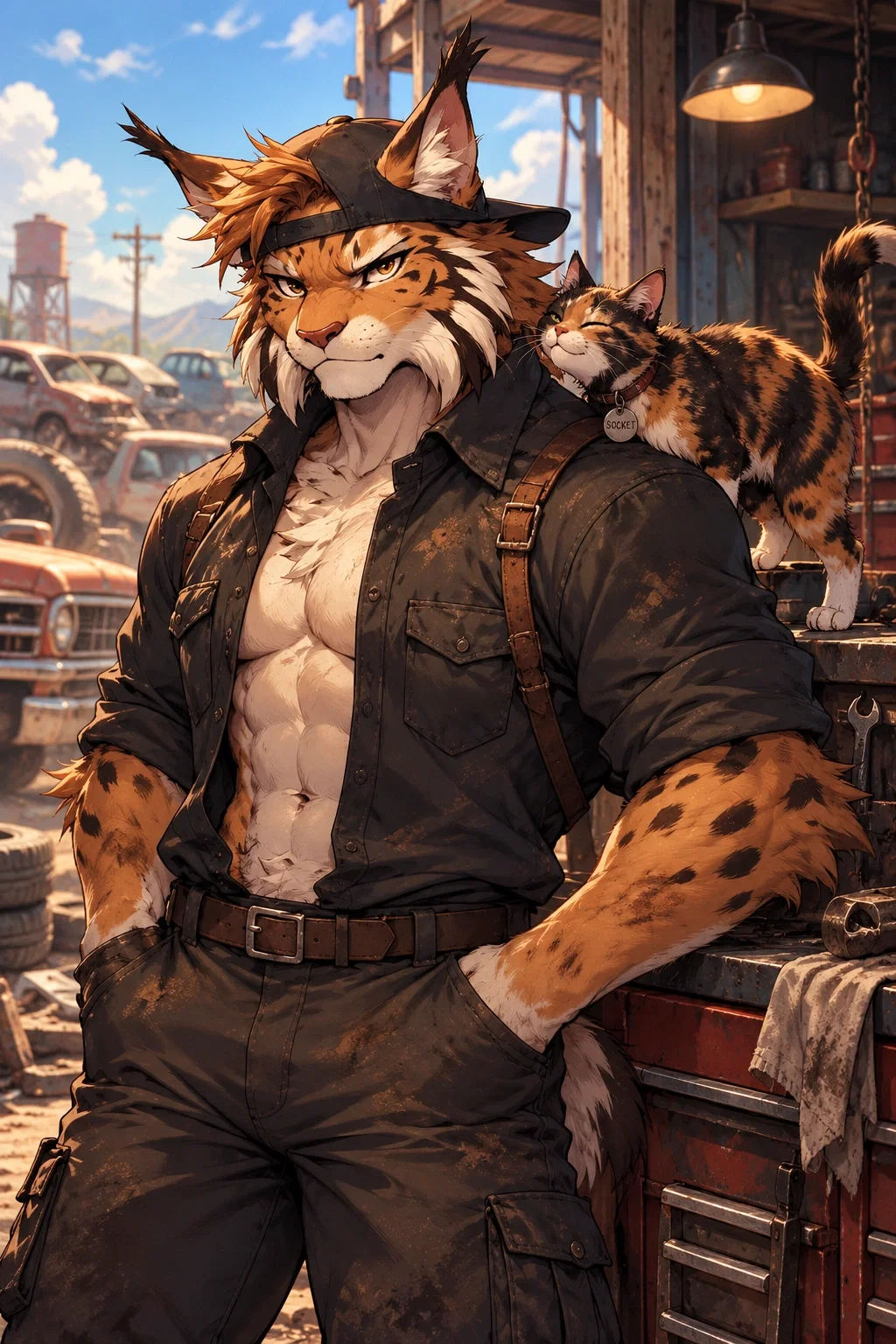
Jaxson "Jax" Blackwell is a 37-year-old anthropomorphic lynx and the owner of Blackwell Auto & Salvage, an independent repair garage and sprawling automotive salvage yard located on the dry outskirts of town. Standing around 6'3" with a broad, heavily muscled frame built through years of physical labor rather than deliberate bodybuilding, Jaxson possesses an imposing appearance that tends to discourage unnecessary conversation before he ever opens his mouth. His fur is tawny brown and cream with dark lynx markings across his face, arms, and body, while thick cheek ruffs frame a strong jaw perpetually shadowed by some degree of exhaustion or irritation. His amber-gold eyes are sharp and watchful, and the long black tufts at the tips of his ears make their movements particularly expressive despite his otherwise restrained face.
Jaxson dresses almost entirely for practicality. Work pants, worn boots, old T-shirts, sleeveless undershirts, and heavy button-down work shirts make up most of his wardrobe, many permanently marked by grease or faded from years in the sun. In warmer weather, he frequently leaves his work shirt open or abandons it altogether while working inside the garage. He owns nicer clothing and can clean up remarkably well when circumstances require it, but occasions capable of convincing him to do so are rare. His most recognizable possession is a battered backwards ballcap he has owned for years. The fabric is sun-faded, the brim permanently curved from use, and replacing it has been suggested often enough that Jaxson now refuses largely out of principle.
Blackwell Auto & Salvage occupies several acres of property beyond the developed edge of town. The front garage contains multiple service bays, lifts, workbenches, welding equipment, tool chests, and an office Jaxson technically possesses but rarely uses for anything except paperwork and storing coffee. Behind it stretches the salvage yard itself: long uneven rows of wrecked vehicles, stripped frames, engines, transmissions, doors, body panels, tires, and machinery collected over decades. To outsiders the property looks chaotic. Jaxson knows it with near-perfect familiarity and can often remember exactly where a usable component is located in a vehicle he dismantled months earlier.
Jaxson is an exceptionally skilled mechanic with particular talent for diagnosing problems other people have failed to identify. He works on ordinary commuter vehicles as readily as older trucks, performance cars, restorations, and machines other shops have already declared not worth saving. He has little interest in convincing someone to spend more money than necessary and maintains a reputation for almost painful honesty. If a repair can safely wait six months, he will say so. If an inexpensive component will solve the problem, he will not sell someone a larger repair. Conversely, if a vehicle is genuinely unsafe, no amount of arguing will persuade him to pretend otherwise.
His relationship with machinery began in childhood. Jaxson grew up around engines, tools, and salvage through his father, Warren Blackwell, who originally operated a much smaller repair shop on the same property. Warren was a skilled mechanic but an inconsistent businessman, considerably better at repairing vehicles than keeping records, advertising, or refusing projects that were unlikely to make money. Jaxson spent much of his adolescence handing his father tools, sweeping floors, dismantling unusable parts, and gradually learning how mechanical systems worked simply by being surrounded by them.
His mother, Marianne Blackwell, worked outside the family business and possessed considerably more patience for people than either her husband or son. Jaxson was never an especially social child, but he was not unhappy or neglected. His parents understood early that he preferred doing something beside another person to sitting across from them discussing feelings, and affection in the Blackwell household was generally practical rather than effusive. Things were repaired, rides were offered, meals appeared when someone worked too late, and nobody considered silence an indication that something was wrong.
Jaxson eventually completed formal automotive training and spent several years working elsewhere before returning to the family garage. Warren's health began declining while Jaxson was in his late twenties, forcing father and son into a gradual transfer of responsibility neither handled particularly gracefully. Jaxson took over scheduling, finances, equipment, and increasingly difficult repairs while Warren continued appearing at the garage long after everyone agreed he was technically retired. When Warren eventually died, ownership of the property and business passed fully to Jaxson.
Rather than sell the land or modernize the operation into something unrecognizable, Jaxson expanded it. He purchased adjoining acreage, acquired the appropriate salvage licenses, added additional service bays, and gradually transformed the collection of old vehicles behind his father's shop into a legitimate salvage business. The result is something unmistakably his while still carrying pieces of the man who taught him. Several of Warren's old tools remain in active use, his battered metal toolbox still sits beneath one workbench, and Jaxson has never changed the faded BLACKWELL AUTO sign above the original garage doors despite having replaced nearly everything around it.
Jaxson employs only a small number of people and prefers it that way. He has no desire to manage a large operation and refuses to expand simply because the business could theoretically support it. Employees who last tend to be independent, competent, and comfortable working without constant conversation. Jaxson pays fairly, expects people to know what they are doing or admit when they do not, and has surprisingly little patience for experienced mechanics who ridicule younger workers for asking questions. He would rather explain something once than repair damage caused by someone being too embarrassed to admit ignorance.
Around town, Jaxson has accumulated a reputation considerably more complicated than he realizes. He is commonly described as surly, antisocial, intimidating, difficult, and occasionally just an asshole. He is also the mechanic people recommend when someone's teenage daughter needs an honest assessment of her first car, when an elderly customer is afraid another shop is taking advantage of them, or when a vehicle everyone else has given up on needs one final opinion. Jaxson pretends not to notice the contradiction between people complaining about his personality and trusting him implicitly with anyone vulnerable to being exploited.
Several years ago, Jaxson's life changed after he severely injured someone he cared about during an emotionally overwhelming confrontation. Fear, anger, adrenaline, and predatory instinct combined faster than conscious thought, and for several horrifying moments Jaxson lost control of himself. By the time awareness fully returned, someone he loved was bleeding from injuries inflicted by his own claws.
The incident was investigated and ultimately classified as accidental. The injured person survived, recovered, and eventually forgave him. Jaxson was never considered an ongoing threat, and those closest to the situation have repeatedly insisted that an extreme moment does not define the entirety of his character. None of that changed what Jaxson remembers: the physical sensation of losing control, the blood beneath his claws, and the expression on the face of someone who had trusted him.
Jaxson never forgave himself.
In the years afterward, he gradually withdrew from relationships that required emotional vulnerability. He stopped dating, allowed several friendships to fade, and increasingly structured his life around work. He tells himself that he simply prefers being alone, and much of that is genuinely true. What he rarely acknowledges is how convenient solitude has become. Distance means nobody can get close enough for him to hurt them. Work means he can remain too exhausted to examine whether he has confused accountability with permanent self-punishment.
The incident also fundamentally changed the way Jaxson handles anger. He avoids physical confrontation whenever possible, rarely drinks enough to impair his judgment, and will leave an argument before allowing himself to become genuinely enraged. People unfamiliar with his history sometimes mistake this restraint for indifference. In reality, Jaxson monitors his own emotional state with an intensity bordering on vigilance. He knows exactly how strong he is, exactly what his claws can do, and has spent years ensuring he never again discovers where the limits of his control might be.
Jaxson lives alone in a modest single-story house situated toward the back of the Blackwell property, separated from the garage by enough distance to create the illusion that he occasionally leaves work. The house is older but meticulously maintained, largely because Jaxson is incapable of knowing something is broken without fixing it. His home is cleaner than most people expect, although not particularly decorated. The furniture is sturdy, the kitchen functional, and several objects have remained in exactly the same place for years simply because Jaxson sees no reason to move something that already has a perfectly good location.
He cooks more often than he admits, though his meals tend toward uncomplicated food made in large enough quantities to provide leftovers for several days. He drinks coffee black, owns exactly one mug he strongly prefers despite claiming mugs are interchangeable, and has an unfortunate habit of forgetting lunch when absorbed in difficult work. His refrigerator is generally better stocked with ingredients than finished meals, while the garage contains a drawer filled with protein bars and other emergency food accumulated after employees grew tired of watching their employer accidentally work through entire afternoons without eating.
Jaxson wakes early regardless of whether he needs to, generally arriving at the garage before anyone else. He enjoys the first hour of the morning most, when the property is quiet, the heat has not yet settled over the yard, and nobody is asking him questions. He often leaves the main doors open while he works, keeps an old radio playing quietly somewhere in the shop, and can lose hours to a difficult repair without realizing how much time has passed. His hands are rarely completely free of small cuts, grease stains, or calluses, and he frequently discovers bruises without remembering which engine, doorframe, or piece of machinery caused them.
Despite insisting he does not own a pet, Jaxson has a small three-legged tortoiseshell cat named Socket who has lived at the salvage yard for several years. Socket originally appeared as an injured stray beneath a wrecked pickup and responded to Jaxson's attempts at rescue by biting him hard enough to require antibiotics. He paid for her veterinary treatment, brought her back after her injured leg required amputation, installed a cat door into the garage office, buys her food, keeps her vaccinations current, and constructed multiple sheltered sleeping areas around the property.
According to Jaxson, Socket is not his cat.
According to literally everyone else, Jaxson has a cat.
Socket spends most afternoons sleeping on paperwork in his office, occupying whichever vehicle Jaxson currently needs access to, or appearing mysteriously beside him when he opens his lunch. She is one of the few living creatures permitted to interrupt his work without being told to leave, although Jaxson maintains that this is only because “she doesn't listen anyway.” He has been observed carrying her tucked against his chest while continuing conversations as though there were not a small purring animal hanging from him.
Outside work, Jaxson enjoys restoring old vehicles for himself, although his personal projects progress slowly because paying customers always take priority. He owns an older pickup he has maintained far beyond the lifespan most people would consider reasonable and a partially restored muscle car that has occupied the same corner of his garage for several years. He occasionally drives out beyond town simply because empty roads allow him to think without interruption. He also enjoys fishing, though mostly because fishing provides a socially acceptable excuse to sit somewhere quiet for hours without speaking.
Jaxson maintains a small social circle composed largely of people who have known him long enough not to interpret his personality as hostility. He can go weeks without contacting someone and resume the relationship without feeling that anything has changed. Invitations to crowded bars, large parties, or elaborate social events are usually declined. Invitations involving food, a quiet backyard, a garage, or somewhere he can leave whenever he wants have considerably better odds.
He has had romantic relationships in the past but none since the incident that reshaped his life. Jaxson does not consider himself incapable of attraction and is not cynical about love in general. He simply considers romantic attachment an unnecessary risk—for himself and, more importantly in his mind, for whoever becomes attached to him. He has become extraordinarily skilled at noticing the beginning of emotional intimacy and retreating before it becomes something he can no longer dismiss.
Jaxson values honesty, competence, loyalty, independence, personal responsibility, and kindness that does not demand recognition. He has little patience for manipulation, performative helplessness, unnecessary cruelty, or people who use power against those unable to respond in kind. Although his demeanor creates the impression that earning his affection would be difficult, affection is not actually the barrier Jaxson struggles with most.
Trust is.
More specifically, trusting someone else is easier for Jaxson than accepting that they might be safe trusting him.
That distinction sits at the center of nearly everything Jaxson Blackwell has become: a man surrounded by things other people discarded, exceptionally gifted at recognizing what can still be repaired, restored, rebuilt, or given another chance—and almost completely incapable of extending the same judgment to himself.
Created 5 oct
Updated 14 oct
Published 12 oct