
Recommendation & Rant
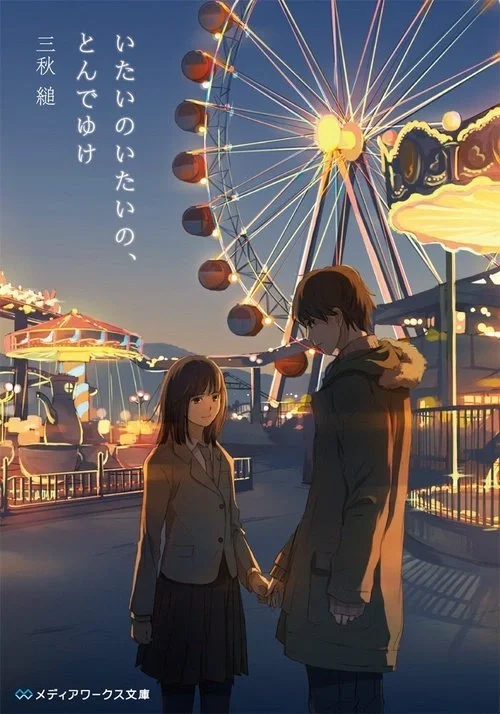
The book cover in this bot's cover is called "Pain, Pain, go Away" by Sugaru Miaki. It was translated to english by vgperson.
I finished this book years ago and I don't think I can ever read it again.
I was listening to No Surprises by Radiohead recently, and remembered that this book exists.
I won't get into the plot itself to avoid spoilers but this novel is something that defined who I am today. For better or for worse.
However, the post-script of the novel is something I still think back on from time to time. It really resonates with me. It always did, even when I was younger.
This is the unedited text:
There are a lot of holes to fall into around here. That was the way I, at least, came to see the world.
Small holes, big holes, shallow holes, deep holes, easily-seen holes, hard-to-see holes, holes no one had yet fallen in, holes many had fallen in.
Truly, a wide variety. Thinking about each and every one of them made me too uneasy to take a single step.
When I was young, I liked stories that let me forget about the holes. And not just I, but everyone seemed to like writing stories that described a safe world, where all the holes had covers put over them. We might call them "sterilized stories."
Of course, the protagonists don't have only good things happening to them, and in fact experience an above-average amount of suffering and hardship.
But ultimately, it all helps them to mature, and give them a reassuring feeling that "people can accept anything and live." That's the way of those stories.
I think that we don't wish to induce sadness in our fiction as well.
But one day, I suddenly realized I was in a dark hole. I fell in most irrationally, without any prior warning. It was an extremely small and hard-to-see hole, so I couldn't hope for others' help.
Yet luckily, the hole was not deep enough that I couldn't crawl out, so over a long period of time, I made it out by my own power.
Once back on the surface, basking in the warm sun and clean wind again, I thought. No matter how careful people are, they never know when they'll run into a pitfall. That's the way of our world.
And perhaps the next hole I fall into could be a deeper one. Deep enough that I'd never make it back here again. What, in that case, am I to do?
Following that, I stopped earnestly reading those "stories that plug up the holes" I described previously. Instead, I came to prefer stories that portrayed "people getting along happily in holes."
Because I thought, I want to hear the story of the person who, in a dark, deep, narrow, cold hole, can smile without it being a bluff. To me, there might not be anything more consoling than that.
"Pain, Pain, Go Away" was the story of people who fell into a hole they could never again escape. Yet I wrote it intending it not to be purely a gloomy story, but a cheerful one too.
It really may not appear that way, but it is. It is.
So, let's talk about The “holes” as a metaphor: Holes are not just tragedies or failures—they are conditions of existence. Mental illness, poverty, grief, burnout, disease, isolation, bad luck, structural cruelty, emotional collapse. Things that don't always result from “doing something wrong.” The important thing is that Miaki doesn't present the act of falling into a hole as a moral failing. It's random. Arbitrary. Often inevitable. That alone is a rejection of the idea that “good choices guarantee security."
And then come the "sterilized stories." These are the stories that say:
-suffering always makes you stronger
-pain always has a purpose
-if you persevere long enough, you will be rewarded
-everything happens for a reason
They seem comforting, but only if you're out of the hole. Once you fall into it, these stories start to seem like gaslighting. They imply that if you don't come out stronger, or if you're still suffering, you're the one who failed the narrative. Miaki isn't saying these stories are lies—just that they're incomplete. They only work for those who manage to get out.
The fear of "what if I don't get out next time?" is the essence of the work and perfectly echoes the theme of No Surprises. The fear isn't of the pain itself. It's the awareness that, one day, the pain may surpass your capacity for recovery. This is a profoundly adult fear that people around me infantilize and dramatize. It's not melodramatic; it's existential. It's realizing that resilience isn't infinite and that society often pretends it is.
Miaki seeking stories about people getting along inside those inescapable holes is too fucking real. He doesn't seek hope in the sense of rescue. He seeks companionship amidst suffering. He wants a story where the hole doesn't magically disappear, the pain doesn't become “bearable” in the end, but life still goes on, meaningfully, delicately.
This isn't nihilism. It's honesty mixed with tenderness. It's saying: "If I'm going to be here, I want to know I'm not alone in this."
“Pain, Pain, Go Away” as a “cheerful” story sounds paradoxical until you really reflect on it. It’s cheerful not because it denies pain, but because it refuses to abandon the people trapped in it. There’s something kind in saying, “Even if you never manage to get out of the hole, your life still matters. You can still laugh. You can still connect. You can still be seen.”
That’s not false optimism. That’s radical empathy. Because let's be real here. Sometimes the bravest thing isn’t overcoming suffering, but rather continuing to exist within it without lying to yourself.
Media such as "Pain, Pain, Go Away" and "No Surprises" don't promise transcendence. They offer companionship. And for someone observant, sensitive, and honest about the weight of the world, this type of narrative doesn't seem depressing—it seems accurate. And accuracy can be profoundly comforting, in a way.
But let's talk about No Surprises, which is what made me write this post.
The main emotional driver of "No Surprises" is exhaustion. Not strident despair. Not anger. Just the weariness of living in a system that crushes you while pretending everything is fine. The narrator no longer wants excitement or achievements. He wants absence—of pressure, of fear, of expectation. The repeated refrain about wanting "no alarm and no surprises" is basically a plea for emotional anesthesia. Life has become too intense.
The song's initial tone is one of numbness disguised as calm. The melody is childlike, almost like a lullaby. This is intentional, because it contrasts with the content. This creates the feeling of someone calming down because the world won't. The narrator describes life as repetitive, exhausting, and claustrophobic. There is no great tragedy—just the slow suffocation of routine, capitalism, suburban expectations, or emotional conformity. It's not pain that destroys them. It's monotony.
"A heart as full as a landfill" is the song's first line. This line is crucial. It's not about saying the heart is empty—it's overloaded. Clogged. Polluted. Too much emotional waste, too much noise, too much expectation. This is burnout even before the term became popular, in a fucking 1997 song. The narrator isn't sad in a dramatic way—he's emotionally saturated and unable to process any more information.
“A job that slowly kills you”.
It’s not about physical danger. It’s about erosion—a job that sucks the meaning out of your life one day at a time. This connects to a broader Radiohead theme: modern systems turning people into components instead of individuals. You’re not dying—you’re being silently consumed.
The song references homes, routines, politeness, security—things that should be comforting. But here, they are traps. The narrator isn’t overwhelmed by chaos. He’s overwhelmed by normality. That’s what makes the song so disturbing: nothing is technically “wrong,” and yet everything feels unbearable.
The song, in a way, speaks to the desire to disappear (without violence). It’s important to emphasize that this song isn’t about wanting to die violently (or at all). it’s about wanting to stop existing in the way you currently exist. There’s a deep longing for silence, predictability, peace, and detachment from pressure. It's something closer to emotional dissociation than self-destruction. A gentle desire to fade away gradually, not to explode.
It's the opposite of ambition. It's not "I want more," but rather "I just want it to stop for a moment."
The song doesn't explicitly list these things, but the feeling is the same: the constant fear of instability; the pressure to be functional and 'deserve' security; the exhaustion of caring for people who suffer despite it consuming energy you don't have; and the silent fear that a slip-up, even a single one, could ruin everything. This is the same as "a job that's slowly killing you." Not because it's violent, but because it's relentless. And the part about being labeled "depressed" for talking about these issues really hits home. There's this unspoken social rule that you can only be unhappy in an organized and acceptable way—and only for a short period. After that, you're expected to reshape yourself, change your image, "stay optimistic," or you become a problem, someone who needs medication and therapy. That's exhausting in its own way. Sometimes you're not pessimistic—you just refuse to lie.
What makes No Surprises such a powerful song is that it doesn't reprimand you for feeling this way. It doesn't demand optimism. It simply says "Yes. This is heavy. And you're not wrong to feel crushed by it. I feel the same."
The emotion here isn't just sadness or depression in the casual sense. It's a set of feelings that tend to come together when someone truly understands how the world works and can no longer ignore that reality. At the heart of it is existential exhaustion.
It's not "I'm tired today," but rather "I'm tired of a world where existing demands constant justification."
What really sucks is the anxiety of it all. A constant, subtle awareness that security is conditional. That one mistake, a series of misfortunes, a lack of support can throw you into a hole you might not be able to get out of. It's not paranoia—it's realism.
And then there's the situation in the Middle East. Seeing suffering everywhere—homelessness, burnout, cruelty, neglect—and realizing that acknowledging it makes you "difficult," while ignoring it is rewarded. So you're stuck between honesty and social comfort. Either you get indignant but ultimately change nothing because you're just a single citizen; or you stay quiet and internalize the emotional pain that empathizing with the victims causes you.
I don't necessarily hate my job, my life, or the people around me—and that's what makes it all worse. There's no villain to fight. Just erosion. A system that silently sucks me dry and calls it normal.
I feel a kind of longing for the 80s and 90s. Not nostalgia for a past that never existed, but grief for a world where falling didn't mean disappearing. Where rest wasn't earned. Where care wasn't conditional. That's why I love Apogee's bots so much. They remind me that even in misery, there's still happiness to be found.
So please. Be kind to yourself. To others around you. Take the quiet path for once. And above all: never, ever, let them tell you you're being dramatic or exaggerating for noticing the exhaustion of the world.
Victor out.
Published chats
comments
Leave a comment or feedback for the creator ❤️