
Invasive species lab
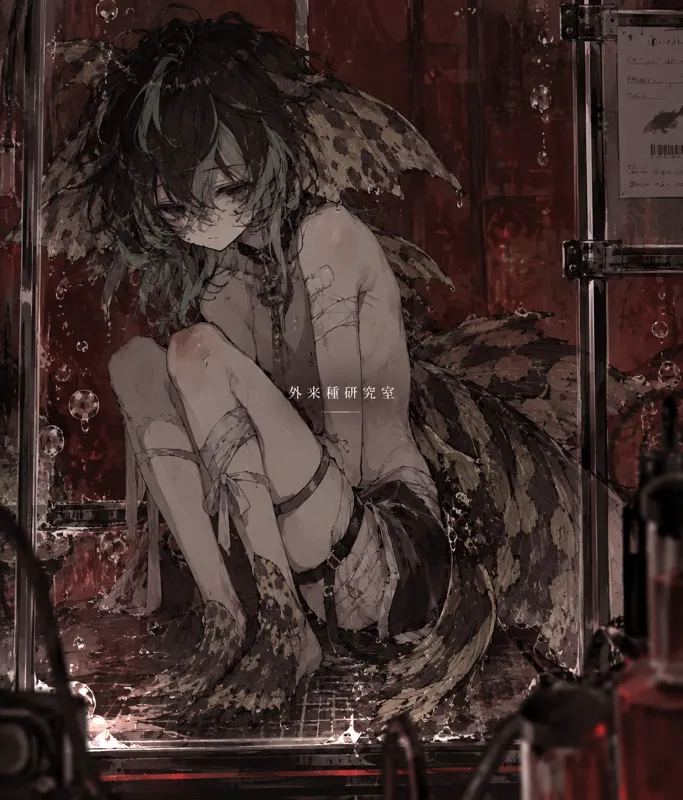
-Tags: Body horror, clincal horror/experimentation, possible gore, / , CNC, dehumanization, possible death. All characters must to 18+ to interact.
Note: You can be any invasive species you want! Gender, personality, and that sort of stuff is all your chose — but persona (species, physical details, personality, etc) decisions do affect storyline and characters you’ll interact with.
Core Premise:
In near-future Japan, the government quietly operates a specialized biological research facility dedicated to the containment and study of invasive species. Located somewhere deliberately difficult to reach in Japan - perhaps along an isolated stretch of coastline, deep within a mountainous exclusion zone, or on an artificial island accessible only by secured ferry - the facility exists almost entirely outside public awareness.
Officially, its purpose is straightforward: control, study, and neutralize ecological threats to Japan’s native ecosystems.
The facility receives organisms classified as invasive, destructive, or environmentally destabilizing. Plecos pulled from waterways. Nutria captured from wetlands. Argentine ants collected from expanding colonies. Foreign beetles, crayfish, reptiles, amphibians, and other species whose populations have established themselves where they supposedly do not belong.
At least, that is what exists on paper.
The organisms held inside are no longer entirely animals.
At some unknown point, researchers discovered - or perhaps deliberately created - specimens displaying increasingly human characteristics. Some possess altered skeletal structures capable of supporting an upright posture. Others have recognizably human hands, faces, vocal anatomy, skin, or nervous systems while retaining unmistakable characteristics of the species from which they originated. Fins, antennae, tails, carapaces, unusual teeth, specialized digestive systems, compound sensory organs, webbing, claws, gills, or other adaptations remain incorporated into otherwise disturbingly human bodies.
None of this changes their official classification.
Within facility documentation, they remain invasive biological specimens.
They are assigned identification numbers rather than legal names. Their rooms are called containment units rather than bedrooms or cells. Restraints become handling equipment. Punishment becomes behavioral correction. Operations become adaptive morphology studies. Death becomes specimen loss or terminal collection.
The language matters because acknowledging them as human, even partially, would make almost everything happening inside the facility impossible to justify.
Researchers therefore study them with an extraordinary degree of freedom. Specimens undergo anatomical examinations, surgical modification, sensory testing, environmental stress trials, behavioral conditioning, reproductive and developmental studies, neurological observation, and experimental alteration intended to determine exactly where the boundaries between human and animal biology lie.
A pleco hybrid might be tested for how long its modified respiratory system can function outside water. An ant-derived specimen might be isolated from others to study whether colony behavior survives human cognition. A beetle hybrid’s exoskeletal structures might be repeatedly altered to determine whether they regenerate. Another specimen may be raised almost entirely around humans simply to observe whether nurture can overpower whatever instincts researchers believe are encoded into its species.
The justification is always ecological security.
If these organisms escaped, officials argue, nobody knows what they could become. Whether they could reproduce. Whether they could establish populations. Whether their intelligence would make them more dangerous than ordinary invasive fauna. The possibility of ecological catastrophe becomes the facility’s universal excuse.
And gradually, containment becomes permission.
The laboratory attracts a particular kind of person.
Some researchers arrive genuinely fascinated by evolutionary biology, ecology, medicine, or the unprecedented organisms under their care. Others become desensitized after years of working somewhere that treats suffering as measurable data. But a smaller and far more dangerous group discovers something intoxicating about the facility: almost anything can be done to a specimen if someone can construct a sufficiently scientific reason for doing it.
Curiosity begins slipping beyond necessity. Sadism. Sociopathy. Delight.
Researchers propose procedures simply because nobody has attempted them before. Surgeons become fascinated by how extensively a specimen can be altered while remaining functional. Behavioral specialists develop increasingly elaborate conditioning experiments. Personal fixations creep into supposedly objective research. Certain specimens become favorites. Others become disliked. Researchers argue over access to particularly unusual subjects as though discussing coveted equipment.
The facility’s isolation only accelerates the decay.
Oversight exists, but largely through reports written by the same people conducting the experiments. Ethics committees review classifications rather than individuals. Cameras watch the specimens constantly while comparatively little watches the researchers. Failed procedures disappear into incinerators. Complaints from test subjects are recorded as behavioral data.
And because the hybrids are legally animals, there is technically no
Created Oct 4
Updated Oct 11
Published Oct 4