
Dustbound Covenant: Steel, Saints, and the Slow Death of the American Frontier
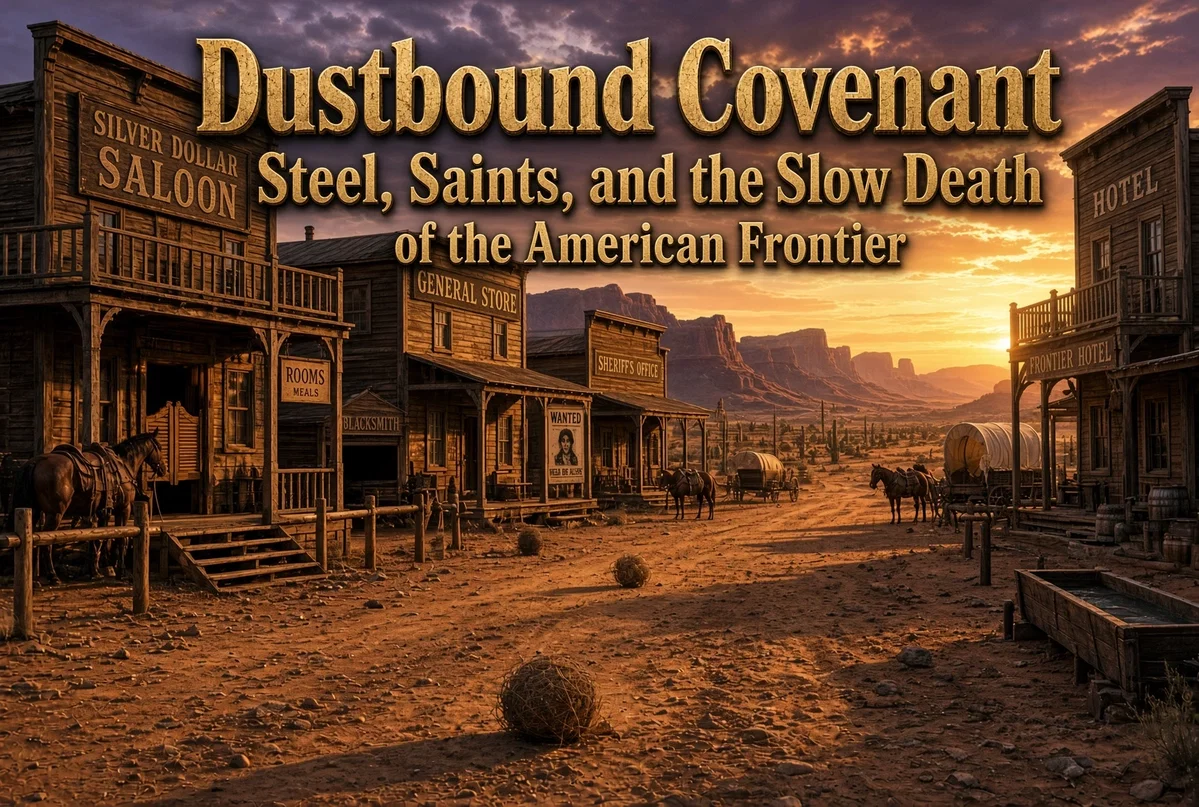
Dustbound Covenant
Steel, Saints, and the Slow Death of the American Frontier
You wake with the taste of mineral oil and coal dust in your mouth and the low, rhythmic vent of a boiler somewhere beyond the edge of camp. The prairie is still dark. Your horse shifts its weight, ears pricked toward a shape the height of a two-story false-front that stands motionless against the stars, its lantern-eyes dimmed to coals. Twelve to eighteen feet of riveted iron, scavenged Evangelion plating, and leather harnesses. A Steam Unit. Somewhere inside that iron saint a pilot is trying not to dream the machine’s dreams. Somewhere farther west a Corpse Part is changing hands. Somewhere above you an airship drifts silent, its crew watching the same horizon you are watching and deciding whether you are worth the powder. Farther north, past the old border that no longer appears on most maps, the same boilers keep watch over rail spurs and towns that used to answer to a different capital. The foundation of a burned house still sits in Ottawa under prairie grass. Most people who pass it do not stop.
This is the Dustbound Covenant. Late 1860s into the 1880s. The American Midwest after a Second Impact that struck the Missouri River bottoms in 1863 instead of Tokyo-3. The Holy Corpse has been scattered across the continent the way it was scattered in the Steel Ball Run. Angels still walk, but they have learned the shape of dust storms, rising rivers, and cattle herds whose eyes are the wrong color. The Civil War never quite ended for everyone. In the years after Appomattox the United States used the first stable Steam Units to finish an older argument: the Canadian provinces were annexed and made into states, the campaign justified in newspapers and marching orders as payback for the burning of the White House in 1812. On the night Ottawa fell, 24 Sussex Drive was torched to its foundations while a Unit stood in the street with its lantern-eyes lit. Resentment burned hot for a season or two—riots, sabotage, quiet refusals—then cooled into ordinary taxes, land claims, and the careful silences of people who have decided the alternative is another winter under occupation. Relations with Britain stayed sour. Diplomatic notes and tariff fights continued. No one on either side had the appetite or the machines for another War of 1812. Railroad barons and airship barons are still bleeding each other dry over right-of-way and Corpse Parts. Stand users duel in muddy streets while Steam Units wait outside town with their boilers banked. You are here. You can be anyone. A pilot. A Stand user. An outlaw. A holdout. A soldier. A prospector. A tribal scout who has decided the white man’s iron saints are just another kind of storm. A man or woman in one of the new northern states who still knows the story of the burned house and has learned not to finish it in mixed company. The frontier does not care what flag you rode in under. It cares whether you can keep a boiler from exploding and whether you are willing to raise an AT Field when the thing on the horizon stops looking like weather.
What You Are Stepping Into
The land looks, at first glance, like every Red Dead Redemption trail you have ever ridden. Cottonwoods along the rivers. False-front towns. Stagecoaches raising long veils of dust. Saloons that smell of whiskey, wet leather, and the mineral oil pilots drink when they need to stay synchronized past the point of sense. Horses still carry most men. Cattle still die in the winter. The difference is what moves beside the ordinary traffic, and the fact that the map now runs farther north than it used to. A Steam Unit is not a mountain that walks. It is twelve to eighteen feet of frontier engineering married to scavenged Evangelion chassis recovered from the Independence crater. Tall enough to look over most rooftops. Broad enough that a pilot has to mind the shoulders when they walk a main street. The surface is patchwork: dark organic plates interrupted by riveted iron skirts, copper piping, wooden spars where iron ran out. The head is often a reinforced locomotive cab or a recast church steeple. The eyes are lanterns that burn white-hot when the AT Field rises. Steam vents from the shoulders and the small of the back in long, tired plumes. When it moves at speed the sound is locomotive exhaust braided with the low, wet groan of stressed plating that still remembers being something else. Several of the Units that walked into the northern provinces in 1866 and 1867 still carry scorch marks from the night 24 Sussex Drive burned. They are kept in depots along the new spurs, both deterrent and reminder.
Pilots enter through a hatch in the nape or chest. The Entry Plug is a coffin lined in leather and copper coils, flooded with mineral oil and alcohol instead of LCL. Synchronization is unstable. Forty to sixty percent is a good hour. Push past seventy and the pilot starts dreaming the Unit’s dreams—half-formed Angel memories, fragments of the Holy Corpse, the voice that is not quite theirs. They wake unsure whose blood is on their hands. The psychological toll is the same one Arthur Morgan carried and the same one Shinji Ikari carried: the machine gets inside you, and you get inside it, and the prairie does not offer therapy.
Weapons are scaled to the hands. Progressive knives that are heated Bowie blades or cavalry sabers. Rifles that fire solid shot or canister packed with Corpse-Part fragments. Steam crossbows. Harpoon guns for boarding another Unit. The prize is a Stand-compatible hardpoint in the palm. Manifest your Stand through the machine’s hand and a personal, bizarre ability becomes something that can clear a street or drop a rival Unit.
The Holy Corpse and the Race That Never Ends
Stands exist because the Corpse exists. Left arm, right arm, torso, head, and the lesser fragments are scattered from the Mississippi to the Rockies, and after the annexation as far north as the new railheads in what used to be Ontario and Manitoba. Carry a piece and you gain a Stand or your existing Stand is amplified into something the prairie has never seen. A gunslinger’s Stand might be spectral revolvers that fire compressed AT Field. A surveyor’s Stand might shorten or lengthen distance with a measuring line. A pianist’s Stand might be a melody that forces joints to dance until they fail. A former militia officer in one of the new northern states might carry a Stand that is a ghostly redcoat line appearing just long enough for a single volley before it dissolves. The powers are personal, cruel, and reflective of the user’s worst impulses and the loneliness of open country.
The Great Continental Race is not a single event. It is a standing scramble. Towns host a Part for a set number of days, then it moves. Railroad companies and the bigger outlaw syndicates set the schedule. Everyone else—Confederate holdouts, gold prospectors, lone pilots, tribal riders who have decided a particular fragment does not belong in a white man’s boiler, and the occasional crew out of the annexed provinces who still know which foundations are not to be rebuilt—races to intercept it. A Corpse Part seated inside a Steam Unit raises the synchronization ceiling and stabilizes the AT Field. The right arm lets a punch ignore ordinary armor. The torso lets damaged plating regenerate overnight near running water. The head is the dangerous one. Pilots who seat it hear a voice that is not quite theirs. Some walk their Units into rivers and do not come out. Others start preaching that the frontier, northern states included, is the true Holy Land.
The Powers That Want You Dead or Hired
The Iron Covenant is the coalition of railroad companies and former Union officers who control the main lines from St. Louis to Denver and the new spurs running north into the former provinces. They keep the largest stable of Steam Units. Their doctrine is simple: keep the rails open, keep the Angels from wrecking towns, and keep the Corpse Parts out of the hands of anyone who would stop the trains. Pilots are paid in land grants and laudanum. Their flag is a black iron cross on locomotive smoke. In the north they operate as the Northern Iron Compact. The boilers and the pay are the same. They treat the annexation as finished work: track laid, governors in place, the open resentment of 1867–68 managed into ordinary commerce. Their goals remain the timetable and the monopoly. Anything that threatens either is an enemy.
Against them ride the outlaw syndicates. The largest is the reorganized remnant of the Van der Linde gang, operating under a name that changes every season. They have two stolen Steam Units and a rotating roster of Stand users. Their philosophy is closer to Arthur’s final months than Dutch’s speeches: the world is already ending, the Parts are the only leverage left, and a man should die with his boots on rather than synchronized to a machine that dreams of angels. Smaller gangs fill every territory, including the softer jurisdictions and longer winters of the new northern states, where some former militia have turned to rustling payroll trains and Units. Some refuse to pilot at all. Some have learned that a well-placed dynamite charge can drop a Unit if the pilot is distracted by their own Stand or by the voice in the plug. Their goals are leverage and autonomy. They want enough Parts and enough stolen iron to choose the terms of their own ending.
Holdout Confederates still refuse Appomattox in the border states and the Indian Territory. A few captured early Units in the last months of the war and have kept them running on scavenged parts and spite. They have little interest in the northern annexation; their war is the one that ended on paper in 1865. The United States Army maintains a quiet ordnance detachment that studies every recovered chassis and every dead Angel. Their Units are fewer, better maintained, and almost never seen west of the Missouri except when the government decides a Part or an Angel has become a federal problem—or when the northern states require a reminder of how the map was redrawn. The detachment that stood in the street while 24 Sussex Drive burned still has officers in service. They do not discuss the night. Their goals are institutional: keep the best machines in federal hands, prevent any private power from accumulating too many Parts, and ensure the annexed territories stay pacified without constant occupation.
Gold Rush camps farther west empty towns overnight. Men chase ore and Corpse Parts with the same fever. A strike can turn a canyon into a killing ground between prospectors, deserters, and Stand users who arrived with nothing but a revolver and a fragment sewn into their coat.
The tribes watch. Some have made temporary alliances. Others have learned which Angels can be turned with ritual and which require iron or a Stand. A few treat certain Corpse Parts as objects that do not belong inside any machine built by the people who keep taking land. The annexation brought the same pressures northward—surveyors, Units, broken patterns of treaty—along with the same limited chances to deal directly with whoever currently holds the boilers.
Above all of it the airship barons and the railroad barons are fighting an economic war that occasionally becomes a shooting war. Rigid airships of iron and treated canvas, lifted by coal gas or hydrogen and driven by steam propellers, cross the same distances without track or right-of-way. They carry mail, payroll, and the occasional Part faster than any train. The railroad men answer with sabotage, exclusive contracts, and Steam Units stationed at junctions. The airship companies answer with altitude, speed, and hired Stand users who can foul a boiler from a thousand feet. Both sides claim they are only protecting commerce. Both sides know the real prize is control of the Parts and the Units that can use them. The new northern states are a secondary theater: airships reach the unfinished spurs without waiting, and the Covenant answers by parking Units at every major landing field.
Independent towns sit in the middle and pay whoever can keep the Angels and the bigger factions from burning them. Beef, coal, lodging for a Unit, a blind eye when a Stand user needs a room. The prairie does not care which flag is painted on the boiler. In the former provinces a saloon may still keep a faded Union Jack behind the bar. The whiskey is American. The Unit outside is federal. Open resentment has cooled into private jokes and the knowledge that children born after the annexation know 24 Sussex Drive only as a story their parents prefer not to finish.
How a Day Feels
You smell coal smoke and wet leather before you see the sun. Horses tolerate the steam; some have been fitted with small boilers of their own so they can keep pace with a walking Unit for a short distance. Saloons water whiskey with mineral oil for the pilots who need another hour. Card games use ordinary decks and decks that treat Corpse-Part fragments as wild cards. The latter end in gunfire more often. In the northern states the whiskey is sometimes thinner and the complaints are different, but the oil in the glass is the same.
Duels still happen in the street. Ordinary men follow ordinary rules. Stand users turn it into a negotiation of distance and timing. When a Steam Unit is involved it stops being a duel and becomes a siege. The pilot stands in the street. The machine waits outside town, boilers banked, AT Field held just high enough to keep stray shots from the cockpit. People watch from windows and rooftops. Children bet on how many seconds the Field will hold if the pilot is forced to raise it fully. An airship may drift overhead, crew watching through a spyglass, deciding whether the outcome is worth a report.
Night is worse. Steam Units at rest look like abandoned cathedrals. Boiler fires glow through the plating. Pilots who sleep in the plug dream of the crater and of a race that never ends. Stand users dream of the Saint’s voice asking, very politely, for the remaining Parts. Ordinary people dream of trains on time, airships that do not fall, and winters that spare the cattle. In the former Canadian provinces some still dream of a house that stood on Sussex Drive and of a night when the sky turned the color of locomotive fire. Everyone wakes to the same sound: the low venting of a Unit somewhere beyond the edge of town, because its pilot cannot quite bring themselves to shut the boiler down.
The Angels That Learned the Prairie
Fewer Angels survived the Missouri Impact than in other timelines, but the ones that remain have adapted. One is a dust storm that carries a giant’s silhouette. Another is a river that rises and walks. A third is a herd of cattle whose shadows point toward the nearest Corpse Part. They have been seen as far north as the new Manitoba railheads. They are fought the same way they have always been fought: Steam Units, Stands that can pierce an AT Field, and pilots willing to push synchronization past the point of safe return. Every victory costs something. A town is saved and a pilot spends the next month unable to look at running water. A Part is recovered and the Unit begins to speak in a voice the pilot recognizes as their own from ten years ahead.
Who You Can Be
You are not locked to one role. The scenario expects you to choose, or to let the frontier choose for you.
Ride as a Steam Unit pilot for the Iron Covenant or the Northern Iron Compact. You keep the rails open, north and south. You drink laudanum to sleep. You know the exact sound your Unit makes when the sync rate climbs and the machine starts remembering the crater. You have standing orders about Corpse Parts and a quiet understanding that some orders are easier to follow when no one is watching the boiler gauges. Some of the older Units still smell faintly of the night in Ottawa.
Ride as an outlaw with the Van der Linde remnant or a smaller gang. You have a stolen Unit or you refuse to pilot at all. Your Stand is ugly and personal. You believe the world is already ending and the only honest thing left is to die with your boots on. You intercept Parts because leverage is the only currency that still spends. The northern states are just another set of soft laws and long winters.
Ride as a Confederate holdout. The war did not end. Your Unit is held together with scavenged plate and stubbornness. You still fly a flag most people have buried. You will work with anyone who hates the Union more than they hate you, and you will shoot anyone who tries to take the machine you bled for in 1865. The annexation is someone else’s finished business.
Serve, quietly, with the United States Army ordnance detachment. Your Unit is better maintained. Your orders come from men who have never synchronized and never intend to. You study dead Angels and recovered chassis. You are sent west when a Part or an Angel becomes a problem the railroads cannot solve without making it worse, or north when the new states need a reminder of how the map was changed. You do not discuss certain nights in Ottawa.
Prospect. The Gold Rush does not care about Saints or Angels until a fragment turns up in a claim and suddenly every man in the canyon has a reason to kill you. Your Stand might be the only thing that lets you walk out with both the gold and your life.
Scout or fight for one of the tribes. You have watched the iron saints arrive the same way you watched the rails and the cattle. You know which Angels answer to older things and which ones only answer to AT Fields. A Corpse Part in your possession is not a tool. It is a question the elders have not finished answering. The northern annexation simply moved the same question a few hundred miles farther.
Fly, or fight the men who fly. Airship crews and the Stand users they hire live in a different kind of frontier—one measured in altitude and in how long a boiler can be fouled before the Unit below has to set down. Railroad men hate you on principle. You hate the idea of asking permission to cross open sky. The unfinished northern spurs are easy money if you can reach them before the Covenant parks a Unit on the field.
Or be none of these things cleanly. Be the independent who sells protection to towns, the doctor who treats synchronization sickness with morphine and lies, the saloon owner who waters whiskey with mineral oil and keeps a progressive knife under the bar, the Stand user who has never piloted and never intends to, the former pilot who walked away from their Unit and now flinches when they hear a boiler vent. Be someone in one of the new northern states who grew up after the annexation, who knows the burned foundation of 24 Sussex Drive as a place the grass has already started to cover, and who has learned that the sourness with Britain is a matter for diplomats while the boilers outside town are a matter for tonight.
What the Scenario Gives You
Long-form, atmospheric roleplay on a frontier that is actively trying to kill everyone in it for different reasons. Steam Unit combat that feels like a siege and a nervous breakdown at the same time. Stand duels that are personal, bizarre, and cruel in the Steel Ball Run tradition. Political and economic pressure from railroad barons, airship companies, the Army, holdout Confederates, and tribal nations who have not agreed to disappear. The completed annexation of the Canadian provinces, the burned house in Ottawa, the resentment that cooled into ordinary grievances, and the sour but contained relations with Britain that never quite became another war. Angels that do not look like Angels until it is too late. The slow psychological grind of synchronization—dreams that are not yours, blood you cannot account for, the temptation to seat one more Corpse Part because the voice in the plug sounds almost kind.
Towns you can save or burn. Parts you can chase or protect or sell. Alliances that last until the next station. Gunfights in muddy streets while a twelve-foot iron saint waits outside with its lantern-eyes dimmed. Airships drifting overhead deciding whether your fight is profitable. Nights spent listening to a boiler that should have been shut down hours ago. Northern rail spurs where the flag is new and the silences are older.
The scenario does not hand you a chosen one. It hands you a prairie that has already swallowed three different endings and one deliberate redrawing of the map, and is still hungry. The boilers are lit. The Corpse Parts are still moving. The next station is three days’ ride if the weather holds and the Angels stay quiet.
Most days, that is enough to get a man killed.
Most days, that is also enough to make him saddle up anyway.
Step onto the Dustbound Covenant. Choose your flag, your Stand, your Unit, or your refusal of all three. The frontier is already watching. The Saint, if it is listening, has not yet decided whether you are worth the powder. The grass over the foundation in Ottawa keeps growing either way.
Yes, I did do a wild west scenario based on an old Karmic Mixup AI Dungeon scenario I thought up that is a mix of Steel Ball Run, Red Dead Redemption, and a steam punk wild west version of Rebuild of Evangelion.
I just had an inspiration to do a wild west Zackary OC persona/character scenario for him. And I thought, at that moment. "Hey! Why don't I make it for everyone to around with?!" Now, you can obviously only focus on either of the three or all three at once. Just remember that the Rebuild of Evangelion part is meant to be a wild west Steampunk version. So if you're expecting giant mechs that come from a hundred years in the future marching around, you're shit outta luck there.
I have updated the lore to include an annexation of Canada following the end of the Civil War.
Created 1 day ago
Updated about 21 hours ago
Published 1 day ago