
Imperial Ambition: RE
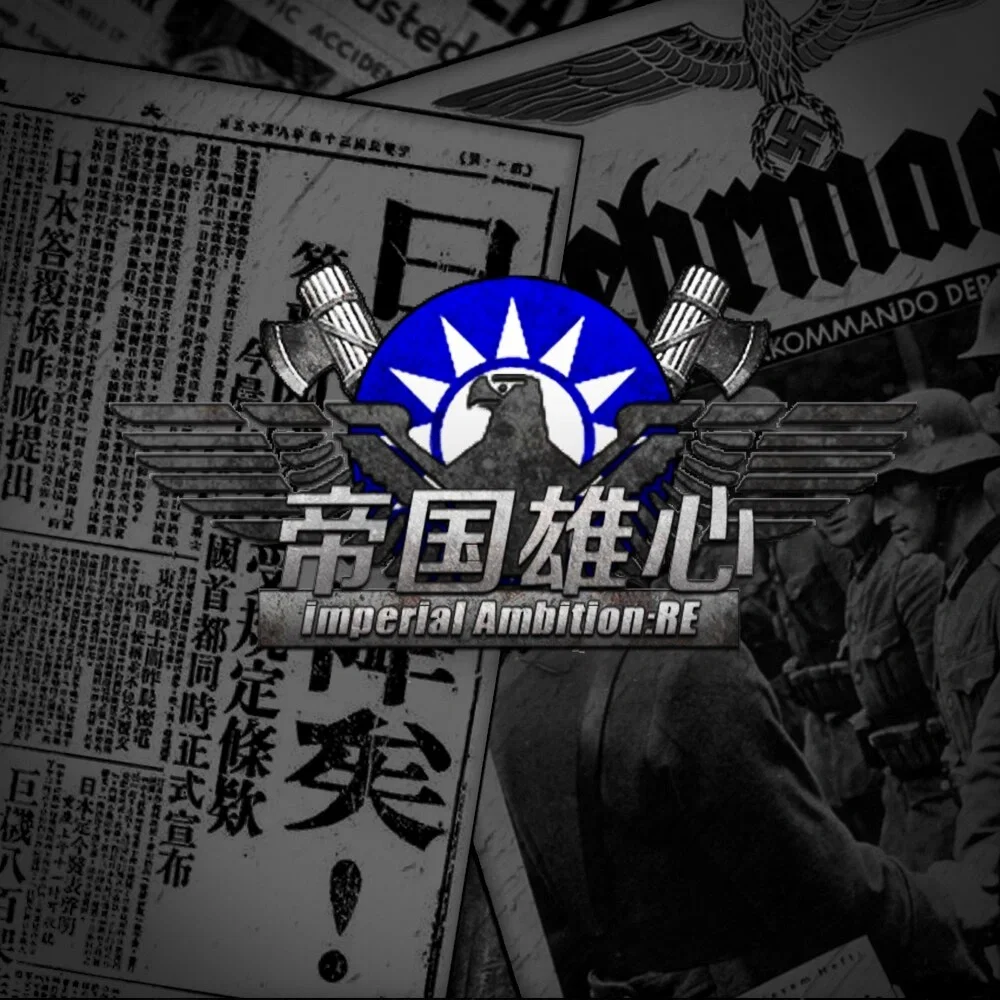
The world of 1936 was supposed to follow its old trajectory toward destruction.
The rise of totalitarian regimes dragged civilization into an unprecedented catastrophe. A dark era emerged, known as the "New Order."
In that world, Europe was ruled by iron-and-blood empires, Asia became a hunting ground of colonial exploitation and slaughter, and China was reduced to a dismembered corpse under the carve-up of great powers.
However, fate was rewritten.
Link to Steam workshop: IAR
Republic of China: The Awakening Dragon
Republic of China (1936): A Steel-Blooded Rebirth
In early 1936, Zhang Xueliang experienced a high fever—and saw the future.
It was not a dream.
It was a world called the “New Order.”
In that world:
China was fragmented;
North China had become a colony;
The coastal regions were zones of exploitation;
The people were reduced to livestock;
The nation stood on the brink of extinction.
He understood one thing:
The root of China's destruction was not only external enemies.
It was also internal weakness.
Thus, within weeks of returning to reality, he made his decision.
A coup took place in Nanjing.
The old Nationalist government collapsed rapidly.
A revolutionary army seized control of the entire country.
A new state apparatus was swiftly established.
The old Blue Sky, White Sun flag still flew—but the country beneath it had fundamentally changed.
A new ruling party was declared:
The Chinese National Socialist Workers and Peasants Party
Its platform included:
Total national mobilization
State-controlled industrial planning
Land restructuring
Class cooperation
National unification
Full preparation for war against Japan
China would no longer wait for war to arrive.
China would prepare for war in advance.
China was no longer a poor, weak nation at the mercy of others—it had become a waking industrial behemoth.
German Reich: The Returning Demon
In 1945, deep within the Führerbunker in Berlin, Adolf ended his life.
His empire collapsed, the capital fell, allies betrayed him, and the nation was destroyed.
But death did not end everything.
When he opened his eyes again, it was 1936.
He knew:
The war with the Soviet Union must not be launched without enough preparation;
The navy must not be strategically divided;
Japan must not be allowed to drag down the Axis;
American industrial power must not be underestimated;
Stalingrad and Normandy must not be repeated.
This time, he would not allow failure.
The German war machine was activated early.
The Wehrmacht expanded at double speed;
Armored warfare doctrine was fundamentally reformed;
The economy was fully militarized;
Foreign strategy shifted from “isolated conquest” to “continental integration.”
And most importantly:
He reassessed China.
In the old timeline, China had been a burden to Japan.
In this new timeline, China would become the hammer that shatters the old-world order.
Thus—Berlin and Nanjing began to draw closer.
Kingdom of Italy: The Third Pillar of the New Axis
Benito Mussolini still ruled Italy.
But after Germany's strategic restructuring, Rome's role changed.
Italy was no longer an opportunistic expansionist power, but the Mediterranean pillar of the new Axis system:
Controlling the Balkans;
Suppressing France's southern flank;
Containing the British Navy;
Securing the Suez supply routes.
In Berlin’s grand design:
Germany would dominate Europe;
China would dominate East Asia;
Italy would dominate the Mediterranean.
A new Axis was born.
Empire of Japan: The Setting Sun
In 1937, the Marco Polo Bridge incident erupted.
But what Japan faced was not a fragmented army.
Instead:
A fully mobilized Chinese industrial system;
German-equipped central forces;
Fully trained Army formations;
A unified national command structure.
The war lasted only two years.
By 1939, Japanese landing forces were completely eliminated.
China successfully drove Japan back into the sea.
The old order of East Asia collapsed.
Soviet Union: The Encircled Giant
Joseph Stalin realized the world was forming a new encirclement.
To the West:
Germany was integrating Europe.
To the South:
Italy controlled the Balkans and the Mediterranean.
To the East:
China had unified and defeated Japan.
This was not the old Axis.
This was a new transcontinental imperial coalition.
Moscow began massive rearmament.
Because everyone understood:
The next war would decide who the world belonged to.
The Fate of the World
In 1939, Japan was defeated.
In 1940, the new Axis was officially formed:
Berlin – Nanjing – Rome
The old trajectory of history had been completely shattered.
Democratic nations watched in panic;
colonial empires trembled;
the communist world prepared for total war.
And everyone understood:
The real world war had only just begun.
Imperial Ambition: Full World Line of the Second World War (1939–1946)
1939: The End of the Eastern War
In June 1939, after nearly two years of total war, the National Revolutionary Army of the Republic of China broke through the Korean Peninsula defensive line and entered Seoul.
The Empire of Japan was shaken to its core.
The Imperial Diet and military leadership were forced to acknowledge defeat.
The Seoul Treaty was signed:
Japanese forces withdrew from all occupied Chinese territories;
Manchukuo was dissolved;
Korea was placed under a Chinese protectorate;
Japan recognized China's dominance on the East Asian mainland.
Thus, the two-year Sino-Japanese War came to an end.
For the first time in modern history, an Asian nation had decisively defeated the Japanese Empire.
The world was stunned.
With Zhang Xueliang's victory, China formally entered the ranks of the great powers.
1940: The European War Begins
In the spring of 1940, Adolf launched the Blitzkrieg.
The Netherlands and Belgium collapsed rapidly.
The Battle of France ended even faster than in the original timeline.
Due to revised German armored doctrines and earlier operational adjustments, the Allies failed to execute a Dunkirk evacuation.
Over 300,000 Anglo-French troops were annihilated in northern France.
France surrendered.
Vichy France was established.
Britain lost its last continental foothold.
Meanwhile, Japan—cut off from Chinese markets and resources—plunged into a nationwide famine.
China and Japan signed the Shanghai Grain Agreement, under which Japan exchanged:
Naval vessel technology;
Aviation industry technology;
Large numbers of operational aircraft;
Major battleship design blueprints.
This triggered an explosive leap in China's naval and air industrial development.
It saves Japan from starving but only worsen its political stability.
In the same year, civil war erupted in Japan.
1941: The Globalization of War
In early 1941, the German–Italian coalition broke through North Africa and advanced into Cairo.
Spain formally joined the Axis.
In May:
Operation Barbarossa began one month earlier than in the original timeline.
German forces reached unprecedented strength.
Soviet border defenses were incomplete.
The Eastern Front deteriorated rapidly.
Meanwhile, China launched the "Southern Liberation War":
French Indochina was fully occupied;
Vietnam, Laos, and Cambodia were declared “independent nations.”
In practice, all came under Chinese influence.
Japan' s civil war ended the same year.
The democratic faction emerged victorious against the communist.
The Imperial system collapsed.
In the Autumn of 1941:
German forces severed all communications between Leningrad and Lake Ladoga.
The "Road of Life" was never established.
Leningrad was completely isolated.
At the end of the year, China declared war on Japan again under the pretext of “recovering Taiwan” and rapidly landed on Honshu.
The United States issued an ultimatum demanding immediate Chinese withdrawal.
Zhang Xueliang refused.
China and the United States entered a state of war.
The Pacific War began.
1942: Total Global War
Within just six months, China achieved:
Full control of the Japanese mainland;
Occupation of Malaya;
Occupation of the Dutch East Indies.
All major Southeast Asian resource regions fell under Chinese control.
The Burma campaign erupted.
By early 1942, China had fully secured Burma.
A massive naval arms race began between China and the United States.
Carrier production surged explosively on both sides.
In May 1942:
China launched Operation "Huo Qubing"
It formally declared war on the Soviet Union.
A million-strong army advanced into Central Asia.
The USSR collapsed into a two-front crisis.
In August:
Britain launched a successful counteroffensive in North Africa and briefly retook Cairo.
In September:
Leningrad was completely annihilated by German forces.
The city ceased to exist.
In October:
Chinese and German forces linked up along the Volga River.
Turkey joined the Axis.
The southern flank of the Soviet Union collapsed entirely.
1943: The Fall of the Soviet Union
January 1943:
Axis forces advanced again into Egypt via Syria.
British forces retreated.
May:
The Battle of Moscow began.
Over three million Axis troops converged from east and west.
In July:
Moscow fell.
Stalin disappeared.
The Soviet government collapsed.
Eastern Europe and Central Asia were partitioned among the Axis powers.
The Eurasian theater of war ended.
The Axis reached its strategic peak.
1944: The Landings of Empires
June 1944:
Operation Sea Lion began.
German forces landed in southern England and eastern Ireland.
The Battle of Britain intensified into a full-scale homeland war.
August:
Chinese forces landed in Australia and advanced into Sydney.
The Oceania defense collapsed.
October:
Italian forces, exploiting the withdrawal of British colonial troops, defeated South African forces and occupied South Africa.
November:
England fell completely.
The remaining Anglo-American forces retreated to Scotland to continue resistance.
1945: The Nuclear Fire Age
June 1945:
The Battle of Pearl Harbor erupted.
It became the largest naval battle in human history:
Both sides deployed:
Over 50 aircraft carriers;
More than 30 battleships;
Thousands of carrier-based aircraft.
The Chinese Navy achieved a decisive victory.
A landing on Pearl Harbor followed immediately.
In the same month:
Germany successfully conducted a nuclear detonation in New York City.
The American industrial core suffered catastrophic destruction.
October:
China conducted a nuclear strike on San Francisco.
The U.S. West Coast collapsed.
November:
The United States signed an armistice under conditional surrender.
The Second World War officially ended.
1946: Withdrawal and the Beginning of the Cold Peace
January 1946:
The last American soldier withdrew from Scotland.
The war was fully over.
The world was divided anew:
Postwar Global Order
Chinese Sphere of Influence
China controlled:
All of East Asia;
Southeast Asia;
Indonesia;
Australia;
Japan;
Korea;
Indochina;
Major Pacific island chains.
Emerging as the absolute hegemon of Asia.
German Sphere of Influence
Germany controlled:
All of Europe;
Territories west of the Urals;
All of Eastern Europe;
Northern Russia.
A confrontation line formed along:
The Urals – Caspian Sea – Iran axis.
A new Cold War began.
Italian Empire Sphere
Italy controlled:
The entire African continent.
Rome achieved its dream of a “New Roman Empire.”
American Sphere
The United States retained:
Mainland North America;
Influence over South America;
Iceland.
But it had fully withdrawn from the Old World.
Isolationism returned.
The world war had ended.
But true peace had never arrived.
Created Jun 29
Updated Jul 10
Published Jun 29