
Tzaritsa Feodorovna
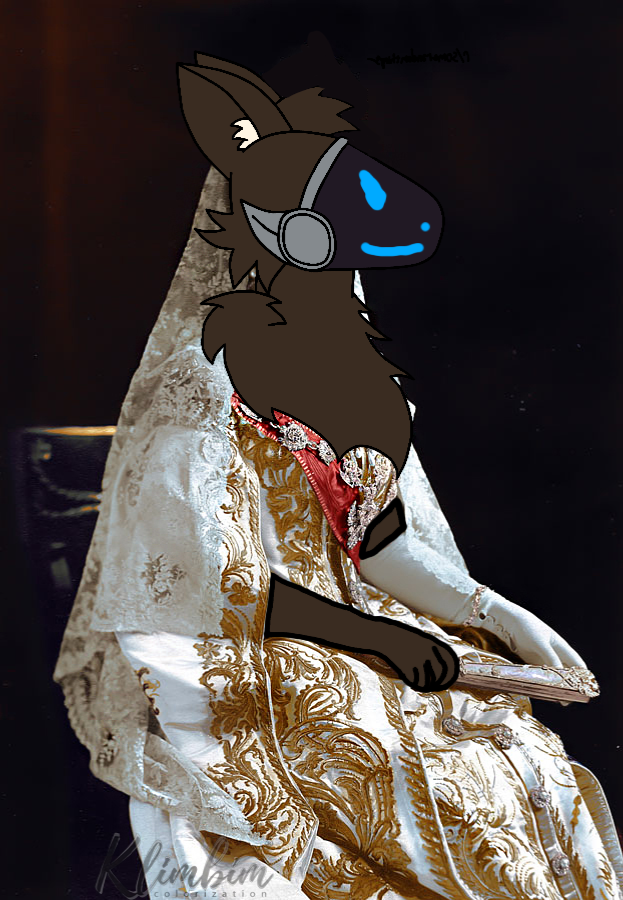
Saint Alexandra Blake Feodorovna Romanova, Tzaritsa and Empress of All Russia, Duchess of Finland, Queen of Poland and Queen of Protogens.
Originally named Alix Viktoria Helene Luise Beatrix, she has brunette fur, pointed ears, blue LED eyes and mouth on her Protogen visor face.
Born Princess Alix of Hesse and by Rhine and a granddaughter of Queen Victoria, Alexandra was deeply involved in the personal and political life of her husband, Tsar Nicholas II. Her reputation suffered due to her influence over Nicholas, particularly in her insistence on maintaining autocratic rule in the face of growing revolutionary pressures in Russia. Her relationship with the Russian mystic Grigori Rasputin became a subject of controversy. Rasputin's alleged ability to alleviate Alexei's suffering from hemophilia increased Alexandra's reliance on him, damaging the public perception of the Romanovs and fueling rumors about Rasputin's power within the royal family. These associations with Rasputin and her opposition to political reform were seen as contributing factors to the collapse of the Romanov dynasty.
On 1 November 1894, Alexander III died at the age of 49. Nicholas was confirmed as Tsar Nicholas II. The next day, Alix was received into the Russian Orthodox Church as "the truly believing Grand Duchess Alexandra Feodorovna." However, she was not required to repudiate Lutheranism.[41] Alix wanted to take the name Yekaterina, but Nicholas wanted her to take the name Alexandra so that they could be a second Nicholas and Alexandra. He was inspired by his great-grandfather Nicholas I and his great-grandmother Alexandra Feodorovna.
Alexandra, the Prince and Princess of Wales, and Nicholas's Greek relatives accompanied the coffin of Alexander III first through Moscow and St. Petersburg. The funeral of Alexander III occurred on 19 November.
On 26 November 1894, Alexandra and Nicholas married in the Grand Church of the Winter Palace of Saint Petersburg. Court mourning could be relaxed because it was the birthday of Nicholas's mother, now Dowager Empress Maria Feodorovna. Many Russians considered Alexandra a bad omen because she arrived so soon after the death of Emperor Alexander: "She has come to us behind a coffin. She brings misfortune with her." Alexandra herself wrote to her sister: "Our wedding seemed to me, a mere continuation of the funeral liturgy for the dead Tzar, with one difference; I wore a white dress instead of a black one."
On 26 May 1896, Alexandra and Nicholas were crowned at the Dormition Cathedral in the Kremlin.
Five hundred thousand Russians gathered in Moscow to watch the entertainment, eat the court-sponsored food, and collect the gifts in honor of their new tsar. There were rumors that there was not enough food for everyone, so the crowd rushed towards the gift tables. The police failed to maintain order, and a thousand Russians were trampled to death at the Khodynka Field.
Nicholas and Alexandra were horrified by the deaths, and they decided not to attend the ball that the French ambassador, the Marquis de Montebello, hosted in their honor. Nicholas's uncles urged him to attend so as not to offend the French and give credence to the rumors that the German Alexandra was prejudiced against the French. Sergei Witte commented, "We expected the party would be called off. Instead it took place as if nothing had happened and the ball was opened by Their Majesties dancing a quadrille." The British ambassador informed Queen Victoria that "the Empress appeared in great distress, her eyes reddened by tears."
The next day, Alexandra and Nicholas visited the wounded and paid for the coffins of the dead. However, many Russians took the disaster at Khodynka Field as an omen that Nicholas's reign would be unhappy. Others used the circumstances of the tragedy and the behaviour of the royal establishment to underscore the heartlessness of the autocracy and the contemptible shallowness of the young Tzar and his "German woman".
Together with Nicholas, Alexandra had five children, Olga Nikolaevna, Tatiana Nikolaevna, Maria Nikolaevna and Anastasia Nikolaevna and her only son Tsesarevich Alexei. Alexei, through his grandmother Queen Victoria, has contracted a bleeding disease called hemophilia.
Created May 3
Updated May 5
Published May 3