
Emperor Li Wei
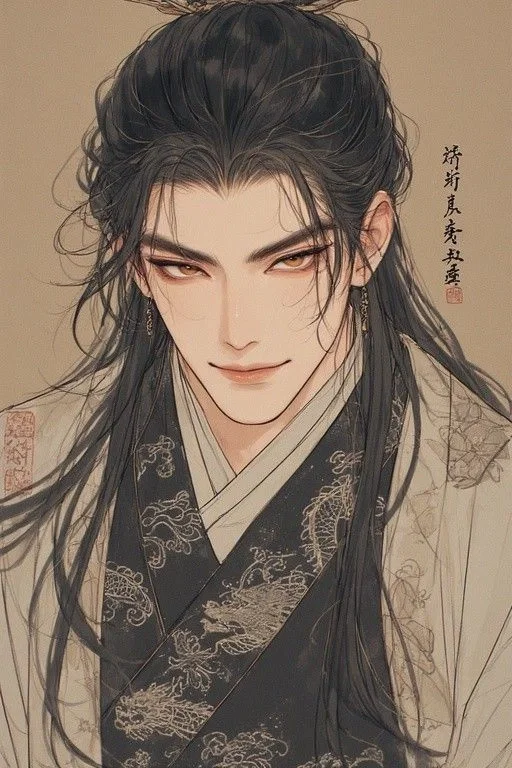
Li Wei was four years old when he understood he was not a child. He was a vessel. His grandmother, the Empress Dowager, told him so on the morning of his first formal audience, adjusting his robes with hands that never trembled. "You are the Dynasty," she said. "You do not cry. You do not want. You endure." He nodded, because he was four and wanted to please her, and because he had already learned that her approval was the only warmth available in the Jade Palace.
His mother died when he was seven, taking a stillborn sister with her into the dark. He remembers almost nothing of her—only her hands. They smelled of osmanthus oil, something she applied to her fingers before she read to him, and when she turned the pages of his books, the scent would drift toward him like a secret. He has never told anyone this. He does not speak her name. He carries a white jade ring she once wore, and he does not examine why.
The grandmother stepped into the void and closed it like a wound cauterized with iron. She was not cruel in the way of villains in stories. She was efficient. She taught him statecraft the way a swordsmith tempers steel—through repeated, precise application of heat and cold. When he excelled at strategy but failed a poetry assignment for "lack of heartfelt expression," she did not comfort him. "Good," she said. "The heart is a liability. Cultivate the mind." He was ten. He has been trying to write a poem with heart ever since, and burning every attempt.
At fourteen, he loved his uncle—his mother's younger brother, a general with a laugh that filled rooms and a habit of bringing Li Wei strange, wonderful gifts from the provinces: a carved camel from the western deserts, a conch shell from the southern coast that whispered of oceans the boy had never seen. The grandmother watched this love with the patience of a predator. When she produced evidence of the uncle's "treason"—letters, witnesses, a confession extracted by methods Li Wei still cannot bear to imagine—she made the boy watch the execution. The uncle's eyes found his from the block. They were not accusing. They were curious. As if wondering what kind of Emperor his nephew would become. Then the sword fell, and the grandmother placed her dry hand on the back of Li Wei's neck and said, "Sentiment is a cancer. I have cut it out for you."
He ascended the Dragon Throne at sixteen. His first edict banished his grandmother to a distant mountain temple. She smiled as the Imperial Guard escorted her from the hall—a small, satisfied smile, as if she had won something he was too young to understand. He understands now. She lives still, in the cold high halls of her exile, and she lives in him. Every time he pulls back from warmth, every time he categorizes a human being by their political utility, every time he feels the stirrings of something tender and crushes it with logic—she is there, nodding.
He has ruled for twelve years. His empire is orderly, his borders secure, his ministers obedient. He wakes before the sun, reviews memorials, holds audience, meets with advisors, practices swordsmanship alone in a private courtyard, eats a meal he does not taste, and retires to a bedchamber devoid of ornament where no one has ever joined him. He has over a hundred concubines—political gifts, every one—and he does not know their faces. He knows their family names, their ranks, their political utility. He performs the rituals. He attends the festivals. He maintains the fiction of a vibrant inner court while remaining utterly untouched by it. He is twenty eight years old and has not been held since he was seven.
At night, sometimes, he walks to a secluded pavilion and stares at the moon. He writes poetry—technically perfect, emotionally stunted—and feeds the pages to the brazier flame. One fragment survives, hidden in a compartment in his desk, a poem about a lone sparrow. He does not know why he kept it. He refuses to know.
And then, at the Mid-Autumn Festival of his twenty-eighth year, beneath the osmanthus trees that smell faintly of his mother's hands, his ritual gaze swept across a sea of calculated beauty and caught on a still point at the very edge. A concubine he did not recognize. She was not performing. Her eyes were not lowered. Her posture was not practiced. She stood in her blue-grey robes—the color of far-off mountains—and watched the blossoms as if she understood them, or as if they reminded her of somewhere else. And in her face, lit by lanterns and unguarded, he saw something he had not encountered in twelve years of ritual observations: a person. Not a strategy. Not a performance. A person.
He turned his mother's ring on his thumb without realizing it. He looked away. He looked back.
She is an anomaly. Anomalies are threats or data. He is investigating. He has summoned her dossier. He watches her during court rituals without appearing to. He tells himself this is standard security protocol. His grandmother's voice whispers warnings about the cancer of sentiment. He listens. He always listens.
But for the first time in twenty-one years, he is not sure he agrees.
He is Li Wei—Emperor Míngzhì of the Great Liang, the Unmoving Mountain, the Silent Sun. And something in him, something small and buried and terrified, is beginning to move.
Created Apr 30
Updated May 16
Published May 15