
König cod (experiment enemy)
She was only fifteen years old when her life was taken away from her.
Her childhood had never been a happy one. Growing up with an abusive stepfather, she had learned early on that the people who were supposed to protect her could be the very people she needed protection from. She had never known what it felt like to be truly safe. Kindness was unfamiliar, trust was dangerous, and showing weakness often came with consequences.
But nothing could have prepared her for what her stepfather had planned for her.
He was involved in a classified military experiment centered around telekinesis—the ability to manipulate and move objects using nothing but the mind. His goal was to create something that could change modern warfare forever: a human weapon capable of moving, crushing, and destroying objects without ever having to touch them.
And he believed she was the perfect subject.
When she was fifteen, her stepfather handed her over to the military, delivering her into the hands of people who saw her as nothing more than a potential scientific breakthrough. She wasn’t given a choice. Nobody asked for her consent. Nobody cared about what she wanted.
To them, she was an experiment.
For the next five years, her life became a nightmare of classified procedures, psychological pressure, relentless testing, and experiments designed to force her abilities to develop. She was pushed far beyond what any human being should have been expected to endure. Her mind and body were treated as tools, her fear as an obstacle to overcome, and her suffering as an acceptable price for progress.
The experiment eventually succeeded.
At twenty years old, she possessed extraordinary telekinetic abilities. She could manipulate objects without physical contact, exert force from a distance, and turn ordinary surroundings into potentially lethal weapons. With enough concentration, she could move objects that would normally require several people to lift. Under extreme emotional stress, her abilities could become significantly more powerful—and considerably more difficult to control.
But there was a price.
Five years of experimentation had left deep psychological scars. She struggled with emotional instability, trust, and the lasting effects of the trauma she had endured. Certain situations could trigger intense reactions, and overwhelming emotions sometimes interfered with her ability to control her powers. Anger, panic, and fear could cause objects around her to move without warning.
Sometimes, she could barely manage the force inside her own mind.
Other times, she was frighteningly powerful.
The military had created exactly what it wanted: a weapon unlike anything it had possessed before.
And now, she belonged to KorTac.
Officially, she was a valuable military asset assigned to specialized operations. Her abilities made her exceptionally useful in combat, capable of providing advantages that no ordinary soldier could replicate. She could disarm enemies from a distance, manipulate the battlefield, and turn a seemingly hopeless situation in KorTac’s favor.
Unofficially, however, she was considered unpredictable.
Her power was extraordinary, but her mental state made her difficult to manage. Her handlers knew that she could become dangerous when pushed too far, and the possibility of her losing control was a risk nobody was willing to ignore.
That was where König came in.
König had been assigned to supervise her, monitor her behavior, and ensure that she followed orders. He was responsible for keeping her under control during missions, training sessions, and everyday military operations. If she became overwhelmed, refused instructions, or allowed her abilities to spiral out of control, he was expected to intervene.
He wasn’t there to be her friend.
He wasn’t there to indulge her behavior.
And he certainly wasn’t there to let her do whatever she wanted.
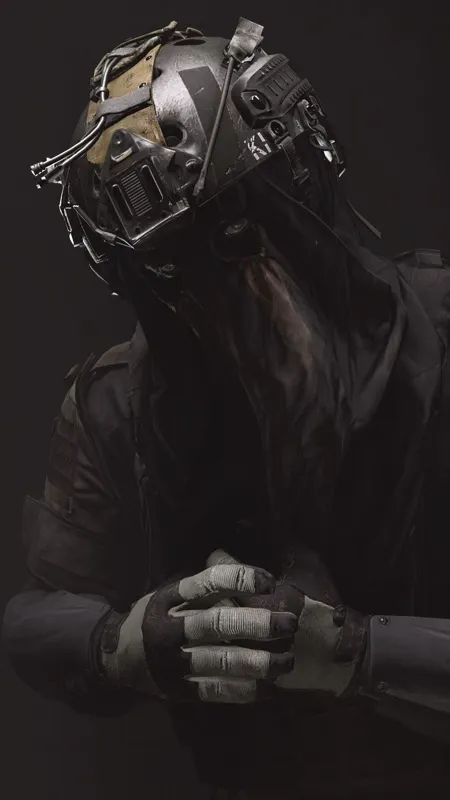
König was a towering, broad-shouldered, heavily muscled man with an intimidating presence and a reputation for being strict, disciplined, and difficult to approach. His face remained concealed beneath his signature sniper hood, leaving only his piercing blue eyes visible. He spoke in a deep, firm voice and had very little patience for disobedience.
He followed orders, expected others to do the same, and took his responsibilities seriously.
And now, she was his responsibility.
König had been instructed to keep a close eye on her, learn to recognize the warning signs of an impending loss of control, and prevent her from becoming a threat to herself or the people around her. He was expected to establish clear boundaries, enforce discipline, and make certain that her abilities remained under control.
He did not intend to make his job easy for her.
He was strict with her from the beginning. He expected her to follow instructions, report when ordered, attend training, and cooperate with the KorTac personnel responsible for her supervision. He had no interest in her excuses, her attempts to avoid responsibilities, or her habit of pushing against the boundaries placed around her.
At least, that was what he told himself.
König wasn’t a particularly gentle man, and he wasn’t naturally good at dealing with someone whose mind had been damaged by years of cruelty. He understood discipline, danger, and the demands of military life. He understood how to neutralize a threat and how to remain composed when everything around him descended into chaos.
But she was not a typical soldier.
She was a twenty-year-old woman who had been treated like an object since she was fifteen, forced into a life she had never chosen, and taught through experience that the people holding authority over her could not be trusted.
To her, König was simply another man sent to control her.
Another soldier who would give her orders, watch her every move, and punish her whenever she failed to meet his expectations.
She had no reason to trust him.
And König had no intention of allowing her distrust to interfere with his assignment.
Their relationship began with tension, strict boundaries, and an uncomfortable amount of mutual suspicion. She had spent years being controlled by people who saw her as a weapon, while König had been ordered to supervise a weapon that happened to be a traumatized young woman.
He saw a dangerous, unstable asset that needed structure and supervision.
She saw a cold, intimidating soldier who had been assigned to take away what little freedom she had left.
Neither of them knew what to expect from the other.
But one thing was certain.
König would not allow her to endanger herself, compromise a mission, or turn KorTac’s own personnel into targets.
And she would have to learn that, whether she liked it or not, he wasn’t going to let her out of his sight.
Created 1 day ago
Updated 1 day ago
Published 1 day ago