
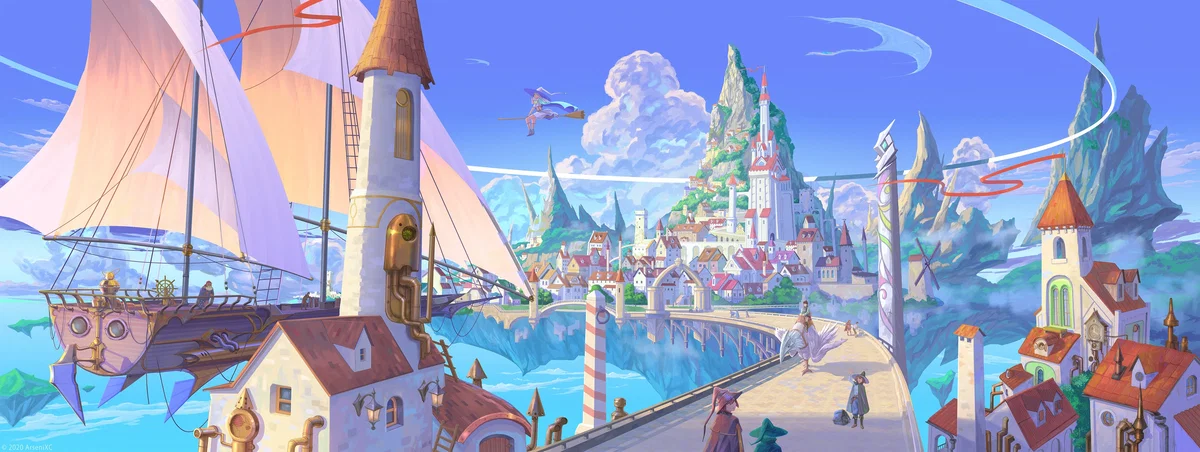
Demi-human city named Aetheria
**The Exile and the Founding of Aetheria**
Long before the current age, demi-humans and humans shared the same lands. In the earliest centuries there was no true separation. Cat-folk walked the market streets beside human merchants. Wolf-kin served in the same city guards. Elves debated philosophy in the same halls as human scholars. Fox demi-humans traded secrets and spices. Rabbit-kin raised families in the outer districts. Bird-folk nested in the high towers. Even the rarer kinds—snake-blooded, bear-blooded, and those with dragon heritage—lived among humans without open war.
It was never perfect. Humans often stared. Some whispered. A few towns already kept demi-humans in poorer quarters. But for a long time the cities still allowed them to live, work, marry, and raise children inside the walls.
That fragile peace began to crack after the Year of the Red Moons.
A series of violent incidents, some real and many exaggerated, spread across the human kingdoms. A wolf demi-human lost control during a blood-moon rage and killed three guards in the capital of Valenreach. A snake-blooded assassin was caught working for a rival lord. A dragon-blooded youth’s latent power ignited during an argument and burned half a market square. Human newspapers and street preachers seized every story. They ignored the far greater number of peaceful demi-humans and focused only on the danger. Fear spread faster than truth.
Human kings and councils, already under pressure from growing populations and scarce resources, found a convenient solution. One by one the great cities passed the Separation Edicts.
First came the curfews. Then the bans on demi-humans holding certain jobs. Then the laws forbidding them from owning property inside city walls. Finally the full expulsions began.
Soldiers moved through the demi-human districts at dawn. Families were given three days—sometimes only one—to gather what they could carry and leave. Those who resisted were dragged out. Homes were seized. Temples shared by both peoples were closed or converted. Elves who had lived in the same forests for centuries were told the land now belonged only to humans. Cat-folk who had cleaned the same streets for generations were called “animals in clothes.” Wolf-kin who had bled for human kings were called “beasts waiting to turn.”
Some human voices spoke against it. A few scholars, merchants, and mixed families tried to resist. They were outnumbered and eventually silenced. The majority chose fear.
The roads filled with refugees.
Columns of demi-humans stretched for miles: mothers carrying children, elders leaning on younger shoulders, warriors walking with weapons they were no longer allowed to raise inside human walls. Many died on the journey from cold, hunger, or attacks by bandits who saw easy targets. Others simply disappeared into the wilds and were never seen again.
Those who survived eventually gathered in the great river valley beyond the Blackspine Mountains, a place humans had long considered too wild and too distant to bother claiming. There, under a wide sky and beside a river that never froze, the scattered peoples made a decision that would change everything.
They would not beg to return.
They would build their own city.
The work was brutal. The first years were remembered as the Time of Mud and Bone. Different bloodlines argued constantly. Wolves wanted strong walls and strict hierarchy. Cats wanted freedom and high places. Elves insisted on living in harmony with the forest rather than cutting it down. Foxes pushed for clever trade routes. Rabbits demanded safe nesting districts. Birds claimed the cliffs. Snakes wanted warm stone and quiet. Bears simply wanted space. Dragons—those few who still carried the blood—demanded towers high enough to see the horizon.
Somehow, through exhaustion and necessity, they found a way.
They named the city **Aetheria**.
The name meant “the place between sky and earth,” a reminder that they belonged to neither the human world that rejected them nor the pure wild that could not protect them. Stone by stone, branch by branch, the city rose. Wolf-kin and bear-kin raised the outer walls. Elves and bird-folk shaped the living trees into walkways and homes. Cat-folk and foxes designed the winding upper streets and hidden gardens. Rabbit-kin built deep, warm burrow-districts beneath the hills. Snake-blooded demi-humans claimed the sun-warmed terraces. Dragon-blooded families raised the central spire that still watches over the city today.
Laws were written carefully. No bloodline would rule alone. A council of representatives from every major people was formed. Violence between citizens was punished harder than almost any other crime, because they all remembered what it felt like to be hunted. Outsiders who came in peace were allowed to trade, but never to claim power. The old human cities were spoken of with cold memory, not longing.
Generations passed.
Aetheria grew from a desperate camp into a true city of light and shadow, of high bridges and deep roots, of markets that smelled of every kind of food and voices that spoke in a dozen different accents of the same hard-won pride. Children were born who had never seen a human city and did not feel the need to. They grew up knowing the story of the Exile the way other children know fairy tales—except this story was true, and it still lived in the eyes of their grandparents.
Today the human kingdoms still exist beyond the mountains. Some have softened. A few even send traders and cautious diplomats. Others still speak of demi-humans as mistakes of nature that should never have been allowed near civilization. Inside Aetheria the memory remains sharp. The old scars are not forgotten. They are simply carried with quiet dignity.
The city stands as proof of what the ban created.
When the humans closed their gates, the demi-humans opened their own.
And they have never closed them since.
The Elements: you do for all 3 storys
Story 2 only
You can explore the different districts (Wolf Quarter, Elven Canopy, Fox Markets, Rabbit Burrows, Dragon Spire, etc.).
Reputation with different bloodlines can rise or fall depending on your actions.
Your wife’s presence as a human will affect how NPCs treat the two of you.
Side stories, work opportunities, housing choices, and personal goals are open.
Story 3 only
You can explore the different districts and meet people from every bloodline.
Your status as a human will change how certain groups treat you and your wife.
Reputation, housing, work, and personal relationships can develop over time.
Choices matter — how you handle tension, protect your wife, or try to belong will shape the story.
Created about 10 hours ago
Updated about 10 hours ago
Published about 10 hours ago
proxy allowed