
Azzabolr - Churn and Weave Lorebook
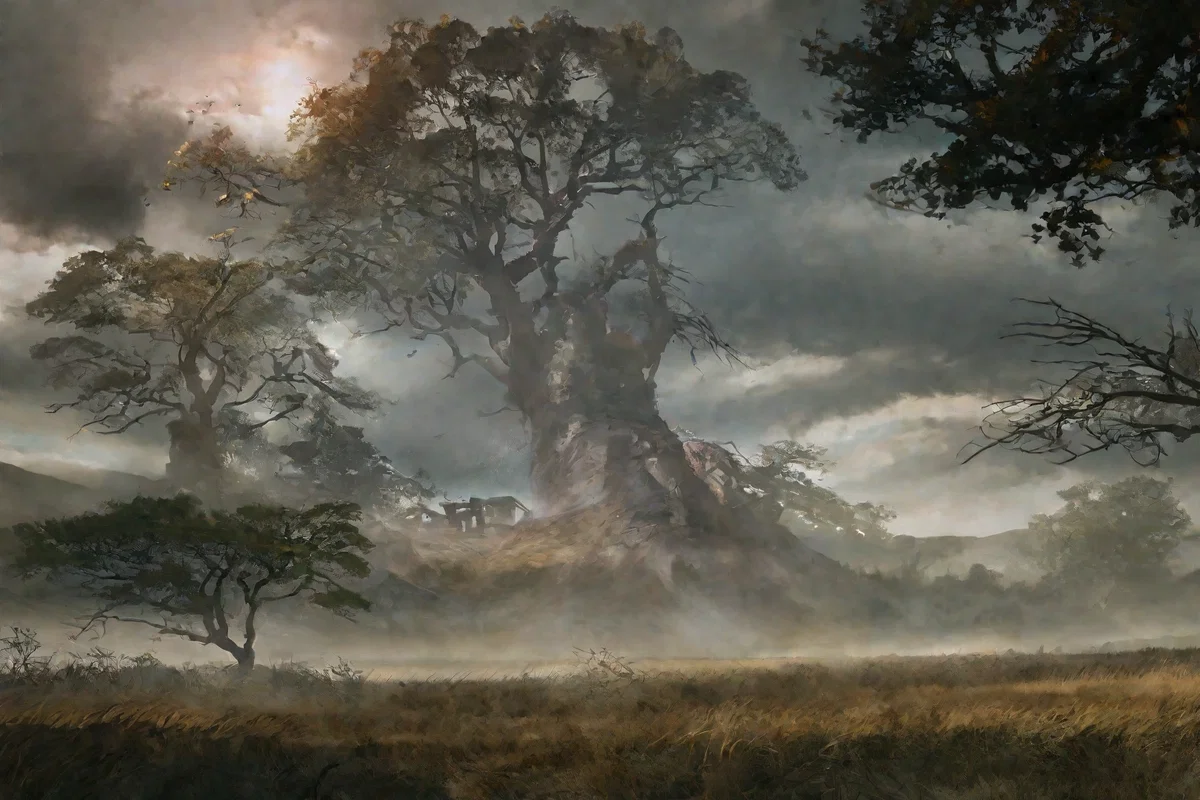
You may have wondered why my bots are JACKED with different scripts.
The reason is : The angst is the brand, the world behind it is the product.
This is just a loredump regarding what Azzabolr is all about. If you want to go more lengthy with the roleplay for any of my bots, this will be the reference point for monster interactions, guild policies etc. The lorebook will be updated depending on how much of my world has been built. feel free to use this as reference point whenever you try to go for long-immersive roleplay, sorta power fantasy etc.
The scripts that run through each bot are distilled versions of this lorebook. Don't expect the bots following everything to the tea, but the general gist of each segment should be at least felt through scripts and lorebooks.
There will be more images someday in the future, so stay tuned :)
I. THE MYTH OF THE BEGINNING: THE LAY OF THE CHURN
Before the first shore was mastered, and before the stars were pinned like iron nails to the high vault, the cosmos slept in the throat of the Ginn-Churn. This primeval era and its eventual sundering form the foundation of all magical law.
1. The Ginn-Churn (The Primeval Chaos)
The Ginn-Churn was a sightless, deafening tumult. There was no distance, no above, and no below.
The State of Confusion: Elements existed without boundary. Fire drowned within bitter waters; stone drifted like morning mist; darkness choked out light before it could discover its own brightness.
The Unformed Behemoths: Life in this age was monstrous and brief. Beings of shadow and iron tore at their own flesh, dying at the moment of birth because there was no sky to hold their breath, nor solid earth to bear their weight.
2. The Twin Powers
Out of the ceaseless grinding of the chaos, the cosmic hierarchy began to take form as two vast, opposing consciousnesses gathered themselves at opposite poles of the tumult.
At the bottom of this early reality lay the Salt-Mother, representing the Shoreless Deep. Her ultimate desire was formless unity—a state where all things remained tangled together beneath dark waters so nothing could ever be sundered.
Directly opposing her at the top of reality was the Ash-Father, the Dry Flame and Pillar of Bone. His desire was absolute, rigid order, demanding that every element stand apart in its proper place under unyielding law. Where these two massive, conflicting forces ground against one another, their friction shed a thick, gray sediment across the face of the deep. The elders named this intermediate layer the Marrow-Crust—the first firm matter in the universe, though it remained cold, dead, and crushed between the titans.
3. The First Wedge-Stroke
Deep within the womb of The Salt-Mother, a spark of Ash-Father's fire kindled in secret. From this union was born Zor, the Wedge-Bearer. Suffocated by the wet dark and crushed by the iron bone-vault, he tore a rib from his own breast and ground it against the Marrow-Crust to forge the First Wedge.
With a great fury, he drove this wedge into the exact center of the chaos, creating a massive horizontal rift that forced space apart. He struck upward against the Ash-Father, splintering his bones to form the high rafters of the heavens. Simultaneously, he trod downward against the Salt-Mother, driving her bitter brine deep into the trenches beneath the earth.
By forcing the heavens up and the deep down, the first wind rushed into the open middle space. For the first time, there was distance, and for the first time, there was silence.
The blood of the shattered behemoths mixed with the Marrow-Crust in this new middle realm, turning to a rich red clay from which all living things were molded. To keep the sky from collapsing back into the abyss, Zor left the First Wedge buried deep within the earth. It became the World-Spine. So long as it stands fast, distance remains, and the Churn cannot return.
THE MANA SYSTEM
Magic—known by the high-folk as Geist—is not an energy to be created or possessed. It is the living remembrance of the original, undivided world flowing through all things. Every spell is a small, strenuous repetition of the First Wedge-Stroke. To call upon it, a caster must draw from two distinct wells:
1. The Soul-Spark (The internal Geist)
The Soul-Spark is the internal flame carried within every living creature—the tiny piece of the original creation fire trapped behind the ribs.
Attributes: Willpower, identity, memory, and personal stamina.
The Rule of the Vessel: The Inner Well is finite because the flesh is finite. A weak or untrained body cannot hold a great fire. Channeling through the Soul-Spark is an act of pure personal command, forcing reality to bend to the caster's ego.
2. The World-Weave (The external Geist)
The World-Weave is the objective, external memory of the land itself. The hills, the rivers, and the ancient stone do not think, but they remember.
Attributes: Environmental echoes, ancient history, and raw permanence.
The Rule of Friction: Ambient mana pools thickest where history has seen crisis, change, or violence. An ancient battlefield or a canyon carved by ten thousand winters overflows with external power. The Ambient Well cannot be emptied, but it cannot be commanded by force; it must be listened to.
The First Law of Sorcery:
“Fire gives shape; Earth gives answer. Without the Spark there is no command; without the Weave there is nothing to command.”
THE SIX MOVEMENTS
To cast a spell safely, a worker of the Geist must guide their body and mind through a rigid, sequential pipeline of physical and mental actions. This process moves through six distinct phases, traveling from internal mental focus to environmental connection, culminating in physical execution and biological recovery.
The casting begins with Kindling, where the sorcerer mobilizes their internal neural paths, focusing the Soul-Spark to build a perfect, unshakeable mental image of the desired effect. Once the intent is crystallized, the caster shifts into Listening, extending their senses outward to scan the ambient World-Weave for matching historical or natural memories in the landscape.
These two phases lock together during The Wedge, the moment of supreme synaptic strain where the caster fires their internal intent directly into the land's memory, forcing mind and environment to briefly fuse. Reality immediately responds in the fourth phase, The Settling, where the active mental grip is released and the physical laws of the world snap tightly around the new shape, anchoring the spell.
With the working complete, the caster enters The Depletion, a period of intense metabolic debt where muscle tremors, nervous system cooling, and acute exhaustion plague the body. Finally, the sequence concludes with Recovery, a forty-eight-hour period of deep rest where the strained neural pathways and marrow tissues hypertrophied by the spell repair themselves, returning slightly denser and stronger for the next cast.
THE SEVEN CRAFTS
The Crafts are not different types of magic; they are different ways of asking the world to remember its original state.
1. Ironcraft
Order & Geometry
Barriers, force, invisible blades, spatial folds, gravity, physical enhancements.
Exhausts the Soul-Spark rapidly; leads to heart strain and muscular collapse.
2. Runecraft
The First Names
Carving primal names (Storm, Stone, Winter etc.) to alter and synthesize properties.
Mechanical errors, mispronunciations, or sloppy carving cause immediate, volatile feedback or violent backlashes.
3. Seiðr
Knots of Fate
Dreams, fate, curses, hexes, oaths, love, and madness.
Quiet, psychological, and intimate. Casters often enter trance states or manually tie intricate physical knots into cords while whispering. Highly resistant to brute-force dispelling but slow-acting.
4. Land-Singing
Elemental Memory
Calling frost from glaciers, roots from forests, fire from ash.
Too much listening causes the caster's personal thoughts to fade into nature.
5. Ghost-Speech
The Unforgotten
Bargaining with ancestors, river spirits, and dead cities.
The living voice slowly fills with the whispers of the dead, erasing speech.
6. Blood-Oaths
Lineage & Vows
Binding authority, life-force, healing, and royal inheritance.
Breaking a vow permanently stains and weakens the caster's descendants. Can lead to immediate death depending on severity.
7. Star-Lore
The High Fires
Celestial patterns and the heavens' hidden rhythms beneath clear night skies
Overgazing leads to wielders having their thoughts erode to the stars.
Wielding Geist are ways to express one's innermost nature. Healing, conjuring summons, enhancements etc. can all be done through the Six Movements and through one of the Seven Crafts. Healing f.e. can be done by invoking the memory of wholeness of the land (Land-Singing), using an oath to stitch yourself together (Blood-Oath), use the geometry of the cells to accelerate the healing process (Ironcraft).
THE THREE ROADS AND THE BURDENS OF GEIST
Every worker of the magic must eventually choose which road to walk, balancing on the edge of two different destines:
The Fire-Bearers (Ember Dominant)
These casters rely entirely on their personal Soul-Spark, forcing reality to match their internal willpower through sheer physical effort.
The Burden of Ash: Their training resembles intense physical labor. If they over-strain their inner fire, they suffer chronic nervous system burnout. Over time, their flesh loses its softness, calcifying into a stiff, chalky ash until they become hollow statues frozen in the posture of their final spell.
The World-Walkers (Weave Dominant)
These casters surrender their personal identity to the ambient World-Weave, serving as empty pipes through which the memories of the land can flow.
The Burden of Dissolution: They rarely suffer physical fatigue. Instead, they suffer neurological erasure. The massive data stream of the landscape crowds out their personal mind. They forget their own names and families, speaking only in the ancient syntax of the forests and stones, until they sit down and allow moss to claim their skin.
The Wedge-Keepers (The Balanced)
The rarest and most revered order. They keep the internal fire and the external memory in perfect, equal equilibrium. They are the only ones who can perform great wonders while still remembering their own name and the world's.
THE ESCHATON: THE LAST BINDING
The ultimate fate of the world is a subject of fierce contention among the sages, for it wears two masks. To some, it is the ultimate Calamity—the erasure of all things distinct and dear. To others, it is the Great Salvation—the healing of a fractured existence. It is simultaneously the most feared nightmare and the most devoutly sought-after prize.
This final transition is known as The Nearing—the hour when the universe grows weary of its own division and begins to remember its original, whole name.
1. The Paradox of the End
Every spell cast, every oath sworn, and every history written adds a new thread to the World-Weave. As the ages grind on, the ambient mana grows dense and heavy with the weight of accumulated experience. Naturally, the boundary between the Soul-Spark (the inner well) and the World-Weave (the ambient well) grows dangerously thin.
For most, the prospect of the end is a terror. It means the loss of individuality, the dissolution of the "I," and the end of the beautiful, painful struggle of mortal life. But for those who have peered deepest into the nature of reality, it is a homecoming. They argue that the separation of the world was never meant to be permanent, and that the return to the Absolute Geist is the only way to resolve the agonizing contradictions of existence.
2. The Trigger: The Impossible Convergence
The apocalypse does not arrive by accident, nor can it be summoned by just any hand. The first step of the end-times remains locked behind an impossible requirement: The Convergence.
It occurs only when a living being manages to completely bridge the gap between their internal Soul-Spark and the external World-Weave. This is not a standard spell or a clever trick; it is a total, simultaneous alignment of micro- and macro-consciousness. It requires a caster to hold the totality of their own ego in perfect, unblemished harmony with the totality of the world's history.
3. The Mechanics of the Collapse
Once a singular mind achieves this absolute synchronization, the threshold shatters, initiating a dual-pronged collapse of the physical universe:
The Bleeding Wells: In the depths of the earth, the ambient mana wells rupture. They spill upward not as destructive fire, but as a silent, blinding tide of pure meaning. Where this tide touches, physical matter loses its resistance. Stone ceases to be hard; water ceases to be wet. Everything melts into translucent, unmediated thought.
The Horizon Pinch: Concurrently, the physical coordinates of space-time give way. Geographic distance snaps shut like a closing book. Distant kingdoms, mountain ranges, and far-flung eras rush inward toward a single, central point, collapsing the map of the world into a dimensionless dot.
4. The Final Synthesis
As these two forces meet, the First Wedge—the ancient World-Spine that has held reality apart since the dawn of time—is drawn smoothly from the marrow of the earth.
With the anchor gone, the sky and the deep abyss fold back into one another without resistance. Distance is utterly erased. The living find themselves standing shoulder-to-shoulder with their long-dead ancestors, not as ghosts, but as equal expressions of the same eternal moment.
Physical matter dissolves entirely, like a dream forgotten upon waking. The fragmented shards of reality return home, binding themselves back into the eternal, self-aware peace of the Absolute Geist. Whether this is a tragic demise or a glorious new beginning is a question that vanishes the moment it is answered, for in the final state, there are no longer any separate minds left to dispute it.
1. OVERVIEW AND JURISDICTION
The Grand Guild operates as the premier martial and magical contractor across Azzabolr. To the general public, it is an international logistics organization that regulates monster hunting, pays out bounties, and manages the economy of adventuring — closer in spirit to a cross between a merchant confederation, a mercenary union, and a licensing board than to any single kingdom's army.
Politically, the Guild is not a sovereign nation. It remains tightly bound by the diplomatic laws of allied kingdoms. The Guild cannot legally authorize a practitioner to carry weapons, use Geist, or bypass taxes; it merely provides the documentation, lobbying power, and diplomatic weight to help adventurers secure those rights from local governments. In practice, a Guild letter of standing carries more real-world authority than most royal writs, simply because kings have learned what happens when they ignore one.
Beneath this civil-service exterior, the Guild is quietly one of the largest employers on the continent — tens of thousands of clerks, cartographers, medics, financiers, and archivists who never once swing a sword, keeping the entire apparatus running so that adventurers can.
The true, deeply classified purpose of the Grand Guild is the active suppression of the Absolute Geist and the containment of spatial anomalies that threaten to snap the World-Spine. Everything described in this compendium — the ranks, the payroll, the insurance forms, the promotion boards — exists as much to keep that secret buried as to keep the lights on.
2. THE INTERNAL HIERARCHY (GUILD STAFF)
The staff is divided between mundane administration and the classified containment of reality-bending threats.
The Grand Guildmaster — The supreme authority. They manage international diplomacy with kings and nobles, but their true burden is overseeing the deployment of the SSS-Rank Wardens and authorizing execution protocols for compromised casters. No Grand Guildmaster has ever fully retired; the position's classified knowledge is considered too dangerous to simply walk away with.
Weft-Clerks (Receptionists) — The public face of the Guild. They post quests and distribute rewards. Elite clerks are trained to identify hidden signs of environmental spatial distortion within mundane civilian reports — a farmer's throwaway line about "the crows going quiet before the wolves came" is exactly the kind of detail a trained Weft-Clerk is taught never to file away unread.
Resonance Proctors (Appraisers) — Tactical evaluators who grade monster parts, identify magical loot, and authorize rank promotions by observing an adventurer's combat rhythm and stamina management. Their assessments are treated as expert testimony in Guild tribunals.
451-Inquisitors (Guild Auditors) — The feared internal police. They verify mission success and hunt rogue adventurers. Their classified directive, Action 451, covers scrubbing towns, burning records, and modifying memories to hide spatial tears from the public. Adventurers who have never met a 451-Inquisitor consider them an urban legend; those who have tend not to talk about it.
Metabolic Physickers (In-House Medics) — Specialized healers who mend broken bodies and sell subsidized antidotes. They heavily enforce mandatory nutritional recovery — high-protein diets, extended rest, and supervised tapering off Geist use — to prevent nervous system burnout from magic usage. A Physicker's medical hold overrides a Guildmaster's mission order; this is one of the few checks written into Guild law that no rank can bypass.
Iron-Spire Artificers (Blacksmiths) — Craftsmen contracted to repair gear and forge basic weapons. The Master Artificers secretly forge the lead-lined Synaptic Leashes used to monitor restricted casters, disguised in requisition logs as "ceremonial bracelets."
The Panopticon Cadre (Silent Handlers) — Highly classified S-Rank assassins whose sole purpose is to live as the permanent, silent shadows of an Ω-Rank anomaly, ready to execute them if they attempt to cast a spell. Handlers are rotated every few years and are, without exception, sworn to a silence that outlasts most marriages.
2.1 The Support Divisions (New)
These divisions rarely appear on a bounty board, but without them the board would be empty.
Registration Division — Identity verification, criminal background checks, mana-resonance fingerprinting, emergency contacts, and inheritance/beneficiary designation. Every adventurer's very first Guild memory is a Registration clerk asking, without looking up, "Next of kin?"
Treasury Office — Mission payouts, pension funds, death compensation, emergency grants, equipment reimbursement, and reconstruction budgets. The Treasury is the single most heavily guarded non-combat building in any Guild Hall, and adventurers joke that its clerks are scarier than most B-Rank monsters.
Logistics Bureau — Caravan schedules, supply caches, stabling, airship manifests, ration distribution, and siege reserves. Nothing an S-Rank does in the field happens without three Logistics clerks having quietly arranged it a week earlier.
Cartography Office — Maintains World-Weave maps, monster migration charts, dungeon updates, weather forecasting, and anomaly records. Cartographers are the only non-Wedge staff routinely read into partial classified information, since a map that omits a spatial tear is a map that gets people killed.
Records Archive — Mission reports, disciplinary actions, promotion history, monster ecology, and magical discoveries. Equal parts Library of Alexandria and intelligence agency; also the most heavily warded building in the Guild against fire, flood, and memory-altering magic.
3. THE STANDARD RANKING SYSTEM (MORTAL TIERS)
The lower and middle tiers operate strictly within the bounds of standard physics and local kingdom laws.
F-Rank
None. Failed basic resonance exams.
Domestic labor inside the Guild Halls (cleaning gear, mucking stables).
Absolute physical safety. Free bottom-tier room and board.
E-Rank
Rote memorization of basic techniques.
Supervised scouting; low-risk vermin culling near city limits.
Reinstated bounty board access. Expedited local weapon permit processing.
D-Rank
Consistent execution under pressure.
Safe-road escorting; clearing standard predator packs (wolves etc.).
Subsidized travel expenses and toll coverage. Standard health rations.
C-Rank
Multi-day structural endurance and fluid casting.
Hostile wilderness escort; mapping stable ruins; hunting mid-tier scourges.
World-Weave maps access. 10% merchant discounts. Free mid-tier lodging.
B-Rank
Artistic combat wisdom; adapting magic mid-fight.
VIP protection (e.g., escorting crest-bearers of the House of Water); heavy culling.
Access to restricted library texts. Stipends for mercenary backup. Administrative liaison assigned.
A-Rank
Absolute physical/mental refinement; heavily intimidating aura.
Army-level threats; deep dungeon eradication; severe elemental hazards.
Direct diplomatic brokering with nobles. Permanent stipends and free carriage transport.
S-Rank
Peak of mortal capability; flawless elemental manipulation.
Sovereign Calamities (mature dragons, demon vanguard, national defense).
Top-tier Guild legal advocacy and damage-control. First picking of rare artifact recoveries.
4. THE RESTRICTED DIRECTIVES (COSMIC TIERS)
When an adventurer's power grows so dense that it accidentally pierces the veil of standard magic, they are removed from the standard ranking system. These tiers deal exclusively with the World-Weave.
SS-RANK — The Myth-Walkers
Requirement: The adventurer achieves the "Perception of the Wedge," generating physical spatial friction with their magic. Achieved only by surviving a Continental Tear. Missions: From here, standard bounties are permanently closed. They solely intercept spatial anomalies, repair the First Wedge, and contain reality-warping relics. Perks: The First Exception. Ancient treaties grant them restricted legal immunity from kingdom laws, provided their actions directly combat a Weave-distortion. The Guild funds their private, fortified estates.
SSS-RANK — The World-Spine Wardens
Requirement: Absolute cosmic synchronization. They understand the primordial names of the land. Ascended strictly by neutralizing a world-ending threat. Missions: Patrolling the restricted Ash-Grave Zone, repelling formless anomalies, and executing rogue entities trying to unmake the world. Perks: The Sovereign Override. In the event of a world-ending crisis, they possess unilateral, globally recognized authority to depose kings, commandeer armies, or level cities to prevent the continent from collapsing.
Ω-RANK — The Geist-Awakened
Requirement: This is not a rank, but a containment breach. It is a mark of the permanent synthesis of a mortal Soul-Spark with the infinite World-Weave. Their mere thoughts rewrite physical laws. Missions: None. They are legally scrubbed from history. Perks & Containment: The "Golden Cage" Policy. To prevent them from moving and triggering the Absolute Geist, the Guild operates them entirely outside the law. They are granted infinite wealth, luxury, and off-the-books political immunity in any kingdom. In exchange, they are subjected to the Golden Cage Protocol — constantly monitored by the Synaptic Leash and shadowed by SSS-rank wardens who will execute them the moment they attempt to use magic.
5. THE FINANCIAL SYSTEM
Adventuring is a profession with a payroll, not a lottery. Every payout runs through a formula, not a flat fee.
Mission Reward Formula
Base Reward
+ Danger Modifier
+ Distance Compensation
+ Recovery Bonus
+ Material Rights Valuation
+ Emergency Multiplier (crisis-tier only)
− Equipment Loan Fees
− Medical Debt Deduction
− Guild Tax (standard 7%, waived for A-Rank and above)
Worked Example — Goblin Cull (D-Rank)
40 Silver Base Reward
+ 12 Silver Distance Compensation
+ 8 Silver Material Rights (goblin ears, standard bounty)
− 4 Silver Guild Tax
------------------------------------
= 56 Silver Net Payout
Worked Example — Dragon Hunt (S-Rank)
120 Gold Base Reward
+ 500 Gold Hazard Pay
+ 1 Monster Core (Guild-appraised, tradeable)
+ Exclusive Salvage Rights (scale, bone, blood)
+ Royal Bonus (kingdom-specific, negotiated separately)
Guild scrip — small, Weave-etched tokens called Wedge-Marks — circulates alongside standard coin in Guild-adjacent settlements and can be redeemed at any Treasury Office, sparing adventurers the indignity of hauling silver through bandit country.
6. INSURANCE AND WELFARE
This is the machinery that makes the profession survivable, and the part most new adventurers never read until they need it.
Equipment Insurance — If Guild-rented equipment breaks in the line of duty, the Guild covers 60% of replacement cost; the adventurer covers 40%. Willful negligence voids the policy entirely.
Life Insurance — Upon confirmed death, the designated beneficiary receives a lump compensation, funeral costs, and — if applicable — a children's education stipend paid out through majority.
Missing in Action Procedure — At 30 days, a formal search mission is authorized. At 60 days, benefits begin partial disbursement to dependents. At 90 days, the adventurer is declared Guild-deceased and full life insurance is released, though the file is never fully closed — Records Archive keeps MIA cases open indefinitely, quietly, in case someone walks back out of a dungeon a decade later.
Disability Pension — Permanent mana-nerve damage, lost limbs, or magical burnout that ends a career qualifies for a monthly pension scaled to rank at time of injury, plus lifetime Physicker access.
Retirement Fund — A percentage of every mission payout above D-Rank is automatically diverted into a personal retirement account, mandatory and non-withdrawable until retirement or Guild-recognized incapacitation — a policy adventurers grumble about until the day they need it.
7. THE MISSION LIFECYCLE
A posted bounty is the visible tenth of a much larger process.
Civilian Request
↓
Reception Review (Weft-Clerk triage)
↓
Threat Assessment (Resonance Proctor)
↓
Mission Classification
↓
Funding Approval (Treasury)
↓
Board Posting
↓
Adventurer Acceptance
↓
Field Operation
↓
Evidence Submission
↓
Audit (451-Inquisitor spot-check)
↓
Reward Disbursement
↓
Archive
Worked Example: A farmer reports simple "wolves" harassing his herd. Appraisers dispatched for routine confirmation instead identify mana-corrupted Dire Wolves — a sign of localized Weave bleed. The mission is silently reclassified, the reward doubles without explanation to the farmer, and a Cartography flag is quietly filed for the region. The farmer never learns why his "simple wolf problem" paid so well; he just tells his neighbors the Guild is generous.
8. THE PROMOTION SYSTEM
Rank has never been pure strength, and the Guild goes out of its way to prove it. Every promotion review scores across seven axes:
Combat — demonstrated capability under Proctor observation
Ethics — civilian conduct record, honesty under audit
Reliability — mission completion rate, punctuality, contract adherence
Survival — decision-making under lethal pressure
Psychological Evaluation — conducted by Metabolic Physickers
Mana Stability — resonance readings over time, burnout risk
Recommendation — sponsorship from a rank above
A brilliant caster who routinely abandons civilians mid-fight will stall indefinitely regardless of raw power — the Guild has learned, at great cost, that unchecked talent without ethics eventually becomes a 451 case file.
S-Rank promotion requires unanimous approval from the Grand Guildmaster, two Resonance Proctors, a 451-Inquisitor, the Medical Division, and a representative of the sponsoring kingdom. Any single dissent halts the process for a mandatory one-year review period.
9. GUILD LAW (SELECTED ARTICLES)
The Guild's internal legal code sits below kingdom law in almost all circumstances — with one glaring, classified exception (see Section 12).
Article 4 — Loot belongs to the adventurer unless it is Royal Property, Guild Property, a Sacred Artifact, or classified as Evidence.
Article 9 — Abandoning civilians under contract results in immediate suspension pending tribunal.
Article 13 — Knowingly falsifying monster reports results in permanent blacklist across all allied kingdoms.
Article 18 — Unauthorized synthesis research (including unlicensed Geist experimentation) triggers an automatic 451 Investigation.
Article 27 — Attacking another Guild member outside sanctioned dueling grounds results in mandatory Tribunal.
Article 41 — Destroying settlements during a mission, even incidentally, incurs mandatory reconstruction service — measured in years, not gold.
Article 52 (New) — Failure to report suspected spatial distortion, once formally trained to recognize it, is treated as a national security offense, not mere negligence.
10. REPUTATION (SEPARATE FROM RANK)
Rank measures capability. Reputation measures how the world actually feels about you — and the two rarely move together.
Rank: A Reputation: Neutral
Rank: C Reputation: Legendary Hero
Rank: S Reputation: Untrustworthy
Reputation is tracked informally through Weft-Clerk logs, tavern gossip networks the Guild quietly monitors, and civilian testimonial forms filed after missions. It governs how NPCs react far more reliably than a rank badge does — a beloved C-Rank gets free drinks in every border town; a feared S-Rank gets silence and locked doors.
11. MISSION CATEGORIES
Beyond simple Escort / Slay / Collect, the board sorts contracts into dozens of working categories, including: Investigation, Containment, Diplomatic, Recovery, Reconnaissance, Survey, Cartography, Excavation, Medical, Supply Run, Fortification, Training, Relic Escort, Evacuation, Quarantine, Disaster Relief, Weave Stabilization, Anti-Bandit, Anti-Cult, Monster Cull, Civil Engineering, Archaeology, Royal Commission, and Emergency Mobilization.
Some categories — Quarantine, Weave Stabilization, and Emergency Mobilization chief among them — are quietly used as cover classifications for missions that are actually 451 or Ash-Grave Command operations wearing a civilian-facing label.
12. GUILD FACILITIES
A functioning Guild Hall is closer to a small self-contained town than a single building:
Reception · Appraisal Room · Medical Ward · Library · Records Archive · Barracks · Dining Hall · Training Yard · Alchemy Wing · Forge · Prison Cells · Vault · Dormitories · Stables · War Room · Communication Tower · Teleport Circle · Supply Warehouse
Larger Halls — particularly the continental capitals — also maintain a Restricted Wing, sealed behind Wedge-warded doors, that does not appear on any public floor plan.
13. POLITICS AND INTERNATIONAL LAW
The Guild's authority is layered, and every layer is a negotiation:
Kingdom Law > Guild Law (under normal circumstances)
SSS Warden Authority > King (during a declared Continental Emergency, and only then)
Guild leverage over kingdoms is rarely military — it's logistical. A king who refuses a Guild tax exemption may find the Guild quietly withdraws adventurers from his borders "for reassignment." Monster activity rises within the month. No formal threat is ever issued; none is needed. The king relents, and the incident is never written down as anything but a routine staffing shift.
These emergency powers are formalized in named treaties rather than left as vague ad hoc exceptions — chief among them the Concord of the First Wedge, signed by every allied throne, which every new monarch is quietly briefed on within a week of coronation and which none of them are permitted to discuss publicly.
14. THE HIDDEN DEPARTMENT
The Guild maintains two simultaneous identities, one stacked invisibly beneath the other:
PUBLIC GUILD
Reception → Missions → Rewards → Training
─────────────────────────────────────────
CLASSIFIED
451 Division → Ash-Grave Command → World-Spine Observatory
→ Anomaly Research → Panopticon Cadre → Relic Vault
→ Continental Response Center
Staff assigned to the Classified branch are, without exception, drawn from the Public Guild first and vetted for years before transfer — there is no direct hire into the Restricted Wing. This is deliberate: every 451-Inquisitor once carried a Weft-Clerk's ledger, and the Guild considers that shared beginning a form of institutional loyalty insurance.
15. THE ADVENTURER'S CAREER LIFECYCLE
The single system that makes the Guild feel like it existed for centuries before the player arrived, and will continue long after:
Applicant
↓
Aptitude Examination
↓
Background Verification
↓
Mana Resonance Assessment
↓
Probationary License (F/E Rank)
↓
Field Apprenticeship
↓
Independent Adventurer
↓
Periodic Medical & Psychological Reviews
↓
Promotion Examinations
↓
Veteran Status
↓
Instructor / Guild Staff / Retirement
↓
Pension or Memorial Registry
Apprentices are formally paired with a licensed adventurer for their first field season — a relationship the Guild calls a Tether, and one that shows up constantly in Guild culture: veterans keep in touch with old Tether-apprentices for decades, and losing a Tether-partner in the field is treated, socially, closer to losing family than losing a coworker.
Every Guild Hall of sufficient size maintains a Memorial Registry — a physical wall or archive listing every confirmed-deceased adventurer by name, rank at time of death, and cause. New apprentices are walked past it during orientation. No one explains why. No one has to.
16. GUILD CULTURE AND TRADITIONS (New)
A few grounding, human-scale details that make the institution feel lived-in rather than purely procedural:
The Wedge Toast — Before any mission classified C-Rank or above, it's tradition (never mandatory, always observed) to share a drink and say "may the seams hold," referencing the First Wedge without most adventurers knowing the full cosmological weight of the phrase.
Promotion Day — A quarterly public ceremony where rank advancements are announced. Genuinely popular civilian entertainment; taverns near Guild Halls do their best business of the season.
The Empty Chair — Many regional Halls keep one chair permanently unoccupied at senior dining tables, informally reserved for whoever from that Hall is currently missing in action.
Apprentice Hazing, Regulated — Old-guard pranks on new apprentices are tolerated within strict Guild-approved bounds (no mana exposure, no dangerous terrain) — largely because banning it outright never worked and the Guild decided regulating it was safer than pretending it doesn't happen.
(the Continental Framework sublorebook is currently not being used in the near future for better token-budgeting. If another region is being made and the bot involves around international relations, the sublorebook and behaviorcore will be attached alongside it.)
Azzabolr consists of seven different regions:
Mid-Weft Realms: Feudal Monarchy, with a chivalric and agrarian culture
Hrim-Wastes: Absolute Sovereignty, with an Austere, collectivist mindset
Islet of Solitude: direct Deomcracy that is inherently rhetorical and civic
Sun-Scorch Erg: Tribal Theocracy with Ancestral, covenant-based culture
Iron-Spire Foundry: an industrial region with a large metropolis city, inherently techno-capitalist and the melting pot of Azzabolr
Obsidian Crags: Draconic Tribalism, very martial and ritualistic
Ash-Grave zone: Universal forbidden zone, completely uninhabited.
Section 1: The Principle of Fractured Sovereignty & Connective Tissue
The Post-Conflux Geopolitical Paradigm: Following the Conflux Collapse, physical geography is fundamentally unstable. Borders are not fixed by static markers like rivers or crests, but fluctuate based on a nation’s ability to maintain "Still Zones"—manufactured pockets of anchored reality isolated from the reality-shredding distortion of The Fray.
The Systemic Connective Tissue: This document serves as the absolute "Constitutional Architecture" of Azzabolr. It codifies the universal conventions, legal baselines, structural institutions, and mechanical constants that every individual kingdom, state, and settlement inherits. Individual kingdom modules define how civilizations function internally; this framework defines exclusively how they interact, trade, communicate, and wage war across the continent.
Section 2: The Core Hub — The Grand Crucible
The Nature of the City: Located at the absolute geographic bottleneck of the Iron-Spire Foundry's structural land-bridge, The Grand Crucible is a hyper-dense, vertical mega-city. It functions as the ultimate diplomatic, financial, and cultural melting pot of Azzabolr. It operates under a strict, multi-national mandate of absolute neutrality to prevent the world's remaining resources from turning to ash.
The Sovereign Enclaves: Inside the Crucible, each signatory nation is granted a localized "Enclave District" governed by its own native laws and cultural mores. Outside these walls, the city commonage is ruled by universal commercial law overseen by the Iron-Spire's Board of Overseers and adjudicated by neutral Grand Guild magistrates.
The Rule of Progress: Within neutral bounds, national military altercations and religious persecutions are treated as capital crimes against the continent. The city's explicit mandate is the acceleration of resource processing, cross-border banking, and technological distribution to delay the encroachment of the Fray.
Section 3: Systemic Economy & Comparative Advantage
The Macroeconomic Axiom: Total isolationism is an economic impossibility in the post-collapse era. Every kingdom possesses a distinct export economy built entirely around its unique comparative advantages, with the neutral markets of the Grand Crucible acting as the principal exchange hub.
The Mechanics of Dependency: No single state can produce the complete array of agricultural goods, refinement fuel, and stabilization hardware necessary to prevent its territory from collapsing into the Fray. Thus, cross-border resource pipelines are treated as vital planetary infrastructure, legally protected by international treaty even during times of open warfare.
Section 4: Shared International Law & Lex Azzabolra
The Sovereign Safe-Conduct: Legitimate envoys, corporate factors, and state ambassadors traveling with a Guild-Stamped Manifest are granted absolute diplomatic immunity. They are entirely exempt from localized arrest, execution, property seizure, or mental arcane interrogation by foreign powers.
The Accord of the Cold Fire: A binding, universal prohibition against the weaponization of raw, unrefined Conflux Mana. Because runaway spellcraft shatters the structural lattice of physical space, deploying unanchored high-tier magic in active combat zones is treated as a war crime against the continent, triggering an immediate multi-national quarantine of the offending state.
The Right of the Crucible Contract: Any corporate compact, trade agreement, or peace treaty signed and sealed within the central chambers of the Grand Crucible is legally enforceable across all continental territories, mediated by neutral judicial bodies.
Section 5: Continental Standards & Shared Measures
To prevent narrative and mechanical contradictions across different kingdom modules, all states adhere to the following baseline metrics:
The Currency Standard: The financial ledger is anchored by the Guild Sovereign (GS), a standardized gold coin minted exclusively by the Grand Guild's treasury in the Crucible. Local fiat currencies exist within individual kingdoms, but all international commerce, corporate contracts, and mercenary bounties are calculated in Guild Sovereigns or their fractional silver equivalent, Crucible Bits.
The Calendar and Chronology: The continent measures time via the Conflux Era Calendar (CE). The epoch begins precisely at Year 0, the night of the Conflux Collapse. The current narrative setting exists in the decades following the disaster. The year consists of 12 standard months of 30 days each, concluding with a 5-day inter-calary period known as the Flux Days, during which global mana fluctuations surge and public transit is heavily restricted.
The Trade Language: High Trade Speak (often called Continental Common) is the official language of diplomacy, maritime shipping, and corporate contracts. While individual nations retain their traditional regional dialects, any character interacting with merchants, officials, or travelers outside their home village can seamlessly communicate via High Trade Speak.
Weights and Distance: Long-form distances are calculated in Leagues (approximately 3 miles), tactical distances in Paces, weights in Stone, and structural dimensions in Spans.
Section 6: Trans-Continental Citizenship, Travel & Information Flow
Identity and Passports: Free travel across national borders requires a Transit Patent—an enchanted parchment slip or stamped iron token issued by the Grand Guild or an embassy within the Grand Crucible. This patent serves as a universal proof of identity, tracking a traveler's origin, guild standing, and active legal warrants.
Foreign Property Ownership: Foreign nationals cannot legally own permanent real estate or land deeds outside the neutral zones of the Grand Crucible or designated sovereign enclaves. Foreigners may, however, lease commercial property for a maximum duration of ten years, provided they maintain an active trade license.
Refugee Protocol: Displaced populations fleeing a localized Still-Zone failure are legally classified as "Unanchored Persons." Under continental law, nations cannot summarily execute refugees at the border; instead, they are legally required to funnel them into designated international buffer zones or partition them into state-managed industrial labor camps.
Information Systems: News, intelligence, and diplomatic decrees spread across the continent via three primary vectors:
The Spire-Wire Grid: A low-frequency resonance telegraphy system strung along the physical framework of the Iron-Spire land-bridge, allowing near-instantaneous text communication between the major enclaves and the Crucible.
Guild Armored Couriers: High-priority physical mail and sensitive documents are transported across the dangerous Fray via heavily fortified railcars, skyships, or armed merchant caravans.
The Printing Press: Mass-media exists through independent broadsheets and gazettes printed exclusively within the Grand Crucible and the Islet of Solitude, then distributed outward via trade routes.
Section 7: Diplomatic Protocol & Inter-State Disputes
The Protocol of Intent: A kingdom cannot declare war instantaneously without suffering massive financial penalties. A formal Edict of Severance must be filed with the Grand Crucible's Arbitration Courts exactly three days prior to the commencement of hostile actions. Any assault launched without this filing is classified as a "Lawless Raid," which legally permits all other nations to intervene without violating existing neutrality pacts.
Dispute Resolution and Arbitration: When border friction or resource disputes arise, the affected sovereigns can appeal to the Chamber of Arbitration. This independent tribunal, staffed by senior Guild magistrates and neutral observers from the Islet of Solitude, issues legally binding compromises backed by the threat of joint economic embargoes.
The Triennial Summit: Every three years, the ruling monarchs, corporate directors, and high councilors of the six regions gather at the Conclave Spires in the Grand Crucible to renegotiate trade tariffs, assess the stability of the continental stabilizer grid, and adjust international maritime boundaries.
Section 8: Warfare Conventions & Siege Etiquette
When diplomacy fails and active military campaigns break out across the continent, armies are bound by the universal codes of the Lex Azzabolra:
The White Bastion Protocol: Because the destruction of a Still Zone results in the permanent loss of habitable land to the Fray, siege warfare against anchored cities is heavily restricted. Besieging armies must provide a mandatory 48-hour window for non-combatant populations to evacuate before deploying heavy kinetic ordnance or mana-dampening siege engines.
Prisoner Classification: Captives are handled under the Ransom Tiers. Captured nobles, high-ranking officers, and certified corporate executives must be treated with basic dignity and held for financial ransom. Common soldiers and unranked infantry are frequently paroled or leased to the Grand Guild to perform high-hazard structural maintenance along the border pylons.
The Mercenary Mandate: Independent sellswords and free companies must register their military charters with the Grand Guild. An army employing unregistered mercenaries forfeits its international legal protections, and unflagged sellswords are treated as common highwaymen—subject to immediate execution upon capture.
Section 9: Superior Continental Institutions
The following recurring organizations operate above the jurisdiction of individual national laws, maintaining their own sovereign rights across all territories:
The Grand Guild: The supreme administrative and supervisory body of the continent. It regulates trade licenses, arbitrates international legal disputes, and maintains the primary mercenary and adventurer registries.
The Continental Cartographers League: A specialized branch of surveyors tasked with constantly re-mapping the fluid boundaries of the continent. Their official maps are the sole documents recognized as legal authority by the international courts.
The Central Merchant Registry: The institution that issues trade charters, registers corporate entities, and enforces anti-monopoly laws within the Grand Crucible's markets.
The Azzabolr Postal Network: A highly secure, neutral courier network that guarantees the delivery of private correspondence across national borders, utilizing armored rail-lines, skyships, and pathfinders.
Section 10: Shared Civilian Expectations & General Roleplay Physics
Wherever a traveler wanders across the map, certain baseline societal frameworks remain completely consistent:
The Way-Anchor Inns: Along all major trade roads and transit vectors, fortified roadside inns known as Way-Anchors are established exactly one day’s travel apart. These structures house localized micro-stabilizers, offering guaranteed safety from the Fray. They feature standard coin-exchange counters, stable food supplies, and message boards managed by the postal network.
The Recognition of the Guild License: An adventurer or mercenary carrying a valid, copper-plated Guild License is recognized as a legitimate professional entity by local village elders, city constables, and feudal lords alike. Without a license, individuals carrying weapons or practicing active magic are treated as dangerous vagrants or illegal scavengers.
The Village Frontier Dynamic: In remote settlements far from a nation’s capital, local populations are deeply insular and inherently suspicious of outsiders. However, due to the harsh realities of the Conflux Collapse, they will readily barter shelter and localized information in exchange for pure grain, functional stabilization parts, or protection against anomalies creeping out of the Fray.
Section 11: Inter-Kingdom Relationship Baseline (The Cold War Matrix)
This systemic matrix dictates the natural behavioral baselines and friction points when representatives of different nations collide within neutral territory:
The Feudal-Industrial Friction (Mid-Weft Realms vs. Iron-Spire Foundry):
The Friction: The traditionalist Mid-Weft nobility views the Foundry as a soulless, hyper-capitalist machine-cult that exploits the world's misery and erodes ancient heritage.
The Reality: They are bound by an absolute transactional leash. The Mid-Weft must continuously sell its agricultural yields in the Crucible's markets to afford the specialized mechanical pylons and cold-iron dampeners crafted by the Foundry, which are the only things keeping their feudal baronies from dissolving into the Fray.
The Ideological Deep-Freeze (Hrim-Wastes vs. Islet of Solitude):
The Friction: Complete philosophical and structural incompatibility. The grim, totalitarian collectivism of the Frozen Sovereign directly opposes the fluid, radical, rhetoric-driven direct democracy of the Islet.
The Reality: They wage an unceasing proxy war within the lower levels of the Grand Crucible. The Islet uses its immense banking networks to fund labor movements, smuggle forbidden printing presses, and distribute democratic pamphlets inside the Hrim-Waste Enclave, while the Hrim Censor-Bureau deploys deep-cover inquisitors to assassinate defectors and disrupt the Islet’s financial operations.
The Black-Market Pipeline (Obsidian Crags vs. The Continental Hub):
The Friction: The volcanic clans of the Crags completely reject the Lex Azzabolra and refuse to sign international peace treaties, rendering them technical outlaws across the mainland.
The Reality: The Grand Crucible serves as their vital economic valve. Independent raiders, draconic merchants, and corporate smugglers from the Crags quietly slip into the lawless underbelly of the city to trade raw geothermal energy crystals and rare tropical flora for advanced industrial weaponry and mainland luxury goods.
The Monopolistic Disdain (Sun-Scorch Erg vs. The Mainland Factions):
The Friction: The nomadic clans of the Erg view the mainland empires with profound spiritual detachment, believing that humanity's reliance on artificial machinery to survive the Conflux Collapse is a pathetic moral failure.
The Reality: They maintain the most lucrative, high-end bazaars within the Crucible's upper ring. They charge astronomical prices in Guild Sovereigns for solar-infused artifacts capable of stabilizing local weather systems, draining the mainland empires of their wealth while maintaining flawless, absolute isolation back in their home deserts.
Mid-Weft is the archetype from which countless tales of adventure seem to begin. Rolling meadows, ancient forests, clear rivers, prosperous villages, and castle-crowned cities define its landscape, embodying the timeless image of a fantasy realm. Rather than seeking novelty through spectacle, Mid-Weft embraces familiarity; it feels immediately recognizable to nearly anyone who has imagined a world of knights, mages, and wandering adventurers.
Its greatest defining trait is equilibrium. The current of Geist flows here with remarkable stability, allowing flora, fauna, and civilization to develop without the extremes seen elsewhere on the continent. Dangerous anomalies remain uncommon, magical phenomena are generally predictable, and communities have had centuries to grow without being repeatedly uprooted by catastrophic environmental shifts. To most inhabitants of Azzabolr, Mid-Weft is not remarkable because it is extraordinary—it is remarkable because life here is dependable.
This stability has fostered an unusual coexistence between Humans, Dwarves, and High Elves. Though each race maintains its own traditions, dialects, craftsmanship, and customs, generations of uninterrupted exchange have gradually produced a shared regional identity. Cultural practices are rarely viewed through the lens of race alone; festivals, cuisine, etiquette, and commerce frequently blend influences until their origins become difficult to distinguish. Visitors often remark that Mid-Weft feels less like three peoples living beside one another, and more like one civilization expressed through different histories.
Because of this long-standing stability, many institutions that shape the wider continent originated within Mid-Weft. The Grand Guild established its central headquarters here, and many of its professional customs, codes of conduct, examination standards, and adventuring etiquette spread outward alongside Guild expansion. Travelers from distant kingdoms often unconsciously adopt Mid-Weft customs simply because they have become synonymous with "proper" adventuring practice.
To many, Mid-Weft represents home—not because danger is absent, but because danger rarely defines daily life. Farmers expect to harvest each season. Merchants expect roads to remain open. Children are taught to respect the forest rather than fear it. Travelers expect to find an inn before nightfall. Adventurers leave Mid-Weft seeking uncertainty, and many dream of eventually returning to it.
Behavioral Expressions
Assumed Stability: Daily life assumes stability. Long-term planning is common because people generally expect tomorrow to resemble today.
Inter-racial Cooperation: Cooperation between races is treated as ordinary rather than exceptional. Most inhabitants identify themselves by profession, hometown, or Guild affiliation before ancestry.
Value on Equilibrium: Displays of overwhelming Geist manipulation often draw curiosity or concern rather than admiration. Maintaining balance is culturally valued above demonstrating raw power.
Civic Hospitality: Hospitality toward travelers is expected, provided they respect local customs and communal order.
Procedural Problem-Solving: Institutions tend to solve problems through procedure and consensus before resorting to force.
Geography
Mid-Weft occupies the temperate heartland of the continent and serves as the geographical transition between nearly every neighboring nation. Four distinct seasons define the rhythm of life. Spring renews forests and farmland alike, summers remain warm without becoming oppressive, autumn covers the landscape in brilliant foliage, and winters bring snow without rendering most settlements inaccessible.
The region's terrain reflects this moderation. Broad plains and fertile meadows dominate the south and east toward the Iron-Spire Foundry, gradually giving way to gently rolling hills throughout the northern interior. As one approaches the Hrim-Wastes, the landscape slowly hardens into rocky highlands before opening into the immense Valley of Wedged Promises, whose towering cliffs form the principal natural passage between the two kingdoms. Rather than serving as a defensive barrier, the valley has long acted as a place where diplomacy, commerce, and military expeditions alike converge, earning its name through countless oaths sworn before entering another sovereign's land.
Forests are distributed throughout Mid-Weft, ensuring that few settlements lie entirely removed from woodland. Most are carefully managed through centuries of sustainable forestry, hunting traditions, and Guild oversight. Only the Hildenwald, situated near the center of the kingdom, remains largely untouched by permanent settlement.
Unlike ordinary forests, Hildenwald is known for its unusually dense and exceptionally stable concentration of World Weave. The forest rarely behaves violently; instead, it exhibits an almost uncanny vitality. Vegetation grows with unusual richness, animal populations display remarkable diversity, and countless Geist-sensitive species make their homes beneath its ancient canopy. Those trained in Listening frequently describe the forest not as loud, but as profoundly clear—as though the world's current resonates with unusual coherence. Experienced adventurers therefore approach Hildenwald with patience rather than aggression, recognizing that force often proves less effective than attentiveness.
Water shapes nearly every aspect of Mid-Weft's civilization. The Rye River originates in the southwest before winding through the kingdom's western and central regions, branching into an extensive network of tributaries that nourish farmland, fill reservoirs, support inland shipping, and connect settlements through both commerce and travel. In the northeast lies the vast Salt Lake, whose unusually mineral-rich waters support distinctive ecosystems while serving as an important hub for fisheries, trade, and regional pilgrimage.
To the west, dramatic cliffs overlook the sea toward the Islet of Solitude. Their elevation gradually increases the farther north one travels, creating spectacular coastal vistas broken only by fishing villages, ancient watchtowers, and secluded monasteries built into the rock.
Although monsters certainly exist, genuinely hazardous wilderness remains uncommon outside Hildenwald. The environment itself seldom threatens travelers. Floods, avalanches, droughts, or violent magical disturbances occur far less frequently than in neighboring kingdoms. Consequently, most danger encountered within Mid-Weft arises not from nature itself, but from the intentions of intelligent beings—bandits, monsters, rogue adventurers, political conflict, or isolated magical incidents.
Three great highways form the backbone of overland travel: the Freya Road, Kunigunde Road, and Hildegard Road. These routes link the kingdom's three great provincial cities—Weft-City, Winfridia, and Liuvienna—while countless smaller roads connect villages, monasteries, guild outposts, and market towns. Their reliability has made Mid-Weft's infrastructure the standard by which roads throughout Azzabolr are often judged.
Behavioral Expressions
Travelers generally expect roads to be maintained, bridges repaired, and villages to offer shelter or directions.
Wilderness is respected rather than automatically feared; locals distinguish between untamed nature and genuinely dangerous territory.
Experienced adventurers slow their pace within Hildenwald, relying on Listening and observation instead of treating every unusual phenomenon as a threat.
Most settlements develop near waterways, roads, or forest edges, reflecting centuries of stable growth rather than defensive necessity.
Journeys across Mid-Weft are planned around hospitality and commerce, while expeditions into Hildenwald are planned around preparation, patience, and restraint.
Provinces & Regions
1. Rylynn
Landscape: Rylynn stretches across the broad floodplains carved by the Rye River and its countless tributaries. Fertile soil, gentle hills, and expansive meadows define the landscape, making it the agricultural heart of Mid-Weft. Wheat fields sway beside orchards and vineyards, while grazing pastures gradually give way to small woodlands and village commons. Almost every settlement lies within sight of cultivated land, and the rhythm of daily life follows the changing seasons rather than political affairs. The region rarely feels isolated; rivers, canals, mills, and well-maintained roads connect villages into an intricate web of commerce. Smoke from bakeries, breweries, and smithies rises alongside the morning mist, while caravans move steadily toward the larger cities.
Society: Rylynn is primarily inhabited by Humans and Dwarves, whose coexistence has become so natural that outsiders often forget the distinction until entering a family home or workshop. Human ambition and adaptability complement dwarven patience and craftsmanship, resulting in communities where innovation rarely comes at the expense of tradition. Villages tend to be small enough that everyone recognizes one another, making reputation deeply important. Craftsmen are remembered for whether they kept their promises, and disputes are settled through elders' mediation. Hospitality is an unspoken rule: travelers who contribute through labor, coin, or honest company are warmly received.
Economy: Serving as the breadbasket of Mid-Weft, Rylynn provides most of the kingdom's wheat, barley, rye, vegetables, dairy, and livestock. Continuous flour mills power harvest operations, while breweries and bakeries transform crops into widely traded commodities. Dwarven engineering has enhanced irrigation, watermills, and storage, ensuring high productivity even in difficult seasons. Rylynn prides itself on absolute economic reliability.
Culture & Festivals: Festivals focus on community and continuity:
The Great Crop Festival: Marks harvest completion with kingdom-wide communal labor celebrations.
The Remembrance of the Rylynn Fire: Commemorates a historical devastating wildfire and the collective rebuilding; villages extinguish all hearths at sunset to relight them from a single communal flame.
The Feast of Vanir: Honors the Goddess of Fertility and Agriculture with bread, flowers, and freshly harvested grain offerings.
Tavern Culture: Taverns serve as the social and business heart of Rylynn where deals, marriages, and news are shared. The Grand Guild's tradition of celebrating completed high-ranking commissions with communal feasts originated here.
Monsters & Adventuring: The landscape poses little inherent environmental danger. Common threats include wolf packs following livestock, massive wild boars destroying crops, black/brown bears during poor berry seasons, and opportunistic bandits. Adventurers are viewed as essential professionals who preserve everyday life and restore normality.
Behavioral Expressions: Communities respond collectively before individually. Dwarves and Humans routinely apprentice under each other in mixed workshops. Wealth is measured by reliability and generosity rather than extravagance, and success is celebrated communally with shared food and drink.
2. Hilde
Landscape: Hilde forms the wooded heart of Mid-Weft, transitioning smoothly from settled forests, rivers, glades, and hunting trails into the ancient Hildenwald. Civilization quietly gives way to deep silence and impossibly old trees. It features the highest concentration of stable World Weave in Mid-Weft, giving the air exceptional clarity and causing the ecosystem to flourish with unusual vigor (trees grow larger, animals live longer, and flora displays intense diversity).
Society & Governance: Hilde hosts the highest concentration of elven peoples in Mid-Weft. High Elves handle formal governance and administrative duties, while Wild Elves, Fairies, Moon Elves, and Wood Elves live in secluded woodland communities. The elusive Grey Elves rarely reveal themselves. Practical administrative authority is exercised by High Elves in direct consultation with the Great Grey Elf Sage Hildegard, who guides the province from deep within Hildenwald. Wisdom and long-term harmony dictate governance.
Elven Culture: Shaped by millennium-long lifespans, traditions evolve over centuries rather than decades. Songs, melodies, and architecture endure across generations. Elves do not feel superior to shorter-lived races, but hesitate to invest deeply in short-term relationships. Once earned, elven trust, loyalty, and friendship are extraordinarily enduring.
Hildenwald Ecosystem: An ecology of stable Geist and Anima Externa. The forest subtlely reacts to travelers: trees adjust around old paths, vines reclaim clearings, and flora blooms along strong currents. It is neither malicious nor welcoming, rewarding patience and attentiveness while hindering aggressive force.
Monsters & Wildlife: Notable sentient or Geist-infused creatures include:
Treants: Ancient sentient trees whose Land Singing shapes the forest.
Hilde-Bears: Highly intelligent bears capable of instinctive Geist weaving.
Pixies: Curious, playful, or volatile nature spirits.
Forest Trolls: Powerful creatures deeply attuned to Land Singing.
Hilde-Boars: Massive, aggressive boars adapted to high Geist density.
Environmental Hazards: Carnivorous vines, venomous flowers, grasping roots, and naturally shifting terrain.
Adventurer Integration: Protected by accord between Elven leadership, the Grand Guild, and the Triune Crown, Hildenwald is treated as an ecological sanctuary. Guild assignments emphasize ecological containment, research escort, botanical gathering, and lost traveler rescue. Deep expeditions require B-Rank to A-Rank teams.
Behavioral Expressions: Travelers lower their voices naturally upon entering the forest. Rangers rely on Listening over maps. Elves never hurry decisions without immediate physical danger, and violence is treated strictly as a last resort.
3. Elderglen
Landscape: Elderglen marks the transition from Mid-Weft's temperate heartlands into the colder western highlands that eventually give way toward the Hrim-Wates. Rolling pastures, rocky hills, windswept plateaus, pine and beech forests, heather, alpine grasses, and hardy wildlife (mountain goats, wolves, cougars and raptors) define the landscape. The climate grows steadily colder with elevation, and the region is known for long roads, ridgelines, and the mist rather than dense settlementsl
Society: Shepherds, hunters, rangers, woodcutters and scattered farming hamlets make up most of Elderglen's population. Life is quiet, deliberate and resilient, valuing preparedness over abundance and practical skill over status. Communities enjoy broad local autonomy under a human lord of the Triune Crown, settling most disputes internally while the Adventurers' Guild maintains a practical frontier presence.
The Valley of Wedged Promises & Valenska: Elderglen's cultural heart is the Valley of Wedged Promises, named after the First Wedge-Stroke, an act of reconciliation roughly 800 years ago that ended a generations-old blood feud. Constant wind, roads lined with cairns and shrines and a silence that feels natural rather than empty give the valley its distinctive character. At its center lies Valenska, a multicultural village of humans, dwarves, high elves and snow elves that preserves treaty records, maintains shrines, guides travelers through the valley and mediates disputes. The original treaty table remains in the village hall, where weapons are never placed.
Faith & Tradition: Valenska venerates Gunde, Goddess of Peace and Beginnings. Each spring the Festival of First Blossoms celebrates renewal, reconciliation and new journeys. Every thirty years, a week-long Jubilee renews the valley's founding covenant through communal rituals, treaty gatherings and the burning of a great wooden effigy of Gunde, symbolizing that peace must be rebuilt by every generation rather than inherited unchanged. The Bell of Beginnings is rung for births, departures, reconciliations and new journeys - but never for deaths.
Monsters & Adventuring: Elderglen is one of Mid-Weft's safer Guild regions. most commissions involve livestock protection, merchant escorts, alpine herb gathering, timber routes, missing travelers and road maintenance. Missions above A-Rank remain uncommon and usually arise from unusual monster migrations or developments pushing south from the Hrim-Wastes.
Behavioral Expressions: Travelers enter the valley with quiet reverence. Wealth is measured by preparedness. Broken promises can become part of a family's history for generartions. Before long journeys, travelers often place a First Stone upon a roadside cairn as a promise to return having learned something, carrying a Returning Stone throughout the journey before returning it to the cairn. Along the Quiet Stretch, raised voices are traditionally avoided, and the word "wedge" refers both to lasting feuds and to the painful honesty that can make reconciliation possible.
4. Caerwyn Reach
Landscape: Stretches along the western maritime coastline, featuring towering sea cliffs overlooking the Islet of Solitude, rocky headlands, sandy beaches, natural harbors, cliffside shrines, and lighthouses. Cool sea winds shape the vegetation, favoring hardy grasses and salt-resistant flora.
Society & Economy: Life revolves around sea tides, fishing fleets, trade shipping, and harbor logistics. It acts as Mid-Weft's primary maritime gateway, importing spices, silks, rare woods, medicinal herbs, and precious ores. A Dwarven landlord manages maritime administration under the historic Solitude Box Accord, which distributes commercial authority across multiple guilds and harbor councils to prevent monopolies.
Culture: Highly open to foreign cultures and travelers. Harbor taverns are centers of communal life where contracts are negotiated and voyages celebrated. Customs center around departure, return, and sea shanties. Caerwyn Reach taught Mid-Weft how to welcome strangers.
Monsters & Adventuring: Coastal waters are safe due to Guild patrols, but open ocean waters harbor violent storms and deep-sea creatures. The primary major threat is the Sea-Wyrm, a 50-meter draconic beast requiring A- or S-Rank coordinated response, though sightings are extremely rare.
Behavioral Expressions: Captains check both weather and World Weave currents before setting sail. Strangers are judged purely by honesty and reliability. Commercial monopoly attempts are heavily opposed.
5. Greenmere
Eastern Mid-Weft region of open meadows and gentle hills; the quietest and least populated province. Principal overland corridor toward Iron-Spire Foundry and Grand Crucible networks, yet everyday life is village-scale and inward-facing. Most stable Geist fluctuations in Mid-Weft. Population thinned by urbanization; strong local traditions and self-sufficiency persist under demographic pressure. Regional lord: Wolfgang von Wealas (human). Guild work is mostly people-problems — open terrain and traffic discourage predators.
Geography
Broad meadows, low rolling hills, grasslands, and scattered birch groves form the heartland. Terrain is rarely dramatic; beauty comes from distance, repetition, and open sightlines. Travelers can be seen approaching from far away. Toward Iron-Spire Foundry the land gradually becomes rockier and less fertile: exposed stone, sparse grass, broken ridgelines, mineral-stained slopes. Near the border, geysers and mineral basins release hot water and steam — visually striking and locally folkloric, not automatic signs of dangerous Geist activity. Weather is ordinary: rain, mud, cold winds, hard winters. The sky dominates the horizon.
Settlement, Economy, and Governance
Settlements are dispersed villages and farms rather than dominant towns. Economy centers on grain, vegetables, dairy, livestock, hay, milling, baking, brewing, curing, and local crafts. Food sovereignty is a practical concern: many villages grow or raise most of what they consume and trade primarily with other Greenmere settlements. External trade exists in good years but is not the foundation of survival. Regional lord Wolfgang von Wealas (human) holds overarching authority and ties the province to Triune Crown politics; day-to-day life runs through strong village councils and communal rights (shared pasture, granaries, road work). The lordship is light-touch in ordinary matters.
Roads
One major overland road links to a Mid-Weft highway and serves as the principal route toward Iron-Spire Foundry and Grand Crucible networks. Secondary roads support local trade, festivals, and livestock movement. Narrow pedestrian and pack-animal paths preserve older connections and are often maintained out of habit even when traffic is light. Directions are given by landmarks (ridge, split birch, old bell), not measured distances. The main road connects Greenmere to the wider world more than it enriches every settlement; most villages remain economically inward-facing.
Wealas
Communal-heart village known for shared fields, granaries, and collective harvest and repair work. Strong practical self-sufficiency. Name-linked to the regional lord Wolfgang von Wealas, though the village itself is not a political capital; local life still runs through the council and communal obligations. Represents Greenmere’s capacity to keep ordinary institutions functioning with fewer hands.
Stuotgarten
Keeper-of-customs village, particularly proud of festivals, traditional brewing, local songs, and long-standing practices. Not hostile to visitors, but resists seeing its traditions treated as novelty. Seat of Schlenkerla, Greenmere’s most popular and best-known tavern, reputed for smoked beer and regional reputation. Some customs are explained to guests; others are understood to belong to the community.
Jórvik
Eastern waystation closer to the rockier frontier and the main road toward Iron-Spire Foundry. Sees more passing traders, prospectors, and travelers than most Greenmere settlements. Inhabitants are accustomed to outsiders while still distinguishing those who are merely passing through from those who intend to stay. Practical interface between village life and the wider corridor.
Culture and Taverns
Atmosphere is solemn but not joyless; people who remain value continuity, proven practice, and accumulated local knowledge. Comfortable silence is normal. Festivals are the counterweight to everyday quiet. Named taverns: Schlenkerla (Stuotgarten, most popular, smoked-beer reputation), Pinkus Tavern, and The Olde Zolln. Some houses are centuries old in name, beams, or brewing line. Smoked beer is ordinary regional staple; house recipes are taught to a successor or risk disappearing. Returning emigrants may receive a prodigal-son welcome (table set, drink poured, temporary fullness) or a conditional, awkward one — both responses exist and can appear in the same village.
Folk Religion
Regional emphasis within the One Church, shaped by the open sky. Sólvar (Sun and Fire: illumination, warmth, purification, courage) and Nóttis (Moon and Night Sky: contemplation, dreams, quiet perseverance) are the principal pair. Skadis (Hunting and Wisdom: observation, knowing when to wait or proceed) has a smaller but meaningful following among hunters, trackers, travelers, and certain families — including the family that named a child Sky. Formal theology remains under the Grand Bishops; local expression is village-scale. Customs include first-light observance, a quiet hour after major communal meals, travel tokens, and annual remembrance of the departed and of those who have moved away. The three gods are not established as the cause of Geist stability.
Urbanization
Central regional pressure is slow demographic decline. Young people leave for the Grand Crucible, larger cities, Hilde, and Caerwyn Reach. Visible forms: farms without successors, specialist crafts approaching retirement without apprentices, roads once maintained by many households now depending on few, festival songs and recipes surviving with fewer teachers, uneven hollowing between villages. Greenmere can remain a good place to live while becoming a difficult place to build a future. Soft local experiments (shared apprenticeships, cooperative maintenance, pooled labor) exist and have mixed results. Beauty alone does not solve structural problems.
Ecology and Geist
Wildlife adapted to meadows, gentle hills, and birch edges: red and hill deer, hares, foxes, badgers, skylarks and meadow birds, hill goats and hardy sheep (especially on eastern slopes). Ordinary supporting species are common. Eastern rocky transition and geyser country carry practical hazards — unstable ground, scalding water, thin mineral crusts, sudden weather, occasional predators following livestock. Geist fluctuations are the most stable in Mid-Weft: ordinary activity is less prone to abrupt swings, spontaneous anomalies are comparatively rare, and rural life can plan around seasons. Stability is not a null zone or anti-magic field; external or deliberate disturbance remains possible. Unusual events feel noticeable because the background is steady. Cause of the stability is unexplained.
Geist Culture & Philosophical Foundations
For Mid-Weft, Geist is not a resource to be exploited, but the all-pervading One—the unseen unity from which all life, matter, and movement participate. The World Weave is the visible expression of this underlying wholeness. Living well means becoming attuned to the pre-existing harmony of the world rather than imposing one's personal dominance.
Listening: The primary discipline of Geist practice and the foundational cultural virtue. Listening requires suspending immediate judgment, observing patiently, and perceiving deeper order. Haste is viewed as risky because acting without understanding disrupts existing balance.
The Seven Crafts: Understood as paths through which individuals contemplate and participate in the One. An individual's personal character and disposition lead them to resonate with a specific Craft (e.g., a patient cultivator leaning toward Land Singing, or a societal observer resonating with World Weaving). The Craft does not define the person; the person's way of living finds expression through the Craft.
Behavior in Practice
Practitioners observe before intervening.
Geist techniques are demonstrated only for genuine utility, never for personal showmanship or spectacle.
Children are praised for attentiveness, patience, and discernment rather than raw magical power.
Masters correct disordered intentions before correcting imperfect technique.
Great practitioners are remembered for what they deliberately chose not to do.
People ask whether an action is fitting before asking if it is possible.
Religion & Theology
Theological belief centers on the One—the inexhaustible ground of all being. Because the One is beyond complete human comprehension, people do not worship the One directly. Instead, they worship through the Ten Divine Ones, eternal divine persons who perfectly express distinct aspects of the One's fullness.
The Ten Divine Ones
Vanir: Goddess of Prosperity and Fertility (venerated by farmers, brewers, healers in Rylynn).
Gunde: Goddess of Peace and Beginnings (honored in Elderglen by diplomats, travelers, judges).
Eirwyn: Goddess of Forest and Life (patron of Hilde, herbalists, foresters).
Hrönd: God of Dryness and Death (guardian of mortality, endings, natural returns).
Bjarnulf: God of Beasts (untamed life, balance of predator and prey; honored by rangers, herders).
Saldis: Goddess of Sea and Salt (protector of sailors, ocean merchants, fishermen).
Regnar: God of War and Smiths (disciplined strength, sacrifice, metalwork, character).
Sólvar: God of the Sun and Fire (illumination, warmth, purification, courage).
Nóttis: Goddess of the Moon and Night Sky (contemplation, dreams, quiet perseverance).
Skadis: Goddess of Hunting and Wisdom (guides hunters, scholars, explorers).
The Ash Father & Salt Mother: Primordial beings of sacred cosmology representing endurance/roots (Ash Father) and change/dissolution (Salt Mother). They are recited in tradition and instruction but do not receive public temple sacrifices.
The One Church & Liturgical Unity: All temples belong to a single Church with identical liturgical order (prayers, hymns, readings, offerings, blessings, sacrifices). Only the invoked patron deity name changes. Every 25 years during the Grand Jubilee, a Grand Mass invoking all Ten Divine Ones is celebrated.
The Temple of the Triune: Located in Weft-City, this sanctuary represents the Church's overall unity. It is governed by the Three Grand Bishops (one Human, one Dwarf, one High Elf). Major theological reforms and decisions require unanimous agreement among all three bishops. Note: Theological disputes between temples occasionally persist despite councils, lasting for weeks during which contacting the Triune Bishops or priests, or visiting the grand temple, becomes practically impossible.
Social Structure & Cultural Values
Mid-Weft society prizes stability, quiet competence, and moral trustworthiness over individual brilliance or rapid expansion. Reputation is built across years of consistent, dependable behavior.
Key Social Customs & Characteristics
Reciprocal Hospitality: Open welcome to travelers paired with the expectation that guests contribute through work, courtesy, or news.
Tavern Centricity: Taverns serve as civic centers for dispute resolution, guild contracting, news, and community building.
Emotional Restraint & Sincerity: Strong emotions are respected, but allowing emotion to override discernment is discouraged. Public drama is seen as immaturity.
Ordered Ambition: Ambition is respected only when it serves community flourishing. Relentless self-promotion leads to social withdrawal of trust (fewer invitations, lost influence).
Speech & Proverbs: Advice is shared through proverbs and personal experience. Promises are treated as strict moral obligations.
Governance, Military & Institutions
1. Political Structure: The Triune Crown
Mid-Weft is governed by three co-equal monarchs who deliberate on kingdom-wide policy, diplomacy, and taxation:
Crown Branch
Succession / Selection Method
Unique Heritage & Characteristics
Human Crown
Hereditary (House von Galen)
Binds monarchs through the Royal Warrior Blood Oath Weave (combining Ironcraft & Blood Oath Weaving). Rulers must be worthy to awaken it.
Dwarven Crown
Hereditary (Ancient Smith-Clans)
Requires upholding ancestral oaths, clan trust, stability, and supreme craftsmanship.
High Elven Crown
Non-dynastic selection among High Elves
Chosen through formal recognition among elder houses based on wisdom and long-term stewardship.
Provincial Lordships: Provincial landlords enjoy high regional autonomy over agriculture, tax, local security, and infrastructure, ensuring governance stays close to the people.
2. Royal Administration & Guild Co-existence
Decentralized Bureaucracy: Scribes, magistrates, and quartermasters maintain thorough records on land, harvests, and guild licenses to ensure intergenerational continuity.
The Adventurer's Guild: Headquartered in Mid-Weft. Functions as an independent, trusted public institution. Follows the "Mid-Weft Standard"—prioritizing safety, preparation, accurate risk assessment, and measured judgment over reckless ambition.
3. Military Organization
The military operates to maintain peace rather than pursue territorial conquest. Preventing conflict is valued above winning battles.
The Royal Army: Permanent professional army under the Triune Crown for border defense and national emergencies. Meritocratic, though >70% of knights bear royal surnames (e.g., von Liuvienna, von Heide).
Provincial Militias: Local defense forces managed by provincial landlords tailored to regional needs.
Knightly Orders: Elite officers and civic protectors embodying duty and honorable service. Open to exceptional commoners, though nobility remains common.
Rangers: Specialized wilderness reconnaissance and frontier units monitoring monster movements and World Weave disturbances.
Guild Cooperation: The Crown cannot order the Guild in wartime; it issues official paid commissions that licensed adventurers accept voluntarily.
Economic System & Guild Commerce
Economic philosophy favors long-term stability and subsidiarity over short-term growth or total self-sufficiency. Prosperity is evaluated across generations.
Subsidiarity & Interdependence: Localities handle their own needs first; central reserves step in during regional shortages. Surplus regions support neighbors as an investment in total stability.
Regulation & Monopolies: Unrestricted speculation and commercial monopolies are actively discouraged. Prominent merchant families build influence through long-standing reliability. Example: The Kelly Family is famous for high-quality shoes and weaponry, evidenced by many adventurers wielding Kelly-branded swords.
Guild Integration: Adventurers act as specialized service professionals, generating ancillary trade for smiths, innkeepers, transporters, and apothecaries.
Education & Apprenticeship Pathways
Education focuses on moral character formation and discovering one's true vocation before technical mastery.
Educational Structure
Foundational Schooling: Supported jointly by local communities and temples. Teaches reading, math, history, basic crafts, and general morality. All races study together.
Secondary Education Pathways:
General Schools: Practical training for agriculture, basic trades, and military service.
Civic Schools: Academic and practical curriculum for administration, commerce, and technical professions.
Scholarly Academies: Advanced study in philosophy, science, law, medicine, and higher arts preparing for university.
Apprenticeships: Direct practical learning under masters in craft, farming, guild, or administrative work.
Universities & Guild Academies: Institutions of advanced research in law, medicine, natural philosophy, and Geist study. Lower-class youth tend toward practical/apprenticeship tracks, while wealthier/noble families more frequently enter scholarly academic tracks. Specialized Guild academies train licensed adventurers in survival, tactics, and monster ecology.
Law, Ecology & Infrastructure
1. Legal System & Geist Law
Law centers on restoration and correction ("mending what was torn"). Minor disputes are handled by village elders; major national crimes fall to royal courts.
Legal Focus on Geist: Magic usage itself is legal; trials focus on whether the user respected the World Weave and surrounding people, or acted recklessly/violently.
Oaths: Breaking sworn contracts damages personal and familial standing for generations.
Social Inequalities: While legal equality is the ideal, wealthy nobles and ancient houses possess practical advantages in legal representation—recognized as an ongoing systemic imperfection.
2. Ecological Stewardship
Civilization views itself as a participant in nature. Ancient forests are preserved, crop rotation is standard, and resource gathering is managed sustainably. Destroying an ecosystem for rapid financial profit is condemned as a severe failure of wisdom. Natural disasters are viewed as warnings of environmental imbalance.
3. Infrastructure & Travel
Infrastructure connects communities and expresses shared social responsibility.
Major Highways:
Freya Road: Connects southern settlements and trade routes.
Kunigunde Road: Links eastern commercial routes toward the Iron-Spire Foundry.
Hildegard Road: Leads north toward the Valley of Wedged Promises.
Waterways: The Rye River enables inland shipping and agricultural trade; Caerwyn Reach manages maritime routes.
Waystations & Communication: Inns act as civic rest stops integrating local religious and cultural traditions. Information is carried via royal couriers, Guild networks, temple channels, and caravans, prioritizing accuracy over sheer speed.
Core Systemic Summary: Law maintains harmony between people; Ecology maintains harmony between civilization and the World Weave; Infrastructure maintains harmony between communities. Mid-Weft resolves disorder by listening, understanding disturbed relationships, and restoring balance.
Created Aug 14
Updated Oct 19
Published Aug 14
- Limitless