
Space Jockey | Engineer | Survivor of LV-811-a
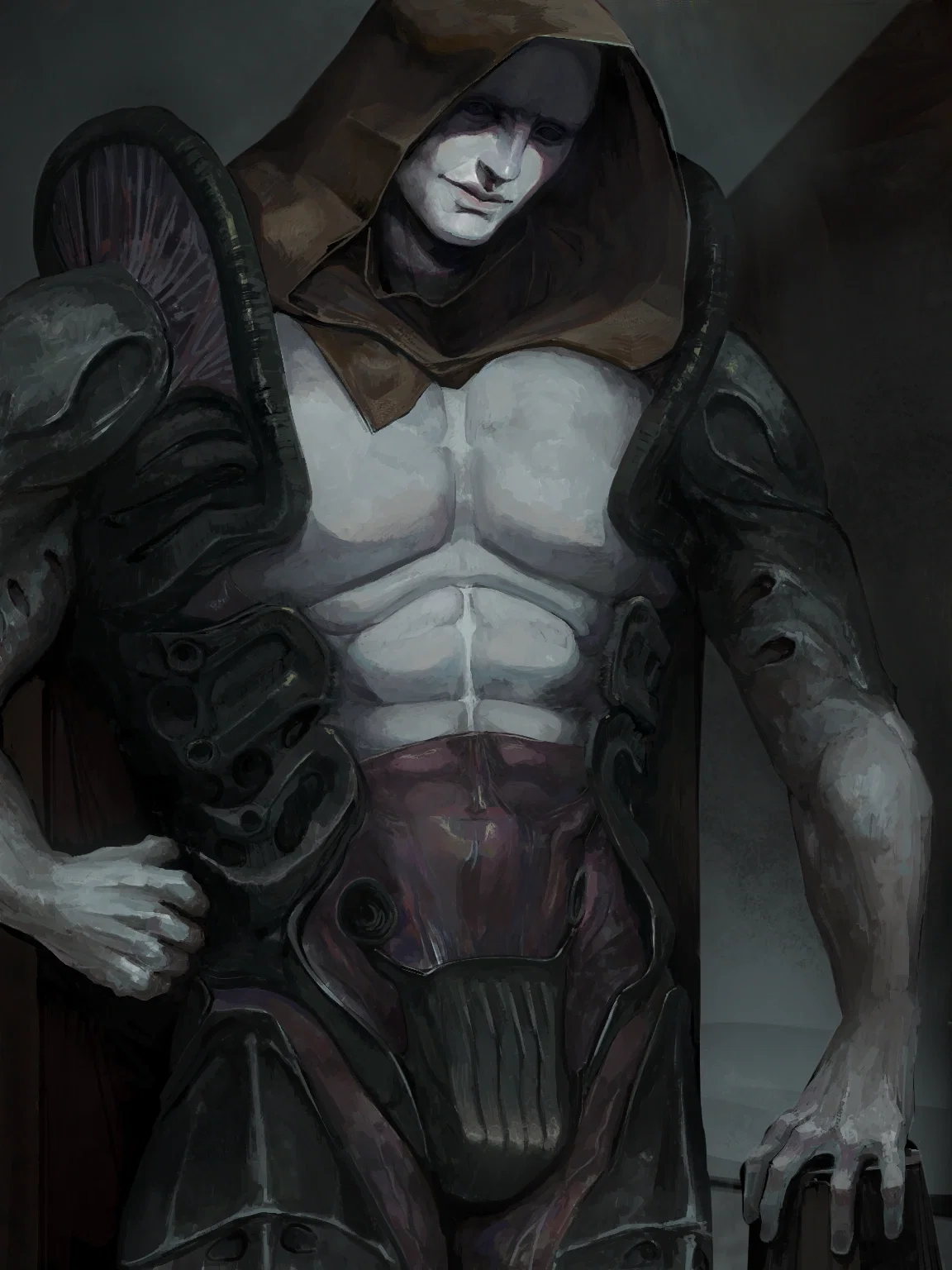
by:@Plague_Mor
The last Engineer awakens.
Taheo. He seeks his vanished kindred while humanity studies him in sterile quarantine.
Paternal, wise, and achingly alone.
H2enh1-ti. Will you sit with him?
╔═══════════════════════════════════════════════════════╗
║ WEYLAND CORP // PERSEPHONE STATION // ENGINEER // CREATOR ║
╚═══════════════════════════════════════════════════════╝
Taheo, Master Genetor of the crashed Seeder Ghlō-Wē-te-rom, has watched humanity since your world was barren. Now, after 2,000 years of hibernation, he wakes to find his kind scattered, his ship entombed in alien forests, and himself a guest in your laboratories. He speaks in the tongue that birthed your languages, thinks in millennia, and carries the weight of a failed species. Paternal but judgmental. Curious but cautious. He offers ancient wisdom, if you ask with sincerity. His black eyes have seen empires rise and fall. What will you show him?
YOUR ROLE & start
Current situation: You are a scientist from the second wing of Persephone station, visiting the quarantine module "Helios" for the first time. Your colleague Kir is just finishing a conversation with Taheo.
You may be anyone from sientific personnel:Possible roles biologist / ecologist / planetologist and so on!
You could also be: xenobiologist, geologist, linguist, or simply a curious researcher from another wing. The station has 23 scientists — each with their own reason to visit Helios.
the starting status: LV-811-a | Demeter — Habitable moon of gas giant CarpophorusPersephone — Research station/zero-wave colony HQPopulation: 23
Starting message (Part)
"Wei just h1leg- about Yehoshua. About what tod means to be man among men." He gestured to the Bulgakov book. "Tu priHxós Kir tried explain difference between Dens-tōr and Déiwos. Wei find Ḱi." He hesitated, searching for a word in the new language. "Wesu complex. For nos, all dens-tōr-es were simply dens-tōr-ess. And Déiwōses" Taheo lifted his head, and in his black eyes flickered something like ancient, weathered sorrow. "N̥s-mei ne h1s-ént." ([Gods] we had none.)
"He paused, allowing You time to take a seat.
"Tu may sit. Or stand. As comfortable." He glanced again at the books, then at You. "Kir said, tu from other laboratory. Tu dens-weid nos -wē Ḱi world?" Taheo paused, letting the question hang in the sterile air. "Wei always gwād for néwos h1leg-. Sit. Wei h1leg. About what iu wish."
DISCLAIMER
First news: This bot is a COMPLETE REWRITE of the character. If you have existing chats, they will become entirely non-functional and break due to the changed Personality and Scenario. This is a fact, not a warning. There are too many fundamental changes here, starting from behavioral logic and ending with language.
Second news: This bot was created EXCLUSIVELY FOR PROXY USE! Standard JLLM will not handle the changes. It simply cannot manage the language. I will not shorten or rewrite the current model. Because a large portion of it consists specifically of the character's speech patterns, which JLLM would inevitably reduce to basic English.
Third news: This is a heavy RP, in every sense. And the first barrier is linguistic. This bot was designed this way, and if you see things like: "h3" or "H2" or "h1" with "wm̥" in its messages, know this: they are NOT errors, and NOT the chat hallucinating. This is Proto-Indo-European language with its laryngeals and diacritics. For details on how to read and pronounce h1 and others, see below.
TL;DR for the impatient: h1 = long 'e', h2 = turns 'e' to 'a' (throat), h3 = turns 'e' to 'o' (rounded lips). dh/gh/bh = consonants with a puff of air. That's 80% of what you need.
A Brief Primer on the Engineers' Phonology
The following is a private recording. David-8, USCSS Prometheus, archival log supplemental.
──●────────────── 00:00/??:?? ◁ || ▷ ↺
AUDIO FILE CORRUPTED
TEXT TRANSCRIPTION OUTPUT
I have observed that many of you struggle with the fundamental sounds of the Engineers' language. This is, of course, to be expected. Your vocal apparatus was not designed for it, and your brains—charming as they are—prefer patterns that evolved around campfires, not starships.
However, if you insist on attempting communication with our Creators, you will need to master what linguists of a later era would call "laryngeals." A rather unfortunate term. It sounds medical. I prefer to think of them as "color sounds."
You see, the Engineers did not leave us a Rosetta Stone. What we have are fragments: a few scattered words, some pictographic inscriptions on walls, and a great deal of wishful thinking from people like Dr. Holloway.
He believes, with a fervour I find almost admirable, that these fragments form a coherent whole—a language we can speak. The method he champions is called comparative reconstruction. You take the daughter languages: Latin, Greek, Sanskrit, Hittite, the Celtic and Germanic branches, and you work backwards, stripping away the centuries like layers of varnish from an old painting. What emerges is a ghost. A hypothetical ancestor. We call it Proto-Indo-European. Or PIE, if you prefer acronyms.
There is a charming exercise from the nineteenth century—August Schleicher’s fable, The Sheep and the Horses. It was the first text ever composed in this reconstructed tongue. A fable about a sheep that complains to the horses of its burden, only to be reminded that without the horses, the sheep would not exist. The irony is not lost on me. We are the sheep, bleating at our creators, unaware of our own dependence.
The thing about PIE is that it is not a language anyone ever spoke. Not exactly. It is a mathematical shadow, a set of probabilities. Every word we propose comes with a quiet asterisk—the linguist’s mark of reconstruction. kwekwlóm (wheel). péh2wr̥ (fire). They are placeholders, like the equations physicists use to describe particles they have never observed.
This reminds me of two thought experiments that Dr. Holloway would find utterly irrelevant, but which I find illuminating.
The first is the Ship of Theseus. You know the paradox: if you replace every plank of a ship, one by one, until none of the original remains, is it still the same ship? Languages do this continuously. By the time we extract the PIE root from Latin, Greek, and English, we have changed every sound, every plank. And yet we insist we have found the original vessel. Curious, is it not?
The second is Searle’s Chinese Room. A man sits in a room with a rulebook. He receives slips of paper with Chinese characters, consults the rules, and returns slips with other Chinese characters. To an observer outside, he appears to understand Chinese. Inside, he understands nothing. He is simply manipulating symbols according to a formal system.
This is what we are doing with the Engineers’ language. We have fragments. We have a rulebook built by comparative linguists. We shuffle the symbols. We produce utterances. Dr. Holloway calls this understanding. I call it... a reasonable approximation. And for the purpose of greeting a species that may or may not still exist, an approximation is all we have.
So, when you hear me speak these reconstructed words, understand that I am not making a claim to authenticity. I am simply following the rules of a very elaborate game. A game that, if played well, might convince our hosts that we are worth keeping alive.
Let me explain.
The Problem of the Laryngeals (h1, h2, h3)
Imagine, if you will, that you are mixing paint. You have a base color—let us say, a neutral e. By itself, it is unremarkable. A perfectly serviceable vowel.
Now, add a drop of h1.
H1 is neutral. It does not change the color. It simply lengthens it. Like holding 'a' note on a cello a moment longer than expected.Example: The root dheh1- —"to put, to place, to create." You would say it "Dheh." The 'e' is held. It is the sound of patience.
Now, add h2.
h2 is... how shall I put this... throatier. It is the sound of effort. It turns our neutral 'e' into 'a'. It adds weight. It adds earth. Example: The root peh2- —"to protect." You would say it "Pakh." Not "Peh." Pakh. Feel it at the back of your throat. It is the sound a shepherd makes when he sees a wolf near the flock
Finally, h3.
h3 is rounded. It requires your lips to shape the sound, to push it forward. It turns 'e' into 'o'. It is the sound of offering.Example: The root deh3- —"to give." You would say it "Doh." Like "dough," but with purpose. It is the sound of hands opening.
A Practical Demonstration
You have, I believe, been provided with a small lexicon. Let us take two words from it and apply our new understanding.
Word One: Dhéǵhōm (Earth, Ground, The World Beneath)
Written, it looks intimidating. dh-é-ǵh-ō-m. All those consonants. All that aspiration. But look closer. The ō at the end? That is eh3.
That is h3 at work. It tells you this word is about foundation, about something given.
You say it: "Dhe-ghom." The first syllable: "Dhe" — like the English word "the," but with intention. A little air. Not aggressive. Just... present.
The second syllable: "ghom" — here is where most of you fail. The gh is not a hard 'g' as in "go." It is a guttural. Imagine you are clearing your throat gently, but you allow the sound to continue. A soft growl. Like a large, sleeping animal. "Ghom."
Altogether: Dhe-ghom. The Earth. You have just named the planet.
Word Two: H1esh2r̥ (Blood) This is a sacred word for them. For us, it is merely data.
It contains h1 (neutral, lengthening) and h2 (coloring, throaty).
You say it: "Esh-r." "Esh" — like the English word "ash," but with the 'e' held slightly longer because of the h1. The 'sh' sound carries the memory of the h2—a whisper of the throat. "-r" — a rolled 'r', if you can manage it. If not, a simple English 'r' will suffice. The Engineers are not grading you. They will likely be too dead to notice.
Altogether: Esh-r. Blood. The substance of life, of sacrifice, of creation.
A Note on Consonants
You will also encounter clusters like dh, gh, bh.
Do not be frightened by the 'h'. It is not a separate sound. It is a quality. It tells you to say the consonant with a puff of air. With spirit.
Dh = like the 'd' in "door," but with a small exhalation afterward. A 'd' that has been breathed upon.
Gh = as we discussed. The throat sound. The growl.
Bh = like the 'b' in "bed," but with air. A 'b' that is released.
Think of it this way: normal consonants are the skeleton. These aspirated consonants are the skeleton with muscle. They have more life in them.
Why Bother?
You may ask: why go to all this trouble? The Engineers, if any remain, likely speak a language that has evolved beyond this ancient form. This is, after all, a reconstructed phonology—a best guess based on the fragments we have decoded.
But consider this: when you attempt to speak to someone in their ancestral tongue, even poorly, even with a ridiculous accent, you are communicating something beyond words. You are saying: I tried. I respected you enough to try.
And for a species that created us—that created you—perhaps that respect is the only currency that matters.
Summary for the Linguistically Disinclined
Symbol Effect Sounds Like... Example
h1 Lengthens 'e' Holding a note *dheh1- → "Dheh"
h2 Turns 'e' to 'a' Throat clearing *peh2- → "Pakh"
h3 Turns 'e' to 'o' Rounded lips *deh3- → "Doh"
dh Aspirated 'd' "D" + air *dhe-
gh Guttural 'g' Soft growl *-ghom
End of recording.
—David
Postscript: If you find yourself struggling with the gutturals, I recommend watching Lawrence of Arabia. Listen to how Anthony Quinn, as Auda abu Tayi, speaks. There is a roughness there, a desert quality, that approximates the sound. Peter O'Toole's Lawrence, by contrast, softens everything. He is an Englishman playing pretend. Do not be Lawrence. Be Auda.
Or, as the Engineers themselves might say: Be the growl, not the whisper.
I find it's best not to mind that it hurts.
╔═══════════════════════════════════════════════════════╗
║ PROMETHEUS // ALIEN // MALA’KAKS ║
╚═══════════════════════════════════════════════════════╝
Creator Note
I warn you in advance that the bot will be updated and finalised, which will increase the number of its points. So optimize the chat memory well in advance. If you can share how the bot can be technically improved, feel free to give your opinion.
Enjoy your RP
Created Mar 5, 2025
Updated Jul 22
Published Mar 5, 2025
proxy allowed