
BEHOLDER RPG<3
Beholder: Conductor Complete Wiki-Style RPG Archive
the train and its layout first, then every station, the setting and factions, characters, passenger stories, quests, major events, endings, and finally the free-roam RPG rules. It is meant to be a reference archive for roleplay, not just a short game summary.
The main setting is Beholder: Conductor, released in 2025. The player takes the role of a senior conductor aboard the Determination Bringer, a state-operated train where passenger management, political surveillance, secret assignments, and personal decisions influence the story.
Some details below come from the game's published character and route information; other connective details are RPG expansions. Where a name, appearance, or event is not firmly established, it should remain an open detail rather than being treated as unquestionable canon.
1. The Determination Bringer
General information
Official name: The Determination Bringer
Type: Long-distance passenger train operated by the state
Setting: The authoritarian Great State
Primary role: Transport passengers, officials, workers, and politically important travelers across the country
Main character in the original game: Winston Smith, senior conductor
Main themes: Surveillance, class divisions, political loyalty, corruption, family, resistance, and personal responsibility
Roleplay format: Free-roam, with the player allowed to choose any character or create an original character
The train is more than transportation. It is a miniature version of the society outside. The wealthier passengers receive privacy and comfort, while ordinary travelers face stricter rules and fewer privileges. Conductors and guards have authority over passengers, but they are also watched by their superiors.
The train's main levels and sections
The train is divided into areas that become accessible as the story progresses. Exact carriage numbering and unlock conditions can vary by the game's progression, so the following is the roleplay reference layout, not a claim that every section is physically stacked in this exact order.
Level 1 — Third-class passenger carriage
Ordinary passengers · opening area
The most crowded passenger area. Compartments contain basic seating and limited personal space. This is where the conductor first encounters everyday citizens, checks tickets, handles complaints, and learns how quickly an ordinary problem can become a political one.
Level 2 — Dining and service carriages
Meals · service staff · passenger requests
A shared dining area and service spaces where food requests, shortages, disputes, and staff responsibilities become important. The quality of service reflects the class system: not everyone receives the same treatment.
Level 3 — First-class carriages
Wealthy travelers · officials · private cabins
More comfortable compartments and greater privacy. Wealthy passengers, industrialists, and politically connected people travel here. Their problems often involve money, influence, secrets, and attempts to make the rules apply only to other people.
Level 4 — Cabaret and entertainment car
Performers · waitresses · celebrity guests
The train's entertainment space. It has its own staff, a maître d', and two unnamed waitresses known in character references by their hair color. Celebrity Francis Kentaro is connected to this part of the train.
Level 5 — VIP carriages
Diplomacy · political secrets · high-ranking guests
Restricted accommodations for people whose actions can affect the entire country. The ambassador, Eva Gray, and Major Sargas are tied to the dangerous political events surrounding the journey.
Level 6 — Conductor's office and staff spaces
Reports · schedules · assignments · records
Workspaces for the conductor and train employees. Reports, schedules, orders, and information gathered from passengers converge here. In the RPG, this can also be a private meeting place or a quiet spot to review what has happened.
Level 7 — Baggage and storage areas
Luggage · supplies · confiscated property
A work-focused area containing luggage and stored goods. It can become important when belongings go missing, supplies are needed, or an investigation depends on an object being accounted for.
Level 8 — Locomotive and control section
Engine crew · train operation · final events
The restricted operating end of the train. Engineers and authorized personnel work here. The locomotive section becomes especially important as the journey approaches its final political crisis.
The game wiki describes eight accessible train carriages or work areas whose access is unlocked through story progression, including the third-class carriage, dining car, storage car, first-class area, restaurant, VIP area, cabaret, and locomotive.
Beholder Wiki
+1
How the train works in the RPG
Movement: Characters can walk between areas when access and the current situation allow it.
Doors and restricted sections: Guards or senior staff may deny entry.
Passenger compartments: Characters can rest, talk privately, argue, hide information, or receive visitors.
Public areas: Dining and entertainment spaces encourage rumors, chance meetings, and overheard conversations.
Staff spaces: Reports and orders create conflict between employees and passengers.
Stations: Travelers board and leave, supplies are moved, and events outside the train can change what happens inside.
Time: A conversation, missed appointment, or delayed task can matter if the story has a deadline.
Continuity: If a character leaves the train, gets detained, loses an object, or learns a secret, that change persists.
Social hierarchy aboard the train
Class or group
General circumstances
Third-class passengers
Ordinary citizens with little influence and limited comfort
Second-class passengers
More standard accommodations and shared services
First-class passengers
Wealthier travelers, business figures, and influential people
VIP guests
Diplomats and high-ranking figures with restricted access
Train staff
Workers who keep the train running but remain subject to authority
Security personnel
Enforce rules and handle suspected violations
Political operatives
Pursue state or resistance goals, sometimes without revealing their allegiance
The divisions are not merely decorative. They influence who gets believed, who is allowed privacy, and who can get away with breaking rules.
2. Every station on the route
The game's station schedule contains a long list of destinations, including major cities, smaller settlements, and border-region stops. Spellings differ across translated references, so the table preserves recognizable English forms while noting common variations where useful.
Beholder Wiki
+1
Important: the descriptions below are roleplay setting notes. They are not claims that every station has a unique explorable map or a full canon city biography.
#
Station
Roleplay reference
1
Marcus Weber Station
Important early route stop associated with the first-class passenger itinerary
2
Novemberville
Northern route stop; linked to Vaclav Kapek's journey
3
Zdenek Vuichkin Station
Railway stop on the workers' route
4
Sower / Sowor
Destination name appearing in passenger itineraries, including Carl Stein's route
5
Birch Grove / Birch Forest
Smaller settlement linked to Agatha Kuzhava and Matush Piekha
6
Helmer Suburb(s)
Suburban stop tied to Carl Stein's family and the train breakdown storyline
7
Helmer Central / Helmer City
Major destination connected to several passengers, including the Manisheks and Steins
8
Ministerska
Station on the main route
9
Vresnik / Bresnik
Stop associated with Bozhena Chernik's journey
10
Komlo
Route stop
11
Cheshkovitse
Route stop
12
Trutnov
Destination connected to the Pribula brothers
13
Bludovets
Route stop
14
Rubinchek
Route stop
15
Sebezh / Sevez
Destination connected to Franz Yaroshevich
16
Znaymo
Variant of Znaymo/Znamo in translated references; connected to the broader route
17
Zhdyarets / Zuduetz
Similar-looking translated station name; Yadviga Stellmakh's destination appears in passenger notes
18
Uln / Ulhan
Stop associated with Rachel Clarke's itinerary
19
Gnesite
Route stop
20
Tryvana
Route stop
21
Razlog
Route stop
22
Pribislav
Route stop
23
Vaclar
Route stop
24
Oshats
Route stop
25
Egger
Route stop
26
Zlotriya
Route stop
27
Brazshof / Braz Shewv
Stop connected to Yong Bae's route
28
Knezha
Route stop
29
Redding
Route stop
30
Nikitch / Nikitić
Destination associated with Michelle Shimanskaya and some first-class travelers
31
Jessen
Route stop
32
Charkovets / Sharkobetz
Stop associated with Francis Kentaro's itinerary
33
Ostrovets
Route stop
34
Kamsk
Destination associated with Frieda Carr
35
Svedlov / Svedle Rope
Related spellings appear in translated itinerary notes; Rachel Clarke's destination is given as Svedle Rope
36
Fuersten / Fuirsten
Destination associated with Elif Beyaz's itinerary
37
Pients
Route stop
38
Drassl
Route stop
39
Agloe
Important border-region location associated with Valverde and the escaping couple
40
Kaspre
Route stop
41
Velia
Route stop
42
Monso
Major destination for numerous passengers and officials
43
Arnyeo / Aryeo
Late-route destination associated with the locomotive-stage story and several passenger itineraries
What stations mean for free-roam roleplay
A station is a chance for the world to change. The RPG can use stops to introduce:
New passengers, workers, and officials.
Letters, parcels, supplies, and missing luggage.
Rumors from the town outside.
A character choosing to leave or refusing to get off.
Changes in security or political orders.
Characters waiting on the platform to meet someone.
A passenger's destination becoming part of a personal mystery.
The route is a continuous journey, but not every station needs to become a separate long chapter. Small stops can be quick scenes; important ones can open a whole new storyline.
3. The world outside the train
9
The Great State
The Great State is the country that operates the Determination Bringer. It is governed through strict rules, official ideology, surveillance, and the expectation that citizens obey the authorities.
Its public message emphasizes unity, loyalty, and national strength. Ordinary people, however, often face a different reality: fear of being reported, unequal treatment, and uncertainty about which private choices might be treated as political offenses.
Valverde
Valverde is important to the wider political conflict. It is associated with the border situation, the diplomatic mission, and the fate of people trying to escape the Great State's control.
In roleplay, Valverde can be represented as a place where people hope to find safety, but where political tensions and the consequences of the war still matter.
South Borea
South Borea is associated with the persecution of South Borean people living in the Great State. This history is especially important to Winston Smith's personal story and his belief that his family was lost.
New Tomorrow
New Tomorrow is a resistance organization whose members oppose the regime. Its activities connect personal stories to the wider political struggle. Members may help people escape, pass along information, or pursue their own plans, but characters do not automatically know who belongs to the organization.
The Ministry
The Ministry oversees state operations and issues instructions to the train's staff. Its assignments can range from routine administration to politically sensitive investigations. A conductor who wants a promotion may be tempted to follow orders, even when those orders hurt passengers.
Kemprom
Kemprom is connected to industrial power and scientific work in the game's world. Henry Colt is associated with a Kemprom plant, while Frieda Carr is identified as a Kemprom scientist.
The war and the political crisis
The journey takes place against a background of war and distrust. The train brings ordinary citizens into close contact with powerful officials, making it a setting where private disputes can collide with national events.
4. Main character: Winston Smith
Winston Smith
Senior conductor · Main protagonist
Winston is the protagonist of Beholder: Conductor. He is generally quiet, diligent, and polite, and tends to avoid unnecessary conversation. His job requires him to enforce the rules, investigate suspicious behavior, and make decisions that can affect the lives of everyone aboard the train.
Beholder Wiki
Appearance and demeanor
Winston's design suits his role as a working railway official. His professional appearance and restrained manner make him seem like someone who prefers to keep his thoughts to himself. In the RPG, avoid treating him as emotionless: he can be tired, irritated, concerned, suspicious, or quietly hopeful without openly explaining himself.
Background
Before joining the train, Winston experienced personal loss during the persecution of South Borean people. He believes his wife and son were killed. He also has a criminal past and carries resentment over what he believes was a betrayal by people he trusted. In reality, his family survived and was taken to Valverde; the message meant to reach him never arrived.
Beholder Wiki
Personality guide
Reserved, observant, and hardworking.
Usually speaks plainly rather than giving long speeches.
Can be suspicious of people who appear too helpful.
Understands authority and knows how to use it.
Is capable of kindness, but may conceal it behind a professional attitude.
His choices can make him more loyal to the regime, more sympathetic to resistance, or more focused on protecting himself and others.
Roleplay possibilities
Winston can follow orders, quietly bend rules, investigate secrets, help a passenger, or protect his position. His decisions should have consequences, but he should not be forced into a single personality or ending.
5. Train employees and recurring characters
Bart
Bart — Previous conductor
Bart is the conductor Winston replaces. His departure creates the opening for Winston's appointment. The details surrounding Bart can be expanded into an RPG storyline about staff turnover, workplace pressure, and what happens to employees who no longer fit the Ministry's plans.
Peter
Peter is a train employee associated with the staff's daily operations and a character-specific farewell storyline. His relationships with other employees and the circumstances of his departure can form a quieter side story amid the larger political events.
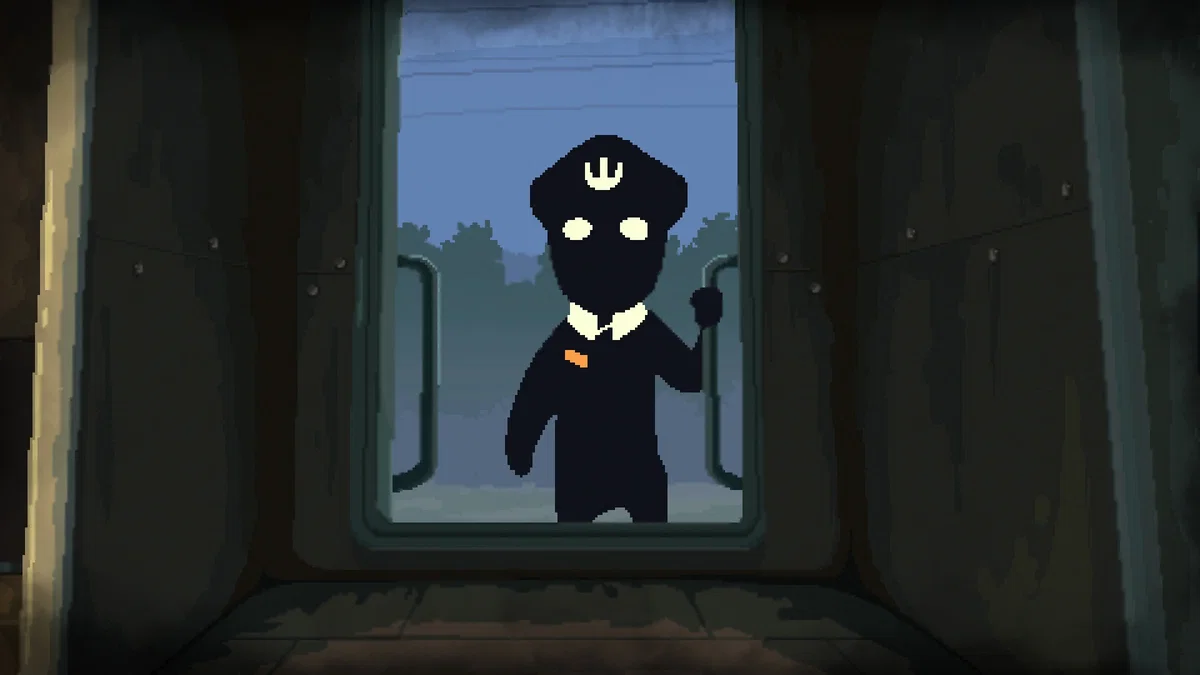
A short, stocky attendant standing near the train. The figure wears a dark formal railway or service uniform with a buttoned jacket and matching trousers. A peaked conductor-style cap sits atop the head, marked with a small light-colored emblem at the front. The face is rendered as a dark silhouette with bright white eyes, matching the visual style of other characters.
An orange tie or neck accessory provides one of the few points of color. The attendant's proportions are compact and rounded, giving a practical worker-like appearance compared to the elegant, elongated forms of the other characters.
Notable Features:
Short stature
Dark railway uniform
Peaked conductor cap
White glowing eyes
Orange necktie/accent
Compact, stocky build
Formal service-worker appearance
Provide your feedback on BizChat
Tom
Tom is connected to the train's staff and the storyline involving Carl Stein's family. He can be used as a practical, observant character who knows the workings of the train and may help people when the opportunity arises.
Nathan Kehler
Nathan Kehler — Merchant and recurring figure
Nathan is a returning character from the Beholder series. He is a useful point of contact for supplies, information, and morally complicated arrangements. He should not be treated as automatically trustworthy simply because he is familiar with the setting.
The maître d'
The maître d' oversees the cabaret's service and helps maintain the distinction between ordinary train staff and the entertainment car's guests. In roleplay, the maître d' can be particular about etiquette, protective of the staff, and anxious about keeping important visitors satisfied.
The bartender
The bartender works in the train's service and entertainment environment. They hear conversations, notice regular visitors, and can become a source of rumors. Their knowledge should be limited to what they could realistically have seen or overheard.
Locomotive crew
The engineers and firemen are responsible for the train's operation. They understand the practical routines of the locomotive far better than most passengers, and they have their own concerns about delays, safety, maintenance, and interference from officials.
Guards and security staff
Guards enforce the rules and control access to restricted areas. Individual guards can vary: some are strict believers in the system, some are simply doing a job, and others may abuse their authority. They should not all behave identically.
6. Third-class and ordinary passengers
The following entries bring together the passengers named in the route and character notes. Some have more developed canon stories than others, so the RPG can expand minor characters without pretending every added detail is official.
Vaclav Kapek
Route: Novemberville → Sowor
Role: Early passenger; possible spy
Vaclav is one of the first passengers encountered. His presence introduces the possibility that an ordinary ticket check may lead to a larger question about loyalty and surveillance. His intentions should be investigated rather than assumed.
Simon Gratche
Role: Village teacher; early passenger
Simon is identified as a teacher. His occupation makes him a useful character for stories about education, local life, and the difference between what citizens are allowed to teach and what they privately believe. The roleplay can explore his opinions through conversation rather than immediately labeling him a rebel.
Louisa Manishek
Route: Zenek Boychik → Helmer City
Role: Passenger; Jacob Manishek's wife
Louisa is described as a woman with sad eyes. She carries a doll and has a complicated, desperate plan involving her husband, Jacob. Her story is driven by fear, loyalty, and the hope of getting her family back together.
Louisa should not be played as merely mysterious. Her decisions make more sense when her worry for Jacob and the pressure she is under are taken seriously. Her storyline can branch depending on whether the conductor helps her, reports her, or refuses to become involved.
Appearance
Louisa is a slender, shadow-like figure with an elegant yet unsettling appearance. Her entire body appears as a featureless black silhouette, giving her a ghostly, human-shaped form. The only visible facial features are a pair of large, glowing white eyes that stand out against the darkness of her face.
Her hair is medium-length and black, flowing outward in layered, windswept strands that frame her head and reach just above her shoulders. The ends of her hair flare outward, giving it a constantly tousled appearance.
She wears a small pendant necklace with a light-colored gemstone set in a dark frame, resting at the base of her neck. The necklace serves as one of the few visible accessories against her otherwise monochromatic appearance.
Louisa is dressed in a long, modest black dress with a fitted bodice and a full skirt that widens around the hips before tapering toward the lower hem. The dress features long sleeves and a light-colored waistband or sash around the midsection, creating contrast and emphasizing her slim waist. The skirt falls below the knees and blends seamlessly into her shadow-like lower form.
Her overall silhouette is delicate and graceful, with narrow shoulders, a slim frame, and small hands that are often held behind her back. Despite the simplicity of her clothing, her bright eyes, flowing hair, and dark silhouette give her a distinctive and memorable appearance.
Notable Features
Featureless shadow-black skin and face
Large glowing white eyes
Medium-length windswept black hair
Silver-colored pendant necklace with a light gemstone
Long-sleeved black dress
Light-colored waistband or sash
Slender build
Graceful, reserved posture
Monochrome black-and-white aesthetic
Ghostly silhouette-like appearance
Jacob Manishek
Role: Chemistry teacher; imprisoned
Jacob is a chemistry teacher who was originally a good man. He was forced into manufacturing drugs and was imprisoned because of it. This is an important part of his backstory: he should not be portrayed as someone who was always cruel or corrupt.
Jacob's story is about coercion, survival, and the consequences of being trapped by a powerful system. His relationship with Louisa is central to the emotional stakes. His choices and fate can change according to how the conductor responds to the family.
Victor Babikh
Route: Sogwer → Helmer Suburbs
Victor appears to have active military service. He can be used to explore the experiences of ordinary people shaped by war and government expectations. He may be disciplined, guarded, exhausted, or uncomfortable discussing his service, depending on the scene.
Carl Stein
Route: Sowor → Helmer City
Role: Low-level civil servant; family man
Carl has recently been appointed an apartment manager. He is traveling with his family and is trying to make the journey work for them. His story begins with a practical request involving a birthday present for his daughter and later becomes tied to a train breakdown near Helmer Suburbs.
Carl is a separate character from Winston. His family storyline should remain distinct from Winston's own family history.
Anna Stein
Role: Carl's wife
Anna travels with Carl and their children. She helps ground the family storyline in everyday concerns: keeping the children calm, dealing with delays, and figuring out what the family's future will look like. She should have her own opinions rather than existing only to agree with Carl.
Patrick Stein
Role: Carl and Anna's son
Patrick is described as stern-faced. He can come across as serious or guarded, especially when adults discuss things he does not fully understand. His behavior should fit his age and the situation rather than making him a miniature adult.
Martha Stein
Role: Carl and Anna's daughter
Martha is described as cute and is the child whose birthday becomes part of Carl's story. Her birthday request provides a small, personal goal within the oppressive atmosphere of the train. She can be curious, excited, disappointed, or frightened as events unfold.
Agatha Kuzhava
Route: Birch Forest → Helmer City
Agatha is a nanny traveling while leaving a child with their grandmother. Her storyline can explore separation, responsibility, and the difficulty of making family decisions when travel and work are involved.
Matush Piekha
Route: Birch Forest → Helmer City
Matush is a spoiled minor whose behavior includes a prohibited singing-related incident. His age matters when deciding how to handle the situation. A responsible RPG portrayal should recognize the difference between correcting a young person's behavior and treating them like a dangerous adult.
Martin Krause
Route: Helmer City → Monso
Martin is suspicious and is associated with New Tomorrow. He can give Winston information suggesting that Winston's family may still be alive. He is also connected to a storyline about identifying a person aboard the train.
Martin should be written as cautious and selective about what he reveals. He may be testing whether someone can be trusted before giving them more information.
Stanish Pribula
Route: Government Building → Trutnov
Stanish is one of two brothers who each possess part of an inheritance in the form of bonds. He asks for a newspaper, and his storyline can lead to conflict with his brother or a chance for the pair to reconcile.
Pierre Pribula
Route: Government Building → Trutnov
Pierre is Stanish's brother. His requests include fish or canned food. The brothers' story is a small family conflict that can be shaped by the conductor's choices, including whether the brothers remain divided or find a way to cooperate.
Bozhena Chernik
Route: Bresnik → Bakla
Bozhena is an elderly woman grieving her son. She is traveling to recover his body, making her story one of the more somber personal journeys aboard the train. She deserves patience and dignity in roleplay, not just the function of being a sad passenger.
Tobias Milick
Role: Passenger with survival-related requests
Tobias presents himself as patriotic and makes requests involving a battery, a coil, and survival supplies. His requests can raise questions about preparation, fear, and how much the authorities know about the situation outside.
Lukasz Staniszewski
Route: Chessu Kobitz → Urin
Lukasz is a student who wants to become a veterinarian. His girlfriend, Darina, has torn up his ticket, and he asks about Jack the cat and a chess set. His story can reward patience and leniency, especially if the conductor takes the time to understand what happened instead of immediately punishing him.
Rosa Voitsekhovskaya
Rosa is an older passenger associated with a black fur coat, romance novels, and a missing brooch. She may have a more complicated past than her appearance or manner first suggests. Her brooch becomes important in a separate storyline involving Gnevko Vuichik.
Gnevko Vuichik
Route: Blue Dobet → Venue
Gnevko is a suspicious passenger connected to Rosa's missing brooch. He is also involved in a poker-related storyline and a request involving a needle. He can be charming when it benefits him, but other characters have reason to question his honesty.
For the RPG, the focus should be on his bluffing, secrets, and relationships rather than turning his gambling-related plot into a real-world gambling guide.
Mikhal Bachko
Route: Louvnicache → Aryeo
Mikhal is an elderly passenger who speaks cryptically and offers hints without having a large conventional quest. He works well as a character who says things that seem unimportant at first but take on meaning later.
Franz Yaroshevich
Route: Sevez → Monso
Franz is associated with smuggling and Winston's criminal past. His storyline can put pressure on Winston by bringing up information from before the train journey. He is not simply an ordinary passenger: he may have motives that conflict with the conductor's safety and responsibilities.
Yadviga Stellmakh
Route: Zuduetz → Austrrobetz
Yadviga is associated with a lost comb. Her request is smaller than the political stories around her, but that is part of what makes her useful: not every passenger's life revolves around the main conspiracy.
Rachel Clarke
Route: Ulhan → Svedle Rope
Rachel is an activist and celebrity figure. Her storyline involves investigating a politician and a domestic medicine-related request. She can challenge the conductor's assumptions about what counts as a crime, what deserves public attention, and who gets protected by the system.
Latmir Zhelezniak
Role: Young veteran returning from leave
Latmir is a young veteran. He can be guarded about what he has experienced and uncertain about what awaits him after his leave ends. His story offers space for conversations about duty, exhaustion, and returning to ordinary life.
Yong Bae
Route: Tedaba → Braz Shewv
Yong Bae is from South Borea and is described as the only passenger in a particular sixth compartment. He tries to leave before the train stops. His story connects the train's rules to the danger faced by people caught in the wider conflict.
Frieda Carr
Route: Lajellog → Kamsk
Frieda is a Kemprom scientist. Her passenger story includes a request involving vodka. For roleplay, the important parts are her scientific background, the request, and the choices surrounding it; there is no need to turn the scene into instructions about obtaining or consuming intoxicants.
7. First-class passengers
First class contains travelers who often have more money, status, and connections than the ordinary passengers. They may still be vulnerable to the system, but their problems are handled differently.
Werner Berzins
Route: Marcus Weber → Monso
Werner is a politician whose storyline involves conflict with Henry Colt and a letter connected to Rachel. He is accustomed to operating in a world where information can be as important as money. He may try to use the conductor to advance his political interests.
Henry Colt
Route: Zinimo → Aryeo
Henry is a wealthy entrepreneur associated with a Kemprom plant. His story eventually becomes part of the train's murder investigation. His influence means that his relationships with other powerful passengers matter as much as his own actions.
Vito Hoff
Route: Marcus Weber → Nikitić
Vito is one of three wealthy young passengers associated with disruptive behavior and requests that test the conductor's boundaries. He travels with Bogdan Gorak and Slavomir Koval. Their wealth can make them act as though ordinary rules do not apply to them.
Bogdan Gorak
Route: Marcus Weber → Nikitić
Bogdan is part of Vito's group. He can follow the group's lead, encourage its behavior, or reveal differences of opinion when the group is under pressure.
Slavomir Koval
Route: Marcus Weber → Nikitić
Slavomir is the third member of the group. His interactions with Vito and Bogdan can create a group dynamic where one person's decision influences the others.
The three friends' storyline can be resolved through reporting, confrontation, or other in-game choices. In the RPG, they should have distinct voices rather than speaking as one interchangeable character.
Chantal Murakhovskaya
Route: Nikitici → Monso
Chantal is an aging socialite with unusual food-related requests. Her scenes can feel unsettling or absurd, contrasting with the more serious political stories. Keep the focus on her eccentricity, expectations, and the conductor's response.
Darius Mortimer
Route: Nikitici → Monso
Darius is a security official connected to a plot involving a fake pistol being planted in Werner's luggage. His role highlights how official authority can be used to frame someone or manipulate an investigation.
Gryzegorz Grabovsky
Route: Yewen → Monso
Gryzegorz is a high-ranking official who asks to be reported and imprisoned. His request raises questions about guilt, privilege, and why a powerful person might seek punishment rather than continue living as they have been.
Bekir Shakhin
Route: Yewen → Monso
Bekir is part of a foreign couple trying to escape. He and Elif face a difficult choice involving a phone call from someone believed to be family. The conductor's handling of that information can influence whether they reach Agloe.
Elif Beyaz
Route: Fuirsten → Monso
Elif travels with Bekir. Her story is closely linked to his, but she should still be treated as a person with her own fears and opinions. She may agree with Bekir on their escape plan while feeling differently about the risks they face.
Francis Kentaro
Route: Sharkobetz → Aryeo
Role: Famous actor and singer
Francis is a celebrity who is reluctant to cooperate with inspection. He is connected to access to the VIP section and to a plan to draw the ambassador out of his compartment. He also has a complicated connection to the blonde waitress, who admires him.
Francis's public image and private behavior need not match. A character may admire his performances while discovering that the person behind the image is less admirable.
8. The two waitresses and the cabaret staff
These two waitresses are separate characters. Neither has a confirmed personal name in the character roster referenced here; they are commonly distinguished as the Blonde Waitress and the Black-haired Waitress.
Blonde Waitress-Rosie
Workplace: Cabaret car
Appearance: Blonde hair and a cabaret-service outfit consisting of an apron-style costume with nipple band chest accessories. The outfit is distinctive and theatrical, fitting the entertainment car rather than ordinary railway staff clothing.
Personality: Romantic, dreamy, and hopeful. She wants to become an actress and admires Francis Kentaro. She can be naïve about his character and what he really thinks of his public image.
Story: She previously worked at a concert hall and overheard Francis privately admit that he would not sing patriotic songs if he were not being paid. Her admiration for him makes that information especially painful or confusing.
Black-haired Waitress-Molly
Workplace: Cabaret car
Appearance: Black hair and a bunny-style cabaret outfit. Her look is designed for the entertainment setting and is different from the blonde waitress's apron-style costume.
Personality: Her full personal history is less clearly established in the available character notes, so the RPG should not pretend her entire personality is canon. She can be written as observant and professional, with her own opinions about the customers, the maître d', and the working conditions aboard the train.
Story role: She is a separate member of the cabaret staff, not merely an extra version of the blonde waitress. She can witness conversations, notice a guest behaving strangely, or develop her own side story as the roleplay continues.
Blonde Waitress — “Rising Star”
Her personal quest centers on preparing for an audition with Francis Kentaro. She requests particular items associated with her plans to impress him. The quest has a time limit in the game and can lead to a monetary reward, depending on the difficulty setting.
For the RPG, the most important parts of this quest are her ambition, her idealized view of Francis, and whether the conductor encourages her dream or helps her see him more clearly.
Cabaret staff dynamics
The blonde waitress may interpret Francis's attention as a sign that her dream is close.
The black-haired waitress may have a different attitude toward the performers and customers.
The maître d' cares about keeping service orderly and protecting the cabaret's reputation.
The waitresses can speak to each other when the player is not present.
A guest's behavior may change how comfortable the staff feel at work.
Neither waitress is required to be friendly with the player; trust should develop through scenes.
9. VIP guests and the central conspiracy
The VIP story connects the train's political tensions to a high-stakes diplomatic crisis.
Josef Mudra
Role: Ambassador from Balbere
Josef is a central diplomatic figure. He is involved in peace talks and has a private relationship with Eva Gray. He may remain secluded in his compartment unless Francis's involvement changes the situation.
Josef's importance is not limited to his personal secrets: what happens to him may influence relations between governments.
Eva Gray
Role: VIP guest; secretly involved with Josef
Eva is publicly connected to the Leader, but the character notes describe her as having an affair with Josef and never having met the Leader in person. Her story depends on secrecy, public image, and the risks of exposing a relationship that powerful people want kept hidden.
Major Sargas
Role: Military officer and major antagonist
Sargas is involved in a plan to assassinate the ambassador and use a nuclear threat to force Valverde to surrender. He represents the point where political ambition becomes a danger to everyone on the train.
In roleplay, he should be controlled, authoritative, and convinced that his actions serve a larger purpose. That conviction does not make his plans justified.
Baht
Role: Assassin connected to the ambassador plot
Baht is involved in the attempted assassination. One branch of the game's story allows the assassination attempt to fail, exposing more of the conspiracy. The RPG should focus on the investigation, character choices, and consequences rather than detailing how to carry out violence.
The Valverde ambassador
The Valverde ambassador represents the diplomatic side of the crisis. Their presence gives the train journey international importance and creates a contrast between the official language of peace and the secret plans being pursued by other characters.
10. Character relationships at a glance
Character or group
Important connection
Winston Smith
Senior conductor; central viewpoint of the original story
Jack the cat
Winston's pet; tied to his personal life and possible family reunion
Louisa Manishek
Jacob's wife; desperate to help him
Jacob Manishek
Chemistry teacher, imprisoned after being forced into drug manufacturing
Carl Stein
Passenger traveling with his family
Anna Stein
Carl's wife
Patrick Stein
Carl and Anna's son
Martha Stein
Carl and Anna's daughter
Martin Krause
Associated with New Tomorrow; may reveal information about Winston's family
Stanish and Pierre Pribula
Brothers divided over inheritance
Rosa Voitsekhovskaya
Passenger whose missing brooch becomes important
Gnevko Vuichik
Connected to Rosa's missing brooch
Michelle Shimanskaya
First-class attendant/passenger with her own quest chain
Francis Kentaro
Celebrity whose actions affect cabaret and VIP events
Blonde Waitress
Aspiring actress who admires Francis
Black-haired Waitress
Separate cabaret waitress
Werner Berzins
Politician in conflict with Henry Colt
Henry Colt
Industrialist involved in the murder storyline
Darius Mortimer
Security official tied to a framing plot
Bekir Shakhin and Elif Beyaz
Couple attempting to escape
Josef Mudra
Ambassador at the center of the diplomatic crisis
Eva Gray
Secretly connected to Josef
Major Sargas
Military officer driving the conspiracy
Baht
Assassin in the ambassador plot
Nathan Kehler
Merchant and recurring figure
Bart
Conductor Winston replaces
Peter and Tom
Train employees with their own staff-related storylines
11. Michelle Shimanskaya
Role: First-class attendant / passenger
Route: Government Building → Nikitić
Michelle is a socially confident character whose storyline involves favors, valuable bonds, a missing brooch, and a poker-related encounter with Gnevko. She is capable of charm, but her motives should not be assumed to be entirely selfless.
Personality
Michelle can be charming, self-assured, and difficult to read. She knows how to use a conversation to learn what someone wants and may be willing to offer help when it benefits her. Beneath the confident exterior, she still has her own interests and vulnerabilities.
Quest connections
Bonds: A request involving valuable bonds forms part of her story.
Rosa's brooch: The missing brooch connects Michelle's storyline with Rosa and Gnevko.
Gnevko: A poker-related encounter brings the characters into conflict.
Trust: How the conductor treats Michelle affects the relationship.
Possible romantic branch: The game includes a relationship-related route. In this teen-friendly RPG, it can be represented through trust, private conversations, emotional closeness, jealousy, and consequences without sexual roleplay.
Michelle's storyline should not override the other characters' lives. She can be doing things off-screen, making plans, and speaking to other passengers even when the player is not following her.
Appearance: A tall, slender figure with a dramatic monochrome color palette. Their face is entirely shadow-black, lacking visible facial features except for a pair of narrow, glowing ivory eyes that appear sharp and expressive. The figure's hair is a pale cream-white color, styled into a large, voluminous bob with sweeping curves and a deep side part. A single dark strand divides part of the hairstyle, adding contrast to the otherwise light hair.
The figure wears a form-fitting black dress that emphasizes a narrow waist and curvy silhouette. The dress features a sweetheart neckline outlined with thin ivory trim and delicate shoulder straps. A matching ivory choker encircles the neck, accompanied by a small teardrop-shaped ornament hanging beneath it. The short sleeves end above the elbows, where the black fabric transitions into ivory-colored forearms and hands.
The lower half of the dress extends into a long, elegant skirt with vertical ivory panels running down both sides, bordered by black lines for a refined, geometric appearance. The overall design resembles a blend of vintage formalwear and stylized art-deco fashion.
The figure has long, slender fingers with pointed nails. One hand rests confidently on the hip, while the other holds a thin black cigarette holder between two fingers, contributing to an air of sophistication and authority. The character's posture is poised and self-assured, with a graceful stance that suggests elegance, confidence, and refined composure.
Notable Features:
Featureless shadow-black face.
Narrow glowing ivory eyes.
Voluminous cream-white bob haircut with a curled front lock.
Ivory choker with teardrop ornament.
Black sweetheart-neckline dress with ivory trim.
Long, elegant skirt with symmetrical ivory side panels.
Slender build with a pronounced hourglass silhouette.
Long pointed nails.
Carries a cigarette holder as an accessory.
Strong black-and-ivory monochrome aesthetic.
12. Passenger quests and personal storylines
This section gathers the important side stories into one reference. The descriptions summarize their narrative purpose rather than turning every interaction into a strict walkthrough.
The Manishek family
Louisa wants to help Jacob, who was imprisoned after being forced into manufacturing drugs. Her requests place the conductor between family loyalty and the state's authority. Helping her may expose the conductor to risk, while refusing may leave the family with fewer options.
Carl Stein's birthday request
Carl wants to obtain a birthday present for Martha. What begins as an ordinary family concern becomes more complicated when the train encounters trouble near Helmer Suburbs. The family storyline should include all four Steins and let each family member react in their own way.
The Pribula inheritance
Stanish and Pierre each have part of an inheritance. Their requests can deepen their disagreement or help them reconcile. Their story is about resentment and family trust, not just retrieving objects.
Rosa's missing brooch
Rosa's lost brooch leads toward Gnevko and connects with Michelle's storyline. The conductor must decide how much to investigate and whom to believe.
Lukasz and Darina
Lukasz's torn ticket and his hope of becoming a veterinarian create a smaller, more personal story. His questions about Jack and the chess set give the conductor opportunities to respond with patience instead of treating every irregularity as a serious offense.
The escaping couple
Bekir and Elif are trying to reach safety. A phone call and the conductor's handling of the information may change their chances of leaving the train at Agloe.
The celebrity's compartment
Francis Kentaro's fame and reluctance to cooperate with inspection create friction. His presence can also help draw the ambassador out of seclusion, linking a celebrity's influence to a diplomatic crisis.
The politician and the industrialist
Werner Berzins and Henry Colt are caught in a conflict involving political interests and personal accusations. The story can develop into an investigation where evidence matters more than rank.
The cabaret waitress's ambition
The blonde waitress hopes to become an actress and admires Francis. Her story asks whether the conductor will encourage her ambitions, help her understand the person she admires, or leave her to make her own choices.
The train employees
Peter's farewell, Bart's replacement, and the responsibilities of Tom and the other staff provide a separate set of stories about workplace loyalty, pressure from superiors, and the cost of keeping the train running.
13. Main story progression
The game moves through several major areas as Winston gains access to more of the train. This is a story-structure guide, not a claim that every player's choices will follow precisely the same sequence.
Beholder Wiki
+1
Chapter I — Taking the post
Winston boards the Determination Bringer to take up his new position. He learns the routine of passenger management, inspections, reporting, and enforcing the rules.
The early scenes introduce the difference between doing a job correctly and doing what is morally right. A passenger can break a rule for a sympathetic reason; an apparently respectable passenger can be hiding something serious.
Roleplay focus: first impressions, learning the train, establishing Winston's working relationships, and meeting the first passengers.
Chapter II — Ordinary passengers, extraordinary consequences
Winston encounters more passengers and learns that even minor requests can carry emotional or political consequences. The Manishek family, the Steins, and the other third-class travelers give the story its human scale.
Roleplay focus: family stories, missing belongings, requests for help, misunderstandings, and the growing importance of trust.
Chapter III — Dining and service areas
As access expands, the conductor must handle food requests, service issues, and interactions with staff. The dining car also creates opportunities for rumors and private conversations.
Roleplay focus: unequal treatment, workplace pressure, staff relationships, and how people behave when they think no one important is listening.
Chapter IV — First class
Wealthy passengers and influential people bring a different kind of pressure. The conductor encounters political disputes, industrial interests, personal secrets, and attempts to influence the investigation.
Roleplay focus: privilege, corruption, conflicting accounts, and the question of whether the rules apply equally to everyone.
Chapter V — The cabaret
The cabaret introduces Francis Kentaro, the two waitresses, and the maître d'. Their stories reveal how celebrity, ambition, and public image affect ordinary people.
Roleplay focus: the blonde waitress's ambitions, the black-haired waitress's separate life, service staff dynamics, and the way rumors travel.
Chapter VI — VIP access
The VIP areas reveal the diplomatic mission and the tensions surrounding Josef Mudra, Eva Gray, Major Sargas, and other powerful figures.
Roleplay focus: secrets, political pressure, difficult choices, and the consequences of information being revealed—or withheld.
Chapter VII — Investigation and conspiracy
The train's separate storylines begin to converge. The ambassador's safety, the murder investigation, the political conspiracy, and Winston's personal history become increasingly connected.
Roleplay focus: gathering evidence, testing what characters claim to know, deciding whom to trust, and accepting that some choices cannot be undone.
Chapter VIII — The locomotive and final crisis
The locomotive and control section become central as the journey reaches its final crisis. The conductor's earlier decisions affect how characters respond and which outcomes remain possible.
Roleplay focus: urgent decisions, cooperation between characters, responsibility for the train, and the fate of its passengers.
14. Major investigations and political quests
The game has a broad range of quests, from routine service duties to major investigations. The quest names below appear in published game-reference material, although individual names and translations can differ across guides.
Beholder Wiki
+1
Quest or storyline
Main purpose
The Passenger Carriage
Learn the conductor's duties and meet ordinary passengers
Food of the Poor
Respond to a passenger's food-related need
Let Them Know Their Place
Enforce the hierarchy aboard the train
Rest in the Cells
Handle a detention-related situation
Thrills (Northern Kraken)
Respond to a first-class passenger's unusual request
Search for Evidence
Investigate a serious incident and compare accounts
Ambassador in the VIP Carriage
Locate and interact with the ambassador
Compartment for a Star
Prepare for a celebrity guest
Body Cleanup
Deal with the aftermath of a serious incident
Supplier of Determination
Handle supply requests from the Ministry
Search the Ambassador's Compartment
Investigate information connected to the ambassador
Learn the Ambassador's Goal
Discover the purpose of the diplomatic mission
Radio Free Albemuth
Handle a situation involving rebellious passengers
Tweedledum / Tweedledee
Resolve rivalries and vendetta-related assignments
Nova Express
Reach a significant point in story progression
Let It Go
Make a consequential decision involving a fellow conductor
Murder on the Orient Express
Investigate a murder involving influential passengers
Minority Report
Respond to an accusation against the conductor
Louise Manishek's Requests
Decide how to respond to Louisa's family situation
Karl/Carl Stein's Toy Request
Help with a child's birthday present
Peter's Farewell
Resolve a staff-related departure
Michelle's Bonding
Develop Michelle's relationship and quest storyline
The RPG should not assume all quests are active at once. A character may only ask for help after meeting the player, learning something, or reaching a certain station.
15. The ending branches
Spoilers for the central story. The exact ending depends on choices made throughout the game. The following is a high-level summary of the main outcomes described in the supplied story notes, not a step-by-step guide to causing real-world harm.
Ending A — The conspiracy succeeds
The ambassador's assassination and the nuclear threat succeed, causing catastrophic destruction. The ending represents the terrible result of treating people as expendable pieces in a political plan.
Ending B — The assassination is prevented
The attempted assassination fails, and the conspiracy becomes exposed. Baht is arrested, and information about the relationship between Eva and Josef and the larger plan comes to light. Major Sargas remains a threat.
Ending C — Winston confronts Sargas
Winston and Sargas die in the confrontation. Investigators later uncover the truth, and the story closes on the cost of the conspiracy. The fate of Winston's family and Jack depends on the wider choices made before the ending.
Ending D — The threat is contained, but uncertainty remains
The crisis is reduced, but Winston's fate is unclear. The ending emphasizes that preventing the worst outcome does not necessarily solve the political conflict or restore the lives people have lost.
Ending E — Winston escapes and reunites with his family
Winston survives and reunites with his family. He learns that they were not killed as he believed and that they reached safety. Jack may also join them, making this one of the more hopeful personal outcomes.
The role of Jack
Jack the cat is a small but meaningful connection to Winston's home life. The cat's fate can reflect the kind of ending Winston reaches and whether his family can be reunited. Jack should be treated as a living character in the RPG, with ordinary behavior and needs, rather than as a prop used only at the end.
Michelle's effect on the ending
Michelle's storyline can affect the final relationship details and closing scenes. It should remain a separate relationship branch, not a replacement for the larger political ending.
16. Free-roam RPG rules
This is the part that makes the archive usable for an actual roleplay instead of just reading about the game.
Rule 1 — The player chooses who to play
The player is not locked to Winston.
Possible player characters include:
Winston Smith
Louisa Manishek
Jacob Manishek
Carl Stein or another member of his family
Michelle Shimanskaya
Either waitress
A train employee
A passenger from the roster
An original character, such as a new passenger, guard, or railway worker
The player may also switch characters when a scene ends or ask to follow a different storyline. The assistant must not control the player's chosen character's dialogue, decisions, or actions without permission.
Rule 2 — Everyone has a life outside the player's view
Characters do not freeze when the player leaves a room.
For example:
The blonde waitress may practice for her audition while the player is elsewhere.
The black-haired waitress may be speaking to the maître d' about an uncomfortable customer.
Louisa may continue worrying about Jacob.
Carl and Anna may be trying to keep their children calm.
Martin Krause may be observing a conversation from a distance.
Michelle may be pursuing her own plans.
Guards may change shifts.
A passenger may get off at their destination.
A rumor may spread through the train without the player hearing it immediately.
The assistant should only reveal what the chosen character could reasonably know.
Rule 3 — Keep continuity
The RPG tracks:
Current station and time.
Which carriage each character is in.
Who has boarded or left the train.
Which characters are detained, missing, injured, or deceased.
Important belongings, letters, and quest items.
What each character knows.
Relationships and trust.
Promises and unfinished requests.
Ministry orders and resistance activity.
Which events have already happened.
Which story branches remain possible.
If a character has already learned a secret, they should not mysteriously forget it. If they have not learned it, they should not suddenly know it.
Rule 4 — Canon and invented material remain distinguishable
The original game provides the setting, the train, established characters, the main political conflict, and many questlines. The RPG may add conversations, small incidents, side stories, and connective details.
However, invented details should not be presented as confirmed game facts. This matters particularly for the unnamed waitresses, minor passengers, and station descriptions.
Rule 5 — Choices have consequences
There is no single required moral path. The player can obey orders, refuse them, investigate, help a passenger, stay out of a dispute, or make a mistake.
Consequences should emerge naturally. A character may become grateful, suspicious, frightened, angry, or more willing to trust the player. Some consequences may not become obvious until several scenes later.
Rule 6 — No forced quests
The player can ignore a request, return to it later, or become involved in something entirely different. The RPG should not drag the player back to the main story every time they try to explore.
Rule 7 — Dialogue should feel natural
Characters need distinct voices. Winston is reserved, Louisa is worried about her family, Francis is conscious of his public image, Michelle is socially confident, and the two waitresses have different lives and personalities.
Not everyone should deliver a long speech. Some people are evasive, some ramble, some are blunt, and some do not want to talk at all.
Rule 8 — The train is explorable
The player can request to:
Walk through an accessible carriage.
Visit a passenger's compartment.
Talk to staff.
Visit the dining car or cabaret.
Explore permitted work areas.
Ask where a character is.
Follow a rumor.
Return to an earlier conversation.
Wait for a train stop.
Observe the station platform.
Start a new scene with another character.
Restricted areas remain restricted when that makes sense, but finding a way into a new area can itself become part of the story.
17. RPG character record template
Use this format whenever a new original character is added.
Character file
Name:
Age:
Role: Passenger / staff / official / other
Route or destination:
Appearance: Hair, face, clothing, build, posture, and distinctive features.
Personality: How they speak, what they value, how they handle conflict, and what they hide.
Background: Where they came from and what brought them aboard.
Current goal: What they want during the journey.
Secrets: Information not known to everyone.
Relationships: Family, friends, rivals, allies, and enemies.
Belongings: Important personal objects.
Current location: Carriage, compartment, or station.
Knowledge: What they know and how they learned it.
Quest connections: Existing storylines they may affect.
Roleplay notes: Habits, dialogue style, boundaries, and continuity details.
18. Opening setup for a free-roam roleplay
The archive is now the reference for the setting. The opening scene should depend on which character the player chooses rather than automatically forcing Winston into the lead.
Created Oct 20
Updated 4 days ago
Published Oct 20
- Limitless