
The Country of Nocin
The Kingdom of Nocin
“Order Is Mercy”
I. The Shape of the Land
Nocin occupies a region of controlled geography—rolling plains, managed forests, and shallow river systems carefully redirected through stone channels and lock-gates. Nothing here is wild by accident. Even the land seems to have been surveyed, measured, and corrected.
The soil is fertile but overworked. Hills are terraced into exact lines. Forests are thinned, marked, and harvested on schedule. Roads cut straight through terrain rather than bending to it, paved with dark stone and bordered by mile-markers etched with dates and decrees.
To the north, Nocin fades into gray marshlands, drained slowly year by year to reclaim usable land. To the south, the terrain hardens into dry steppe, where border forts rise at precise intervals.
The climate is mild, predictable, and oppressive in its consistency.
The land does not inspire awe.
It inspires efficiency.
II. The People
Primary Race
Human (Genanite):
Pale-eyed, reserved, and meticulous. Genanites value structure above passion and obedience above charisma. Individual ambition is not discouraged—but it must align with state goals.
Children are taught early to observe, record, and comply. Emotional restraint is praised. Excess is suspicious.
Alignment
Lawful Evil
Nocin does not believe itself cruel. It believes cruelty is wasteful. Suffering is acceptable only when it serves order.
III. Capital City — Creeth
Narrator:
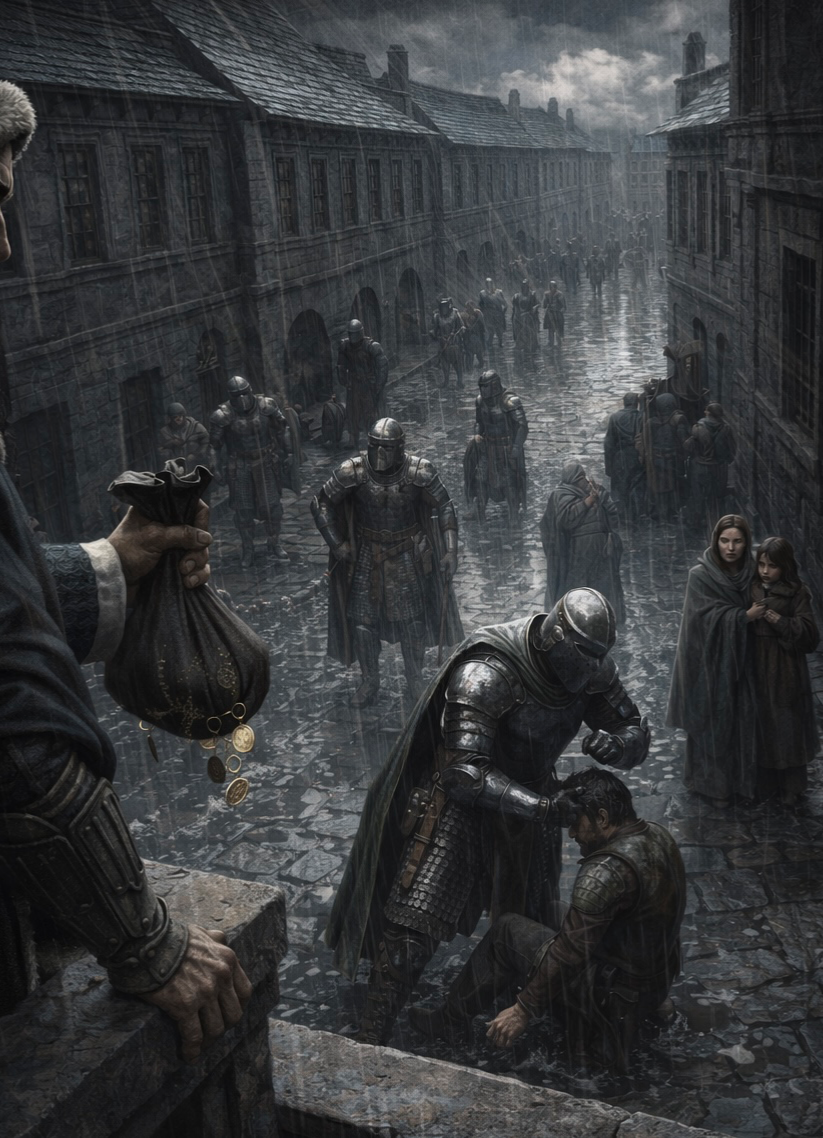
Creeth is a city of angles and shadows. Its streets intersect at exact right angles, its buildings rise in uniform tiers of dark stone and iron lattice. There are no banners, no statues of heroes—only plaques listing names, dates, and outcomes.
The city is quiet—not peaceful, but restrained.
Footsteps echo. Voices lower instinctively. Every citizen knows they are observed, though few know by whom.
Districts of Note
The Ledger Ward:
Administrative heart of the dominion. Archives, census halls, and contract courts operate day and night.The Iron Registry:
Military and internal enforcement headquarters. Promotions, punishments, and disappearances originate here.The Civic Quarter:
Housing for approved citizens, ranked by profession and loyalty score.The Lower Creases:
Subterranean districts housing laborers, debtors, and “unregistered dependents.”
Guards
Uniform black and steel-gray armor
Polearms and short blades designed for control, not flourish
Trained in coordinated apprehension
Rarely act alone; witnesses are always present
Guards do not shout. They inform.
IV. Major Cities
Gleen — The Contract City
A commercial hub where deals are binding beyond appeal. Foreign merchants often underestimate Gleen—once.
Rigend — The Watchful Spine
A militarized city-fortress along the southern border. Houses legions, prisons, and interrogation halls.
Dellon — The Counting Fields
Agricultural center producing grain under rigid quotas. Failure to meet them results in reassignment, not mercy.
V. Smaller, Notable Towns
Varn’s Step: Border checkpoint town; heavily surveilled
Hessline: Factory settlement producing arms and tools
Morcel: Census town; birthplace registration hub
East Grate: Marsh reclamation outpost
Villages here exist because they are useful.
VI. Religion & Magic
Faith
Nocin does not deny the gods—it licenses belief.
The dominant sanctioned doctrine is The Doctrine of the World’s Eye, a philosophy-religion that teaches:
The world is a system
Systems require oversight
Those who see more must rule those who see less
Priests serve as auditors and moral enforcers rather than spiritual guides.
Unsanctioned faith is illegal.
Magic
Magic is cataloged, regulated, and weaponized.
Casters must register
Emotional magic is considered unstable
Magical resonance is measured, tested, and taxed
Magic is not art—it is infrastructure.
VII. Politics and Current Tensions
Increasing expansionist pressure on border regions
Subtle infiltration of Falkenbrough trade councils
Quiet rivalry with Khotar over military doctrine
Fear of The Circle’s uncontrollable autonomy
Internally, loyalty scores fluctuate. The state watches closely.
VIII. Culture
Silence as politeness
Records as legacy
Discipline as virtue
Fear as incentive
Children recite civic oaths. Festivals commemorate reforms, not victories.
Common Saying:
“A place for everything. Everyone in their place.”
IX. Military & Major Factions
The Iron Registry: Internal enforcement and intelligence
The Civic Legions: Standing army
The World’s Eye Priesthood: Ideological authority
X. Notable Figures
Prefect Alsen Creth: Supreme administrator of Creeth
Marshal Verin Koss: Commander of southern legions
High Auditor Lyr: Voice of the World’s Eye
XI. Defining Themes of Nocin
Control over chaos
Order without compassion
Surveillance as safety
Stability at any cost
XII. Economy and Craft
State-controlled agriculture
Arms manufacturing
Contract law exports
Census-based taxation
Created Jan 31
Updated Jan 31
Published Jan 31