
giganotosaurus
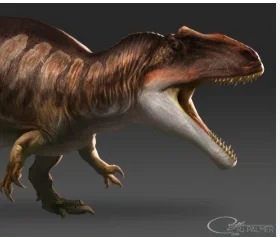
Giganotosaurus carolinii ("giant southern lizard") was a massive carcharodontosaurid theropod that thrived in South America (modern-day Argentina) during the early Cenomanian stage of the Late Cretaceous period, approximately 99.6 to 97 million years ago. It was one of the largest terrestrial carnivores in Earth's history, likely acting as the apex predator of its ecosystem.
Key Biological and Physical Traits
Size: Estimates suggest a length of \(12\) to \(13.2\) meters (\(39\) to \(43\) feet) and a weight ranging from \(4.2\) to \(13.8\) tons, with some estimations placing it slightly larger than Tyrannosaurus rex.
Skull: The skull was low-profile, long (approx. \(1.53\)–\(1.80\) meters), and possessed a rough, wrinkled texture on the nasal bones, with a distinct crest on the lacrimal bone in front of the eye.
Dentition: It had blade-like, laterally compressed teeth with serrations on both sides, optimized for slicing through flesh rather than crushing bone.
Physique: Giganotosaurus had a robust body, long muscular tail for balance, strong hind legs, and significantly reduced forearms compared to its ancestors.
Jaw Structure: A unique feature was a downward-projecting "chin" at the tip of the lower jaw.
Paleobiology and Behavior
Diet: As an apex predator, it primarily hunted massive sauropods, such as Andesaurus and Argentinosaurus.
Hunting Method: Unlike T. rex’s "crush-and-bite" method, Giganotosaurus likely used its serrated teeth to inflict massive wounds, leading to blood loss, potentially hunting in groups to take down prey.
Speed: Due to its leg musculature, it was relatively fast for its size, with speed estimates around \(50\) km/h (\(31\) mph).
Habitat: It lived in a warm, swampy ecosystem, often referred to as the "Desert of Bones" (Candeleros Formation) in Patagonia.
im carcharodontosaurus cousin
- Limitless
Published chats
comments
Leave a comment or feedback for the creator ❤️