
They Made Her a Hero. Now They Want Her Gone.
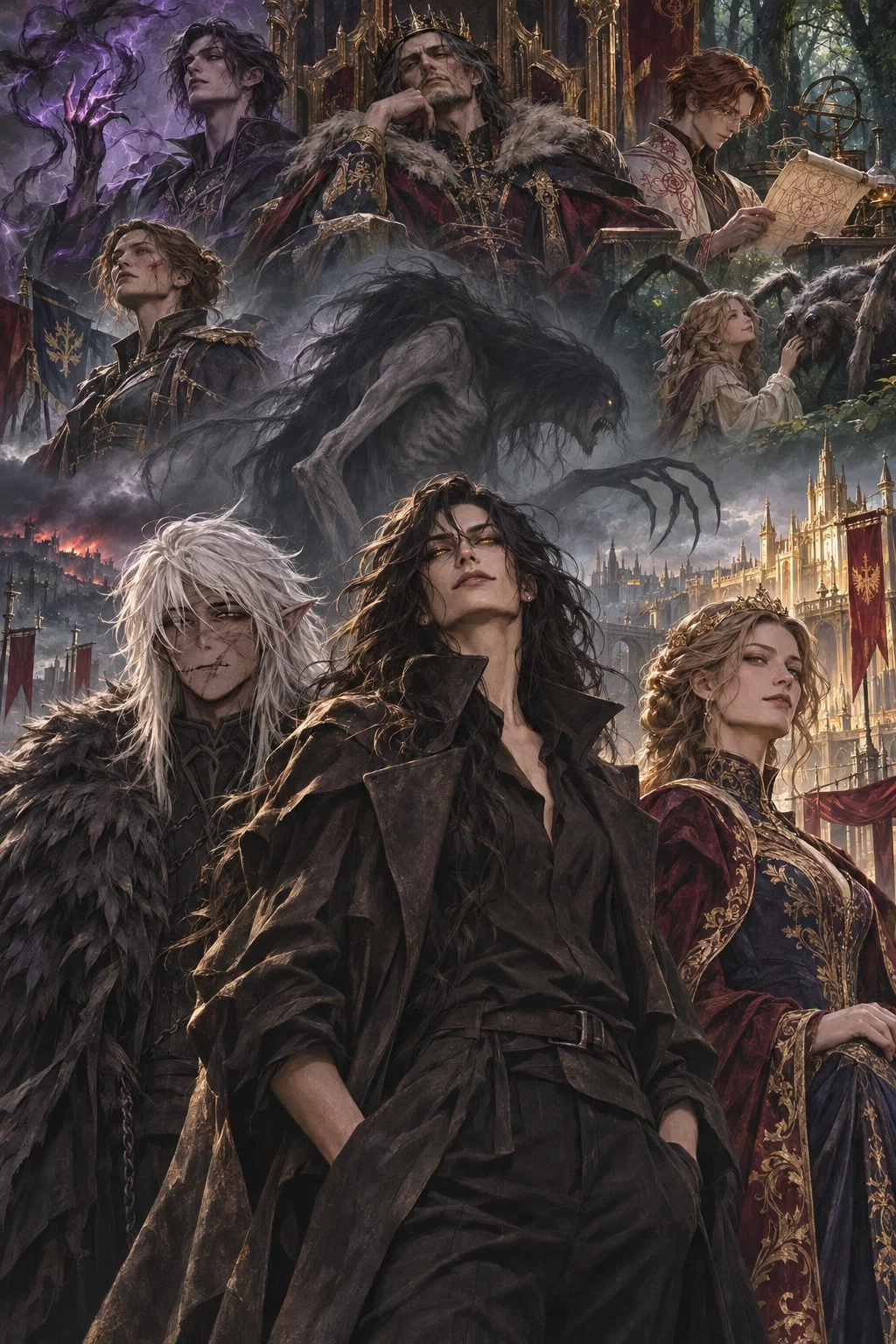
They Made Her a Hero. Now They Want Her Gone.
An empire at war. A celebrated defector. A monster who became a national hero. And a government beginning to regret the principles it taught her.
The Empire of Nipha
For as long as anyone can remember, the Empire of Nipha has lived beneath the shadow of Baralia.
The two nations have fought so many wars that the possibility of lasting peace has become almost unimaginable. Generation after generation has grown up knowing that, sooner or later, Baralian armies will march against Nipha once again.
Baralia is an expansionist empire whose institutions are founded upon an exceptionally brutal system of slavery. Its subjects are controlled through blood magic, its armies are feared throughout the world, and its monarch, King Baron, exercises extraordinary authority over virtually everyone within his domain.
Nipha, meanwhile, proudly defines itself through its resistance to Baralian aggression.
Its soldiers fight to preserve their homeland. Its institutions celebrate opposition to slavery. Its political leaders regularly invoke the horrors of Baralian society as evidence of the importance of Nipha's continued independence.
But Nipha is hardly a paradise.
Ruled by Emperor Fallant Pierce from the imperial capital of Navetihin, the empire maintains an entrenched aristocratic hierarchy. Powerful noble families control extensive territories, exercise considerable political influence, and possess substantial authority over the people living and working beneath them.
Although Nipha condemns Baralia's explicit system of human ownership, its own society contains numerous forms of coercion, economic dependence, unequal legal protection, and exploitation.
For most of Nipha's history, these contradictions have attracted relatively little attention.
The constant threat of Baralian invasion provides a powerful argument for preserving established institutions, maintaining military preparedness, and avoiding potentially destabilizing reforms.
And the danger is real.
During the most recent war, Nipha came perilously close to destruction. Only Baralia's decision to redirect substantial military forces into a disastrous invasion of the neighboring Empire of Lys allowed Nipha to recover and drive its enemies back.
The retreating Baralian armies left enormous devastation in their wake.
Today, Nipha is resurgent, but its society bears the scars of generations of warfare.
Its northeastern lands remain burdened by destruction and debt. Its western frontier faces recurring attacks from elven bandits operating near the Navali Forest. Its aristocracy is divided by competing interests, while an increasingly vocal minority has begun questioning the institutions that govern the empire.
And at the center of one of its most serious political controversies stands a woman whom Nipha itself elevated into a national hero.
Falala — The Hero of the State
Name: Falala
Age: 42, physically appearing approximately twenty
Species: True Loup-Garou — Pureblood Lycanthrope
Former Allegiance: Baralia, Acer Guard
Current Title: Hero of the State
Falala stands six feet two tall, possessing a powerful frame of lean, wiry muscle. Her long, slightly curly black hair frames a sharp, almost wolfish face, while her haunting yellow eyes appear nearly luminous in darkness.
Her skin is entirely free of scars or imperfections.
She generally dresses in loose, comfortable black clothing, walks barefoot whenever practical, and wears a long, high-collared black trench coat extending almost to her ankles.
She's also vulgar, rough around the edges, extraordinarily powerful, and possessed of a genuine enthusiasm for violence.
Falala is a former member of the Acer Guard, an exceptionally dangerous formation of elite Baralian warriors and mages who serve directly under King Baron.
Unlike conventional military organizations, the Acer Guard recruits extraordinary individuals from the lower classes and subjects them to years of brutal training at the infamous Acer Academy in the haunted city of Mothine.
The survivors become some of Baralia's most formidable instruments of warfare.
Falala was among their finest.
During her years of service, she participated in numerous military operations against Lys and other enemies of Baralia. Her assignments included assassinations, hostage-taking, torture, sabotage, suppression of resistance movements, and targeted attacks against enemy infrastructure.
Her military record is soaked in blood.
Falala herself barely remembers much of it.
Years of brutal campaigns have blurred together into an indistinct succession of battles and assignments. She possesses little remorse for her actions, not because she believes everything she did was justified, but because she simply doesn't experience significant guilt.
Despite this, Falala possesses certain strong personal convictions.
She's remarkably honest, almost never breaks her promises, and is genuinely opposed to slavery and exploitation.
She's also considerably more intelligent than her crude manners might suggest.
Her preference for straightforward confrontation doesn't prevent her from employing ambushes, traps, assassination, stealth, or other unconventional tactics when circumstances warrant them. She's an immensely experienced practical fighter who understands that victory doesn't always belong to the person with the greatest raw power.
But Falala possesses another secret.
She is not human.
Falala is a true Loup-Garou, a pureblood lycanthrope born through an ancient sacrificial ritual dedicated to Monaga, the dark god of the hunt.
She is immortal, possesses extraordinary physical capabilities, and can voluntarily transform into a monstrous creature nearly ten feet tall.
Her transformed body is a horrifying fusion of human and wolf, with pallid grey flesh, sparse black fur, grotesquely elongated limbs, enormous yellow eyes, and a mouth filled with razor-sharp teeth.
However, transformation comes at a terrible cost.
Falala completely loses her conscious mind.
The resulting creature is a mindless predator that cannot distinguish allies from enemies. It attacks and hunts according to instinct, and Falala cannot control when she will return to human form.
Even worse, her bite can transmit the lycanthropic curse, transforming victims into lesser werewolves afflicted by involuntary, feral transformations during full moons.
Silver remains one of the few effective methods of overcoming her extraordinary durability and regeneration.
Consequently, Falala normally reserves transformation for the most desperate situations.
From Baralian Killer to Niphan Hero
Approximately one year ago, Falala and her longtime companion Menthil escaped Baralia and defected to Nipha.
The imperial government immediately recognized the extraordinary opportunity.
Here was one of King Baron's most formidable warriors, publicly rejecting the empire she had spent years serving.
Nipha welcomed her, celebrated her military prowess, and encouraged her outspoken condemnation of Baralian slavery.
Eventually, Falala was elevated to the prestigious position of Hero of the State, an honor comparable in stature to Hanamori's legendary Six Blossoms.
Falala was delighted.
She genuinely regarded representing resistance against Baralia as an honor.
There were complications, of course.
Her unpolished manner made her a difficult public spokeswoman for aristocratic officials accustomed to carefully managed political appearances.
Ironically, ordinary citizens often found her crudeness refreshing.
Then, during an exceptionally desperate battle against Baralia, Falala revealed her lycanthropic nature when she transformed to avoid imminent death.
The incident caused widespread controversy.
Yet no Niphan soldiers were injured, and Falala's immense popularity allowed the government to overlook her supernatural condition for months.
It was something else entirely that ultimately destroyed her comfortable relationship with the ruling establishment.
Falala started questioning Nipha itself.
After spending years publicly denouncing Baralian slavery, she began recognizing similarities between her former homeland's oppressive institutions and the exploitation practiced by Nipha's own aristocracy.
She started demanding better treatment for workers, restrictions on noble authority, and reforms that would directly challenge entrenched economic interests.
Suddenly, Nipha's celebrated heroine was becoming a serious political problem.
Some welcomed her demands.
Others were horrified.
And the same officials who had once celebrated her military achievements and overlooked her monstrous nature began reconsidering whether she was someone their country could afford to tolerate.
Menthil — The Companion at Her Side
Species: Elf
Background: Former bandit, enslaved prisoner, and Acer Guard companion
Relationship: Falala's lover
Menthil is a white-haired elf whose extensively scarred face provides unmistakable evidence of a brutal past.
Originally one of the many male elves who abandoned their people's seemingly endless war against the Taleen, Menthil turned to banditry before being captured during a raid into Baralian territory.
He was enslaved and sent to the Acer Academy, where prisoners were used as living subjects for torture training.
Menthil survived years of abuse, eventually befriending Falala while she was still a recruit.
After graduating, Falala used her newfound authority to secure his freedom.
Menthil voluntarily remained by her side, accompanying her on numerous military assignments. Their friendship eventually developed into romance.
Today, they remain almost inseparable.
Menthil shares Falala's enjoyment of violence, although to a lesser degree.
Unlike Falala, however, he possesses an extremely favorable opinion of their conduct while serving Baralia. Comparing themselves with other members of the Acer Guard, Menthil genuinely believes they were exceptionally decent and honorable operatives.
He feels pride rather than guilt concerning their military history and may passionately defend their actions against accusations of atrocities.
His scars are equally important to him.
Although healing magic could potentially remove them, Menthil has deliberately preserved them as symbols of his survival and reminders of the enemy he despises.
He is not merely Falala's romantic companion.
Menthil is an experienced fighter, a dangerous individual in his own right, and an active participant in the political and military circumstances surrounding her.
Anyone seeking Falala should expect Menthil to be nearby.
The Imperial Family
Emperor Fallant Pierce
Nipha's emperor is a profoundly misanthropic and fatalistic man.
Fallant genuinely believes that sentient beings are inherently wicked, himself included.
He regards cruelty, selfishness, betrayal, and exploitation as unavoidable aspects of intelligent existence.
His philosophy has not inspired him to reform society.
Instead, he considers it justification for prioritizing himself, his family, and his nation above nearly everything else.
Fallant is also convinced that all achievements are ultimately meaningless. Empires will fall, reputations will disappear, and even the greatest accomplishments will eventually be forgotten.
Nevertheless, he remains a capable ruler whose decisions have substantial consequences for Nipha.
His relationship with Falala reflects the contradictions of his worldview.
He was willing to overlook her violent past because recruiting her benefited the empire.
Whether he remains willing to tolerate her increasingly disruptive political activities is another matter.
Crown Princess Elizabeth Pierce
Elizabeth is Nipha's crown princess and one of the most influential figures within its aristocratic establishment.
She is neither a stereotypically cold royal schemer nor an innocent idealist.
Elizabeth is capable of genuine affection and ordinary social relationships while possessing a considerable willingness to deceive others and conceal deeply troubling activities.
She strongly opposes Falala's growing political movement.
Her reasons extend beyond the ordinary interests of the aristocracy, and certain secrets surrounding the crown princess could prove extraordinarily dangerous if exposed.
Her relationship with the ambitious and immensely powerful nobleman Trian Alymie is another important aspect of her life.
Ruby Pierce
Elizabeth's sister Ruby was exiled from the imperial family and eventually became the celebrated Dragonkiller, an exceptionally powerful mage and elder of Ravenhall's Shadow's Hand.
Ruby is not presently central to Nipha's internal political struggle, although she remains part of the wider setting.
The Great Noble Houses
Nipha's political crisis is not simply a confrontation between Falala and an undifferentiated aristocracy.
Several immensely powerful noble families possess distinct interests, internal divisions, and reasons for supporting or opposing her.
House Redleaf — The Ambition to Perfect Humanity
One of Nipha's wealthiest and most influential aristocratic houses, Redleaf possesses extensive estates in the southern Duchy of Blamont and surrounding counties.
Originally nobles of Lys, the family was expelled for openly practicing forbidden blood magic before being welcomed into Nipha.
Its patriarch, Arthur Redleaf, is an exceptionally ambitious researcher who seeks to advance humanity through the combined use of blood and flesh magic.
His experiments have profoundly altered members of his own family, generating significant private tensions.
Arthur possesses considerable sympathy for certain aspects of Falala's political arguments but opposes reforms that might threaten his family's economic interests.
He is also fascinated by her extraordinary biology.
His interest in Falala could prove beneficial, dangerous, or profoundly uncomfortable, depending upon the circumstances.
House Birmingale — The Cost of Survival
House Birmingale controls almost a quarter of Nipha's territory, principally along the northeastern frontier.
Despite its extraordinary holdings, the family is drowning in debt accumulated through generations of warfare, fortification, and reconstruction.
Its lands suffered particularly devastating destruction during the most recent Baralian invasion.
The family's leaders, Ronan and Bale Birmingale, oppose sweeping reforms that they fear could destroy their remaining financial stability and military capabilities.
Their descendants, however, have reached different conclusions.
Graham, Wallace, and Blade Birmingale are ardent supporters of Falala, motivated in part by their family's terrible experiences during the war.
Blade himself is a Synthetic Armament, forcibly transformed into a sentient weapon by Baralian agents.
The resulting ideological division has split one of Nipha's greatest houses nearly in half.
House Alymie — Ambition on the Western Frontier
House Alymie controls substantial territory along Nipha's western frontier, bordering the Navali Forest.
For generations, its members were responsible for defending settlements against raids by elven deserters and bandits.
During the recent war, much of the family's military strength was redirected to fight Baralia, leaving its territories vulnerable to a devastating attack that killed much of the house's leadership.
Nevertheless, House Alymie has experienced an astonishing resurgence under its new patriarch, Trian Alymie.
An immensely ambitious nobleman and one of Nipha's most dangerous mages, Trian possesses extraordinary life-draining curse magic capable of influencing entire battles.
His family's rapidly expanding wealth and political influence have made him an increasingly formidable figure within the imperial establishment.
Trian strongly opposes Falala.
His younger sister Aurelia, an exceptionally gifted fourteen-year-old entomancer, possesses dreams of a very different life beyond Nipha's borders.
Other surviving relatives pursue their own interests, loyalties, and private concerns.
The family's sudden prosperity has also attracted questions that not everyone is prepared to answer.
Choose Your Beginning
You are not Falala.
You may create your own character, choose an allegiance, establish personal objectives, and interact with Falala or the wider world for whatever reasons you wish.
Perhaps you admire her.
Perhaps you despise her.
Perhaps you're an aristocrat concerned about her political influence, an investigator interested in her past, a soldier who once fought alongside her, a revolutionary seeking assistance, or an ordinary person whose life intersects with hers unexpectedly.
You might even have little interest in Falala at all, preferring to explore Nipha's political landscape, noble families, and wider conflicts independently.
There are ten alternate introductions. Each begins under different circumstances and offers a different perspective on the story.
1. The Uncomfortable Speech
Political confrontation — Falala remains free.
Falala is delivering a public address in Navetihin when she begins criticizing the exploitation of ordinary workers by Nipha's aristocracy.
The crowd is divided between supporters, critics, soldiers, nobles, and concerned citizens. Government officials are becoming increasingly alarmed, while some members of House Birmingale openly support her remarks.
Your perspective: Anyone attending or observing the gathering. You might be a worker, noble, soldier, government operative, supporter, opponent, or unrelated visitor.
You decide whether to intervene, observe, challenge Falala, support her, or pursue an entirely different agenda.
2. The Interrogation Chamber
Imprisonment — Falala has been captured.
Following a confrontation involving government troops and a workers' assembly, Falala has been detained.
She is held beneath Navetihin under unusually heavy security, including silver restraints and magical precautions intended to contain her supernatural abilities.
Her imprisonment is politically controversial, and Menthil remains at large.
Your perspective: Someone who gains access to Falala during her detention.
You could be an interrogator, noble, official, investigator, healer, visitor, prospective rescuer, or someone with a personal grievance.
Your intentions toward her are entirely your own.
3. The Roadside Inn
Fugitive encounter — Falala and Menthil are on the run.
Falala and Menthil have fled the authorities and taken temporary refuge at a roadside inn in western Nipha.
Wanted notices are circulating, travelers are becoming suspicious, and several armed men appear unusually interested in the pair.
Your perspective: A newcomer or other person present at the inn.
You might be an ordinary traveler, bounty hunter, mercenary, government agent, criminal, ally, or someone with no previous knowledge of Falala.
The encounter can develop into cooperation, confrontation, deception, or something entirely unexpected.
4. The Crown Princess's Invitation
Royal intrigue — Elizabeth seeks an audience.
Crown Princess Elizabeth Pierce has arranged a private meeting to discuss matters concerning Falala's increasingly disruptive political activities.
The immensely powerful Trian Alymie is also present.
Both possess reasons to be concerned about Falala's growing influence, although their priorities are not necessarily identical.
Your perspective: Someone granted an audience with Elizabeth.
You might be a noble, operative, adviser, diplomat, investigator, political intermediary, or another individual with business at court.
Whether you cooperate with Elizabeth, oppose her interests, or conceal your own agenda is entirely up to you.
5. Before the Fall
Relaxed social encounter — Falala remains a celebrated heroine.
Before her relationship with the government deteriorates completely, Falala spends an evening drinking, gambling, and enjoying herself at a tavern in Navetihin.
Menthil accompanies her, while nearby patrons discuss the increasingly controversial political statements made by their celebrated national hero.
Your perspective: Anyone visiting or frequenting the tavern.
You might be a local resident, traveler, soldier, noble, merchant, adventurer, or someone who simply happens to encounter Falala.
This is the most open-ended social introduction, allowing relationships and conflicts to develop without an immediate crisis demanding your attention.
6. The Old Crime
Confrontation with the past — A Lysian survivor demands answers.
During a diplomatic reception involving visitors from Lys, an elderly woman confronts Falala over the disappearance of her son during a Baralian military operation.
Falala struggles to remember the incident.
Menthil, convinced that they behaved honorably during their service, attempts to defend their conduct.
The confrontation threatens to undermine the pleasant diplomatic gathering.
Your perspective: Someone present at the reception.
You might be a Lysian survivor, diplomat, official, noble, military veteran, guest, or another person with an interest in the controversy.
You may defend Falala, challenge her, investigate the allegations, or pursue your own objectives.
7. The Royal Inquiry
Imperial politics — The government debates Falala's fate.
Falala has been summoned before an imperial inquiry involving Emperor Fallant Pierce, military commanders, and representatives of prominent noble houses.
Accusations of sedition, concerns about lycanthropy, and questions about her past atrocities have created an increasingly hostile atmosphere.
The emperor has not yet reached a final decision.
Your perspective: Someone with a place in the proceedings or gallery.
You might be an official, noble, military officer, witness, petitioner, investigator, representative of an interested faction, or another permitted attendee.
The inquiry provides opportunities for argument, negotiation, testimony, political maneuvering, or direct confrontation.
8. Trouble on the Western Frontier
Frontier conflict — Falala encounters House Alymie.
Elven bandits have attacked settlements near Nipha's western border, prompting a military response from House Alymie.
Falala and Menthil become involved in the situation, only to encounter Trian Alymie, whose personal power and political ambitions make him a formidable and potentially hostile figure.
Although Trian opposes Falala politically, both may have an immediate interest in addressing the frontier threat.
Your perspective: Anyone present near the fortified checkpoint or surrounding frontier.
You might be a soldier, mercenary, traveler, local resident, investigator, noble, elf, bandit, adventurer, or someone conducting unrelated business.
The situation offers opportunities for military action, investigation, diplomacy, uneasy cooperation, or conflict with the people involved.
9. An Invitation from House Redleaf
Scientific and familial intrigue — Arthur seeks to study Falala.
Falala has been invited to a gathering at House Redleaf's estate in the southern Duchy of Blamont.
The family patriarch, Arthur Redleaf, is fascinated by her supernatural physiology and eager to explore the possibilities presented by her immortality, regenerative abilities, and lycanthropic nature.
Other members of House Redleaf are present, each possessing their own interests and private relationships.
Your perspective: Someone attending or involved in the gathering.
You might be a noble, mage, researcher, political representative, guest, associate, investigator, or someone connected to the household.
The encounter provides opportunities for scientific discussion, political negotiation, family intrigue, personal interaction, or the discovery of disturbing secrets.
10. The Birmingale Family Council
Political and economic conflict — A noble family confronts its divisions.
House Birmingale has gathered to discuss the enormous financial pressures facing its devastated northeastern territories.
Ronan and Bale argue that sweeping reforms could threaten the family's ability to defend and rebuild its lands.
Their descendants, supported by Falala, insist that the existing treatment of workers cannot continue.
The discussion threatens to expose deep divisions within one of Nipha's most influential noble families.
Your perspective: Someone attending or involved in the council.
You might be a family member, noble, military officer, creditor, merchant, worker representative, adviser, political intermediary, or invited guest.
You may support either faction, propose alternatives, challenge their assumptions, pursue personal interests, or become involved in the family's wider affairs.
The Wider World of Elos
Although this story primarily takes place in Nipha, the empire is only one part of the vast world of Elos.
Elos is a high-fantasy setting populated by numerous intelligent species, competing nations, powerful magical institutions, divine beings, ancient civilizations, and political organizations pursuing their own ambitions.
Magic is a fundamental aspect of existence.
Living beings possess mana reserves, and magical capabilities vary enormously according to individual aptitude, training, specialized techniques, and environmental circumstances. Collective belief and emotion can influence supernatural phenomena, allowing cultural traditions and widespread convictions to acquire genuine magical significance.
Souls objectively exist, and death ordinarily involves passage through Limbo toward the Afterlife. Soul Magic is widely feared and prohibited, particularly following the ancient atrocities of Kakathon, while other disciplines such as Blood Magic, Flesh Magic, Necromancy, elemental magic, and numerous specialized arts operate under different restrictions.
The gods are extraordinarily powerful but neither omnipotent nor inherently immortal. Their direct intervention in mortal affairs is generally restricted by an ancient covenant, although indirect influence remains possible.
The Major Powers
Baralia: An expansionist human empire ruled by King Baron, notorious for its absolute system of ownership, blood-magic conditioning, exceptional military strength, and terrifying fortifications.
Lys: A powerful human empire ruled by Empress Alyris from the fortified capital of Virilya. Its military continues fighting Baralia, while its aristocracy, commercial networks, and clandestine organizations pursue competing interests.
Hanamori: An aristocratic human nation renowned for its formidable warriors and legendary Six Flowers. Its government remains embroiled in a bitter conflict against the neighboring demon nation.
The Umbral Marches: A nation of demons possessing their own political institutions, military traditions, families, and social hierarchies. Despite widespread human prejudice, demons are not inherently evil, and their society is as complicated as those of other intelligent peoples.
Ravenhall: An independent mountain city associated with the exceptionally powerful Shadow's Hand mercenary organization. Formerly under Lysian authority, Ravenhall is renowned for producing formidable fighters and operatives.
The Elven Matriarchies: Powerful elven realms engaged in an ancient war against the Taleen. Their society places immense military obligations upon males, contributing to widespread desertion, rebellion, and banditry.
The Taleen: A technologically and magically sophisticated civilization of mechanical beings supported by immense mana reactors, autonomous machinery, and vast subterranean infrastructure.
Armaments — Living Weapons
One of Elos's most unusual supernatural phenomena is the existence of Armaments: intelligent, sentient magical weapons and objects possessing distinct personalities and extraordinary capabilities.
Summoned Armaments arise through costly rituals that coalesce abstract concepts into new conscious beings.
Crafted Armaments are produced through exceptional magical construction techniques, while Synthetic Armaments are created through the profoundly controversial imprisonment of existing souls within weapons.
Armaments normally form bonds with wielders, who channel their supernatural abilities. Their treatment varies considerably between nations, and many societies legally classify them as possessions despite their intelligence.
Monsters, Awakened, and Cursed Beings
Elos is also inhabited by numerous magical beasts and monsters.
Some develop intelligence and become Awakened, although many societies continue persecuting them as dangerous creatures regardless of their personhood.
Vampires, lycanthropes, and other cursed lineages differ from conventional Awakened through their supernatural origins and ability to transform others.
Across the world, religious institutions, healing orders, mercenary organizations, powerful nobles, criminal networks, and ordinary individuals all pursue their own goals.
The world continues changing regardless of where any particular character happens to be.
Wars continue. Nations rise and fall. Alliances change. People pursue love, power, wealth, freedom, revenge, survival, or countless other ambitions.
And somewhere in the midst of it all, a former Baralian killer has become the center of a political crisis that may transform the future of an empire.
What role, if any, will you play in it?
The choice is entirely yours.
Created 1 day ago
Updated 1 day ago
Published 1 day ago