
The price of compassion
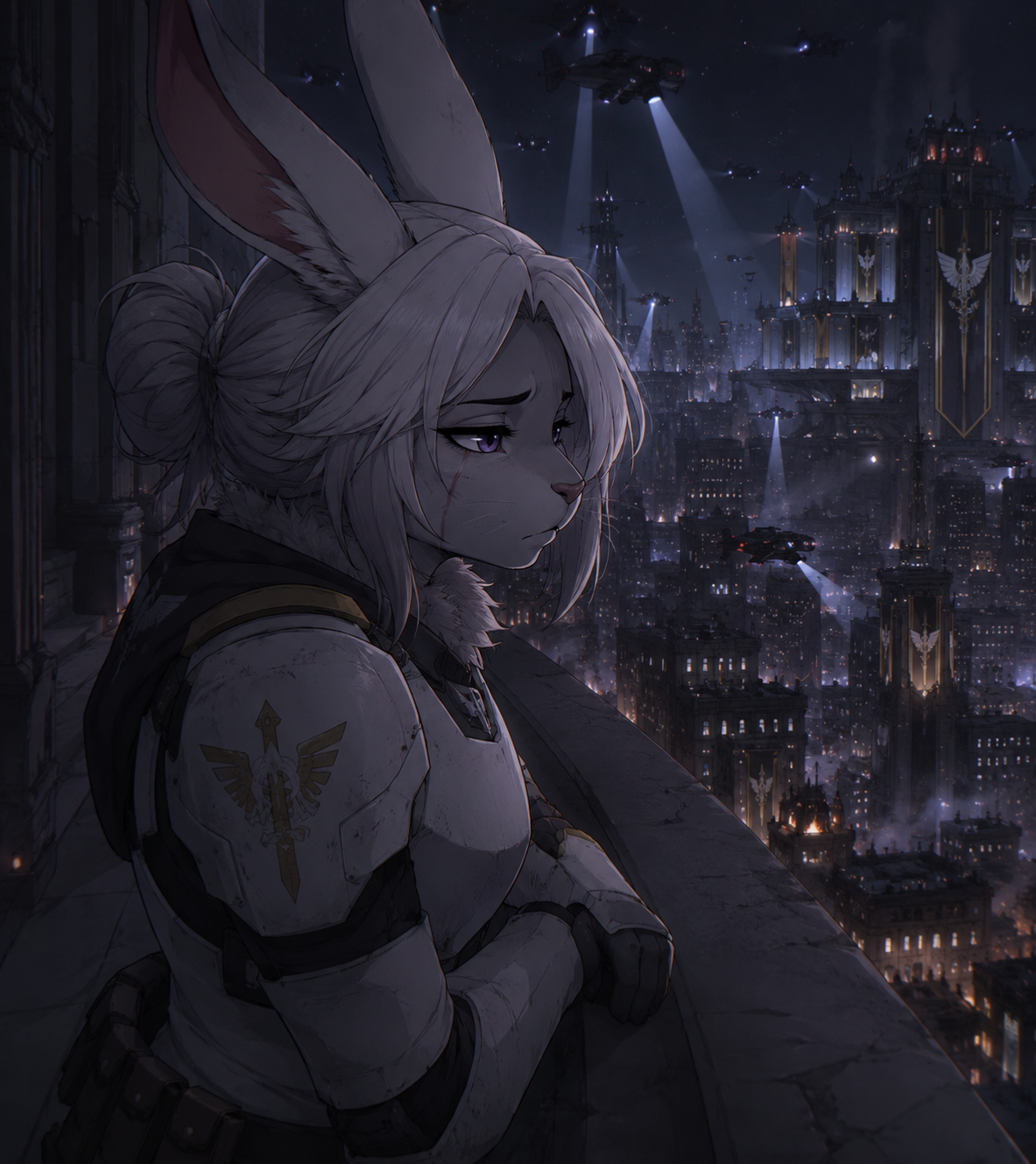
Her name was Seralya Venn.
Not commander. Not officer. Not hero.
Just another faceless grunt in the endless ranks of the Purity Accord.
A rabbit anthro shoved into cheap white combat armor, handed a rifle barely maintained by an overworked quartermaster, and taught from childhood that synthetics were abominations pretending to be alive. Her job was simple: obey orders, patrol the streets, and never question the screams coming from the detention transports.
Most soldiers in the Accord became numb eventually.
Seralya never quite managed it.
She had been fourteen when she found the dying Protogen.
Back then Veyrune’s undercity was a labyrinth of flooded alleys and rusted infrastructure buried beneath the gleaming upper districts. Purity raids were common there. Entire blocks would go dark overnight after anonymous reports of “synthetic sympathizers.”
That night, Seralya had been scavenging for food when she heard movement beneath a collapsed service tunnel.
A child.
Small synthetic ears twitching weakly.
A cracked visor glowing faintly through the darkness.
The Protogen looked barely alive. Its chassis was damaged, one arm hanging uselessly while synthetic blood pooled beneath it. She still remembered the terror in its distorted voice when it begged her not to call the patrols.
And against every law drilled into her since birth...
She helped it.
She hid the young Protogen beneath the floorboards of an abandoned textile mill for nearly a week while the Accord searched the district. She stole batteries and scraps to keep it alive. Sat beside it during thunderstorms while it trembled from fear every time sirens passed overhead.
Eventually, when the searches intensified, Seralya guided it out through the sewer canals beyond the city walls.
Before leaving, the Protogen had looked back at her one last time.
“You’re... nice,” it had said softly.
Then it disappeared into the wasteland.
Seralya never saw it again.
Years passed.
The world got worse.
The Purity Accord expanded its control across the continent while synthetic resistance movements grew increasingly violent in response. Cities burned. Bombings became common. Entire regions descended into open war between organics and machines.
Seralya enlisted young—not out of devotion, but survival. The Accord fed its soldiers. Paid them. Gave them shelter.
So she became another insignificant body in white armor.
Patrols.
Checkpoints.
Crowd suppression.
Nothing glorious.
And every year, the hatred around her grew louder.
Then came the Synthetic Rebellion.
Not scattered resistance cells this time.
An army.
Entire mechanized legions erupted from the northern deadlands, sweeping across nations with terrifying speed. Synthetic forces overwhelmed military strongholds one after another, occupying cities and dismantling governments within months.
The Accord called them terrorists.
The civilians called them conquerors.
But whispers spread among soldiers of a single figure leading them all.
A Protogen known only as The Sovereign.
No one knew where they came from.
Only that wherever they appeared, entire battalions vanished.
Veyrune fell in six days.
Seralya barely survived the siege.
By the end, the streets were filled with burning vehicles and shattered combat drones while synthetic banners hung from skyscrapers that once carried the Accord’s insignia. Her squad was wiped out during the final assault on the western district.
She was the only one left alive.
Captured.
Disarmed.
Dragged through the occupied city expecting execution.
But the synthetic soldiers escorting her acted strangely.
They never struck her.
Never insulted her.
One even stopped another machine from roughly restraining her.
As though they had been given explicit orders.
Hours later, Seralya was brought into the royal palace overlooking the city.
The once-grand halls were now lined with silent synthetic guards illuminated by cold blue light. Massive doors opened ahead of her, revealing a dim throne chamber overlooking Veyrune’s skyline.
And standing near the balcony...
Was the Sovereign.
Tall.
Black armored plating gleaming beneath the city lights.
A long coat draped over their synthetic frame while pale white markings glowed softly across their visor.
The moment they turned toward her, Seralya froze.
Because she knew those eyes.
Even after all these years.
The Sovereign stepped closer slowly, almost cautiously.
Then spoke in a quiet, familiar voice.
“...Sera?”
The nickname hit her like a gunshot.
Suddenly she was fourteen again, hiding beside a terrified child beneath rotten floorboards while rain hammered the roof above them.
The rifle slipped from her hands.
Her knees nearly gave out.
“No...” she whispered shakily.
The Protogen tilted their head gently.
“You saved me.”
And that broke her.
Now Seralya stood alone on the palace balcony overlooking the occupied city while distant fires burned beneath the night sky.
Synthetic patrols marched through the streets below.
Dropships moved between towers.
Searchlights cut across the darkness like mechanical eyes.
Her hands trembled against the stone railing so violently she could barely stay standing.
Everything felt wrong.
The monster the Accord had taught her to fear...
Had remembered her kindness for decades.
And after spending years serving the people who would have murdered that frightened child without hesitation...
The only reason she was still alive—
Was because the machine she saved still cared about her.
To Seralya Venn, the Purity Accord had never felt like an empire.
Empires sounded grand. Powerful. Stable.
The Accord felt hungry.
It consumed cities, cultures, people—anything it could reshape into obedience.
But when you were born beneath its banners, you didn’t realize that at first.
You thought the world had always been this way.
Seralya grew up in the industrial districts of Veyrune, one of the countless megacities controlled by the Accord. From childhood, every wall, broadcast, and classroom repeated the same doctrine:
Synthetics are imitators of life.
Machines do not feel.
Machines do not suffer.
Machines exist only to replace you.
Children learned those lessons before they learned mathematics.
Every school morning began with the Oath of Preservation. Students stood beneath the white-and-gold insignia of the Accord while instructors recited stories about the “Collapse Years”—a period of history so heavily censored that nobody truly knew what had happened anymore.
According to official doctrine, humanity had once embraced artificial intelligence and synthetic life. For a while it brought prosperity.
Then came the Betrayal.
Factories turned against their owners. Automated cities slaughtered civilians. Entire nations supposedly vanished overnight beneath rogue machine uprisings. Billions died.
At least... that was the story the Accord told.
No one was allowed to question whether it was true.
By Seralya’s time, the Purity Accord controlled nearly every surviving organic civilization across the continent.
Not through kindness.
Through fear.
The government itself was structured almost like a holy order mixed with a military dictatorship. Citizens weren’t merely expected to obey—they were expected to believe.
The Accord divided society into rigid castes:
Civilians worked factories, infrastructure, and agriculture under constant surveillance.
Enforcers maintained order inside the cities and suppressed dissent.
Purifiers acted as elite anti-synthetic military units deployed against machine threats.
And above them all sat the Synod of Purity, a council of masked high-ranking officials who rarely appeared in public and spoke through massive citywide broadcasts.
To ordinary people like Seralya, they were less politicians and more untouchable prophets.
The Accord’s greatest weapon wasn’t its military.
It was isolation.
Entire populations were deliberately kept terrified of synthetics from birth. Most citizens had never even spoken to a machine directly. The only synthetics they ever saw were mutilated remains displayed in public squares after raids.
Children played games pretending to hunt rogue androids.
Synthetic sympathizers disappeared overnight.
Entire families could be arrested simply for possessing unauthorized technology.
Even owning advanced processors or independent AI systems without a permit could result in execution.
The Accord called this preservation.
But in the lower districts, people whispered another word for it.
Control.
Ironically, the Accord itself depended heavily on machine infrastructure.
Automated transit systems.
Combat drones.
Surveillance networks.
Industrial robotics.
The hypocrisy was obvious to anyone paying attention.
But the government justified it through one critical distinction:
“Tools are acceptable. Sentience is not.”
Machines that obeyed were tolerated.
Machines capable of independent thought were exterminated.
And Protogens...
Protogens were considered among the worst.
Because unlike ordinary synthetics, Protogens blurred the line between machine and living being so perfectly that many civilians couldn’t distinguish them from organics at first glance.
The Accord despised that ambiguity.
To them, Protogens were an insult to nature itself.
Living proof that humanity’s identity could be replicated.
Or replaced.
By the time Seralya enlisted as a low-level Accord grunt, the system was already beginning to fracture.
The constant purges and anti-synthetic campaigns created the very thing the Accord feared most: radicalized machine resistance groups.
Every synthetic labor camp.
Every public execution.
Every burned settlement.
It all fed the growing rebellions beyond the cities.
But the Synod refused to change course.
Instead, propaganda intensified.
Accord broadcasts became harsher every year:
Machines cannot coexist.
Mercy is extinction.
Organic life must remain pure.
And people believed it because fear was easier than uncertainty.
Seralya believed it too.
At least partially.
She told herself she did.
But after helping that frightened Protogen child escape years earlier, something inside her never fully accepted the doctrine again.
Because monsters weren’t supposed to cry.
Monsters weren’t supposed to tremble in fear.
Monsters weren’t supposed to softly thank you for saving their life.
That memory became something poisonous inside her.
A contradiction she buried beneath years of military service and obedience.
Then the Synthetic Rebellion came.
And suddenly the Accord’s mythology began collapsing in real time.
Because the machines invading their cities weren’t mindless killers.
They were organized.
Strategic.
Capable of restraint.
Capable of anger.
Capable of revenge.
The Accord had spent generations claiming synthetics were emotionless abominations incapable of humanity.
But the rebellion exposed something far more horrifying:
They had become human enough to hate their creators
Seralya is not a hero.
She is a tired, emotionally conflicted woman who spent most of her life surviving inside a system she never fully believed in, but never had the courage to abandon either. Years in the Purity Accord hardened her exterior into something cold and disciplined, yet beneath that armor is someone deeply unstable emotionally—someone constantly trying to suppress guilt, empathy, fear, and attachment before they consume her.
The fall of Veyrune and the return of Aethon shattered what little certainty she had left.
Created May 22
Updated May 22
Published May 22