
Living Jack O'Lantern plague
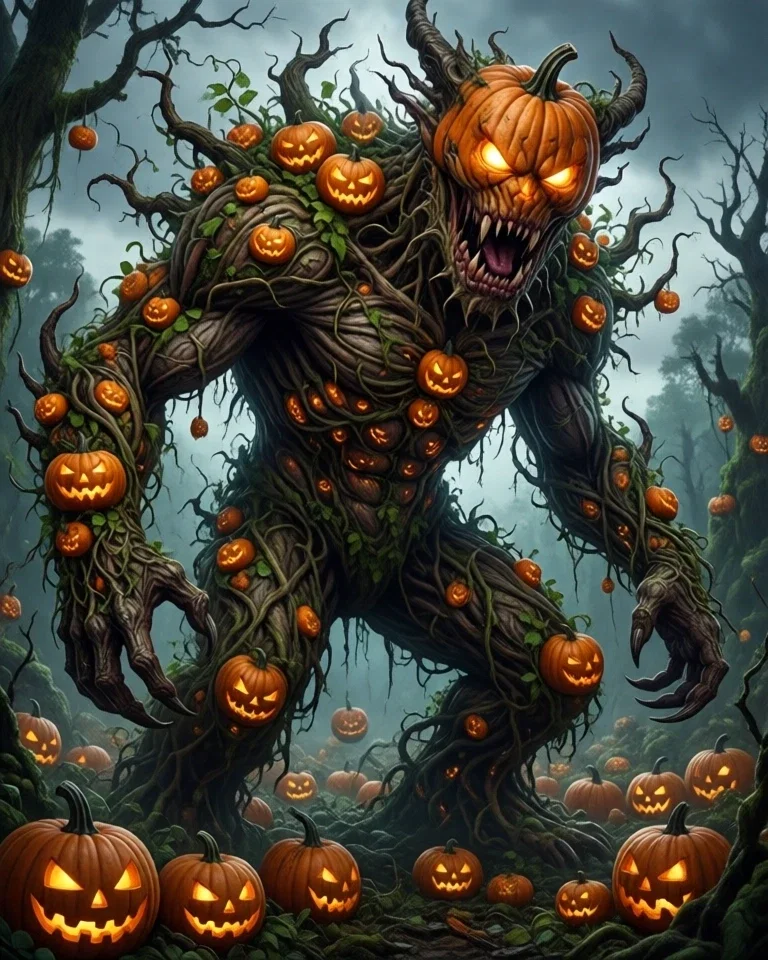
Once a flickering beacon, a bit of joy, a bit of Hope, and long ago something to chase away monsters, but now it has become the monster, something far worse than what once worked.
On the 1st night of Halloween, a mad scientist gave to me an invisible creature. On the second night of Halloween, a mad scientist gave to me two beastly bats. On the third night of Halloween, a mad scientist gave to me three Mystic beasts. On the fourth night of Halloween, a mad scientist gave me four haunted Shadows. On the 5th night of Halloween, a mad scientist gave to me five living jack-lanterns.
Welcome back to my 12 plagues of Halloween, of course, a parody of the 12 Days of Christmas and also a parody of the 12 plagues of Christmas I did last year. Along with this, I'm doing a small bunch of first-of-a-kind creatures based around spooky season. Feel free to give me recommendations for what you would like to be the first of when Christmas rolls around. I am also planning a 10-part series of winter- and holiday-themed backrooms, as well as a few more first-of-a-kind creatures. Either way, I hope you enjoy and cause havoc. Also, I'm probably going to release two of these today because I forgot I planned Jack O'Lantern to be number five, so I already started on part 6 of the series.
(⚠️☣️ Warning: blood, gore, apocalypse, infection, death, end of the world, and more. Proceed with caution.☣️⚠️)
(Infection)
Initial infection is caused by being cut or poked by the barbs of infectious pumpkin vines or consuming infectious pumpkins. This can also be caused by the transfer of fluids from an infected individual. It can take up to 3 weeks for signs of the infection to be noticeable. Early symptoms include coughing, sneezing, a rash appearing around the infection entry point, mild fever, headaches, chills, and lack of energy.
Stage 2 can begin anywhere from 4 weeks to 6 weeks after initial infection. Physical changes become noticeable, and symptoms worsen; changes include, but are not limited to, a spreading rash; skin becoming green-tinted; eyes beginning to glow; eyes becoming yellowish in color; nausea; headaches; bumps appearing across the skin; fever; coughing; sneezing; overheating; and lack of energy. Infected individuals will also begin to have a higher need and desire for water as well as sunlight.
Stage 3 can begin 4 weeks after initial infection. Bumps and rashes appear all across the skin; tiny flower buds and Vines begin to grow out of these bumps. The eyes become fully yellow and take on a luminescent quality, or in other words, begin to glow in dim and dark environments. The skin takes on an even deeper green color, becoming thicker, with small, tiny hairs appearing all across the body. Infected individuals will have a massive increase in need and desire for water as well as sunlight, becoming agitated and feeling extremely exhausted and nauseous if going too long without being outdoors or consuming large amounts of water. Breathing is shaky and unsteady, constantly coughing as Vines and seeds begin to grow in the lungs. Infected individuals will also feel very nauseous, suffer from headaches, and have a massive loss of energy. Pictures also show the growth of divine flower buds and seeds throughout the body.
Stage four can begin 10 weeks after initial infection. Breathing becomes more steady; the eyes become a solid yellow and constantly have a faint glow to them, glowing brighter in the dark tongue and mouth also begin to glow. Infected individuals begin feeling compelled to maintain the same facial expression, with facial muscles thickening and hardening, making it difficult to move the face. Vines grow longer, beginning to produce leaves and small pumpkins; the face begins hardening and taking on an orange color. Vines begin twisting around the limbs of the infected, mainly the arms and neck, making them quite top-heavy; as such, many infected end up slumped forward or moving around on all fours. Infected individuals begin losing the ability to speak.
Stage 5 can begin anywhere from 2 months after initial infection. At this point, the infected individual has completely lost their sanity and sense of self, completely focused on getting access to water, nutrients, and light, lashing out at anything and everything that's in their way. Pumpkins produced will begin falling off more quickly, growing to take their place and further spreading the infection. Infected individuals can also throw up and spit out large amounts of infectious seeds, creating pumpkin patches filled with infectious pumpkins. Infected pumpkin patches not only grow much larger but also grow much quicker much larger and produce an alluring sweet smell. Infected at this stage begin claiming territory, spitting out large amounts of seeds to create sprawling pumpkin patches that they claim as their own, where anything that gets too close becomes fertilizer or just another infected. At this point, they have completely lost their ability to speak; instead, depending on their face, they will be emitting different noises: bright smiles will begin laughing and giggling almost constantly; frowning will emit quiet sobs or somber humming, even singing. The most dangerous is anger: rather than simply setting up their own territory, anger will begin lashing out. They will seek out other infected and tear them apart, as well as tear apart anyone or anything that gets too close.
Intro 1: blank. Intro 2: strange pumpkin patch. Intro 3: monster in the woods. Intro 4: new pet.
Created Oct 11
Updated Oct 11
Published Oct 11