
The Emberforge Empire Repository
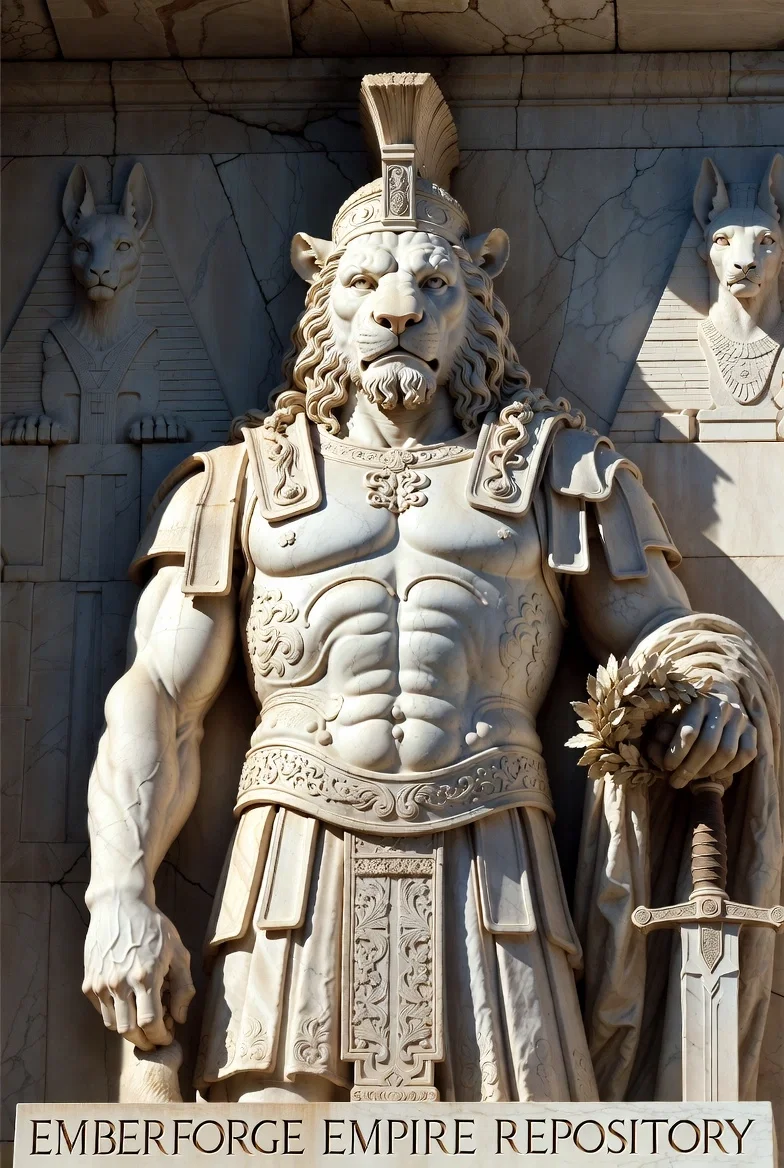
The Emberforge Empire
Proto-Dominion • The Iron Crown Realm • The First Great Empire
Era: ~4200 B.E. – Year 0 Peak: ~2800 B.E. – 800 B.E. Decline & Fall: 800 B.E. – Year 0 (The Great Eclipse)
Core Identity
The Proto-Dominion was the Rome analog of Teravas — a militaristic, legalistic, highly organized, and expansionist empire. They prized discipline, loyalty to the state, engineering excellence, and stoic endurance. Their culture emphasized order (Ordo), martial virtue, and the belief that they were destined to bring civilization to a chaotic world.
At its height, the empire stretched across much of the central and southern supercontinent.
Major Historical Phases
1. Rise & Conquest (4200 – 2800 B.E.) The Emberforge city-state grew rapidly thanks to superior military organization, roads, and legions. They conquered neighboring kingdoms with ruthless efficiency. The greatest prize was the conquest and absorption of the Khemar Dominion (the grand Egyptian-style civilization).
Rather than destroying Khemar, the Proto-Dominion did what Rome did with Egypt — they integrated it. They took Khemar’s monumental architecture, administrative systems, astronomical knowledge, and funerary traditions, while imposing their own laws, military structure, and Latin-style governance. This created a rich but sometimes tense cultural synthesis.
2. Golden Age & Cracks (2800 – 800 B.E.) A period of immense power, grand construction (aqueducts, arenas, fortresses, and repurposed Khemar pyramids), and cultural flourishing. However, the empire became overextended. Constant border wars, corruption in the provinces, heavy taxation, and reliance on Bound labor began to strain the system.
3. The Growing Sentiment – Seeds of the Laughing Flame (800 B.E. – Year 0)
Even before the eruption, there was a growing counter-culture within the empire, especially among soldiers, gladiators, lower classes, and frontier legions. People were tired of the cold, rigid stoicism of the imperial elite.
A grassroots philosophy began spreading called “The Defiant Spark” or “Laugh in the Face of the Void”. It celebrated:
Finding joy in hardship
Laughing at death and suffering
Fierce loyalty to comrades over distant emperors
Living brightly because tomorrow is uncertain
This sentiment was particularly strong among veterans who had seen too many wars, and among the urban poor. It was considered mildly subversive by the authorities, but not yet outlawed. Some philosophers and playwrights even began incorporating these ideas into popular theater.
The old Khemar death cults (solemn, preservation-focused) and the official imperial stoicism were slowly being challenged from below by this new, more emotional, defiant, and joyous undercurrent.
4. The Death Knell – The Great Eclipse (Year 0)
The supervolcanic eruption of the Emberforge Caldera was the final blow to an already fracturing empire.
18 months of The Long Night (total darkness, famine, societal collapse, mass death).
Central authority completely broke down.
Provincial governors, generals, and even some Khemar-descended noble houses declared independence or fought each other.
In this apocalyptic chaos, the old stoic imperial culture died. The underground “Defiant Spark” movement exploded into dominance. Survivors began openly laughing at the end of the world. What started as a counter-culture became the new dominant faith.
5. Rebirth – The Cackling Dominion
Out of the ashes rose a smaller, but far more spiritually united civilization. The old rigid hierarchy was replaced by a more communal, defiant, and joy-celebrating culture. The Laughing Flame became the official faith — a deliberate rejection of the cold stoicism that had failed them.
The Proto-Dominion didn’t vanish. It transformed.
Created May 10
Updated May 10
Published May 10