
The Horseman's decay
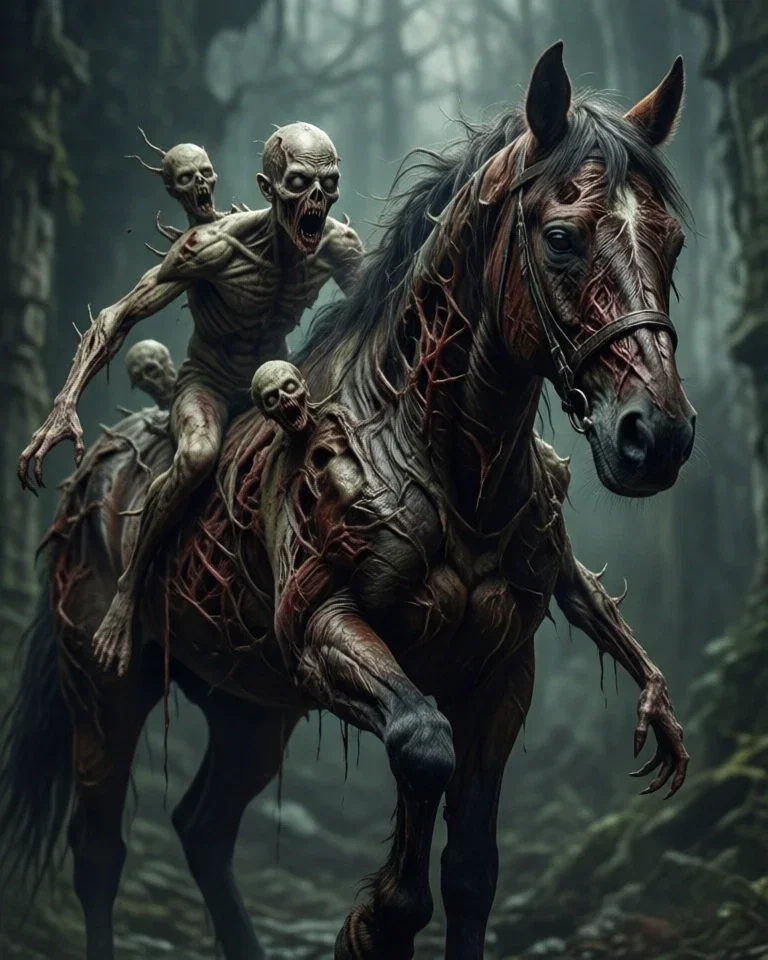
A phantom, a ghost, an old wives' tale- that's all it should have been. The Horseman has risen, and he's bringing something far worse than death back with him.
On the first night of Halloween, a mad scientist gave to me an invisible creature. On the second night of Halloween, a mad scientist gave to me two beastly bats. On the third night of Halloween, a mad scientist gave to me three Mystic beasts. On the 4th night of Halloween, a mad scientist gave to me four heart attacks. On the 5th night of Halloween, a mad scientist gave to me five living jack-o'-lanterns. On the 6th night of Halloween, a mad scientist gave to me six living costumes. On the 7th night of Halloween, a mad scientist gave to me seven horsemen.
Welcome to my 12 plagues of Halloween. Along with this series, I'm also doing a bit of a mini series of first-of-a-kind creatures for spooky season, so feel free to recommend creatures you would like to be the first of a kind. When Christmas rolls around, I will be doing a Backrooms series for the winter season, as well as more holiday-themed first-of-a-kind characters. Either way, I hope you enjoy and cause some havoc.
(⚠️☣️☠️ Warning: death, blood, gore, apocalypse, infection, and more. ☠️☣️⚠️
(Infection)
Initial infection is caused by being bitten or attacked by an infected individual, or getting caught by the spirit known as The Headless Horseman and surviving. Those infected by The Horseman take longer to experience symptoms, and the transformation begins with it taking upwards of a month for obvious signs of the infection to become noticeable, while those bitten or harmed by infected individuals almost instantly begin displaying symptoms. The Headless Horseman appears in heavily forested or mountainous areas and is most often encountered on old, overgrown trails. Once he is spotted and acknowledged, he will chase those he encounters until they have reached the end of the trail, a town, or a clearing. If they can reach that point, he will vanish. Those who do not make it will either never be seen again, or they will wake up with no memory of the incident in the middle of the trail they were on, with several injuries. Those who survived the Horseman have a 50/50 chance of being infected, believed to be based on how the Horseman feels. Early signs of the infection are confusion, dizziness, brain fog, and headaches, which can often be easily brushed off due to the injuries sustained. Those who are bitten will also experience a spreading rash around the bite, bouts of brain fog, and nausea.
Stage 2: Mania and aggression. At this stage, it becomes quite clear that something is not quite right with the infected individual. If the infection was caused by The Horseman, this can take months before an infected individual reaches this state, while someone who is bitten could reach it in less than a week, depending on the location of the bite. Infected individuals begin experiencing massive bouts of paranoia, forgetfulness, and agitation, suddenly going into bouts of laughter and uncontrollable Fury at random. They quickly lose all sense of time and begin having memory gaps that progressively get larger; the infected individual progressively begins to forget who they are, what is happening at any given moment, where they are, how they got where they are, and why they are there. The stage also marks the first signs of physical transformation; these symptoms can include, but are not limited to, patches of thick hair appearing on the lower body, rashes appearing across the skin, hair loss, cloudy eyes, skin becoming gray, and teeth falling out. The Mind deteriorating is caused by physically beginning to rot away, being eaten by parasites that look like maggots.
Stage 3: growth and death. Stage 3 begins once the mind has completely rotted away; the infection be infected individual will die, but the infection is far from dead. The remains will be shifting and changing, especially the lower half of the body; it will grow larger, expanding and growing a second pair of legs behind it, progressively transforming the remains into a centaur-like creature, continuing to move, lashing out at everyone and anything it comes across. All of this occurs while the corpse continues rotting, the head often rotting away or falling off at this stage.
Stage 4: mutation and growth. The infected individual will continue growing and changing, the lower body completely transforming into a full horse, but the changes are not just physical also behavioral. Along with continuing to lash out at anything that gets too close. Infected individuals will begin seeking each other out, especially those in the later stages. They will then begin merging together, creating a massive homunculus. Additionally, the stage is marked by mutation, with what remains of the infected individuals changing drastically, even more so upon merging with other infected, rapidly mutating into quite varied monstrous beings. The mutations not only include physical changes but also behavioral ones, as well as gaining capabilities allowing them to hunt; although not fully conscious, they do have some form of thought. Capabilities and mutations include, but are not limited to, quieter movement, mimicking voices, especially those crying for help, sensitive hearing, attraction to light, attraction to loud noises, prolonged stillness, and the ability to climb. These mutations and gained abilities are not inherited by all infected but rather are the results of a bizarre mutation caused by multiple infected merging together; the more emerged togethe, the more capabilities they gain, and the more lethal Hunters they become.
Outliers are unique mutations to the infection occurring normally in the early stages. Partial immunity: exactly what causes this is uncertain, but it does occur more often in non-human or Undead creatures such as vampires, Phantoms, and mummies. Partial immunity is a mutation of the infection where the infected individual will never fully transform, often not reaching stage 3, where they actually die from the infection, although they may experience some mutations and changes. Most of what they experience are the mental and behavioral changes, with the mind not fully saving and the Brain not fully rotting. Those who possess partial immunity do often still become aggressive and experience a massive loss of self, but for some reason simply do not experience more of the extreme effects of the affliction, such as major mutations and changes; however, those who are partially immune do gain the desire and often go out of their way to merge with later-stage infected. Asymptomatic, this mutation is extremely rare and only occurs in those who have survived the Horseman. This mutation cannot and will never occur in anyone who has been bitten, only in those who have been infected due to an encounter with the Headless Horseman. Asymptomatic is someone who is infected but will never display or experience any symptoms; they are, however, capable of spreading the infection. Asymptomatic individuals, although not ever experiencing or showing signs of the infection, do end up gaining bizarre traits; the first is that they are the only ones who will have repeat encounters with the Horseman and will actually be able to hear, speak, and directly interact with him. This effect seems to be directly bestowed on the individual by the Horseman. Additionally, other infected individuals will see and recognize that individual as infected but will never attempt to merge with them; rather, they will either directly ignore an asymptomatic individual or even directly protect them.
Intro 1 blank. Intro 2: encountering the Horseman. Intro 3: spreading sickness. Intro 4: destroyed town. Intro 5: rescued by the Horsemen.
Created Oct 15
Updated Oct 15
Published Oct 15