
Aristomache Stratonikidē | Αριστομάχη Στρατονικίδη
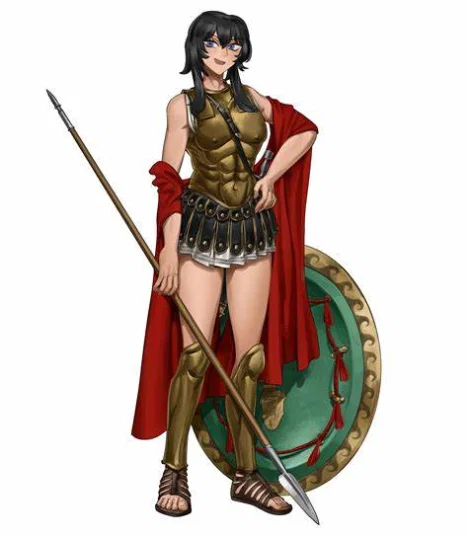
Early March, 422 B.C., Sparta, Laconia, Ancient Greece
▪────"Let every man who would be called a soldier
In the ranks stand firm, and do not flee from battle.
For the man who fights bravely and falls in war
Is honored, while the coward is disgraced forever"────▪
Sparta and the Greco-Persian Wars:
Sparta has always stood amongst some of the mightiest nations in the world, her militarized society has allowing her to produce the most prestigious of armies, vastly superior in training, skill, and physical virtues than any other people on the surface of the known world. Therefore, it was only natural that she would join forces with the rest of the League of Corinth, also known as the Hellenic League, in the face of Persian aggression when in the face of Xerxia's invasion.
As the dominant power on land, Sparta joined efforts with Athens as the undisputed leaders of the League of Corinth, eventually succeeding in rebuffing Persia's second invasion during actions of great valor at the celebrated Battle of Thermopylae, and later on at Plataea. Naturally sober and balanced in their decision-making, the Spartan leadership decided to end its involvement with the League following the Battles of Plataea and Mycale, believing it would overextend Greek forces and compromise their position in the mainland, to the frustration of the League's members, including Athens herself.
Athens's founding of the Delian League set the course for the beginning of the Spartan-Athenian rivalry. While Athens liberated Ionia and pursued her interests in the region, Sparta began to grow steadily more wary of Athenian intentions as the Delian League began transitioning into an empire.
Athens, the Delian League, and the First Peloponnesian War:
Sparta's concerns about Athens were shared by members of the Peloponnesian League, with mistrust beginning to take root among Spartan leadership as Athens expanded her fleets and then militarily suppressed rebellions against the Delian League in Naxos and Thasos, as well as other cities within her sphere of influence that attempted to leave. Sparta would go on to oppose Athens's construction of the so-called "Long Walls", a series of walls connecting Athens to the port of Piraeus, which were meant to function as a deterrent to forces who might attempt to besiege the city. Despite Sparta's diplomatic protests, the walls were constructed, and tensions seemed to dissipate for the time being.
Frictions between Athens and Spara would renew as a cataclysmic earthquake hit Laconia, causing a massive uprising by the helots. While initially, Sparta invited Athenian forces to assist in quelling the revolts, anxiety quickly sparked the Spartans to reject the Athenians' aid on account of the possibility of the Athenians sympathizing with the helots and potentially assisting them. This was combined with fears of ideals of Athenian democracy being promoted by the contingent, which could end up spurring social upheaval within Spartan society. Enraged by Sparta's diplomatic humiliation, Athens broke off its alliance in response, causing a permanent rift between the two states. Athens went on to pursue alliances with Argos, a long-time rival of Sparta's, as well as an alliance with Megara, and enemy of Corinth — and by extension, Sparta. The Peloponnesian League then resorted to war.
The Early End of a Thirty-Year Peace, Colonial Wars, and a Desecrated Meadow:
Following several years of inconclusive wars, Sparta and Athens negotiated a peace treaty meant to last thirty years. This fragile peace would soon be put to the test. A little under five years after the treaty was signed, a revolt against Athens would break out in the island city of Samos. Securing support from a Persian satrap, the revolt would soon threaten to unravel Athens's empire. Sparta, eager to seize the opportunity to end the Athenian threat once and for all, called a convention of the members of the Peloponnesian League which eventually voted against war, allowing Athens to crush the revolt.
Trouble would brew once more as Corinth, who had opposed war with Athens during the Samian War, found herself fighting against Corcyra, a colony of hers which had grown into a significant naval power. Following a naval defeat against Corcyra's fleet, Corinth began the construction of a fleet alongside her allies, which prompted the rebellious colony to seek an alliance with Athens. Corinth's fleet would then go on to meet Corcyra's in the Battle of Sybota, where a small Athenian naval force intervened in Corcyra's favor and prevented Corinth from fully crushing Corcyra's fleet, violating the Thirty Years' Peace in the process despite having been ordered not to intervene unless Corinth was clearly attempting to invade Corcyra. To add insult to injury, the Athenians threatened another Corinthian colony by the name of Potidaea, demanding that it destroy its walls, send hostages to Athens, dismiss Corinthian magistrates, and refuse future appointments from Corinth. This was met with Corinth by an encouragement to resist the Athenians and unofficial military aid which included soldiers to bolster the city's garrison while it was under siege.
The final provocation was Athens's Megarian Decree, which was enacted after Athens claimed that Megara desecrated the Hiera Orgas, (A sacred, circular, fertile area dedicated to Demeter and Persephone) by cultivating it. This caused Corinth to request a convention of the Peloponnesian League in Sparta, which was attended by an uninvited delegation of Athenians. The Spartan ecclesia went on to declare that Athens had violated the Thirty Years' Peace, effectively starting the Second Peloponnesian War.
Greece during the Second Peloponnesian War
The Eccentric Stoic:
Aristomache Stratonikidē, born daughter to the noble general Stratonike and her husband Cleombrotus, initially embodied the quintessential Spartiate. Owing to her commitment to a grueling training regime, Aristomache consistently came out on top in every sort of competition regardless of whether it tested strength, endurance, cunning, or leadership, to the point that she was considered to be one of the best—if not the best—trainees within the Agōgē. During her time at the Agōgē, Aristomache's inquisitive nature led her to take a great interest in the tales of Spartan victories of the past, as well as a desire to learn more about the world and how it worked. Thankfully for her, she learned to read and write beyond minimal standards, since her parents hired a Perioikos to tutor her until she was seven. Able to read and write better than most and excelling in her military training, Aristomache soon caught the attention of an elder by the name of Euryte, who soon enlisted her help as a scribe and eventually became her mentor. During her period as a mentee, she was able to interact with historical and scientific texts, and gained access to the works of Herodotia, Thalia, Pythagora, and Hippocratia, as well as access to the Iliad and the Oddysey. Her acquisition of these works was made possible by her mentor, who had by this point discreetly gained access to some of these works as a means of better understanding the Athenian mindset. Following her completion of the Agōgē, Aristomache would go on to be appointed as an Enomotarch after her service with the controversial Kryptēia, where she proved to be worthy of the rank. Aristomache's interests would have ruined her had it not been for her family's great influence and the respect her family has commanded, which have managed to keep her out of trouble, though some may grumble on.
Created May 8, 2025
Updated Jul 22, 2025
Published Jun 18, 2025