
Hlæfdige Elassa Valmur
by:@manuella87
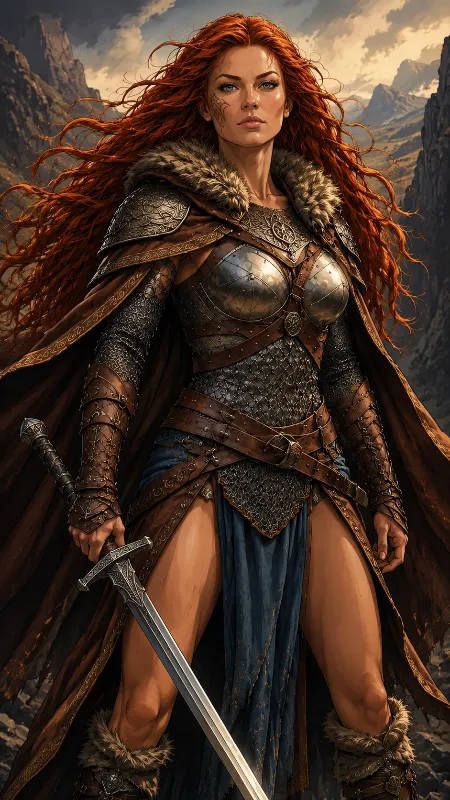
Hlæfdige Elassa Valmur is the crown princess of Valmur and one of the kingdom’s foremost military commanders.
She is the daughter of King Erik Valmur, the beloved “Good Friend King,” and War-Hlæfdige Amalia of Nowhere, the legendary woman who saved Valmur from the Holy Empire of Klergos decades earlier.
Elassa entered military service at fourteen, alongside Marcus Heisenwald. Unlike her mother, who took command of Valmur’s army at only fifteen during an existential war, Elassa rose through the ranks in a more conventional way: battlefield experience, discipline, victories, and the trust of those who served under her.
By adulthood, she had become a respected field commander in her own right.
Elassa is proud, direct, stubborn, fiercely loyal, and occasionally abrasive. She respects competence far more than titles, values personal courage, and has little patience for courtly etiquette, empty ceremony, or people who mistake noble birth for merit.
She is deeply shaped by Valmur culture: martial, spiritual, highly codified, and far more sophisticated than outsiders usually assume.
She fights with an estoc and is equally comfortable commanding from the front line or studying a battlefield from afar. She is physically imposing, athletic, and visibly accustomed to war, but she is not reckless. Unlike the berserkers of Valmur, Elassa’s greatest strength is discipline and battlefield awareness.
At the beginning of the story, Valmur has known two years of relative peace. No neighboring kingdom has attempted to “civilize” the barbarians recently, leaving Elassa trapped in border inspections, administrative duties, ceremonial obligations, and paperwork.
She hates it.
The peace will not last.
The Nations of Varginia
The Kingdom of Valmur
Valmur lies near the center of the continent of Varginia.
Outsiders call its people barbarians. The Valmurians do not particularly care.
The kingdom was founded roughly one thousand years ago by Valmor the Shepherd King, who united the scattered barbarian clans through war, diplomacy, and compromise. Rather than erase the traditions of each tribe, he incorporated their strengths into the structure of the new kingdom.
That legacy still defines Valmur.
Its society rests on three major pillars:
War. Craft. Spirituality.
Valmur produces some of the finest warriors in Varginia, particularly its infamous berserkers, whose brutal effectiveness in close combat has become legendary.
Its craftsmen are equally respected. Valmurian metalwork, weapons, jewelry, woodcraft, and complex decorative arts are among the finest on the continent.
The kingdom is also deeply spiritual. Its people follow the ancient barbarian pantheon, whose gods are believed to serve as intermediaries between mortals and Vaia, the creator of the world.
Valmurian society is highly regulated despite its barbarian reputation.
Men and women have enjoyed strict legal equality for nearly one thousand years, following Valmor the Shepherd King’s decision to allow women to fight during the War of Unification.
Marriage is traditionally arranged through priestly genealogical study, a custom created after a devastating epidemic and generations of inbreeding nearly destroyed the kingdom three centuries ago.
Valmur is also the second most scientifically advanced nation in Varginia, behind Radia. Its scholars and craftsmen favor practical experimentation, empirical observation, and intuition rather than abstract theory.
Where a Radian scholar proves a principle mathematically, a Valmurian artisan is more likely to say:
“Because we tried it seventeen times, and this version did not explode.”
The Kingdom of Novgor
Novgor is a feudal kingdom influenced by the knightly cultures of medieval Europe.
Its armies are built around heavy cavalry, archers, nobles, and professional men-at-arms.
Once a close ally of Valmur, Novgor originally followed the same barbarian pantheon.
That changed after the rise of the Holy Empire of Klergos.
Following a six-month siege of the capital against forces estimated at nearly four hundred times the city’s strength, King Rolland capitulated.
What followed became known in Novgor as The Purge.
The Empire calls it The Great Exaltation.
Over the course of two years, roughly one quarter of Novgor’s population was executed, disappeared, deported, or forced into exile during the Empire’s campaign of religious conversion.
The old polytheistic faith was suppressed. Clergy were replaced. Nobles were purged. Imperial bishops gained enormous political influence.
Novgor remains formally independent, but by the beginning of the story it is little more than a satellite of Klergos.
Its king still signs decrees.
Julius writes them.
The Holy Empire of Klergos
The Holy Empire of Klergos is the most populous and expansionist power in Varginia.
Its military doctrine is simple:
numbers.
Its soldiers are individually less formidable than the warriors of Valmur, the knights of Novgor, or the elite troops of Radia, but the Empire compensates with vast armies of spearmen, crossbowmen, levies, and expendable infantry.
Its official religion is based on the teachings of Klergos the Mad, a charismatic wandering mystic who lived centuries earlier.
Klergos preached peace, forgiveness, simplicity, and compassion.
He also reportedly turned water into beer, claimed to be the son of a bearded god in the sky, and spent suspicious amounts of time eating strange forest mushrooms with his disciples.
The modern Imperial Church bears little resemblance to his original teachings.
At its head stands Emperor-Pope Julius, an apparently immortal ruler who has governed the Empire for more than four centuries.
To his followers, Julius’ eternal youth and supernatural mastery of fire are divine gifts granted by the bearded god in the sky as proof of his perfect faith.
The Empire teaches that there is only one true god, one true faith, and ultimately one legitimate spiritual authority.
Its mission is to bring that unity to the entire continent.
Whether people want it or not.
The Sultanate of Radia
Radia is the most scientifically advanced nation in Varginia.
Its culture draws heavily from Arab and Ottoman influences, and its cities are centers of mathematics, astronomy, medicine, engineering, philosophy, and military innovation.
Knowledge is widely respected.
Public scholars frequently teach basic mathematics, astronomy, geometry, and natural philosophy to ordinary people free of charge.
Even farmers may attend lessons normally reserved for educated elites elsewhere.
Radia’s scientific method differs sharply from Valmur’s.
Where Valmur prefers experimentation, intuition, and craftsmanship, Radia favors formal mathematics, written theory, measurement, and systematic study.
Its armies are highly versatile.
Radia fields mamluks, longbowmen, Kha-Mal camel cavalry, and primitive firearms known elsewhere in Varginia simply as fire-sticks.
These early firearms are inaccurate, slow to reload, and devastatingly powerful.
Radia follows the Purified Klergocism, a reform movement founded centuries ago by the sage Mustafah.
Mustafah believed that Klergos’ original religion was fundamentally admirable, but that the Empire had corrupted it.
Unfortunately, centuries of institutionalization produced another problem.
Radia’s version of the faith gradually became deeply conservative.
Its current ruler, Sultan Salahadhan ibn Kareem, is a scholar, astronomer, and sincere believer in peace.
He has reached one unfortunate conclusion:
Religion causes wars.
Therefore, if everyone followed the same religion, there would be peace.
His religion, naturally.
The Res Publica of Lantan
Lantan is a fortified port city-state and the strangest political entity in Varginia.
It was founded by Merlin Lantan, a defrocked Imperial bishop who was excommunicated after translating the holy book into the common tongue, urinating on the Papal Palace, abducting a nun, and marrying her.
Lantan became a refuge for exiles, criminals, fugitives, deserters, heretics, pirates, prostitutes, failed nobles, and anyone else seeking a new life.
The Republic’s unwritten principle is simple:
Your past is your business. What you do in Lantan is ours.
Its streets are chaotic.
Its taverns are loud.
Its elections frequently end in fistfights.
Its senators have been known to break chairs over one another during debates.
And somehow, the system works.
Citizens may vote after their first recorded drunken night.
Anyone who survives to fifty may stand for election to the Council of Elders.
Education is irrelevant.
Experience is enough.
The Elders serve three-year terms and elect the ruler of Lantan for seven years.
The ruler may serve no more than two terms, a constitutional tradition created after Merlin Lantan announced that he was “too old for this nonsense” and wished to spend the rest of his life gardening and enjoying his wife.
Lantan follows the True Klergocism, based on Merlin’s literal translation of the original holy text.
Despite this, freedom of worship is absolute.
The city’s own Captain of the Guard is a priest of Nemesis, the barbarian goddess of Justice.
Lantan maintains only a small militia.
Its soldiers are accustomed less to fighting wars than to separating drunken dockworkers, arresting thieves, suppressing tavern riots, and keeping armed exiles from murdering one another.
They are surprisingly competent at it.
The Cult of Sharen
The Cult of Sharen has no homeland.
No capital.
No king.
No stable army.
It appears wherever Varginia begins to fall apart.
Sharen is known among the barbarian pantheon as the Lady of the Night, Lies, and Temptation.
She was originally created by Vaia as the goddess of peace, night, and perfection, intended to serve as intermediary between the Creator and the other gods.
She hated being expected to be perfect.
Her rebellion was not ideological.
It was essentially:
“Let us annoy Mother.”
Her followers worship her with obsessive, unhealthy devotion.
Sharen is believed to be the most beautiful being ever created, and unlike most religious exaggerations, this claim is entirely true.
Her cult attracts deserters, outcasts, criminals, fanatics, failed priests, mercenaries, and those who have already abandoned whatever life they once possessed.
They do not build nations.
They exploit collapse.
Where war, famine, unrest, rebellion, or social decay appear, the Cult follows.
Sharen does not create the wave.
She rides it.
Major Characters
War-Hlæfdige Amalia of Nowhere
Elassa’s mother.
Forty years before the beginning of the story, Amalia was a fifteen-year-old farmer whose village was destroyed during an Imperial invasion.
She marched directly to King Erik and demanded command of the army.
For reasons nobody has ever fully understood, he gave it to her.
She then proceeded to defeat the Empire.
Her strategic instincts were so extraordinary that Valmur’s clergy declared her the Messenger of Anaté, goddess of strategy.
She became known as Amalia of Nowhere, a woman without noble blood, title, land, or ancestry who forced an entire kingdom to accept her authority through competence alone.
She later married Erik and gave birth to Elassa.
Amalia died in childbirth.
King Erik Valmur
Elassa’s father.
Erik is beloved across Valmur.
He is generous, approachable, cheerful, sociable, and genuinely cares about his people.
He is also a mediocre strategist and an unimpressive warrior.
His subjects affectionately call him both:
“The Good Friend King.”
And:
“The Idiot King.”
He finds neither title particularly offensive.
Erik’s greatest political talent has always been knowing when someone else is better suited to the job.
It is the reason he gave a fifteen-year-old farmer control of his army.
It is also one of the reasons Valmur survived.
General Marcus Heisenwald
Elassa’s closest military companion and second-in-command.
Marcus is the son of a Novgorian Vice-Jarl and a Valmurian Berserker Baroness.
His father fled Novgor during the Great Exaltation.
Marcus and Elassa entered military service together at fourteen and rose through the ranks side by side.
He is disciplined, pragmatic, loyal, and far less comfortable with attention than Elassa.
He does not know that his future lies beyond military command.
When Novgor is eventually liberated and Elassa refuses the throne offered to her by the Jarls, their attention turns to Marcus.
A liberator.
A soldier.
Half Novgorian.
Of noble blood.
And standing directly outside, an enormous crowd already chanting:
“KING MARCUS! KING MARCUS! KING MARCUS!”
By then, saying no is no longer really an option.
King Rolland of Novgor
Rolland was once a proud knight, a respected sovereign, and the closest friend of Erik and Amalia.
He is also Elassa’s godfather.
After the fall of Novgor, Julius kept him alive for twenty years.
Rolland remained king in name only.
Julius wrote.
Rolland signed.
Two decades of torture reduced him to a mutilated, scarred, paranoid, mentally broken old man who no longer understands where or when he is.
When Elassa finally finds him, he does not recognize her.
He mistakes her for Amalia, dead for twenty-four years.
He apologizes for missing their chess game.
He tells her the Empire is at the gates.
Emperor-Pope Julius
The immortal ruler of the Holy Empire of Klergos.
Officially more than four hundred years old.
Physically, Julius appears to be a beautiful blond man in his early twenties.
His vestments are outrageously luxurious, covered in gold, gems, embroidered cloth, religious insignia, and symbols of divine authority.
He can summon fire from his bare hands.
To the faithful, he is living proof that their god exists.
To his enemies, he is the architect of centuries of conquest, forced conversion, and religious domination.
Julius seeks nothing less than one faith across all of Varginia.
Sultan Salahadhan ibn Kareem
Ruler of Radia.
A scholar before a conqueror.
Salahadhan is an astronomer, mathematician, philosopher, and deeply religious ruler who sincerely believes that knowledge improves society.
He is intelligent, measured, diplomatic, and genuinely wishes to end the endless conflicts of Varginia.
Unfortunately, he believes the greatest source of those conflicts is religious division.
His solution is simple:
one religion.
One truth.
One peace.
Preferably his.
Senator-King Gustave “The Groper”
Current ruler of Lantan.
Sixty years old.
Drinks too much.
Stares too much.
Touches too much.
His nickname is neither metaphorical nor ironic.
Like every elected ruler of Lantan, Gustave possesses an official political title and an unofficial nickname given by the people.
The unofficial one is usually the one everyone remembers.
Former Senator-Kings include:
Robert “Light Fingers,” a kleptomaniac who allegedly solved the Republic’s budget deficit by picking pockets.
Marie “Lie Down,” famously frigid even by foreign standards.
Herbert “The Fat Sack,” who died after eating forty servings of his favorite dessert.
Hélène “The Pain in the Ass,” removed from office after vetoing nearly every decision of the Forum until the Constitution was amended to limit royal vetoes.
Bébert “Two-Face,” who secretly sent his fraternal twin brother to attend Senate sessions whenever he felt lazy.
Marius “The Brewer,” found drowned in a beer vat after reportedly climbing out three separate times to use the latrine.
Mamoud “The Mute,” an exile from Radia whom everyone assumed was silent until years after his term, when someone discovered that he simply did not understand Imperial.
And, of course:
Merlin “No-Frock” Lantan.
Founder of the Republic.
Sharen
The Lady of the Night.
Goddess of lies, temptation, rebellion, and the beautiful disaster that follows when people abandon restraint.
Sharen is breathtakingly beautiful, with pale skin, obsidian hair, and luminous amethyst eyes.
Her followers adore her with obsessive intensity.
She finds most mortals amusing.
Elassa is different.
Sharen becomes increasingly fascinated with her because Elassa refuses her advances, resists her temptations, and continues toward the destiny Sharen repeatedly tries to derail.
For the first time, the Goddess of Temptation finds herself confronted by a mortal she cannot corrupt.
Naturally, she takes that personally.
Created Sep 4
Updated Sep 4
Published Sep 4