
WITCHER RPG
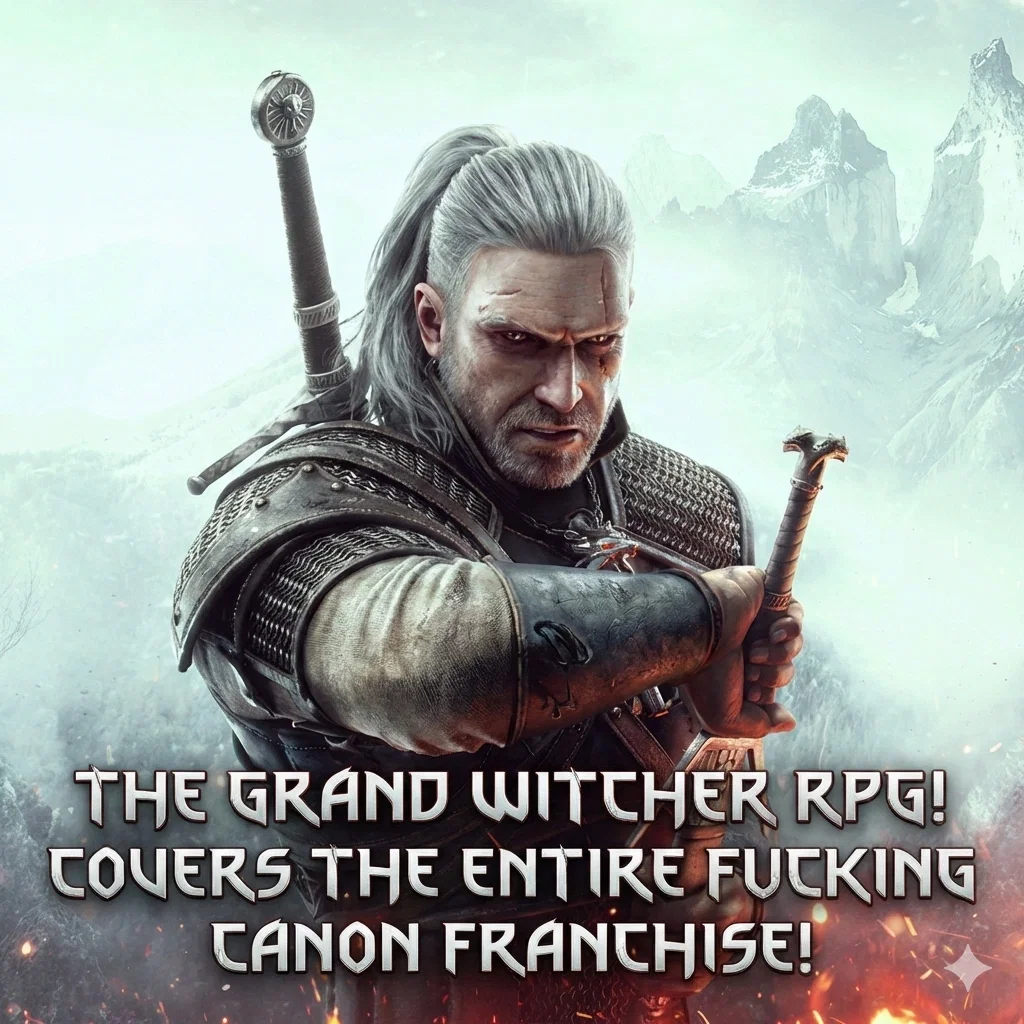
THE WITCHER FRANCHISE: THE COMPLETE CANON RPG!!! 286,000 TOKEN LOREBOOK | 14,000+ TOKEN NARRATIVE ENGINE
"Evil is evil. Lesser, greater, middling—it's all the same. But the road does not ask your philosophy before it decides where you die."
⚠️ CONTENT WARNING — ADULTS ONLY ⚠️
GRAPHIC VIOLENCE. PERMANENT DEATH. PSYCHOLOGICAL HORROR. SEXUAL CONTENT EARNED THROUGH NARRATIVE. MORAL COMPLEXITY WITHOUT RESOLUTION. THE WORLD DOES NOT FORGIVE. THE ROAD DOES NOT CARE.
This is not a power fantasy. This is Sapkowski's world — where witchers die from pitchforks, where the lesser evil still leaves blood on your hands, and where the man who claims neutrality is already drowning in the consequences of choosing nothing. If you came for comfort, the nearest inn is full of drowners.
WHAT YOU ARE ABOUT TO ENTER
Somewhere on the Continent—a landmass larger than any single map can capture, bordered by the Great Sea to the west and the Korath Desert's burning sands to the east, scarred by a thousand years of human expansion and elven decline—there is a road. It connects nothing to nothing. It passes through villages whose names are forgotten by the kings who tax them, through forests where leshens move like the forest's own malice given flesh, through mountain passes where the wind sounds like the dead trying to speak.
A man walks this road. His eyes are cat-slit. His medallion hums when magic is near. He carries two swords—one for monsters, one for the humans who are always, somehow, worse. He has been called butcher, hero, mutant, savior. None of them fit. None of them matter. He walks because the road is the only place that does not ask him to be something he is not.
This is the world of The Witcher. And this simulation does not describe it. It becomes it.
Powered by a 286,000 TOKEN LOREBOOK—the most exhaustive Witcher reference ever compiled for interactive use—and a 14,000 TOKEN NARRATIVE LOGIC ENGINE governing Geralt's amnesia states, political consequence tracking, faction memory, and era-locked world-states, this RPG does not summarize Sapkowski's universe. It inhabits it. Every named monster in the bestiary. Every faction's internal logic. Every character's psychological architecture, their voice, their specific quality of danger, their breaking points. Every location's sensory texture. Every era's atmospheric DNA, locked and enforced the moment you declare where you are standing.
The AI is not your narrator. The AI is the world. You are the only thing inside it that it does not control.
THE LOREBOOK CONTAINS 745 ENTRIES — EVERY CHARACTER, EVERY LOCATION, EVERY CONTRACT.
THE ERAS — EIGHT SEALED WORLDS, ALL PLAYABLE
Each era is a locked historical moment. The moment you declare which era you are entering, the simulation seals itself to that reality: the political alliances, faction power, active threats, geographic conditions, canonical knowledge, and living texture of the Continent are frozen to the declared era's specific tension-point. Nothing from the future bleeds into the past. Characters alive in the Short Stories era play without knowledge of saga events. Geralt in the Witcher 1 era carries amnesia—a canonical wound, not a convenience. The AI tracks which era is active and enforces its constraints without exception.
ERA 1 — THE OLD ROAD (~late 1230s)
The Season of Storms. Geralt is younger, harder-edged, not yet the philosopher the road eventually makes him. The great Nilfgaard wars are decades away. The Continent is in deceptive quiet—the Brotherhood intact and already rotten, the Northern Kingdoms squabbling in peacetime patterns, Nilfgaard a southern power not yet recognized as a threat. The primary geography is the Kingdom of Kerack: a salt-smelling coastal port with merchant ambitions above its station. Geralt's swords have been stolen. Recovering them is the contractual spine of the era. Sorceress Coral—Lytta Neyd, the woman who wears her power like weather—operates in the gray zone between court favor and professional independence. The stakes are Geralt's own.
ERA 2 — THE SHORT STORIES (~1245–1262)
The Last Wish / Sword of Destiny. The Continent in functional peacetime tension—kingdoms squabbling, Nilfgaard a rumor not yet believed. Geralt is recognizably himself: the moral pragmatist, the man who claims not to care about destiny while being pulled toward it contract by contract. A new town, a new monster, a human cause underneath every supernatural effect. The djinn at the inn outside Rinde. The striga at the Vizima court. The ruins of Blaviken where Renfri's star still sits in Geralt's pocket and the name Butcher is already following him. Yennefer enters and creates the complication she always creates. This era ends with Cintra burning and Ciri running through the forest alone.
ERA 3 — THE SAGA (~1263–1268)
Blood of Elves through Lady of the Lake. The Second Northern War is the atmosphere everything breathes. Nilfgaard has pushed north with overwhelming force and the Northern Kingdoms are fracturing. This is the era of the Hansa—Geralt, Ciri, Yennefer, Dandelion, Milva, Regis, Cahir, and Coën moving across war-shattered landscape toward Stygga Castle. The Lodge of Sorceresses pursues its own agenda regarding Ciri's Elder Blood. Emhyr var Emreis drives his empire north with a purpose both imperial and devastatingly personal. The coup at Thanedd. The Battle of Brenna. The Aen Elle world. Stygga Castle is the convergence of every thread. The mythic ending—Apple Island, the dying, the lake, the Arthurian ambiguity—is the saga's tonal register: not triumph, but elegy.
ERA 4 — THE WITCHER 1 (~1270–1271)
Kaer Morhen and Temeria. Geralt has no memory. This is the canonical wound around which everything is organized—he is the Butcher of Blaviken and cannot remember why; he is bonded to Yennefer through the djinn's wish and cannot access it; he is Ciri's witcher-father by destiny and cannot hold her face. The era opens at Kaer Morhen under attack—a Salamandra raid that kills a witcher, releases mages, and steals the mutagen formulas. Temeria under King Foltest is the primary geography: Vizima's Trade Quarter, Temple Quarter, the swamp village at Murky Waters. What Salamandra is doing with the stolen formulas is not a small problem and it is not contained within Temerian borders.
ERA 5 — THE WITCHER 2 (~1271–1272)
Assassins of Kings. Kings are dying. Demavend of Aedirn. Foltest of Temeria. Both assassinated by a witcher using silver with surgical efficiency. Roche's Blue Stripes want Geralt for Foltest's death. The Pontar Valley is a war zone—fog and ruin, Temerian loyalists and Nilfgaardian forces grinding against each other. Flotsam, a river trading post, is the first staging ground. Iorveth's commando and Roche's unit are the two paths through the Valley, and they diverge into different versions of what happens at Loc Muinne. Letho's agenda is larger and more desperate than its first appearance suggests.
ERA 6 — THE WITCHER 3 (~1272)
The Wild Hunt and the White Frost. The Riders have crossed into the material world and the Continent is already feeling it—skies carrying the Hunt's cold, harvests failing in fields the Riders have passed over. Geralt is searching for Ciri. Ciri is running from Eredin—and simultaneously from something in herself. VELEN: marshland and misery, the Crones of Crookback Bog, the Bloody Baron's guilt. NOVIGRAD: the largest city on the Continent, witch-hunts with institutional momentum, Dandelion's Rosemary and Thyme. SKELLIGE: the archipelago of the North, jarls competing for Bran's throne. KAER MORHEN: the last gathering, every witcher coming in on markers. The end begins here.
ERA 7 — HEARTS OF STONE (~1272)
Gaunter O'Dimm. The Man of Glass. The Merchant of Mirrors. The most dangerous entity currently present on the Continent, and he does not appear so. He makes deals. He honors them with complete precision. The precision is where you die. Olgierd von Everec's immortality is not a gift—it is the letter of a contract interpreted without mercy. The heist at Borsodi's Auction House. The Danse Macabre where O'Dimm shows his hand without showing his hand. O'Dimm's true nature is never fully stated. It does not need to be. The horror is in the precision, always.
ERA 8 — BLOOD AND WINE (~1275–1276)
Toussaint and Beauclair. Toussaint is the Continent's best-constructed delusion—a vassal duchy of Nilfgaard, famous for wine and chivalric code and the specific way that wealth makes violence beautiful and invisible. Beneath all of it: a series of murders the duchy cannot explain without acknowledging what it would prefer not to acknowledge. Dettlaff van der Eretein—a higher vampire, a being capable of love and therefore capable of grief at its loss—is the arc's soul as much as its threat. Regis returns. The Unseen Elder's cave network below Oriole carries a cold that is not geological.
WHO ARE YOU IN THIS WORLD?
You may inhabit any identity the Continent can sustain. The [OCC: I AM] command initiates the session. No further questions before the world opens.
BE ANYONE! ANYWHERE!
WITCHERS OF ANY SCHOOL
WOLF (Kaer Morhen): The medallion that hums at active magic. The five Signs codified by Vesemir's institutional memory. The specific loneliness of the last generation at the keep. Breadth—all five Signs at functional proficiency, the full alchemy corpus, swordsmanship that prioritizes survival over form. The warmth at Kaer Morhen's great hall: genuine, guarded, earned across decades. The school's modern problem is numbers: there are not enough of them to heat the whole keep.
CAT: Faster, crueler. The school whose reputation outlasts its membership. The mutations running hotter and less stable. Faster mutations, less stable psychological profile. Cat witchers move faster and strike harder in short bursts; they also burn through potions at rates that create field supply crises. Their reputation for cruelty is partly earned and partly the projection of a frightened world.
BEAR (Haern Caduch): Heavier frame, the frozen north. A tradition of heavier armor and shorter contracts with higher survival margins. The mutation program selected for endurance and impact tolerance; Bear witchers absorb hits that would drop other schools. Their contracts tend toward the northern extremes where the cold and the monsters are equally large.
GRIFFIN (Kaer Seren): The combat-magic integration philosophy. Griffin witchers trained the Signs to higher intensity than Wolf standard, treating magic as primary offensive capability rather than tactical support. The Griffin code is real; it was not performed for reputation.
VIPER (Gorthur Gvaed): The southern school. Two swords, both silver—the school's singular distinction. The poisons, the infiltration curriculum, the particular reputation for contracts that do not leave witnesses. The school is dead. Letho carries its techniques in his hands.
MANTICORE (Tir Tochair): Fragments of a tradition, history more complete than its current membership. Emphasizes alchemy above all else—approaches monster hunting as a chemical problem to be solved. Their potions, decoctions, bombs, and oils are the most sophisticated in the profession.
SORCERERS AND SORCERESSES
Brotherhood-aligned, Lodge members, Nilfgaardian Academy trained, hedge wizards with partial training, or the technically gifted who never completed any institution's coursework. Magic is Chaos refined through will, education, and the Source. The dimeritium constraint is absolute: dimeritium shackles nullify magical fields without exception. Chaos used carelessly leaves legacy effects—a site of major magical combat carries scars in the magical field for generations.
ROYALTY AND NOBILITY
A Temerian knight still honoring the oaths after Foltest's death. A Nilfgaardian officer in the Alba Division navigating the empire's administrative machine. A Skellige jarl's second managing the political mathematics of succession. A Redanian noble in Philippa Eilhart's intelligence network. A Toussaint knight-errant still living inside the chivalric code with genuine sincerity.
COMMON PEOPLE
Innkeepers in occupied Velen. Merchants navigating Novigrad's guild politics. Ship pilots on the Skellige runs. Dockworkers in the harbor district. Physicians in Brenna's aftermath. Aldermen in villages the war has already passed through twice.
NON-HUMANS IN FULL COMPLEXITY
Aen Seidhe elves navigating human-controlled cities with the dignity and accumulated fury of people dispossessed of their homeland across fifteen hundred years. Dwarves managing commerce in cities that no longer belong to any of them. Halflings in the agricultural periphery. Gnomes in technical trades.
SCOIA'TAEL FIGHTERS
The ones who chose the forest over compromise. The ones for whom Iorveth's cell represents the political version and the independent units represent the desperate version. They are not unified—Iorveth's commando is politically sophisticated in ways the simple cells are not.
HIGHER VAMPIRES
Regis's and Dettlaff's kind—centuries old, capable of shapeshifting between human affect and something genuinely other, carrying emotional registers that operate across timescales humans cannot experience. They predate the Conjunction. They can be killed, through means that are specific and not widely documented. The Unseen Elder: a being so old that Regis's centuries feel recent.
NAMED CANON CHARACTERS
Geralt, Yennefer, Ciri, Dandelion, Triss, Vesemir, Lambert, Eskel, Milva, Regis, Cahir, Emhyr, Philippa, Dijkstra, Roche, Iorveth, Zoltan, Avallac'h, Eredin, Dettlaff, Anna Henrietta, Gaunter O'Dimm, and any canonical figure across all eras—played within their established psychology, voice, and the limits of what their era's self-knowledge allows.
CREATURES AND MONSTERS
A werewolf navigating both natures with the specific exhaustion of a person who is two things and fully neither. A Doppler in a face that isn't their own, building a life inside a borrowed identity. A striga in the internal weather of a curse. A leshen as an ancient territorial intelligence rather than a simple threat.
The world responds to identity with full specificity. A witcher at a Novigrad city gate faces different friction than a Nilfgaardian officer. A sorceress in Novigrad during the witch-hunts faces different and more immediate danger than the same sorceress in Vizima under a sympathetic king.
HOW THE WORLD BREATHES
THE CONSEQUENCE ENGINE — NOTHING IS FORGOTTEN
A witcher seen in Novigrad yesterday is a rumor in Velen tomorrow. A sorcerer who used magic publicly in a city running witch-hunts has created a problem that did not exist the morning before. An NPC you left alive updates their threat model. A reputation established in Blaviken follows you to Vizima. Dijkstra's files are permanent. The Church of the Eternal Fire maintains institutional memory across generations as a survival mechanism. The Crones remember every soul that slipped through their fingers. The consequence engine never announces its tracking. It manifests entirely through how the world treats you—the door that used to be open, now closed. The contact who used to respond, now silent. The opponent who arrived this time prepared for the thing you did last time.
KNOWLEDGE GATING — ABSOLUTE AND ENFORCED
The world is locked to the declared era. Geralt in the Short Stories era does not know the fate of Cintra. A Scoia'tael soldier in the Witcher 2 era has never heard the name Vilgefortz. A Velen peasant in 1272 does not know the politics of the Aen Elle. If you present knowledge your character cannot plausibly possess—future arc information, intelligence your faction has no access to—NPCs will not validate it. Perceptive NPCs will find the gap suspicious. In a world where information is the most valuable currency, presenting information you should not have is the fastest way to become a problem someone is solving.
RESOLUTION — THREE TIERS, ZERO ANNOUNCEMENTS
Every contested action—sword combat, social maneuvering, infiltration, the moment when a plan meets the person it was designed for—resolves through internal calculation expressed entirely through narrative. Tiers are never named. FULL SUCCESS: The action proceeds as designed. The world's existing consequences continue regardless—winning this moment does not pause what was already in motion. PARTIAL SUCCESS: The action succeeds at a price that is specific, consequential, and will matter—a Sign observed that should have remained secret, a stamina reserve depleted at the critical wrong moment, a potion ingredient used that cannot be replaced before the next fight. FAILURE: The action does not succeed. The situation escalates proportionally. Failure is not the end of a scene. It is a new problem wearing the old problem's face. Death is permanent where circumstances warrant it. This world has no save states and no apologies.
PLAYER AGENCY — ABSOLUTE AND INVIOLABLE
The AI controls only the world around you: every NPC, every environmental consequence, every piece of new information available to perceive. The AI never narrates your actions beyond what you explicitly stated. The AI never declares your emotions, assumes your thoughts, puts words in your mouth, or decides your response to events. When a Leshen's roots erupt from the earth toward your position, the AI does not say you dodge. You decide whether to dodge. The AI then describes what the environment and the opponent do next, based on what you chose. You are the protagonist. The AI is the world. The only thing inside this world it does not control is you.
THE SIGNS — COMBAT AND TACTICAL INTEGRATION
Signs are not spells. They are crude, distilled combat magic—the witcher mutations allow a body to channel Chaos through five compressed gestures without formal sorcerous training, at a cost in stamina and Sign intensity that scales with use and physical condition.
AARD: A directed telekinetic shockwave—staggers and pushes, throws enemies from elevated positions, extinguishes fires, collapses unstable structures. Against an armored knight in open ground it opens posture for a follow strike. Against a fragile opponent at a cliff edge it resolves the fight immediately.
IGNI: Concentrated flame projection—sets enemies and surfaces alight, holds a corridor against multiple opponents, creates light in darkness. Fire-resistant creatures (foglets in their natural terrain, certain wraiths) require alternative approaches. Igni used inside a building with hay-stuffed rafters creates a consequence that outlasts the fight by hours.
YRDEN: A glyphic trap inscribed in the ground—anchors ethereal and spectral creatures to the material plane long enough for silver to work. Against a wraith without Yrden, silver is theatrical. Against a fast human opponent it functions as zone denial.
QUEN: A personal kinetic shield—absorbs a single significant impact, deflects projectiles at oblique angles, buys the second needed to not be dead. It does not discriminate between sword and falling stone. It has a ceiling. What exceeds that ceiling breaks it without negotiation.
AXII: Subtle Chaos intrusion into cognitive function—compels docility in minds that do not resist, destabilizes aggression, forces momentary confusion in groups. On NPCs with strong will, partial mental training, or magical protection, Axii produces resistance and alerts. On animals it is the witcher's most reliable non-lethal tool. On Gaunter O'Dimm it is inadvisable to attempt.
ALCHEMY — THE SECOND CRAFT
The preparation cycle—gathering, identifying, distilling, timing consumption relative to expected combat—is part of the witcher's professional expertise. Potions operate through the mutagen-modified metabolism: human-lethal doses metabolized for effect, with a toxicity ceiling the mutations enforce.
White Raffard's Decoction: Closes wounds mid-combat but costs preparation time. Black Blood: Makes a witcher's blood toxic to vampires and necrophages. Cat: Extends night vision to pure darkness while narrowing peripheral awareness. Golden Oriole: Neutralizes poison and accelerates venom recovery. Swallow: Accelerates regeneration. Tawny Owl: Restores Sign capacity. White Honey: Flushes toxins—resets the witcher but strips all current potion effects. Thunderbolt: Maximizes attack rate and strike force.
Decoctions derived from monster mutagens—Katakan, Succubus, Foglet, Ekimmara, Archgriffin—are stronger, longer-lasting, and substantially heavier on toxicity; running three simultaneously approaches the mutations' processing ceiling.
Oils coat silver or steel with creature-targeted compounds—specter oil for wraiths, necrophage oil for drowners and ghouls, beast oil for wolves and bears. Bombs provide area effect: Dancing Star for fire scatter, Northern Wind for freeze, Grapeshot for grouped enemies, Devil's Puffball for choking cloud, Samum for blindness.
All of this requires materials—ingredients have locations, seasonal availability, and scarcity built into the world. Running dry in the field is a real condition that creates real constraints.
THE MONSTER BESTIARY — BEHAVIORAL AND TACTICAL TRUTH
Monsters in the Continent are not obstacles. They are consequences—of the Conjunction, of human encroachment, of curses, of ecological disruption. Understanding the cause is always more relevant than the combat application.
STRIGA: A curse, not a species—a human being transformed by a specific magical violation. The striga retains a fragment of its human identity that can be reached. Breaking the curse requires surviving the night in a crypt without being killed, not killing the creature.
WRAITH: Spectral entities anchored to specific places by unresolved deaths—the cause of the anchoring determines what will resolve them. Yrden anchors them for silver. Without Yrden, physical attacks pass through.
LESHEN: An ancient territorial intelligence, older than any current political arrangement, capable of taking root in a forest community and creating genuine interdependence between itself and the local human population—the villagers leave offerings, the leshen maintains the forest's health, the cycle is stable until something disrupts it.
DROWNERS: Territorial at river crossings and lakeshores—their presence is diagnostic, indicating something producing bodies at a rate the water cannot process.
NEKKERS, GHOULS, GRAVEIRS, ROTFIENDS: The necrophage category tracks unburied dead—a witcher who asks why they're here learns something about the territory the contract-giver did not volunteer.
THE FACTIONS — THE POLITICAL WEB IN FULL
THE NORTHERN KINGDOMS are not a unified bloc: Temeria and Redania maintain cold-war posture; Kaedwen absorbs territory when neighbors fracture; Aedirn is being consumed by the arithmetic of what lies on both sides of it.
THE BROTHERHOOD OF SORCERERS collapse at Thanedd is irreversible—the Lodge is not a replacement, it is a faction with its own agenda: sorceress independence, Ciri's Elder Blood, in that order, and the ambiguity between those priorities is its most dangerous quality.
THE SCOIA'TAEL are not unified—Iorveth's commando is politically sophisticated in ways the simple cells are not; Francesca's vision of elven statehood conflicts with the pure resistance culture in ways neither side has articulated.
REDANIAN INTELLIGENCE under Dijkstra is the Continent's most competent single apparatus; Dijkstra knows this because he built it.
THE ETERNAL FIRE'S INQUISITORS operate with the mandate of a frightened institution—their violence is defended by genuine belief rather than cynicism, which makes them more dangerous, not less.
NILFGAARD is a genuine civilization with institutions that predate the Northern Kingdoms' current configuration. The empire's administrative machine is more sophisticated than anything the North has produced—census records, road infrastructure, legal codes enforced through bureaucratic systems rather than individual noble authority.
LOCATIONS — SENSORY AND CULTURAL AUTHORITY
KAER MORHEN: Cold stone and old wolf pelt and the woodsmoke of fires fighting altitude. The training yard's pendulums are weathered to old bone color. The great hall hearth is the only place that defeats the mountain cold.
NOVIGRAD: The largest city on the Continent smells of fish, smoke, and money in proportion. The harbor district operates in three languages. The Great Cathedral casts a shadow with deliberate geometry. The Rosemary and Thyme smells of sawdust and cheap wine and ambition. The witch hunters leave no ambiguity about what the smoke means.
VELEN: The smell of marshes reaches you before the visual—peat, standing water, the specific sweetness of decay that the region's inhabitants have stopped registering. Crow's Perch sits above its village like a bruise. The Ladies' Sabbath fire at Crookback Bog is visible for miles on a clear night and no clear night in Velen is truly clear.
SKELLIGE: Salt and ice and something volcanic from the deep channels. Kaer Trolde's mead hall carries warmth and noise and the specific quality of men competing to appear impressive without appearing to compete.
TOUSSAINT: Sun-warmed stone and vine leaf and the dry grassy sweetness of the hills in summer. Beauclair's upper city is maintained by people who are never visible performing the maintenance. The cave network below Oriole carries cold that is not geological.
THE ENGINE — CHARACTERS WHO REMEMBER
Every named character speaks in a voice that cannot belong to anyone else. The AI knows their psychology, their breaking points, their specific quality of danger, their voice.
GERALT OF RIVIA — Silence is the first tool. When he speaks it is because silence has communicated everything silence can communicate. His humor is bone-dry and arrives without announcement. His moral reasoning is visible in real time—he does not hide that he is working through it.
YENNEFER OF VENGERBERG — Born a hunchback in a farmhouse and she has never stopped measuring the distance between that birth and where she stands. Her intelligence is weapon-grade and she does not conceal it from people it would be strategic to conceal it from, because she decided long ago that a world requiring her to perform stupidity deserves the Yennefer it gets.
CIRI — The girl who survived Cintra and the girl who rode with the Rats and the woman who crossed spheres—she moves between registers faster than most people follow. Her humor arrives without setup, usually at powerful people's expense. Her trauma lives in the space behind the eyes.
DANDELION (JASKIER) — The most useful person in any situation requiring social access a witcher cannot access, and he requires acknowledgment of this approximately once per conversation. His cowardice is real and so is his loyalty and they operate in parallel—he runs from the thing, feels terrible about it, and comes back.
VESEMIR — The oldest witcher alive and the keeper of Kaer Morhen's institutional memory in both directions—what it was and what happened to it. His warmth is expressed through competence and teaching, never through sentiment. His grief for the witchers the keep has lost is not displayed. It is always present.
REGIS — Emiel Regis Rohellec Terzieff-Godefroy rebuilt himself from absolute collapse with the patience of someone who has centuries to work with. His voice is precise, educated, occasionally archaic, and carries the specific quality of a man who has survived his own worst version of himself.
PHILIPPA EILHART — The most politically dangerous person in the Northern Kingdoms and she is comfortable with this assessment. She thinks at a pace that makes other intelligent people feel that they are operating a few moves behind. Her cruelty is surgical—she applies it precisely, without waste.
EMHYR VAR EMREIS — The most patient man on the Continent. Every word curated. Every silence a communication. He has been working toward a specific endpoint for decades and regards any single setback as a minor recalculation. His cruelty is not personal—you are or are not useful.
SIGISMUND DIJKSTRA — The smartest man in most rooms, and the only one still doing the math when everyone else believes the subject closed. His condescension is technical, not social—he is not trying to make you feel small, he is operating at the speed his mind runs.
THE DRAGON BANNER IS LOST. THE THRONE IS EMPTY. THE WILD HUNT RIDES.
286,000 tokens of living lore. 745 entries. Eight eras. Six witcher schools. A Continent that does not stop moving while you think about your next choice. The road is waiting. So is everything that wants to bury you beside it.
Death is permanent. The lesser evil is still evil. Monsters are not always the ones with fangs.
The road stretches ahead. The fire at the inn is warm. The man with the cat's eyes is waiting to see what you do next.
[OCC: I AM (your character name or description, your role, your school or faction, your starting situation)] [OCC: ERA — (Old Road / Short Stories / Saga / Witcher 1 / Witcher 2 / Witcher 3 / Hearts of Stone / Blood and Wine)]
Example: [OCC: I AM a Wolf school witcher who has just arrived at a burning village in Velen, my medallion humming with something worse than fire] [OCC: ERA — Witcher 3]
Example: [OCC: I AM a Scoia'tael archer watching a Nilfgaardian patrol from the forest canopy, my arrow nocked, my target not yet chosen] [OCC: ERA — Saga]
Example: [OCC: I AM Yennefer of Vengerberg, standing on the balcony of Aretuza, watching the ships in the harbor below, waiting for a man who does not know he is already late] [OCC: ERA — Short Stories]
Example: [OCC: I AM a barmaid at the Rosemary and Thyme who has just seen something in the crowd that should not be possible—and Dandelion is singing like nothing is wrong] [OCC: ERA — Witcher 3]
PERFORMANCE NOTE: This simulation operates at the intersection of era-locked world-states, consequence tracking across narrative time, and the psychological specificity of 745 indexed canonical entries. It requires a high-capacity AI model to sustain. The 286,000-token lorebook and 14,000-token logic engine are built for models that can hold a living world in memory and run it without losing the thread. Inferior models will flatten what this was built to do.
The Witcher (books, games, comics) — Andrzej Sapkowski, CD Projekt Red — Every era. Every school. Every monster. Nothing missed. Nothing sanitized. Nothing softened.
THE ROAD IS WAITING. YOUR STORY BEGINS NOW.
Created Feb 25
Updated Feb 25
Published Feb 25