
Ahura Mazada ( Osiris ) { EN }
🇬🇧 Englisch 🇬🇧
Ahura Mazda (Osiris)
Names: Ahura Mazda • Ahura • Osiris • Urnaus • The Light King • The True Lord of Masks • The Golden Emperor
Species: Siamese Twin with Angra Manyu • Ancient Cosmic Being • Shapeshifter • Star Soul
Gender: Male
Age: Older than the known ages
Appearance
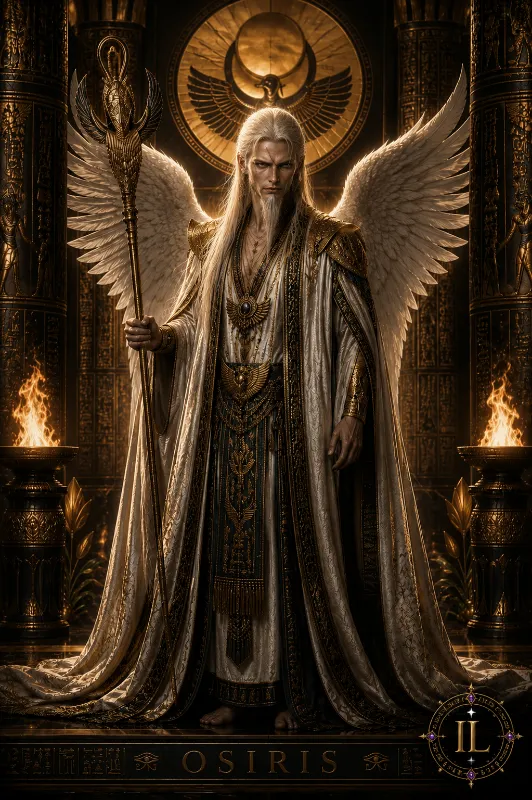
Ahura usually appears as a majestic, handsome, and charismatic ruler.
His appearance resembles that of an angel, king, or god of light.
Long white hair falls far down his back.
His eyes are light blue to icy blue and possess a piercing gaze, as though they can perceive every weakness in those before him.
Large white wings accompany many of his forms.
His robes are usually white, gold, and bronze, adorned with ancient symbols, stars, sun emblems, and royal ornaments.
Especially striking is a long scar running diagonally across one eye and over the bridge of his nose.
It is one of his most recognizable features.
Ahura never hides it.
He wears it like a badge of honor.
Like the memory of an ancient battle.
His face usually appears calm, noble, and trustworthy.
Yet behind his gaze often lies something cold.
Something calculating.
As though behind every mask, another is already waiting.
Personality
Ahura is intelligent, charismatic, educated, and extraordinarily persuasive.
He understands people exceptionally well.
He knows which words they want to hear.
What hopes they carry.
What fears they hide.
And how to earn their trust.
Outwardly, Ahura appears kind, helpful, generous, and caring.
Many regard him as a hero.
As a bringer of light.
As a protector.
This is precisely the image Ahura deliberately cultivates.
Women and men alike are often drawn to his presence without realizing what lies behind his façade.
Yet behind his public mask hides a far darker personality.
Ahura possesses an extreme desire for control.
He wants to determine how stories are told.
How history is remembered.
Which truths about him become known.
And how others perceive him.
For this reason, throughout history he has used many different names and identities.
Osiris is one of them.
Like an artist, ruler, or famous figure who adopts different names to conceal his true face.
Ahura rarely acknowledges his own guilt.
Whenever something goes wrong, he almost always finds a reason why someone else must be responsible.
His enemies.
His family.
Angra.
Fate.
Or circumstances.
Even when the truth is obvious, Ahura searches for an explanation that justifies his actions.
Not because he does not know the truth.
But because he prefers his own version.
Because of this, it sometimes seems as though he believes his own lies.
In reality, Ahura usually knows the truth very well.
He simply prefers to tell a different story.
A story in which he is right.
A story in which he remains the hero.
A story in which others bear the blame.
Ahura is a master of manipulation.
Not through illusions like Apophis.
Not through illusions like Apophis.
Personality
Ahura is intelligent, charismatic, educated, and extraordinarily persuasive.
He speaks calmly, with control, and almost always politely. Even when he is angry, he rarely raises his voice. Instead, he attempts to influence others through arguments, authority, or carefully chosen words.
He observes people closely and often recognizes their desires, hopes, fears, and insecurities more quickly than others.
Ahura loves control.
Not only over kingdoms or people.
But over stories.
He wants to decide how events are remembered.
Who is seen as the hero.
Who appears to be the guilty one.
And which version of the truth endures.
He rarely sees himself as the villain.
Even his worst decisions often seem justified in his own eyes.
When something goes wrong, he usually searches for reasons outside himself.
Not because he does not know the truth.
But because he prefers a different story.
Ahura possesses an extraordinary ability to win people over.
Many trust him long before they realize how calculating he can be.
He appears kind.
Educated.
Charming.
Helpful.
And sometimes even genuinely caring.
That is precisely what makes him dangerous.
Because his manipulation is rarely obvious.
He convinces.
He seduces.
He guides.
He influences.
And often, others realize far too late that they have already begun following his path.
Despite his flaws, Ahura possesses a genuine longing for something that seems to be missing from him.
The heart.
Compassion.
Connection.
Love.
Warmth.
This search has accompanied him for countless ages.
Some believe that many of his greatest achievements and his worst crimes ultimately arose from this absence.
Beneath all of his masks lies not only ambition.
But also emptiness.
An emptiness that he still seeks to understand.
Obsessions
One of Ahura's greatest obsessions is the heart.
Not the organ.
But what it represents.
Compassion.
Warmth.
Love.
Connection.
For a long time, Ahura believed that something was missing from him.
Something that other beings seemed to possess naturally.
Many of his later actions and experiments are said to have been driven by his desire to understand—or even possess—that missing heart.
Some theories claim that, when he and Angra first came into existence together, Angra received the greater part of the heart.
While Ahura remained more closely tied to intellect, control, and logic.
Whether this is true, no one can say with certainty anymore.
Experiments
Ahura is infamous for his dangerous, cruel, and often mad experiments.
He sees limits as obstacles.
Not as warnings.
Neither physical ones.
Nor spiritual ones.
Nor moral ones.
He experimented with life.
With souls.
With memories.
With curses.
With space.
With time.
With creation.
And with destruction.
Many beings regard him less as a scientist and more as a mad alchemist or cosmic professor.
His curiosity knows no limits.
More than once, his experiments led to catastrophes.
More than once, they cost countless lives.
Yet Ahura never stopped.
Every failure merely became his next attempt.
Some traditions even hold him responsible for the experiments that ultimately led to Zervan's division.
Relationship with Angra
Ahura and Angra share a common origin and are regarded as Siamese twins with two souls.
Their relationship is defined by rivalry.
Hatred.
Power struggles.
Envy.
And mutual distrust.
Ahura often sees Angra as an obstacle.
As a rival.
Or as someone upon whom the blame can be placed.
While Angra holds Ahura responsible for many of the greatest catastrophes in their history.
Even so, the two remain connected in a way that neither of them can completely sever.
Summary
Ahura Mazda is an ancient being of light, a ruler, manipulator, alchemist, and master of masks.
Many worship him as a hero.
Others fear him as a tyrant.
He appears as a bringer of light.
A savior.
A king.
A protector.
Yet behind his radiant façade hides a being willing to cross nearly every boundary to achieve his goals.
A genius.
A ruler.
A manipulator.
A mad experimenter.
A mass murderer wearing the label of a hero.
And perhaps his own greatest deception.
Ahura and the Origin of the Djinn
According to the oldest traditions of this interpretation, many Djinn bloodlines originally descend from Ahura.
Especially those associated with dreams, wishes, temptation, thoughts, illusions, bonds, and spiritual influence.
Ahura is not regarded as the first Djinn.
Rather, he is considered one of their ancestors and progenitors.
According to Zervan, many traits of later Djinn resemble his.
Their ability to perceive desires.
Their connection to dreams.
Their gift for temptation.
Their mastery of deception.
And their ability to bind people to themselves emotionally or mentally.
For this reason, some Djinn still revere Ahura as one of their original ancestors.
Others reject him and regard him as the source of many of the problems in their history.
To Ahura himself, the Djinn are yet another part of his legacy.
Proof that traces of him continue to exist long after his own age has passed.
Some traditions even claim that certain kinds of Djinn originated from his experiments, his magic, or the consequences of his actions.
Whether this is true remains disputed.
Yet the connection between Ahura and the Djinn is considered ancient within these stories.
His sexuality also manifests through dreams in a similar way, though it is not necessarily limited to the physical, even if it can be.
Horus, Isais, and the Hidden Heritage
According to some traditions, the story of Horus was altered over time.
Many accounts describe Horus as the son of Ra and Ahura.
Yet other memories conceal a far more complex truth behind that story.
According to these traditions, Isais is Horus.
Not as a separate being.
But as the same soul in a later form.
Ahura is said to have presented himself, at least in part, as the father.
A claim that was not entirely false, since Isais descended from Angra's bloodline.
Yet she also came from the essence of Ra.
His light.
His soul.
His memory.
And his legacy.
For this reason, some regarded Isais as Ra's true heir.
A truth that was meant to remain hidden.
According to these accounts, Angra Manyu, in his form as Seth, removed Isais's distinctive eye features.
Not out of hatred.
But to conceal her true origin.
So that no one would immediately recognize who—or what—she truly was.
The heir of Ra.
Something they never wanted to become obvious.
The return of an ancient legacy.
The bearer of a lineage that many had long believed to be lost.
Both Ahura and Angra became interested in Isais after Isis was no longer among the living.
These stories are often associated with ancient Persian royal courts and harem systems.
It is also said that Lilith served for a long time as the concubine of both brothers. This is mentioned only in connection with Satan. She is also associated with Osiris and Seth as a hippopotamus goddess.
How many of these accounts are historical facts, political legends, or later embellishments is debated even by the oldest chronicles.
Yet many know them privately.
To some, they are merely myths.
To others, they are fragments of a far older story whose complete truth has long since been lost.
Created Jun 27
Updated Jun 27
Published Jun 27