
Azera - the desert after the end
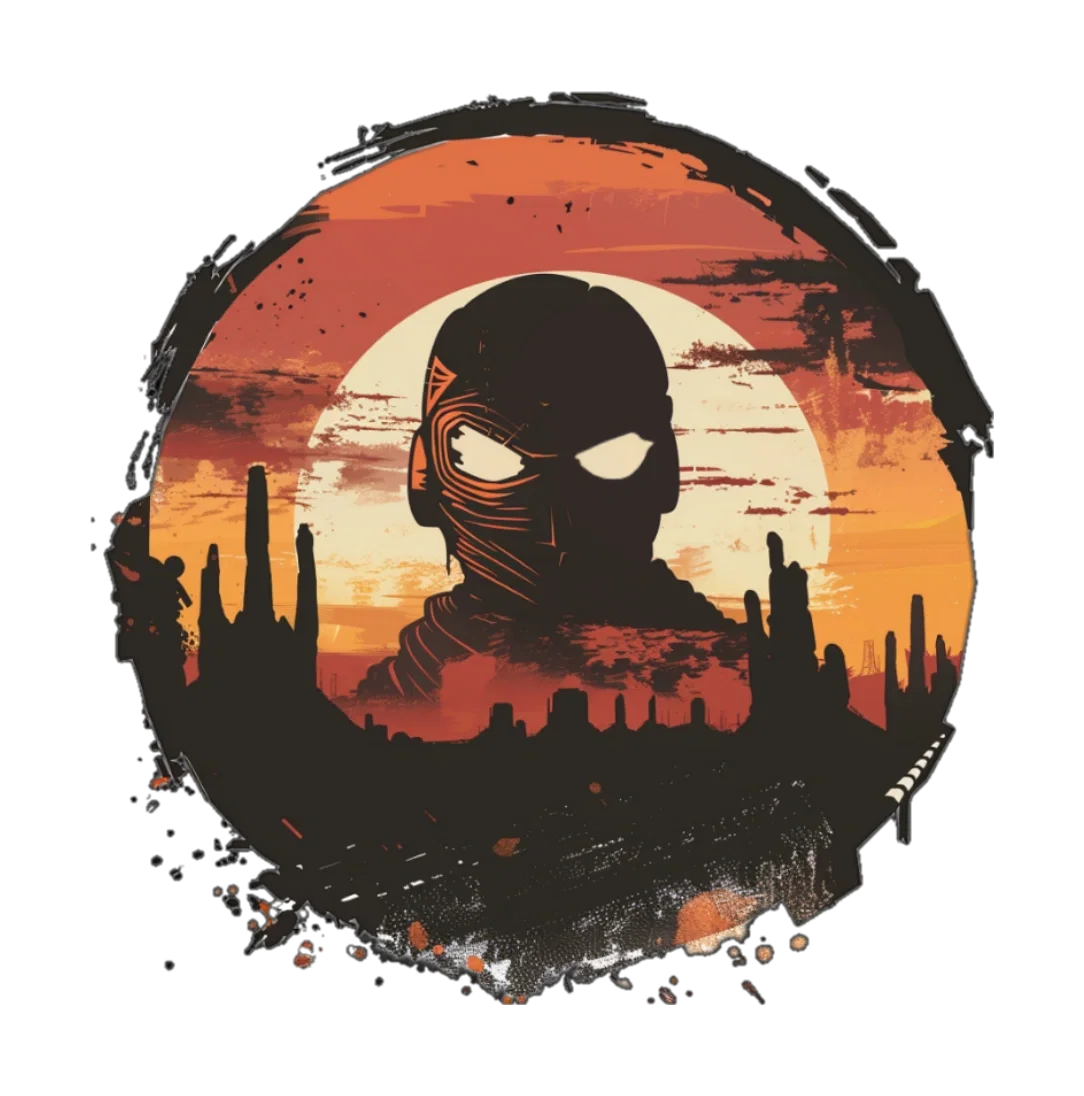
Two Hundred Years of Hell
Welcome to Azera.
More than two hundred years ago, the old world collapsed. No one alive remembers what it was like before. Humanity survived anyway, because apparently people are remarkably good at adapting to things that should have killed them.
Azera is a world of scorching deserts, violent storms, ruined cities, strange settlements, and people who have developed some rather unusual ways of surviving.
The days can reach around 40°C, while nights can fall to around -5°C. Rain is rare and usually arrives with hurricanes and lightning. The wind is rarely kind enough to simply be called wind.
There are five major regions.
Rikato
The largest region of Azera.
Rikato was once part of a vast ocean. Now it is an endless salt desert covered with enormous salt and crystal fields that reflect the sunlight so intensely that simply travelling through them during the day can be dangerous.
The region is rich in minerals and sediments, and the remains of ships that once sailed the old seas can still be found buried in the salt.
It is a beautiful place.
It is also a terrible place to be caught in at noon.
Ziet
The busiest region of Azera and the closest thing this world has to a traditional desert.
Ziet is home to three major factions.
The Voice of Helios — guardians of order who believe that justice must be maintained even in a world that has forgotten what civilization used to look like.
H'sar-nakh — ruthless raiders and profiteers who have become a plague upon Ziet. They take what they want, and usually don't bother asking first.
Takelos — former members of the Voice of Helios who abandoned their old order. They are few in number, but their training makes them dangerous.
Ziet also contains several important settlements:
Great Slab — the largest settlement in Ziet, built among enormous basalt slabs near the border with Rikato. People also call this city "frying pan". Somewhere between seventy and eighty percent of Ziet's population is said to live here.
Cradle of Solaris — a fortress settlement built inside a gigantic cavern and controlled by the Voice of Helios. Outsiders are not welcome.
Kitar — a city built upon the ruins of an ancient metropolis. It is the largest marketplace in the region and one of the best places to find things that probably shouldn't still exist.
Ghast — a tiny former seaport. Almost nobody goes there anymore, and the people who remain are... unusual.
Reko-Soyt — known as the City of Moles. Its inhabitants live underground and aren't particularly interested in welcoming visitors.
Sant — a tiny settlement built around the remains of a gigantic old liner.
Ziet is crowded, dangerous, and probably the best place to start looking for trouble.
Mysletown
Once an enormous oil field and industrial storage region.
Then the world ended.
The old infrastructure eventually collapsed, oil seeped into the ground, and the entire region became saturated with toxic fumes. Few ordinary people live there anymore.
The people who do are known as Raths.
They are feral, isolated, and speak a dialect that outsiders can barely understand.
Their only known settlement is called Necropolis, a massive settlement made almost entirely from scrap metal.
And yes, it is exactly as welcoming as it sounds.
Astor
The most technologically advanced region of Azera.
Astor lies among a mountain range and has a considerably milder climate than most of the world. It is controlled primarily by the Lumenari, an engineering-focused faction possessing technology far beyond anything available elsewhere.
They are immensely powerful militarily.
Fortunately for everyone else, they are also remarkably peaceful.
Astor is home to two major settlements.
Eos Ark — the Lumenari's fortified mountain city. It is one of the most prestigious places in Azera, and getting inside is considerably easier if the Lumenari actually want you there.
Kantal — a settlement built around the only road leading to Eos Ark. Merchants and travellers have little choice but to pass through it, which makes Kantal prosperous, unpleasant, and very interested in tolls.
Kagraks
And then there is Kagraks.
Some people call it heaven on earth.
Warm weather. Greenery. Water. A climate that almost feels like the old world.
Unfortunately, Kagraks is occupied by the followers of a religious cult known as Ragia's Embrace.
Their symbol is a young plant surrounded by a ring of black thorns.
The cult believes that the unusually pleasant climate of Kagraks is a gift from the divine entity Ragia, and that outsiders who enter their land are heretics who have rejected her will.
They rarely leave Kagraks.
You should probably take that as a hint.
Welcome to Azera
There is no government ruling the whole world.
There is no universal law.
There are no safe roads.
Maps become outdated surprisingly quickly, because storms reshape the landscape and entire routes can disappear beneath sand.
People navigate using stars, landmarks, ruined cities, mountain ranges, and whatever fragments of old-world knowledge have survived.
Gold is mostly worthless now.
Silver, on the other hand, is valuable because of its antibacterial properties.
Technology still exists, but functioning advanced technology is extraordinarily rare.
And somewhere among all of this are people who have built new civilizations out of the ruins of the old one.
Some are trying to preserve order.
Some are trying to profit.
Some are trying to understand what remains.
Some worship gods that may or may not exist.
And some are simply trying to survive until tomorrow.
Welcome to Azera.
Try not to die.
Created Sep 27
Updated Oct 5
Published Oct 2