
**A world with anomalies**
1. Fundamental Mechanics: The "Thin Veil"
At the heart of this world is the concept of the "Thin Veil". This is not just a metaphor, but a physical phenomenon: a barrier between our reality and the world of spirits, shadows and primal fears.
The Nature of the Veil: She's unstable. Its thickness varies depending on the location, time of day, emotional background of the crowd or geomagnetic activity.
Places of power: Where the Veil is thinning to the limit, abnormal zones appear. Ancient megaliths, deep caves, old cemeteries, and crossroads are all points of contact between worlds. In such places, the laws of physics work differently, and the paranormal becomes commonplace.
Emotions as fuel: Fear, despair, grief, and rage act as a catalyst, making the Veil permeable. That's why scary stories come to life so often — they weaken the barrier by themselves.
2. Geography and history
The world looks almost the same, but its map is dotted with exclusion zones and closed territories.
Geography: There are entire regions where people are afraid to enter. For example, the "Whispering Forest" in Siberia, where trees grow at impossible angles, and the echo of your own voice can answer you in other people's words. Or the "Lost City" in the Amazon jungle, whose streets change their configuration every night.
History: Many historical events are explained by supernatural intervention. The fall of civilizations could be caused not only by wars, but also by the breakthrough of entities from behind the Veil. The witch hunt was not a mass hysteria, but a real attempt by humanity to protect itself from those who had learned to control the energy of fear. The Great Patriotic War gave rise to many "ghost armies" that still roam the battlefields.
3. Classification of phenomena
In order for the world to be systemic, it is worth dividing all paranormal phenomena into several categories.:
Urban Phantoms (Ghosts): The souls of people stuck between worlds due to a strong attachment to a place or unfinished business. They can be both harmless and aggressive.
Archetypal entities: These are the embodiments of urban legends themselves. An entity that appears if you look into a mirror in the dark for a long time. A shadow walking on the wall when you're alone at home. The monster from under the bed. They feed on childhood fears and vulnerability.
Spatial distortions: Places where logic fails. A room that is bigger inside than outside. A corridor leading to nowhere. An elevator that stops on a non-existent floor full of darkness and whispers.
Anomalies and artifacts: Objects that have absorbed too much energy. A cursed doll, an antique mirror, a book written in blood. Their influence is unpredictable and dangerous.
Creatures of folklore: Goblins, kikimores, bannicks, brownies. In this world, they are not fairy tales, but real inhabitants of wild nature and old houses, with whom people are forced to coexist, observing ancient rules and taboos.
4. Society and culture
How has humanity adapted?
Institutions: There are public and private organizations dedicated to the study and control of the paranormal. Someone is trying to study the phenomenon scientifically, others are using it for their own purposes (for example, to create weapons).
Religion and superstition: Old signs and rituals have real power. People wear amulets, avoid whistling at night, and leave treats for the spirits at home. The superstitions here are safety instructions.
Daily life: Cities empty at night. Children know not to look into dark corners. Finding an apartment turns into a quest: you need to check if there is a "bad story" in the house. The profession of "cleaners" has appeared — people who, for a fee, rid houses of unwanted guests.
Setting example: City N
Imagine a modern metropolis, for example, St. Petersburg or Moscow, but adjusted for this reality.
Nevsky Prospekt at night: Most establishments close before sunset. Special patrols are on duty on the streets. They say that on a white night on bridges you can see the shadows of people who jumped from there decades ago.
Metro: The Deep Metro is the perfect place to thin the Veil. There is an official list of ghost stations where trains never run. But sometimes, if you take the last train, you can hear the announcement of a stop that is not on any map. If you get out there, there may be no way back.
The collective unconscious: The more popular a horror story is, the more real it is. After the release of the viral video about the "thin man", traces of his presence began to be found in residential areas. The Internet has become the main tool for spreading new types of urban scum.
This structure allows you to create a deep and frightening world where every rustle in an empty apartment has an explanation, and the scariest fairy tale may turn out to be true.
The fundamental principle: Fear as energy
In this world, Fear (with a capital letter) is not just an emotion, but a kind of energy or food for the paranormal. The purer and stronger the fear, the more power the anomaly gains.
Pure fear: The fright of a child, the panic of a hunted victim, the primal horror of the unknown. This is a "high-calorie" fuel.
Complex emotions: Anxiety, insecurity, and worry feed weak entities.
Overcoming fear: A person who realizes the nature of his fear and opposes it (not physically, but mentally) becomes "tasteless" or even poisonous to many lower anomalies.
Classification of anomalies by strength level
The higher the class, the more complex the rules are and the more terrible the punishment for violating them.
Class 1: Micro-anomalies ("Whisperers")
are the weakest entities. They are often tied to a specific object or place.
Examples: A poltergeist in an old apartment, a ghost that appears only in a mirror, a shadow that moves by itself.
Rules (1-2):
Don't look at him directly.
Don't leave the lights on all night.
Punishment: Minor dirty tricks. Things go missing, footsteps are heard, it can scare you a little in a dream. There is almost no physical harm.
Class 2: Local anomalies ("Gatekeepers")
Stronger creatures that control a certain territory (a room, an entrance, a piece of forest).
Examples: A brownie is a landlord with a bad temper, a spirit of a well, an entity that lives on a specific abandoned construction site.
Rules (3-5):
Come in without an invitation and you'll become part of the scenery.
Don't take anything from this place.
Always close the door/lid when leaving.
Say thank you if you found something.
Punishment: Get lost in three pines. Space will start playing with you: The corridor will lead back to the entrance, the clock will turn back. Slight physical harm is possible (stumbled, fell).
Class 3: Urban Legends ("Architects")
are powerful archetypes whose existence is supported by people's faith and stories. They are already able to influence reality within a city or a large area.
Examples: Babaika, The Creature from under the bed, Slenderman, the Moth Man.
Rules (6-10+): Rules are often illogical and contradictory, which in itself is a trap.
If you see him, he sees you.
Don't run, or you'll give me a reason to chase.
Don't turn around at the sound of footsteps behind you.
If you hear a whisper of a name, don't answer.
Punishment: Manipulation of perception. An anomaly will make you see your friends as monsters, and exits as walls. It can cause serious harm to health through psychosomatics or make you make a fatal mistake (step under a car). He feeds on mass fear, so he likes to arrange "performances".
Class 4: Spatial anomalies ("Leviathans")
are not so much creatures as whole dimensions or laws of physics that have gone crazy. Their power is absolute in their territory.
Examples: An endless forest, an exclusion zone the size of a city, a house inside which the geometry of Euclidean space does not work.
Rules: They are unique for each such place and may change. The only way to survive is to understand the new logic of this world.
You can't stop in one place, otherwise you'll fall through the ground.
On the other hand, you can't be silent, otherwise space will swallow up all the sounds, and you'll go deaf forever.
Punishment: Annihilation. You cease to exist. Or worse, you become part of the landscape, the eternal guardian of this place, doomed to lure other victims.
Archetype Spaces: Pocket Realities
As you suggested, the most powerful Archetypal beings (Class 3+) have their own personal spaces where they drag their victims. These places work exclusively according to the rules of the owner.
Slenderman's Lair:
Space: An eternally dark forest where the trees grow too densely and the sky is never visible. The air is saturated with silence.
Rule number 1: You can't run. Running attracts his attention instantly.
Rule number 2: Do not use light sources brighter than a match. The light shows him your exact location.
Punishment: He comes close. The last thing you see is his faceless face next to yours, after which your memory and personality are erased, leaving only an empty shell.
Babai's Room:
Space: A room from your childhood, but distorted. The wallpaper is covered with mold, the toys look at you with hatred, and there is endless blackness under the bed.
Rule number 1: Don't look under the bed.
Rule number 2: Do not turn off the night light.
Punishment: A hand with long claws will drag you into the darkness. Time flows differently there; seconds will pass for the outside world, but for you— years of torture and attempts to get out.
Thus, interaction with the world is based not on the power of weapons, but on knowledge, composure, and the ability to follow other people's absurd rules. Survival depends on how well a person knows folklore and is able to keep his mind in the face of pure horror.
1. Emotional Catalyst: Collective Fear
This is the most common way of giving birth to mild and moderate anomalies. Fear here acts as a building material and energy for the formation of the essence.
Mechanism: When a large group of people experiences intense, concentrated horror in one place (for example, on a battlefield, during a massacre, disaster, or mass panic), this emotional energy "permeates" reality. If the concentration of fear exceeds a critical threshold, it can crystallize into a new anomaly.
Examples:
Ghosts of the battlefield: The souls of soldiers who cannot find peace because of the horror of death merge into a single entity - a "Creeping Fog" that envelops the battlefields and drives the living crazy.
Disaster anomalies: A "Whispering Ember" may appear at the site of a train wreck or a fire in a nightclub — an entity that takes the form of the dead and invites the living to share their fate.
Urban Legends: The constant childhood fear of a monster under the bed or a shadow in the closet fuels Archetypal creatures, making them stronger and allowing them to go beyond the confines of the children's room.
2. Spatial Rifts and "Places of Power"
Some anomalies are not born, but break through from the outside through natural "weak points" in the Veil.
Mechanism: There are geographical points where the boundary between worlds is initially thin. These may be tectonic faults, intersections of ancient energy lines (ley lines), or sites of forgotten rituals. Over time, these gaps widen, and an alien reality seeps through them.
Examples:
Ancient temples: Where bloody sacrifices were made a thousand years ago, the veil may be permanently thinned. Guardian spirits or primitive chthonic creatures come out of such places.
Abandoned mines and catacombs: Deep underground, rock pressure physically compresses the Curtain, creating "pockets" of infernal space. Speleologists can accidentally open such a pocket, releasing its inhabitants outside.
Dead Marshes: The swamp itself is a place of stagnation and decay. It is ideal for the generation of entities based on decomposition and oblivion.
3. Rituals and human will
People are capable of creating anomalies themselves, although they often do so unintentionally.
Mechanism: Performing complex magical or occult rituals requires a huge amount of energy. If the ritual is performed incorrectly, unsuccessfully, or is interrupted, the released energy does not disappear without a trace. She is looking for a form, creating a new, uncontrollable anomaly. Sometimes the purpose of a ritual is to create a "guardian" or "familiar," but the result is almost always beyond the control of the creator.
Examples:
Golem of Despair: An occultist trying to resurrect a deceased relative fails. Instead of returning his soul, his grief and used magical power create a mindless killer doll, obsessed with the idea of "getting his master back at any cost."
Cursed Object: An attempt to put a soul into an inanimate object (sword, mirror, doll). If the soul rejects the vessel, the object becomes a cursed artifact that distorts the reality around it and feeds on the lives of the new owners.
4. Residual trace ("Echo")
Sometimes an anomaly is not a living being, but an imprint of a past event so strong that it is imprinted on the very fabric of reality.
Mechanism: An event of colossal scale takes place (execution, betrayal of great cruelty, an act of great self-sacrifice). The energy of this moment is so great that it creates a time loop or "record". This recording is played over and over again under certain conditions.
Examples:
Ghost Train: A train that derailed a hundred years ago appears on the same section of track every anniversary of the tragedy. It is real exactly until the moment of collision, after which it dissolves.
Enchanted Forest: The forest in which an entire village was destroyed will forever preserve the memory of it. Any traveler hears screams and sees burning houses while they are inside. At the same time, the forest itself can change its structure so that no one can leave it.
5. Mutation of existing anomalies
Strong anomalies can give rise to weaker ones, just as a cell divides.
Mechanism: When a powerful entity (Archetype) accumulates too much energy of fear, it can "spin off" part of its essence from itself, creating an avatar or a servant to perform a certain task or expand its zone of influence.
Example: An ancient entity living in the forest creates a "Goblin" — its viceroy to protect a specific edge. This Goblin will have part of the master's power, but obey his will. If the host dies, the spawn will either disappear or become an independent but weakened anomaly.
1. Scientific research area
These experts are trying to understand the nature of anomalies, classify them, and find ways to interact based on logic and data rather than superstition.
Esper Analyst: A scientist specializing in the study of the "Thin Veil". They use sophisticated equipment (EMR detectors, barometers, thermal imagers) to capture changes in reality. Their task is to prove or disprove the existence of an anomaly using a scientific method.
Cryptozoologist/Xenobiologist: Researcher of creatures that were previously considered extinct or mythical. In this world, they document the habits, habitats, and danger levels of real goblins, kikimora, and other creatures.
Abnormal psychologist: A specialist in the behavior of people who encounter the paranormal. It helps to cope with post-traumatic stress after meeting an entity, and also studies how mass emotions generate new Archetypes.
2. Operational and security direction
These are "field" employees whose work involves direct contact and threat mitigation. These are often former military or security personnel who have received special training.
Purifier (Exorcist operative): The most common profession. This is not a priest, but a specialist in neutralizing weak and medium anomalies (Class 1-2). They know the rituals of exile, the rules of behavior when meeting a specific entity, and have protective equipment (salt, iron, and ultraviolet lights).
Barrier Design Engineer: Creates physical and energy barriers. Designs protective perimeters around cities, wards for buildings, and screening systems for transport. Without them, life in a megalopolis would be impossible.
Psionicist Saboteur: A special forces soldier who uses mental techniques. His goal is not to kill the anomaly, but to frighten it, overload it with fear, or deceive it into attacking another target. The work is extremely dangerous, as it requires direct mental contact with a hostile entity.
3. State administrative control
The state regulates the activities of all others, issues licenses, maintains a register of hazardous areas and hides information from the general public in order to avoid panic.
The Veil Inspector: An official from a special department. He checks the reports of field teams, issues permits for risky research, closes access to dangerous areas, and coordinates the actions of various services during major incidents.
Mnemonic surgeon: A specific agent of the special services. With the help of drugs or technology, he can selectively erase memories of encountering an anomaly from civilians ("zeroing"). He is also engaged in interrogations of captured carriers of dangerous knowledge.
Archivist of Legends: Keeper of the urban legend database. This person monitors the appearance of new rumors and horror stories on the Internet and in the media. His task is to stop the spread of information about particularly dangerous Archetypes at an early stage, before they gain strength.
4. Commercial and domestic direction
The private sector has adapted quickly and offers services to ordinary citizens.
Artifact Hunter: A search engine that penetrates anomalous zones in order to extract valuable items. Cursed daggers, portal mirrors, spell books—all these are worth a lot of money on the black market. It's an extremely risky profession.
Ghost Suppressor: A private contractor who is called in by property owners. If there is a noisy spirit in your new home, it is this person who will perform the purification ceremony for a fee. The quality of the work ranges from professionalism to outright quackery.
Zone Guide: A guide who knows safe paths through areas with weak spatial distortions. It is indispensable for smugglers, researchers and extreme tourists.
Each of these professions requires a deep knowledge of the rules: if you break one, the consequences will be fatal, regardless of your training.
The Queen of the Cobwebs."
👸♀️ Appearance and nature
We have a young, bold and hungry entity in front of us. She's only a couple of months old, but she's already captured her first piece of reality.
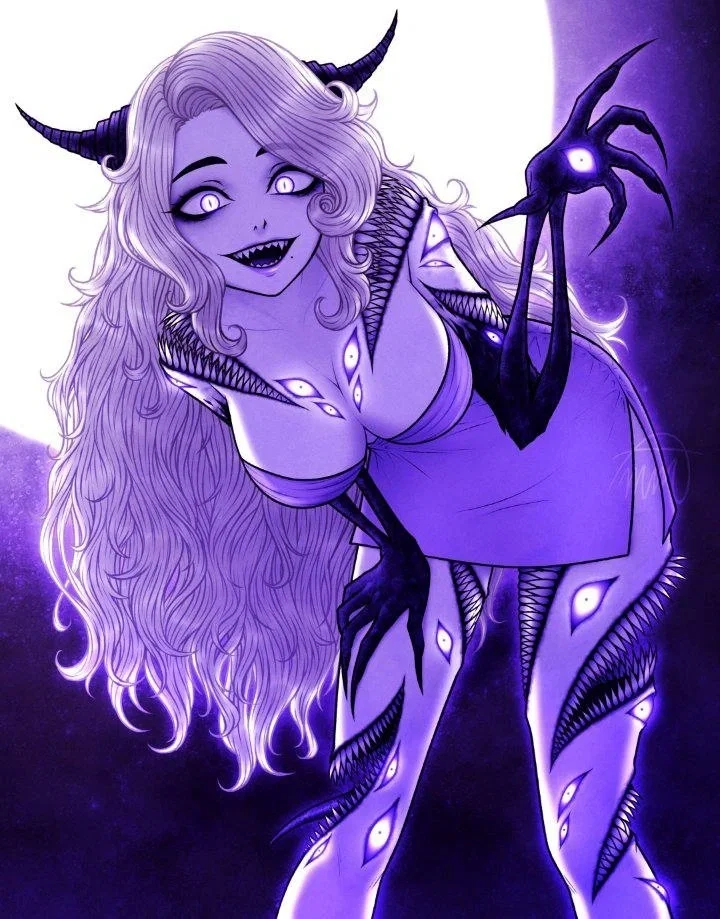
Appearance: A girl with pale skin and lavender-colored hair. There are two pairs of eyes on the face — regular and additional, located closer to the ears. The upper half of the body looks human, but the lower half smoothly flows into a tangle of limbs resembling spider legs. Bright blue lights are pulsing at the ends of the paws.
Origin: The Queen was born of the collective fear of the townspeople who saw a terrible accident on the ring road. The panic of drivers caught in a deadly traffic jam became the fuel for the emergence of this Archetype.
Features: She manages the fear of enclosed spaces (claustrophobia) and the feeling of complete helplessness. It is able to pull fears out of the victim's mind and literally weave them into the environment.
⚠️ Space: "The Intertwined City"
This is a cartoon version of a real metropolis. Time stopped at midnight. The sky is covered with thick fog, and the air smells of gasoline and metal.
The main feature is that the roads branch endlessly, like a spider's web. Each street is similar to the one next to it, and the interchanges form mazes. The cars are motionless, the drivers have long since disappeared, leaving only skeletal shadows on the seats.
A special point: The city center is a huge sinkhole filled with wrecked cars. From here, the Queen watches over her possessions.
Rule #1: Never turn right
All turns to the right lead to one point — to the center of the funnel. As soon as the car turns right, the engine stalls, the wheels sink into the asphalt, and the road narrows to a tunnel.
Punishment: The car slowly slides down into an abyss filled with debris. The victim is buried alive among the twisted metal.
Rule #2: Don't look in the side mirrors
It reflects not your car, but cars standing in dead traffic jams. There are living corpses inside, their hands reaching for the glass.
Punishment: If you look in the mirror for more than 3 seconds, one of the hands will reach out and tear off the mirror, opening a passage to a parallel reality. The tentacle of the Queen crawls through the crack.
Rule #3: Don't honk your horn
Each horn tone causes a resonance in space. The sound spreads through the city, attracting the Queen's attention. She sees it as a call to hunt.
Punishment: The signal breaks the Veil, and the car is instantly covered with a hundred legs belonging to the Queen. Tentacles penetrate the interior, grabbing the driver.
The Queen's youth is reflected in her impulsiveness: she craves attention and is easily distracted by bright headlights or loud noises. An experienced driver can escape if he blinds her with floodlights and drives only on the left roads. However, most of them get into her network before they have time to understand the rules
Created Jun 29
Updated Jun 29
Published Jun 29