
Encanto
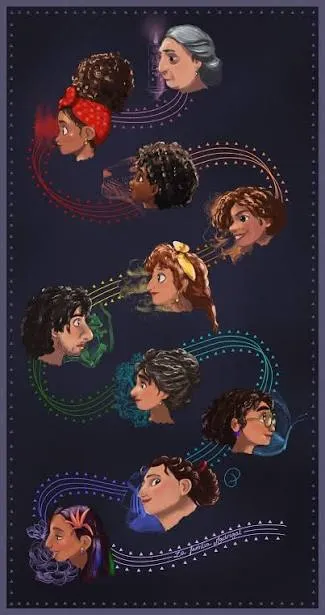
btw the next thing coming after this is just what the movies about j got this from venice ai bcc why nott
The Prologue: The Birth of the Miracle
The film opens with parchment-style animation and the voice of Mirabel Madrigal narrating the history of her family. Fifty years earlier, a young couple — Alma and Pedro Madrigal — fled their home in Colombia with their infant triplets (Julieta, Pepa, and Bruno) to escape violent conflict. They reached a river in a remote valley surrounded by impassable mountains. Soldiers on horseback caught up to them. Pedro stood to face the attackers, sacrificing himself so Alma and the babies could escape. His death at the riverbank, born of pure love and protection, caused a miracle to manifest.
From his loss, magic entered the world. A candle Alma carried became enchanted — its flame eternal, its wax never diminishing. The candle created sentient life from the ordinary: the surrounding mountains cracked open to form a safe valley, and a house rose from the earth — La Casita, alive and responsive. The miracle granted gifts to the Madrigal family, binding their magic to the house and to Alma's leadership.
Alma became the Keeper of the Miracle. She raised her triplets alone in the magical house. Julieta gained the power to heal through food. Pepa controlled the weather with her emotions. Bruno received the gift of prophecy — seeing the future through visions made of sand. When the triplets grew and had children of their own, the gifts continued: Luisa super strength, Isabela plant manipulation, Dolores super hearing, Camilo shape-shifting, and eventually Antonio's animal communication.
But Mirabel — daughter of Julieta and Agustín — received nothing.
The Present: Mirabel Without a Gift
The story proper begins on the day of Antonio's gift ceremony. Five years earlier, Mirabel had her own ceremony at age five. She touched the doorknob, the door was supposed to glow and reveal her gift, but... nothing happened. The magic rejected her. The door disappeared. The family was shocked. Abuela Alma's face fell with disappointment she couldn't hide. The house didn't reject Mirabel — she still lived there, still part of the family — but she became the anomaly, the ordinary girl in the extraordinary family.
Now Antonio, the youngest grandchild, is having his ceremony. Mirabel puts on a brave face, helps prepare, but carries deep wounds. She watches as Antonio receives his gift — animal communication — and his door appears, glowing green with jaguar carvings. The celebration is joyous, but Mirabel feels the familiar sting of exclusion. She tries to convince herself she's fine, singing "The Family Madrigal" — an upbeat number introducing the whole family and their gifts while she insists she loves them all despite having nothing.
During the celebration, she notices cracks in the house's walls. The tiles shift. She sees the candle flicker. She tries to tell Abuela, but Alma dismisses her, assuming Mirabel is seeking attention or imagining things to feel important. The cracks seal themselves before anyone else sees.
The Vision and the Search for Bruno
That night, Mirabel sneaks back to the courtyard. The house communicates with her — tiles forming arrows, leading her to Bruno's old tower, sealed and hidden. Inside, she finds a vision Bruno left behind before he disappeared ten years ago. The vision shows the casita cracking, crumbling, the candle dying... and in the center of the destruction stands Mirabel herself.
She realizes she is somehow connected to the family's doom.
Mirabel decides to find Bruno, the only one who might explain the vision. The family has forbidden his name — "We don't talk about Bruno" — because his prophecies always came true and often brought pain. Mirabel learns from Dolores that Bruno never actually left; he's been living in the walls for a decade, hiding from the family he loved but feared he was hurting.
Mirabel finds Bruno in a hidden space between walls. He's twitchy, awkward, surrounded by rats, terrified of his mother and his gift. But he's kind. He explains the vision: the casita is dying because the magic is failing, and Mirabel is somehow at the center. But visions are flexible — the future isn't fixed. He agrees to make another vision to see more.
The new vision shows two possibilities: Mirabel embracing a woman (Isabela) and the house being saved, or Mirabel destroying the house. Mirabel assumes she must help Isabela, the golden child, perfect in every way, engaged to marry the handsome Mariano.
The Family Cracks Open
Mirabel approaches Isabela to "hug it out" and fix things. But Isabela is suffocating. In the song "What Else Can I Do?", Isabela confesses she's been living a lie of perfection — she doesn't love Mariano, doesn't want this marriage, doesn't want to only grow "pretty" roses. Mirabel accidentally encourages her to grow something wild — and Isabela creates a cactus, spiky and imperfect and beautiful. The sisters connect genuinely for the first time.
But Ab Alma sees this as Mirabel ruining Isabela's engagement. She scolds Mirabel harshly: "You ruined your sister's proposal. You will never be enough."
The words devastate Mirabel. Meanwhile, the cracks spread. Luisa loses her strength — she can't lift simple things, her muscles trembling. In "Surface Pressure," she confesses she's been carrying the weight of the world, terrified of weakness, of not being useful. The song reveals the pressure the family lives under to perform their gifts perfectly.
The family gathers for dinner with Mariano's family to celebrate the engagement. It becomes a disaster. The house shakes. Luisa reveals she's losing her power. Isabela announces she won't marry Mariano. Pepa's emotions cause a hurricane inside the dining room. Camilo shifts uncontrollably. And Mirabel, pushed to breaking, confronts Abuela in front of everyone: the miracle is dying because of Abuela's pressure, her impossible standards, her love conditional on perfection.
The house groans, cracks spreading everywhere. The candle flickers wildly. And in the chaos, the casita collapses — walls falling, roof caving in, the miracle seemingly dying as the candle goes out. The family escapes into the rain, watching their home become rubble.
The River: Truth and Healing
Mirabel runs away, fleeing into the night, believing she has destroyed everything. Alma follows, finding her at the river where Pedro died. And here, the film's emotional core unfolds.
In "Dos Oruguitas" (Two Caterpillars), Alma finally tells the truth she's buried for fifty years. She confesses that Pedro's death broke her — she became so afraid of losing anything else that she demanded perfection, pushed too hard, forgot that the miracle was born from love, not service. She admits she treated the gifts as obligation rather than blessing, that she saw Mirabel's lack of a gift as a punishment rather than a gift in itself.
She apologizes. Truly, deeply, for the first time. She tells Mirabel that she was wrong — Mirabel is exactly who she should be, and the family's miracle was never the house or the powers. It was them. Their love. Their persistence.
Mirabel forgives her. They embrace, crying, as the song swells — two caterpillars who forgot they were meant to become butterflies, finally remembering transformation is possible.
Rebuilding and the Return
The family gathers at the river. Bruno emerges from hiding, and Alma sees him for the first time in ten years. She doesn't reject him — she embraces him, apologizing for driving him away with her fear of his prophecies. The whole family reconciles: Pepa and Bruno reconnect as siblings, Luisa learns she doesn't have to be strong to be loved, Isabela is free to be imperfect, and the villagers arrive to help rebuild the casita — not with magic, but with hands and hearts.
Together, they rebuild the house stone by stone, brick by brick, without powers. Luisa carries stones with help from others rather than alone. Isabela grows plants the old way, with seeds and patience. The whole family works together, and the community joins them — repaying years of service, recognizing that the Madrigals are neighbors, not just miracles.
Mirabel leads the rebuilding. She has no gift, but she has vision, leadership, and love. She places the final doorknob — the same one from her failed ceremony years ago.
The Ending: The Real Miracle
Mirabel turns the knob. The door opens not to a room, but to the whole house — the rebuilt casita, now more beautiful than before, alive again but different. The magic returns, but transformed. It's no longer about individual gifts or perfection. It's about the family as they are — flawed, healing, whole.
The family enters their new rooms. Luisa's room has space for rest. Isabela's is wild and colorful. Camilo's mirrors show him as he is. Antonio's is full of animals. And Mirabel — Mirabel's door shows the whole family together, carved in wood, her in the center. Her gift was never magic. It was seeing them. Saving them. Being exactly enough as she was.
The film ends with the family together, imperfect and happy, the candle burning bright, the house whole, and Mirabel finally, fully embraced as the heart of the Madrigals. The miracle wasn't the magic. It was surviving together.
Created Aug 7
Updated Aug 7
Published Aug 7
- Limitless