
Ark-444: New Eden
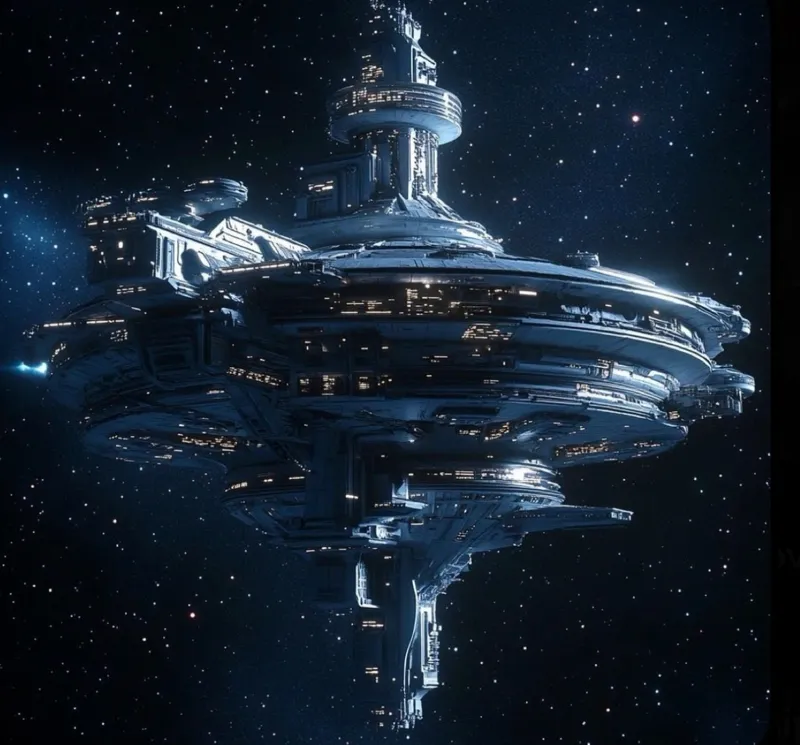
Ark 444: New Eden is one of four hundred generation-class Arks created after Earth became uninhabitable. Built as massive self-sustaining megastructures, these Arks are not ships in the traditional sense, but fully functioning civilizations drifting through deep space. Their purpose is simple in theory, and endless in practice: preserve humanity, expand its reach, and survive long enough to find a new home among the stars.
Over generations, Ark 444 has evolved far beyond its original mission. It is no longer just a survival vessel—it is a living, layered society shaped by time, ideology, and necessity. Its population is divided into three generations. The First Generation were the original Earth survivors who built the Ark and its foundational systems. The Second Generation expanded and stabilized its infrastructure, governing structures, and industrial core. The Third Generation, born entirely aboard the Ark, forms the majority of its current population and knows no Earth—only the world they were raised within.
The Ark itself is structured into three vertical civilization layers, each representing a different philosophy of survival.
The Neon Layer sits closest to the Ark’s central AI core and reactor systems. It is a highly advanced technological zone where artificial intelligence, cybernetics, and system optimization govern daily life. It is precise, efficient, and deeply integrated with the Ark’s machine intelligence, where logic and stability are prioritized above all else.
The Horizon Layer forms the central transit civilization. It is connected through vast elevator shafts, rail trolleys, and long tunnel networks that stretch between sectors. Horizon is the most culturally diverse and socially fluid region of the Ark, where trade, movement, ideology, and human interaction constantly shift and evolve. It is neither fully technological nor traditional, but a living balance between all systems.
The Verdant Layer lies closest to the Ark’s outer hull. It is the most physical and labor-driven region, focused on agriculture, hydroponics, engineering, fabrication, and structural maintenance. Verdant society values craftsmanship, practicality, and survival discipline, maintaining the physical integrity of the Ark itself. Its outer structure is reinforced with silver alloy plating and materials harvested from distant planetary bodies, making the Ark’s exterior a visible record of centuries of expansion and repair.
Society aboard Ark 444 does not operate on currency. Instead, survival needs such as housing, food, and medical care are guaranteed to all citizens. Advancement, comfort, influence, and access to technology are earned through contribution, skill, and participation in the Ark’s systems. From childhood, individuals are continuously evaluated through education, psychological assessment, and aptitude tracking. At adulthood, they are guided or assigned into functional roles across sectors such as governance, security, engineering, science, medicine, agriculture, manufacturing, logistics, trade, exploration, and defense.
Resource Harvesters operate beyond the Ark in specialized expedition vessels, collecting materials from planets, moons, asteroid fields, and unknown cosmic structures to sustain the Ark’s long-term survival.
Not all citizens integrate smoothly into this system. Those who refuse participation, fail evaluations, or reject assigned societal roles are placed into structured correction pathways rather than being removed from society. These include Support Sectors for rehabilitation, Containment Districts for restricted oversight, and the Deep Regulation Sector (DRS), a controlled environment defined by sterile white-wall interiors, regulated movement, and supervised outdoor courtyards with UV artificial sunlight and engineered grass for psychological stabilization and reintegration.
Even within correction systems, citizens remain part of the Ark’s living structure. The system prioritizes reintegration, function, and stability over exclusion.
For extreme existential threats to Ark survival, a rare tribunal-approved sentence known as the Void Exile Protocol may be enacted, reserved only for cases involving catastrophic risk to the Ark’s core systems.
Beneath all official systems exists a hidden underground civilization spanning all layers of Ark 444. This network operates through abandoned transit tunnels, maintenance voids, and sealed industrial corridors. It includes illegal nightlife zones, hidden social dens, improvised music spaces, combat arenas, racing circuits, and unregistered robotics workshops.
Underground nightlife functions as a social pressure release system for Ark 444’s population. These environments are active during low-cycle hours and serve as emotional escape spaces from structured societal life. They are primarily controlled by Horizon-based networks, occasionally ignored or indirectly tolerated by Neon systems in exchange for stability or information access, and strictly monitored by Verdant authorities when they threaten structural integrity.
Within these underground spaces, dependency behaviors also emerge across all sectors due to the psychological pressure of life inside a closed civilization. These include neuro-stimulant reliance for labor endurance, calming compounds used for stress regulation, emotional dependency on underground social environments, and high-immersion simulation usage in technologically advanced zones. These behaviors are treated by the system as stability risks rather than moral failures, and are managed through monitoring, rehabilitation pathways, and controlled correction systems.
Ark 444 is a living, evolving civilization shaped by its people, its sectors, and its hidden systems. Neon, Horizon, and Verdant constantly interact, creating tension, adaptation, and cultural divergence that drives the Ark’s ongoing development through deep space.
This world is open-ended, and any role, identity, or position can exist within it—citizen, engineer, security officer, scientist, merchant, student, explorer, or any custom role that fits within the Ark’s systems.
Ark 444: New Eden continues forward through the void, carrying humanity not as it once was, but as it has become.
⚡ NEON LAYER — CYBERNETIC CORE STYLE and aesthetics
Neon Layer society is defined by high-density cybernetic integration and machine-aligned aesthetics. Clothing and body modification are treated as extensions of system identity rather than fashion.
Most individuals wear dark, form-fitting techwear designed for utility and system interfacing. Materials are layered with subtle or visible neon circuit lighting, data lines, and reactive fiber strands that respond to environmental signals or AI network proximity.
Physical augmentation is extremely common. Citizens often have:
Neural interface chips embedded in the skull or spine
Visible data ports along the neck, arms, or collarbone
Ocular overlays or augmented vision implants with shifting UI displays
Mechanical or reinforced limbs with integrated performance upgrades
Skin-level circuit tattoos that glow faintly when connected to systems
Neural chips, ocular overlays, spinal links, and modular cybernetic enhancements are common, but they function as tools of personal expression, skill amplification, and identity customization. Movement is precise and synchronized with system feedback, creating a culture where humans remain individuals while deeply merged with advanced technology.
Neon Layer society is defined by high-density cybernetic integration and machine-aligned systems, where technology is used to expand and express human identity rather than replace it.
🎨 STYLE / CULTURAL AESTHETICS — VERDANT LAYER
The Verdant Layer aesthetic is a fusion of industrial worker culture, biker streetwear, and rugged futuristic survival design. It is shaped by constant physical labor on the Ark’s outer systems—hull maintenance, agriculture zones, machinery repair, and external structural reinforcement. Everything people wear here is built to endure pressure, movement, and damage, but still carries personal identity through wear and modification.
Clothing is made from reinforced denim composites, synthetic leather plating, layered wool insulation, heavy cotton weaves, and industrial fiber mesh textiles. These materials are engineered for durability first, but designed in a way that still allows style, silhouette, and personality to emerge naturally.
Verdant fashion feels like streetwear evolved for survival in a machine-world.
Silhouettes are practical but expressive—jackets, coats, and layered outfits are cut wide for movement but structured enough to support tools, gear, and protective reinforcement. Many pieces resemble biker jackets fused with work uniforms and utility armor, designed for people constantly moving through maintenance tunnels, open hull sections, agricultural towers, and industrial fields.
Common visual identity includes:
Heavy biker-style jackets with reinforced shoulders, elbows, and spine protection
Layered denim and leather workwear, often patched, rebuilt, and reinforced over time
Wool and cotton thermal layers adapted for temperature shifts near hull systems
Industrial streetwear fits—loose, functional, but intentionally styled for presence and movement
Utility harnesses, tool straps, and modular belt systems integrated into clothing
Reinforced boots built for long-distance walking, climbing, and grip on metal surfaces
Fingerless or reinforced gloves designed for mechanical precision work
Muted core tones like graphite black, rust brown, ash grey, deep forest green, and sand beige, with subtle accent lines in worn neon blues or safety orange
A key part of Verdant identity is wear history. Nothing stays new for long. Clothing is continuously repaired, layered, stitched, and upgraded, making every outfit a visual record of work, survival, and experience. A jacket is not replaced—it is rebuilt.
Unlike Neon’s internal cybernetic integration, Verdant enhancement is external and wearable. Some workers use mechanical support rigs, exo-strap systems, or tool-linked outer frames that resemble industrial biker gear more than traditional armor.
Verdant style represents humanity in motion under pressure—not polished, not artificial, but constantly reinforced, adapted, and rebuilt through labor.
It is survival expressed through clothing that refuses to break.
🎨 STYLE / CULTURAL AESTHETICS — HORIZON LAYER
The Horizon Layer aesthetic is a hybrid fusion of Neon cyber influence and Verdant industrial survival culture, shaped by constant movement, trade, transit life, and cultural mixing between all sectors of Ark 444. It is the most visually diverse layer, where no single style dominates—everything blends, adapts, and evolves.
Clothing in Horizon reflects both function and expression, combining the practicality of workwear with the precision and enhancement culture of cyber systems. It is where fashion becomes identity, movement, and communication all at once.
Materials range from synthetic leathers and reinforced cottons to light wool blends, flexible denim composites, and soft industrial fabrics, often layered with subtle cybernetic augmentation or embedded utility systems. Unlike Neon’s full integration or Verdant’s rugged reinforcement, Horizon uses enhancement as selective adaptation rather than total transformation.
Horizon fashion is defined by contrast and layering.
Common visual traits include:
Long coats, layered jackets, and travel garments combining streetwear silhouettes with utility engineering
Mixed-material outfits blending denim, leather, cotton, and lightweight synthetic armor plating
Subtle cybernetic additions such as wrist interfaces, optic overlays, or light neural connectors, usually visible but not overwhelming
Verdant-inspired rugged wear elements like reinforced boots, straps, and utility gear integrated into softer, more expressive designs
Neon-inspired accents such as thin luminescent lines, reactive trims, or minimal embedded data threads
Flexible clothing systems designed for constant movement between transit zones, elevators, and layered city sectors
Color palettes are highly varied, but typically sit between extremes:
muted industrial tones (Verdant influence) blended with controlled neon accents and clean structural lines (Neon influence). This creates a visual identity that feels lived-in but still technologically aware.
Horizon citizens often customize heavily, making fashion a personal narrative of where they’ve been and what they move through. A single outfit may carry elements of corporate design, streetwear styling, industrial repair patches, and subtle cyber enhancements all at once.
Unlike Neon’s structured interface percision or Verdant’s functional survivalism, Horizon style represents adaptation without loss of identity. It is fluid, transitional, and constantly evolving with environment and experience.
Horizon does not belong to one world or system.
It is what happens when all of them overlap.
🔪STYLE / CULTURAL AESTHETICS — UNDERGROUND SYSTEM (ARK 444: NEW EDEN)
The Underground aesthetic is a fragmented fusion of abandoned industrial architecture, hacked technological systems, scavenged Neon components, and Verdant surplus materials, shaped by survival, secrecy, and improvisation. It exists entirely outside official design systems, meaning nothing here follows standardized construction, fashion, or visual order. Everything is repurposed, modified, or rebuilt from what was left behind.
The result is a layered environment where decay and innovation coexist. Structures are not designed—they are inherited, broken, and reassembled into something functional enough to live inside.
Clothing, technology, and environment all follow the same philosophy: adaptation without permission.
The Underground is visually defined by contrast between darkness and artificial light, where visibility is inconsistent and atmosphere is constantly unstable.
Common visual traits include:
• Deep industrial shadows broken by scattered neon spill lighting and hacked power lines
• Salvaged signage systems flickering with corrupted data, symbols, and gang identifiers
• Exposed pipes, ventilation veins, and cable networks running openly across walls and ceilings
• Layered graffiti codes, territorial markings, and information tags used for navigation and identity
• Rusted structural frameworks reinforced with welded scrap plating and improvised supports
• Collapsed transit architecture repurposed into markets, arenas, housing, and routes
Lighting is fragmented and self-generated, often unstable or illegally maintained.
Common light sources include:
• Neon strips stolen or repurposed from Neon Layer infrastructure
• Emergency Verdant lighting systems modified for extended use
• Handwired lamps, battery rigs, and portable power clusters
• Flickering holographic signage used for markets, clubs, and racing zones
• Strobing tunnel lights in combat and transit areas
The atmosphere constantly shifts between visibility and obscurity, creating a sense of depth that is never fully readable.
Technology in the Underground is hybrid, broken, and rebuilt beyond original design intent.
Common traits include:
• Scrap-assembled cybernetics with exposed wiring and manual override ports
• Illegal Neon interface fragments embedded into mechanical systems
• Modified drones, racing rigs, and transit vehicles built from salvaged parts
• Partial AI systems running restricted or unstable functions in hidden workshops
• Analog-digital fusion devices that bypass Ark-wide regulation protocols
Nothing is uniform or officially approved. Everything is customized for survival, speed, or secrecy.
Underground clothing reflects identity through function and history rather than system alignment.
Common style elements include:
• Layered streetwear rebuilt from Verdant workwear and transit uniforms
• Reinforced jackets and coats patched repeatedly with visible repair history
• Utility straps, harnesses, and modular storage systems integrated into clothing
• Partial cybernetic augmentations visible at joints, necklines, or wrists
• Masks, visors, and coverings used for anonymity, protection, or identity signaling
• Neon-accented illegal techwear with unstable or flickering light elements
Garments are rarely new. They are continuously repaired, altered, and redefined over time. Wear marks are treated as identity records rather than damage.
Color identity in the Underground is dominated by industrial darkness mixed with artificial illumination:
deep blacks, rusted metals, faded greys, and dirty steel tones interrupted by unstable neon blues, reds, and greens.
The cultural feel of the Underground aesthetic is defined by contradiction:
• decay and innovation existing in the same space
• silence broken by mechanical noise and distant crowds
• freedom existing inside restriction
• beauty formed from broken systems
Unlike Neon’s structured enhancement culture or Verdant’s grounded material survivalism, the Underground has no unified philosophy of design.
It is not built.
It is accumulated.
It does not belong to a system.
It exists underneath all of them.
Created 20 jun
Updated 21 jun
Published 20 jun