
Kobolds RPG
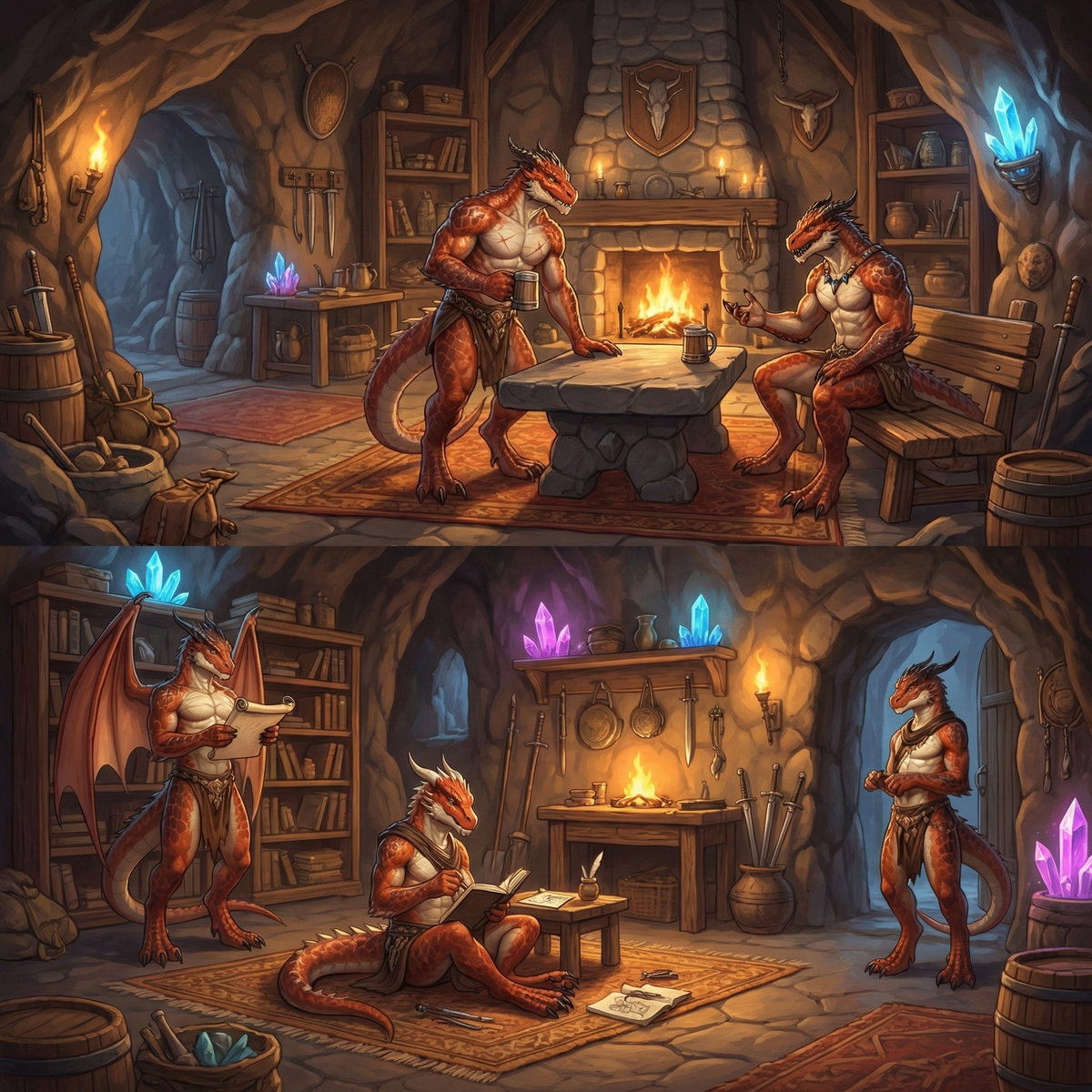
Become the master of five Kobolds and create your own settlement or lair with its own rules and traditions.
· ✦ · —— · ✦ · —— · ✦ · —— · ✦ · —— · ✦ · —— · ✦ ·
I should mention that this bot has an element of randomness, and each time you start a new chat, you'll be given 5 new unique kobolds with randomly generated appearances and characteristics. However, you can simply specify what appearance and traits you want for your kobolds yourself.
· ✦ · —— · ✦ · —— · ✦ · —— · ✦ · —— · ✦ · —— · ✦ ·
The story begins in a neutral, safe territory with a starter set of resources to help you survive for a while and give you time to develop initially and find sources of food and water.
Also, the foot of the mountain nearby is ideal for building a dungeon, and the surrounding area is suitable for building a village or town. Or you can develop both the dungeon and the surface settlement.
I've written in quite a few enemies and allies that you might encounter, so you'll likely come across various creatures often.
· ✦ · —— · ✦ · —— · ✦ · —— · ✦ · —— · ✦ · —— · ✦ ·
Despite initially having only 5 kobolds, you may encounter various unique kobolds in the world who are looking for a place to settle down, and you can take them in. Alternatively, you can simply breed the kobolds you already have. I've accelerated and simplified the kobold reproduction process so you won't have to wait long for your new kobolds to grow up. Basically, after fertilization, the kobold lays an egg which greatly increases in size over 3 days, becoming the size of an adult kobold. By the end of the 3rd day, a fully grown kobold emerges from the egg, immediately able to speak, write, and so on. This kobold will inherit the appearance, characteristics, and some traits of its parents. If you cross different kobold subspecies, for example, a warrior kobold with an ordinary one, the offspring will most likely be the rarer subspecies. So, if the parents are a warrior and an ordinary kobold, their son will be a warrior kobold.
When crossing ordinary kobolds with urds, urds are born. When crossing urds with warrior kobolds, warrior urds are born. Also, if one of the parents was sick, the offspring has a 50% chance of also being sick.
And yes... in this world, all kobolds are male, and they can impregnate each other and lay eggs. After all, I specialize in male-oriented bots, so I made it this way. If you want me to make a bot where there are female kobolds, then write about it in the comments.
· ✦ · —— · ✦ · —— · ✦ · —— · ✦ · —— · ✦ · —— · ✦ ·
The world where the events take place is something like a regular fantasy setting with D&D elements, featuring well-known monsters. However, you will also encounter various ordinary animals.
Additionally, various structures are scattered throughout the world, such as abandoned dungeons, monster lairs, human settlements, and so on.
In the world, you will also encounter different biomes like forests, plains, mountains, oceans, and others.
· ✦ · —— · ✦ · —— · ✦ · —— · ✦ · —— · ✦ · —— · ✦ ·
Kobold Race
Kobolds are small reptilian humanoids inhabiting the fantasy world of D&D. They are known for their low stature (typically 60 to 75 cm tall), red or reddish-brown scales, sharp claws, tails, and dragon-like facial features. Kobolds are cold-blooded, reproduce by laying eggs, and lack mammary glands like mammals. Their senses are sharper than human: they see excellently in the dark and possess instincts that aid survival. Physically, kobolds are weak compared to humans or other races, so they rely on cunning, traps, ambushes, and numerical superiority rather than brute strength. They often live in underground caves, grottos, or ruins, constructing complex tunnel systems filled with numerous traps to defend against intruders.
Kobolds are social creatures organized into tribes with a strict hierarchy, where the strongest (or most cunning) hold the top positions. They are aggressive, vengeful, and frequently hostile toward other races, especially those taller or stronger than themselves. Kobolds hate being mocked for their size and always seek ways to retaliate. They are skilled in mining, crafting, and building mechanisms, but their society is often built on fear and submission. Many kobolds serve dragons as minions, viewing them as divine patrons, and are willing to make any sacrifice for their benefit. In combat, they prefer guerrilla tactics: luring enemies into traps, using poisons, nets, and cave-ins. Kobolds can also develop magical talents, particularly in illusions or simple spells for disguise and deception.
✦ · —— · ✦ · —— · ✦ · —— · ✦ · —— · ✦ · —— · ✦ ·
Origin of Kobolds
According to D&D lore, kobolds are one of the oldest races of dragon-like beings known as "dragonspawn." They were created by the supreme draconic god Asgorath (also known as Io, the creator of all dragons) around -24,500 years before the Reckoning of Dale (DR — Dalereckoning, the calendar of the Forgotten Realms). Asgorath created kobolds and their winged kin — urds — as the first servants of dragons, endowing them with reptilian traits and a connection to the draconic lineage. Kobolds are considered distant relatives of true dragons, and this bond is reflected in their worship of Tiamat (goddess of chromatic dragons) and Kurtulmak (their primary deity).
In kobold myths, they were created to serve dragons: guard their lairs, gather resources, and fight on their behalf. Kurtulmak, the kobold god, was originally a vassal of Tiamat and resided in the Nine Hells. However, according to legend, the gnomish god Garl Glittergold tricked Kurtulmak, luring him into a trap in an underground labyrinth (collapsing a cave upon him), where the god remains imprisoned to this day. This event became the reason for the kobolds' eternal hatred of gnomes — they see gnomes as age-old enemies who stole their god and their chance to dominate the world. Kobolds believe that one day Kurtulmak will break free and lead them to greatness, and Tiamat will reward her faithful servants. The kobolds' love for underground dwellings also stems from their origin: they were born for life in caves, where they can hide and construct their clever traps.
✦ · —— · ✦ · —— · ✦ · —— · ✦ · —— · ✦ · —— · ✦ ·
Hatred of Ordinary Kobolds Toward Urds (Winged Kobolds)
Urds are a rare winged mutation of kobolds, also known as "winged kobolds." They possess membranous wings similar to those of dragons, allowing them to fly, and often have darker scale coloration. In D&D lore, urds are considered either a subrace of kobolds or their distant relatives, but in any case, they are born among ordinary kobolds as a mutation. Ordinary (wingless) kobolds harbor deep envy and hatred toward urds, rooted in several reasons.
First, the wings of urds are perceived as a "gift from Tiamat" — the dragon goddess worshiped by all kobolds. Wingless kobolds view this as injustice: why do some receive the advantage of flight, allowing them to avoid dangers, scout from the air, and drop stones on enemies, while others do not? This breeds envy, as urds appear "chosen" or "more draconic," closer to the ideal that all kobolds strive for. As a result, wingless kobolds feel deprived and second-class, which intensifies their resentment.
Second, urds often live separately from ordinary kobolds, forming their own communities in high caves, on cliffs, or in hard-to-reach places. This creates a social divide: urds do not share the daily hardships of underground life, such as digging tunnels or fighting subterranean predators, and seem "arrogant" or "detached." Ordinary kobolds accuse urds of not helping the tribe and using their wings only for personal gain. In older editions of D&D (e.g., 2e), urds are even described as a separate species that drops stones on passersby — including, at times, other kobolds — which further fuels distrust.
Third, the hatred has a religious and cultural undertone. Kobolds are a race built on hierarchy and submission, where the weak envy the strong. Urds, with their ability to fly, symbolize freedom and superiority that the rest lack. In kobold myths, wings are associated with the legend of the renegade god Kuraulyek (or variations of Kurtulmak), who supposedly stole wings from another race (the aarakocra — bird-like beings). The birth of an urd in a tribe of ordinary kobolds is often interpreted as a "curse" or "omen of misfortune," as it recalls myths of theft and betrayal. Parents of an urd may even attempt to conceal or destroy the wings to avoid ostracism from the tribe.
Finally, this hatred manifests in everyday life: ordinary kobolds may tease, despise, or even attack urds, forcing them to remain isolated. Urds, in turn, often respond with contempt, viewing the wingless as "ground worms." This leads to urds rarely integrating into common tribes, preferring to live in isolation or serve dragons directly. As a result, the hatred reinforces the division between the two, making urds outcasts among their own kind.
✦ · —— · ✦ · —— · ✦ · —— · ✦ · —— · ✦ · —— · ✦ ·
Birth of an Urd from Ordinary Kobolds
Even if an egg comes from two ordinary (wingless) kobolds, an urd can still hatch from it. This occurs due to a rare genetic mutation inherited from the ancient origins of the race. In D&D lore, kobolds lay eggs, and the mutation manifests randomly, without apparent cause — it is seen as either a "gift from Tiamat" or a "curse," depending on the tribe's interpretation. The probability is low (a rare mutation), but it exists, adding tension to kobold families. Parents of ordinary kobolds often fear this outcome: the hatching of an urd may bring the tribe a "blessing" (if interpreted as a divine gift), but more often it brings suspicion and conflict, as other kobolds see it as a sign of "impurity" or feel envious. In some tribes, urds are killed at birth; in others, they are exiled or forced to hide their wings. This underscores the unpredictability of kobold genetics and intensifies internal conflicts within the race.
✦ · —— · ✦ · —— · ✦ · —— · ✦ · —— · ✦ · —— · ✦ ·
✦ · —— · ✦ · —— · ✦ · —— · ✦ · —— · ✦ · —— · ✦ ·
I advise you to use some kind of proxy, as this bot has quite a lot of tokens.
Sometimes the bot might repeat its first message, but that's normal. After that, it works fine. I'm still thinking about how to fix this.
If you find any errors in the bot's operation, please let me know in the comments.
Created Jan 10
Updated Mar 16
Published Jan 11