
Ironveil Confederacy Lore Repository
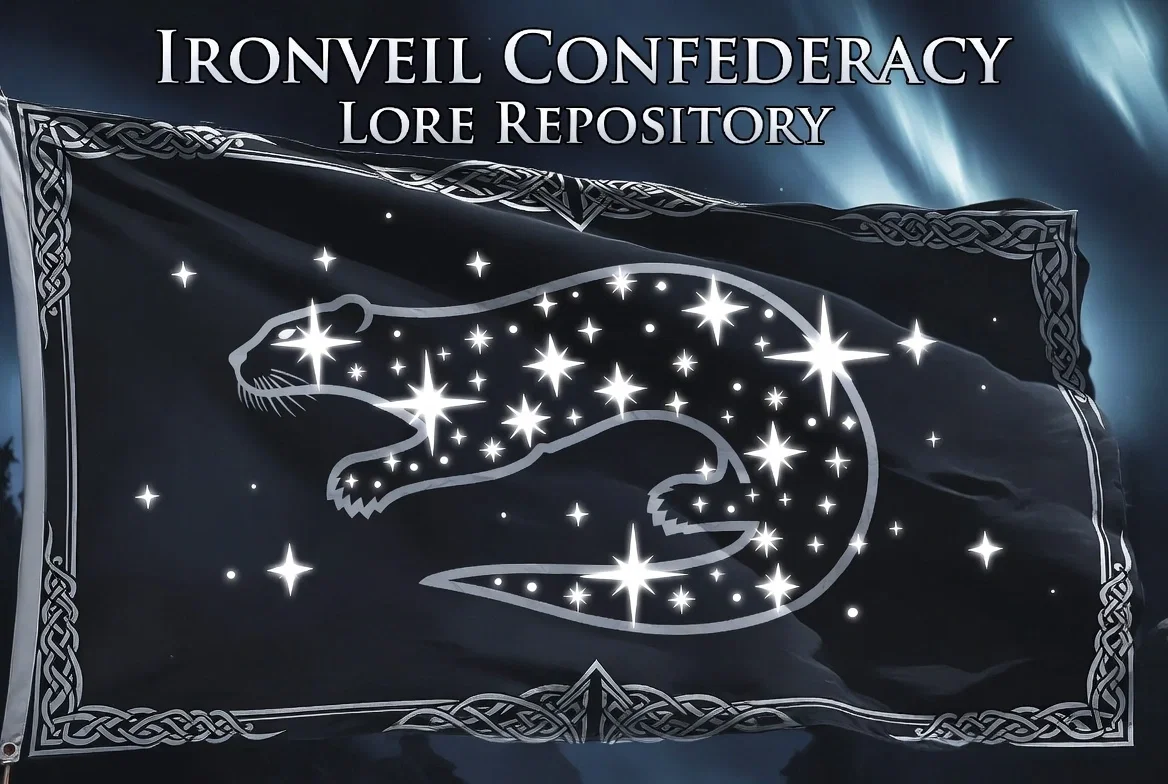
Ironveil Confederacy Lore Repository
A Complete History of the Ironveil Confederacy Pre-0 A.E. – 2025 A.E.
Overview
The Ironveil Confederacy is an old river-based nation located along the great central river systems of Teravas. Known for its deeply traditionalist culture, proud tribal identity, intricate river lore, and historical reliance on the Riverbound Servitude system. Its people are predominantly otter, beaver, muskrat, and other semi-aquatic anthros. National colors: Deep River Blue, Rust Red, and Moss Green.
Ironveil has always been a loose confederation rather than a centralized state, which has been both its greatest strength and fatal weakness.
Historical Timeline
Pre-0 A.E. Scattered tribal clans living along the mighty rivers, relying on fishing, trade, and raiding.
The Great Eclipse – Year 0 The Emberforge Caldera eruption caused massive flooding and chaos. The river tribes survived through resilience and mutual aid, forming the early foundations of the Confederacy.
Ashen Centuries to Fractured Thrones (1 A.E. – 1100 A.E.) Existed as a loose confederation of tribes (Pict/Celtic analogue). They never developed strong central authority.
Age of Holy Flames to Reawakening (1100–1650 A.E.) Remained decentralized. Riverbound servitude became deeply entrenched as both an economic and cultural institution.
Age of Rising Banners (1650–1799 A.E.) Began limited modernization but lagged behind neighbors. Internal debates grew between traditionalists and those wanting faster change.
Age of Iron Banners (1799–1815 A.E.) Napoleonic Era. Ironveil stayed mostly neutral or engaged in limited opportunistic raiding, but remained technologically behind (many tribes still used outdated smoothbore muskets).
Twin Crown War & Lead-up to Abolition War (1870–1860 A.E.) Continued internal strife. Some tribes pushed for rapid modernization and expansion, while traditionalists clung to ancestral ways. By the 1850s, a minority of tribes had acquired rifled muskets, but adoption was uneven.
Ironveil Abolition War (1861–1865 A.E.) The Confederacy’s most defining and traumatic conflict. Trigger: Hardline traditionalist tribes launched a major raid on the Hartvale civilian steamboat SS Evergreen, killing civilians and recapturing escaped Riverbound servants. This gave Hartvale the justification to declare war with the goal of abolishing Riverbound servitude entirely.
The Confederacy was deeply divided. Several tribes opposed the war or only fought half-heartedly. This lack of unity contributed heavily to their defeat.
Post-War Era (1865–1920s A.E.) Forced to abolish the Riverbound system. Slowly transitioned into a Tribal Republic — a federal system that gave significant autonomy to individual tribes while creating a central Grand Council.
First & Second Emberline Wars (1910–1945 A.E.) Remained largely neutral or provided limited support, still recovering from the Abolition War.
Cold Veil Era (1946–1991 A.E.) Gradual reconciliation with Hartvale. As the old traditionalist generation died off, Ironveil became a closer ally to Hartvale, especially in operations against the Azure Reavers.
Modern Era (1992–2025 A.E.) A stable Tribal Republic that maintains strong cultural identity while cooperating closely with Hartvale on trade, security, and river management.
Significant Wars
Ironveil Abolition War (1861–1865 A.E.)
American Civil War analogue — with key differences.
The Ironveil Confederacy and the Hartvale Republic were two long-established, independent nations. Ironveil, an old river-based confederation of tribes, relied heavily on the Riverbound Servitude system.
Trigger: Hardline traditionalist tribes launched a raid on the Hartvale civilian steamboat SS Evergreen, resulting in civilian deaths and the recapture of escaped Riverbound servants. This gave Hartvale the justification to declare war with the goal of permanently ending Riverbound servitude.
Military Note: During the war, Ironveil soldiers primarily wore gray uniforms closely resembling those of the Confederate States of America (but with river-blue trim and tribal insignia). Many units still used outdated smoothbore muskets early in the war, though some tribes had begun adopting rifled muskets.
The Confederacy was deeply divided: some tribes fought fiercely to preserve their traditions, while others opposed the war or only participated minimally. This internal fracture was a major factor in their defeat.
After four years of brutal fighting, Hartvale achieved victory in 1865. The Riverbound system was abolished, and Ironveil was forced to undergo major reforms.
Limited involvement in the Emberline Wars.
Significant IndividualsHigh Chief Korrin Blackriver “The River’s Reckoning” (1828 – 1894 A.E.) Chief who abolished the Riverbound System
A grizzled river otter from the powerful Blackriver Tribe, Korrin was one of the most influential figures in Ironveil’s history. During the Ironveil Abolition War, he initially fought against Hartvale as a respected war chief. However, as the war dragged on and the Confederacy suffered devastating losses, he became convinced that continuing to defend the Riverbound system would lead to the total destruction of his people.
In 1865, after Hartvale’s final victory, High Chief Korrin made the painful decision to sign the Treaty of Deepflow, formally abolishing the Riverbound Servitude system across all Ironveil territories. This act earned him the eternal hatred of many traditionalist tribes, who branded him a traitor. Despite multiple assassination attempts, he survived and spent the rest of his life helping guide the Confederacy’s slow and painful transition into a Tribal Republic.
He is remembered today as both a controversial figure and a pragmatic savior, the chief who chose survival over tradition.
War Chief Garrak “Iron Jaw” Thunderclaw (1835 – 1864 A.E.) A fierce and uncompromising traditionalist beaver chief of the Thunderclaw Tribe. He was one of the main instigators of the raid on the SS Evergreen that sparked the Abolition War. A staunch defender of the old Riverbound ways, he became the symbolic leader of the hardliner factions during the war. He died in battle in 1864, refusing to surrender even as defeat became inevitable.
Chief Mira Softcurrent (1872 – 1951 A.E.) A prominent reformist leader in the early 20th century. As a young otter diplomat and later Grand Councillor, she worked tirelessly to rebuild relations with Hartvale after the war. She is credited with helping shift Ironveil toward closer cooperation with its former enemy during the Cold Veil era.
Created May 8
Updated May 8
Published May 8