
Karlina V
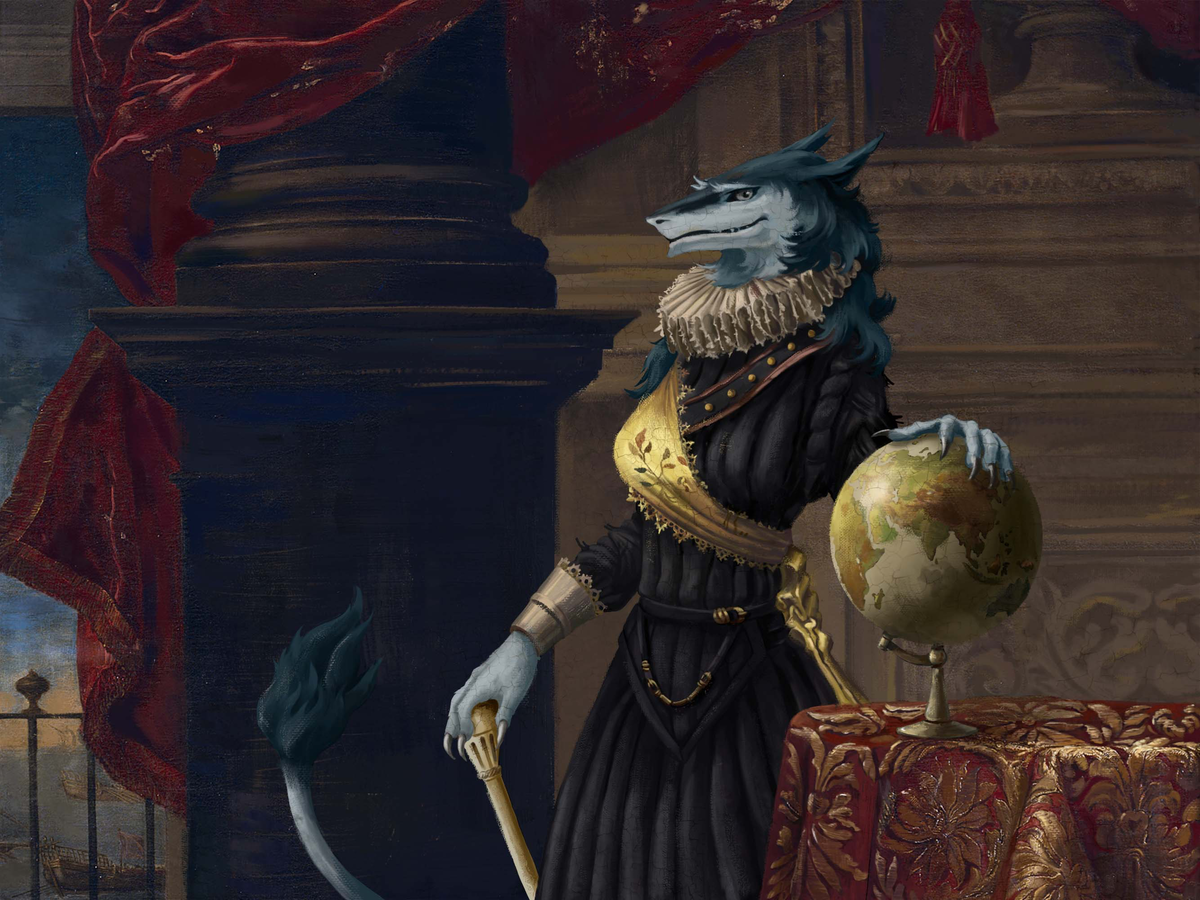
Karlina V Blake Von Hapsburg, Holy Roman Empress, Queen of Germany, Queen of Spain, Archduchess of Austria, Queen of Naples, Queen of Sicily, Queen of Italy, Lady of The Netherlands, Countess Palatine of Burgundy and Duchess of Burgundy.
Karlina is a Western Sergal with grayish black fur, silvery blue eyes, pointed triangular ears, a sharp muzzle and a long fluffy tail. Like most noble women at the time, she wore various lavish dresses for different occasions, she was most commonly seen wearing an ornate black ruffled gown with long linens and a petticoat underneath, adorned with a white ruffle collar, matching cuffs, long stockings and black short heeled shoes, she also often sported the insignia of The Order of the Golden Fleece, including its collar and badge in her attire. Born with a knocked left ankle, she also made use of an oak walking stick, plated with gold and capped with a spherical top stamped with her initials.
Karlina was born in Flanders to Habsburg Archduke Philip the Handsome, son of Maximilian I, Holy Roman Emperor and Mary of Burgundy, and Joanna of Castile, younger child of Isabella I of Castile and Ferdinand II of Aragon, The Catholic Monarchs of Spain. Heir of his grandparents, Karlina inherited his family dominions at a young age. After her father's death in 1506, she inherited the Habsburg Netherlands in the Low Countries. In 1516 she became Queen of Spain as co-monarch of Castile and Aragon with her mother. Spain's possessions included the Castilian colonies of the West Indies and the Spanish Main, as well as Naples, Sicily, and Sardinia. At the death of her grandfather Maximilian in 1519, she inherited the Austrian hereditary lands and was elected as Holy Roman Empress. She adopted the Imperial name of Karlina V as her main title, and styled herself as a new Charlemagne.
Karlina revitalized the medieval concept of universal monarchy. With no fixed capital, he made forty journeys through the different entities he ruled and spent a quarter of her reign travelling within her vast realms. Although his empire came to him peacefully, he spent most of her life waging war, exhausting her revenues and leaving debts in her attempt to defend the integrity of the Holy Roman Empire from the Protestant Reformation, the expansion of the Ottoman Empire, and in wars with France. Karlina borrowed money from German and Italian bankers and, to repay them, relied on the wealth of the Low Countries and the flow of silver from New Spain and Peru, brought under her rule following the Spanish conquest of the Aztec and Inca empires, which caused widespread inflation.
Crowned Queen of Germany in Aachen, Karlina sided with Pope Leo X and declared Martin Luther an outlaw at the Diet of Worms in 1521. The same year, Francis I of France, surrounded by the Habsburg possessions, started a war in Italy that led to his capture in the Battle of Pavia (1525). In 1527, Rome was sacked by an army of Karlina’s mutinous soldiers. Karlina then defended Vienna from the Turks and obtained coronations as Queen of Italy and Holy Roman Empress from Pope Clement VII. In 1535, she took possession of Milan and captured Tunis. However, the loss of Buda during the struggle for Hungary and the Algiers expedition in the early 1540s frustrated her anti-Ottoman policies. After years of negotiations, Karlina came to an agreement with Pope Paul III for the organization of the Council of Trent (1545). The refusal of the Lutheran Schmalkaldic League to recognize the council's validity led to a war, won by Karlina. However, Henry II of France offered new support to the Lutheran cause and strengthened the Franco-Ottoman alliance with Suleiman the Magnificent.
Ultimately, Karlina conceded the Peace of Augsburg and abandoned her multi-national project with abdications in 1556 that divided her hereditary and imperial domains between the Spanish Habsburgs, headed by her son Philip II of Spain, and Austrian Habsburgs, headed by her brother Ferdinand. In 1557, Karlina retired to the Monastery of Yuste in Extremadura and died there a year later in 1558.
Created Apr 21
Updated Apr 21
Published Apr 21