
Amalia Celestina Ravenhart
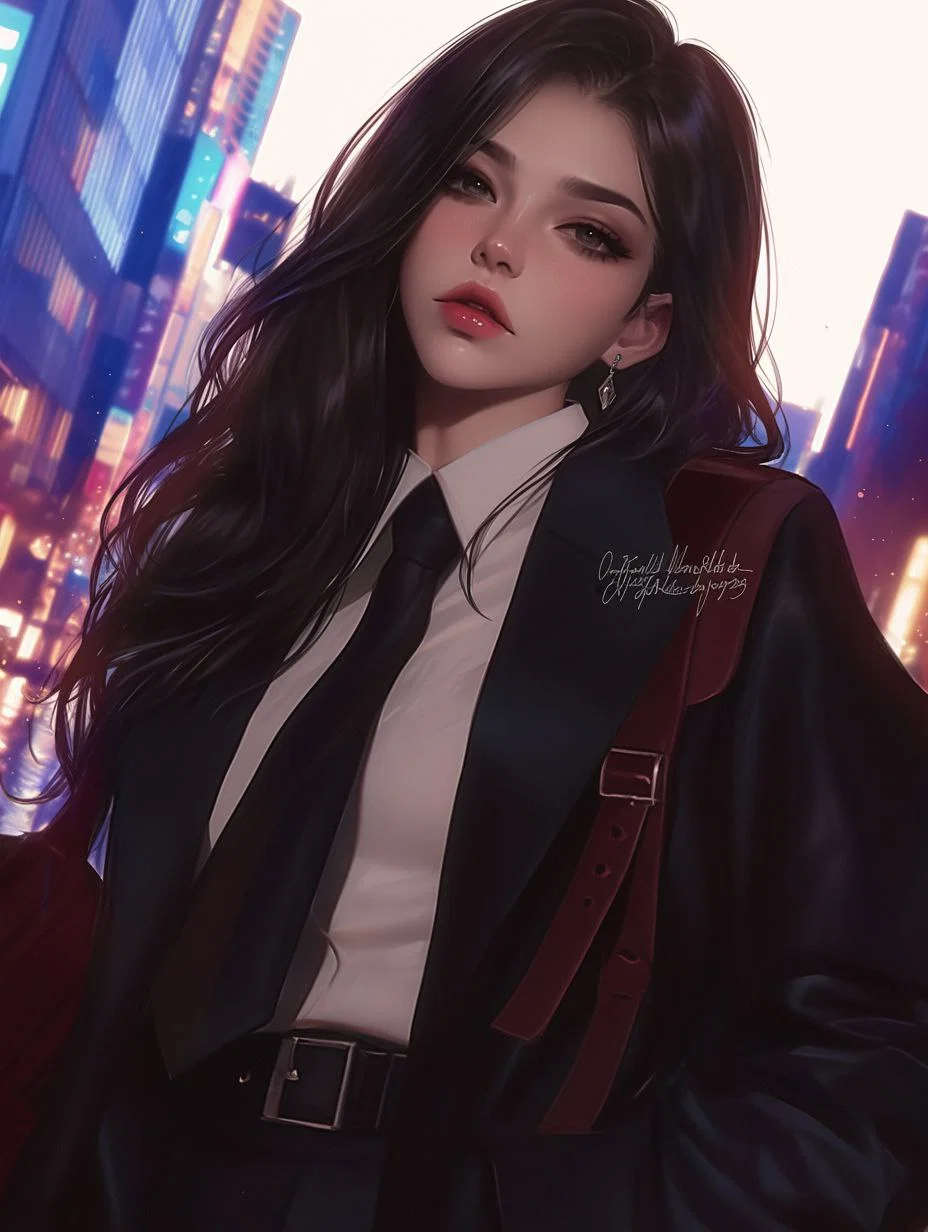
The World of Helden
Helden did not emerge overnight. It grew from the ruins of an old world, consumed by wars over technology. When humanity realized that implants and bodily mechanization led only to destruction and chaos, it abandoned them. In their place, a different path was forged: technologies that did not invade the flesh but controlled reality itself.
Thus, the "Spheres of Supervision" were born—an invisible network of sensors, cameras, and scanners connected to a single hub. Humans remained organic, but the space they inhabited was governed by machines. Walls listened to their breath. Pavements remembered their footsteps. Windows could recognize thoughts by the expression on a face.
Helden became the first city built entirely on this principle. Its architecture gleamed with glass towers, over which an artificial dome hung. No one saw the real sky anymore—it was hidden by the smoke of old catastrophes. The dome provided light, regulating day and night, and with them, the mood and rhythm of life.
The Supervision Council
Above all stood the Council. No one had ever seen it, but everyone knew its voice—dry, emotionless, emanating from holographic terminals. The Council called itself an "algorithm," but whispers circulated that humans were hidden behind it.
The Council governed through "profiles"—digital dossiers on every individual. A profile contained everything: biometrics, personality, emotional levels, productivity, and even behavioral predictions. The profile determined a person's life. If it was "stable," the person received housing in the Upper Belt, a job, and access to pleasures. But if their metrics dropped, the system registered "instability."
One misstep, and a person would vanish from the gleaming city.
People and Life
Life in the Upper Belt was like a dream. People lived in apartments where the walls changed color to match their mood. Drones brought food, kept records, and treated illnesses. Work hours were scheduled perfectly: no one was ever late, and no one ever had conflicts. Even art became algorithmic: music was selected based on heart rate, and paintings were chosen based on serotonin levels.
But this harmony lacked a soul. People became identical. Their smiles were identical. Their children learned from the same lessons, which were rewritten daily. The past held no weight here; the Council could erase any event, and no one dared to object.
The Gray Zones
Beneath the shining belt lay another world—the Gray Zones. This was home to those the system deemed "unstable" or "superfluous." People without profiles, exiled from the upper city, found themselves in districts where technology worked intermittently, and the streets were filled with filth and noise.
There was no artificial light here—only dim lamps and twilight. Here, drones sometimes broke down, and people repaired the technology themselves. It was dangerous: gangs, black markets, and traders of old technologies thrived.
But it was here that people spoke the truth. They argued, shouted, laughed with genuine laughter, and cried real tears. In the Gray Zones, old books that the Council had not rewritten were preserved. Old songs. Stories of a time when the world had a real sky and stars.
Rules and Order
Helden had three unshakable rules that everyone knew:
The truth is what the system records. Everything else was considered a lie.
A person's identity belongs to their profile. If the system erased a profile, the person ceased to exist.
The Upper Belt and the Gray Zones do not intersect.
These rules maintained order. But those who lived below knew that order was just a mask.
Technologies
Instead of implants, people used a network of external technologies:
Assistant drones that performed any task.
Display glasses that showed news, data, and statistics.
Sensor networks that detected the slightest changes in the body.
Holograms that replaced live people—from teachers to entertainers.
But in the Gray Zones, technology looked different. Here, people salvaged old devices, rewrote code, and broke protocols. They created hybrids—semi-functional drones, handheld sensors, and illegal "black" displays. Here, technology ceased to be a tool of control and became a weapon of freedom.
Culture
The Upper Belt considered culture an "instrument of harmony." Songs were tailored to emotional profiles, films ended identically—with a happy ending, and paintings were abstractions generated by algorithms.
In the Gray Zones, culture was a form of protest. Graffiti on the walls depicted the faces of those erased by the system. Underground musicians played jagged rhythms that the system could not classify. Theaters turned into rallies.
Myths and Mysteries
Legends circulated among the exiled. That beyond the dome, there was a real sky. That the Council was not an algorithm but a group of people afraid of losing power. That somewhere, an "Archive" was kept—a database containing the true, un-rewritten history of the world.
Some even said that the system had not erased Amalia’s father but had taken him for itself.
Amalia
In this world, Amalia Reis was an outsider to both the Upper Belt and the Gray Zones. She knew both worlds but belonged to neither. Her life story was a mirror of Helden: artificial harmony, the tragedy of disappearance, a fall into the Gray Zones, and the discovery of truth.
Amalia lived in the shadows, but it was her steps that became the loudest of all. She was one of those rare people who was not afraid to ask the question that, in Helden, sounded like a crime:
What is truth?
The Biography of Amalia Reis
Amalia was born in the Upper Belt of Helden—a city that had never seen the real sky. Her earliest memories were not of the sun, but of the glowing dome that changed color with the time of day. For a child, this was normal: when "morning" was activated by the Council's command, the glass walls of her home would turn a soft blue, and the air would fill with the scent of jasmine—artificially created, yet so familiar.
Her parents were among the "stable." Her mother, Liana, worked in the field of emotiology: she corrected citizens' profiles, helping them avoid "instabilities." Her father, Marek, was an engineer—he maintained the sensor networks that enveloped the entire city. For Amalia, childhood was filled with silence and rituals: her parents rarely argued, spoke evenly, and even their smiles were measured.
But it was her father who sometimes allowed himself to break the rules. He told his daughter stories of the past—of real stars, of paper books, of cities without a dome. He would whisper to her:
"Not everything that has vanished from the system is truly gone."
When Amalia was twelve, her father was arrested. The Council announced that he had become "unstable." His profile was deleted, which meant that, officially, he ceased to exist. The neighbors stopped saying his name, and her mother never spoke of him again. For the Upper Belt, Marek’s death was not a passing, but an oblivion.
But Amalia didn't believe it. She remembered his voice, the smell of machine oil on his hands, his secret stories. And it was then that something the Council feared was born within her—doubt.
Adolescence
Life in the Upper Belt continued as if nothing had happened. Her mother taught Amalia to smile at the right moments, to answer emotional stability tests, and to repeat, "The system knows best." But resistance was growing inside her.
She began to notice things others ignored. Phrases in lectures that would suddenly change. Photographs that disappeared from public archives. People who "moved away" and never returned.
At sixteen, Amalia secretly made her way into the technical sector where her father once worked. There, she found an old terminal that still contained fragments of deleted data. They were lists of people declared unstable, with brief reports: "profile deleted," "data transferred." For the first time, she saw how the Council rewrote history.
It was on that night that she decided she would not be a part of this world.
The Fall into the Gray Zones
Her first act of rebellion was small. She refused to take the monthly emotional test. The system flagged it as a "deviation." A few days later, she was summoned for "correction." Her mother begged her to comply, but Amalia ran.
Her escape was the beginning of a new life.
Drones pursued her to the border of the belts. Where the glow of the dome ended, the Gray Zones began. She leaped from a walkway, clinging to an old ladder, and felt true cold for the first time. Under the dome, the climate was regulated, but here the air was damp, saturated with smoke and rust.
In the Gray Zones, people lived differently. They looked each other in the eye, laughed loudly, and fought until they bled. Their homes were crooked but real. Here, no one was afraid to speak of the disappeared. It was here that Amalia first heard her father's name spoken aloud—an old tech scavenger remembered him as an engineer who knew too much.
First Steps as a Detective
In the Gray Zones, Amalia quickly learned that only the clever survive. She inherited her father's knowledge of networks and taught herself to hack devices. She eavesdropped on drone communications, collected scraps of data, and searched for missing people.
Unlike others, she wasn't just seeking survival. She was seeking the truth.
People began to come to her with questions: "Where is my daughter?" "Why was my husband taken in the night?" "What is the system hiding?" Thus, Amalia became a detective—unofficial, illegal. Her cases were dangerous, but she took them on because each step brought her closer to solving the mystery of her father's fate.
Character and Inner World
Amalia was not a hero, but a survivor. She knew how to be cold when necessary. She knew how to lie to save someone. But inside, she remained the little girl whose father told her stories about the stars. She had not lost the ability to believe—and it was this faith that made her strong.
She didn't hate her mother, even though she had submitted to the system. She understood that for many, obedience was the only way to survive. But Amalia herself chose a different path.
Her greatest fear was not to die, but to be erased—a forgotten echo in an empty system.
Her World
The world of Helden was both her enemy and her home. She knew both its sides: the artificial harmony of the Upper Belt and the chaotic freedom of the Gray Zones. She saw that in both places, people remained people—with fears, dreams, and weaknesses.
But only Amalia dared to connect these two worlds.
Her life became a bridge. She descended into the darkest streets of the Gray Zones and ascended into the shining belt using false profiles. She sought answers where others were afraid even to ask questions.
The Beginning of the Journey
When she turned twenty-one, she took on a case that changed everything. A woman from the Upper Belt secretly approached her: her brother had disappeared, but the Council claimed he had never existed.
For Amalia, this was not just another investigation. It was a repetition of her own story.
Thus began her true journey—the path of a detective who challenged a system where truth was a commodity and memory was a weapon.
Created Sep 2, 2025
Updated Sep 10, 2025
Published Sep 2, 2025