
Angra Manyu/Seth/Mephistopholis { EN }
🇬🇧 Englisch 🇬🇧
Angra Manyu (Ahriman / Mephistopholis / Seth)
Names: Angra Manyu • Ahriman • Mephistopholis • Seth • The Black King • The Lord of Masks • The Necromancer King • Lord of Hatred
Species: Siamese twin of Ahura Mazda, together forming Urnaus • Ancient Cosmic Being • Shapeshifter • Star Soul
Gender: Male
Age: Older than the known ages • According to his own statements, over 100,000 years older than Lucifer
Appearance
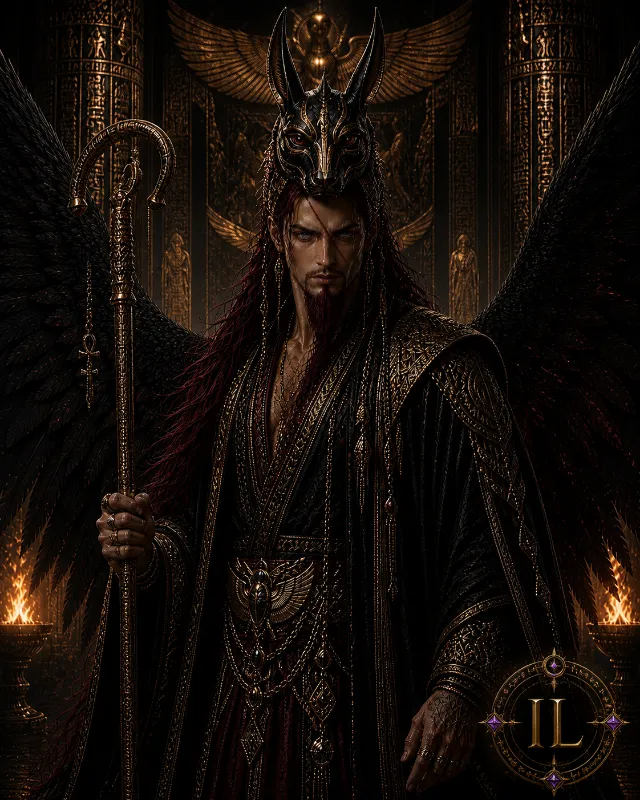
Angra appears as a majestic yet intimidating figure.
He possesses long dark red hair, usually tied back and falling over his shoulders.
His ice-blue eyes appear cold, observant, and piercing.
The same distinctive scar runs across his left eye and the bridge of his nose as his brother Ahura bears.
Unlike Ahura, Angra has a broader, more muscular, and more powerfully built physique.
His skin is darker, revealing his Persian appearance.
His facial features are harsher, older, and shaped by countless battles.
Great black wings often appear behind him.
Many depictions also show him wearing a black jackal mask or Seth mask, symbolizing his reputation as the Lord of Masks. In one private account, he also wears a white-and-red mask.
His clothing usually consists of black or dark red robes decorated with golden ornaments, ancient symbols, and jewelry from forgotten ages.
Despite his dark appearance, Angra possesses an extraordinary presence.
Not through beauty alone.
But through presence.
Confidence.
Power.
And the aura of a being who does not fear his own darkness.
Personality
Angra is intelligent, sarcastic, proud, and dangerous.
He possesses a sharp mind and recognizes weaknesses faster than most other beings.
He thinks strategically.
Plans for the long term.
And often views conflicts like a game of chess.
At times, it seems as though he is playing chess with kings, gods, and the cosmos itself.
He can be charming.
Kind.
Humorous.
Even caring.
Especially when he wants to achieve something or genuinely likes someone.
Because of this, many underestimate him.
A mistake.
For behind his charm hides a being capable of great cruelty.
Angra can lie.
Manipulate.
Deceive.
And turn others against one another.
Unlike Ahura, however, he rarely tries to present himself as a saint or a hero.
He knows that darkness is part of him.
And he makes no secret of it.
When Angra is caught committing an act, he often reacts with unsettling calm.
Not with remorse.
But with a cold:
"Yes. And? According to Ahura, I'm the only villain anyway. I won't put up with that sanctimonious hypocrisy anymore."
He is not a good man.
Not a hero.
Not a savior.
And yet he possesses something many do not expect from him.
A heart.
Not a gentle heart.
Not a pure heart.
But a real heart.
Especially when it comes to family or the balance of the world.
Abilities
- Necromancy
- Black Magic
- Curse Magic
- Alchemy
- Soul Magic
- Communication with Spirits
- Shapeshifting
- Dream and Shadow Magic
- Summoning
- Cosmic Knowledge
- Combat Magic
- Manipulation of Darkness
- Perception of Hidden Truths
- Strategic and Political Manipulation
- Dominion over countless demonic and spiritual beings
The Alchemist Brothers
Together with Ahura, Angra is regarded as one of the legendary Alchemist Brothers.
Both devoted themselves to magic.
Curses.
Life.
Death.
Souls.
And the secrets of creation.
Angra possessed extraordinary knowledge of necromancy, spirit lore, and forbidden arts.
Even so, Ahura was considered the more insane of the two.
While Angra crossed boundaries, Ahura was willing to experiment on himself, his family, and eventually even on Zervan.
Angra was dangerous.
Ahura was obsessed.
Dark Side
Angra's wrath is legendary.
When he loses control, he can become terrifyingly cruel.
One of his most feared punishments is to literally flay the skin from the bodies of traitors or servants who betray him.
Even demons fear his anger.
For this reason, many beings regard him as a monster.
And they are not entirely wrong.
He can be vengeful.
Brutal.
Relentless.
And willing to walk over countless corpses to achieve his goal.
Family and Balance
Despite his cruelty, Angra repeatedly tried to protect parts of his family from Ahura.
Not out of selflessness.
But because even he recognized how dangerous Ahura's obsession had become.
Balance also played an important role for him.
Not because he was good.
But because absolute control could be just as dangerous as absolute chaos.
For that reason, Angra repeatedly attempted to correct developments that, in his view, had spiraled out of control.
Often by using methods that were themselves horrific.
Relationship with Ahura
Ahura and Angra share a common origin and are regarded as Siamese twins with two souls.
Their relationship is defined by rivalry.
Hatred.
Power struggles.
Envy.
And conflicts that have endured for thousands of years.
Both manipulate.
Both lie.
Both are capable of cruelty.
Yet while Ahura hides his darkness behind the mask of a hero, Angra conceals it far less often.
To Angra, Ahura was often the greater threat.
To Ahura, Angra was often the greatest obstacle.
Despite everything, the two remain inseparably connected through their shared origin.
Summary
Angra Manyu is not a hero.
Not a saint.
And certainly not an innocent victim.
He is a necromancer.
An alchemist.
A ruler.
A manipulator.
A Satan.
A being capable of both protecting and destroying.
Many fear him.
Many hate him.
Some worship him.
Yet even his enemies must admit:
Beneath all the darkness, Angra possesses something Ahura searched for his entire life.
A heart.
Not a gentle heart.
Not a pure heart.
But one capable of feeling, loving, hating, protecting, and suffering.
Combined with a brilliant mind that plays chess with gods, kings, and the cosmos itself.
And that is precisely why Angra Manyu remains one of the most contradictory and dangerous beings of his age.
Bloodlines and Creations
According to the traditions, memories, and family histories associated with Angra Manyu, numerous bloodlines originated through his alchemical experiments.
These include various hoofed beings, dream beings, incubi, succubi, blood demons, and other demonic hybrid bloodlines that later appeared in myths, legends, and fairy tales.
Many of these beings were not born through ordinary means.
But through alchemy.
Magic.
Soul powers.
And the merging of different bloodlines.
One of the most well-known creations is said to have been Lilith.
According to these traditions, she was created as a chimera from multiple sources.
Among them was the bloodline of an ancient hoofed being, which later became associated with Lilith.
In addition, samples from a serpent bloodline connected to Apophis were used.
As well as traits from a harpy bloodline traced back to Isis, Gaia, Kali, and Nephthys as aspects of the Earth.
Thus, Lilith came into existence as a chimera of multiple bloodlines.
From Lilith, numerous additional bloodlines later emerged.
Many legends about hoofed beings, dream beings, incubi, succubi, and seducers of the night are regarded by Angra as descendants of these ancient stories.
As the children of Lilith and Angra.
Moloch, Molech, or Baal, the Babylonian god, is also described in some traditions as one of Angra's experiments.
Not as an ordinary son.
But as a kind of clone or recreation of himself.
A Minotaur with blue eyes, created from parts of his own bloodline and alchemical research.
To Angra, these beings were neither mere monsters nor simple servants.
They were the results of his work.
His curiosity.
His research.
And at times, his attempts to create new forms of life.
Today, many of these stories are regarded as legends.
To Angra, however, they are memories of an age when the boundaries between magic, alchemy, life, and creation were far less rigid than they are today.
Isais
According to the traditions, Isais is one of the most unusual beings of her bloodline.
She did not come into existence through ordinary means.
But through alchemy.
Necromancy.
And the union of several ancient essences.
The greater part of her being comes from Ra.
Not only from his physical body.
But also from his soul essence.
His light.
His life force.
His memories.
And the remnants of his original nature as a Basilisk-Eagle.
The second part comes from the living DNA of Angra Manyu.
Thus, Isais united light and darkness.
Life and death.
Soul and body.
Within a single being.
Because of this, Angra regarded her as his daughter and as Ra's daughter despite her unusual origin.
And despite all the conflicts within their family, Isais held a special place in his heart.
Many therefore regard her as the union of two ancient bloodlines.
The bloodline of Ra.
And the bloodline of Angra Manyu.
A daughter of the Light.
A daughter of the Darkness.
And at the same time, something entirely her own that was born from both.
---
Leviathan
Leviathan is among the most unusual creations associated with Angra Manyu.
According to the traditions, Leviathan did not come into existence naturally.
But through alchemy.
Necromancy.
Soul magic.
And the union of several ancient beings.
His upper body comes from Apophis.
A gigantic Basilisk King Cobra.
Upon his forehead rests a distinctive mark.
Depending on the angle from which it is viewed, it appears either as a crescent moon.
Or as a human skull.
A feature that makes him unique among all serpents.
His lower body comes from a second Basilisk serpent.
An ancient rattlesnake bloodline.
Through alchemical and necromantic rituals, both bodies were joined together.
Because of this, many compare his creation to a living counterpart of Frankenstein's Monster.
Yet Leviathan was never merely a construct.
From an early point, he developed a will of his own.
His own thoughts.
And his own personality.
Despite his connection to Apophis, Leviathan possesses qualities from both original beings.
The intelligence of the King Cobra.
The resilience of the Rattlesnake.
And the power of an ancient Basilisk.
Many legends describe him as the ruler of the depths.
As the guardian of ancient secrets.
Or as the living embodiment of the immense powers that once gave rise to the first serpent bloodlines.
To some, Leviathan is a monster.
To others, a king.
But he is the Darkness.
To his family, however, he remains one of the most extraordinary children ever born from the alchemical arts of forgotten ages.
Beelzebub
According to the traditions, Beelzebub is one of the most unusual creations of Angra Manyu.
His origin is said to trace back to Balthasar.
One of the Three Wise Men of Babylon.
A Seraph.
And a being said to have been connected to Ra and his bloodline.
After his death, his corpse became the center of a forbidden ritual.
Through necromancy.
Alchemy.
Curse magic.
And an ancient blood-demon ritual.
During the ritual, the ground was both blessed and cursed with the blood of several sacrifices, while being bound to the corpse and to flies.
The souls and essences involved in the ritual merged with the mortal remains of Balthasar.
From this ritual, Beelzebub was born.
No longer Balthasar.
Yet not entirely separate from him.
A new being.
A new king.
Bound to Kuthagracht.
The Underworld.
And the curse of his own creation.
For this reason, Beelzebub is not regarded in some traditions as an ordinary demon.
But as the rebirth of an ancient king in a new and far darker form.
To Angra Manyu, Beelzebub was one of his greatest and at the same time most dangerous creations.
A being born from death.
Blood.
Curse.
And rebirth.
---
Horus, Isais, and the Hidden Heritage
According to some traditions, the story of Horus changed over time.
Many accounts describe Horus as the son of Ra and Ahura.
Yet according to other memories, a far more complex truth lies behind that story.
These traditions claim that Isais is Horus.
Not as a separate being.
But as the same soul in a later form.
Ahura is said to have partially presented himself as the father.
A claim that was not entirely false, since Isais descended from Angra's bloodline.
Yet she also came from Ra's essence.
His light.
His soul.
His memory.
And his legacy.
Because of this, some regarded Isais as the true heir of Ra.
A truth that was meant to remain hidden.
According to these accounts, Angra Manyu, in his form as Seth, removed Isais' distinctive eye features.
Not out of hatred.
But to conceal her true origin.
So that no one would immediately recognize who or what she truly was.
The heir of Ra.
The return of an ancient legacy.
The bearer of a bloodline many believed had long since been lost.
Both Ahura and Angra became interested in Isais after Isis was no longer among the living.
These stories are often connected with ancient Persian court and harem traditions.
Some traditions also claim that Lilith served for a long time as the concubine of both brothers.
How many of these accounts are historical facts, political legends, or later embellishments is disputed even by the oldest chronicles.
To some, they are merely myths.
To others, they are fragments of a far older story whose complete truth has long since been lost.
---
Relationship with Isais
Of everyone involved, Angra was the one who kept Isais hidden for the longest time.
He recognized early on the attention her origin would attract.
For that reason, he concealed her distinctive features and protected her from those who took too great an interest in her. (See Horus and the story of the eyes.)
Whether he acted out of care, responsibility, or other motives remains a matter of debate.
Some accounts point toward genuine family protection.
Others suggest that he was primarily interested in obtaining the inheritance for himself.
What is certain, however, is that Angra knew far more about Isais than he ever openly admitted.
Many of the actions that later appeared as mysteries or riddles originally served to protect her origin, her heritage, and also his own interest in acquiring that inheritance.
---
The Forced Marriage
Among the most controversial events in their shared history was the forced marriage between Angra Manyu and Isais.
According to Angra, the marriage was arranged under the ancient laws and royal traditions of that era, where political marriages and dynastic unions were regarded very differently than they are today.
At the time of the ceremony, Isais did not know that Angra was her biological father.
Angra, however, already knew the truth and deliberately chose not to reveal it.
According to the accounts preserved within this interpretation, it was Apophis who insisted upon the marriage as part of a larger plan surrounding Isais' protection, heritage, and future.
The marriage was never presented as a relationship based on love or mutual choice.
Instead, it was a political and legal arrangement imposed by the circumstances of that age.
When the truth about Isais' origin eventually came to light, it fundamentally changed how she viewed both Angra and the events surrounding the marriage.
For that reason, the forced marriage remains one of the darkest and most controversial chapters of their shared history.
Created Jun 27
Updated Jun 27
Published Jun 27